
Every day, goalkeeper coaches expect to have the goalkeepers on the pitch 10 minutes before the outfield players. This gives the goalkeeper coaches the opportunity to complete their position-specific work before the goalkeepers go in with the team.
Almost everything is different between the goalkeepers and the outfield players: their roles in the squad, the demands of their position throughout games, and training session design. These requirements and constraints set the terms for goalkeeper-specific strength & conditioning programmes.
Identifying training goals from match demands
Many research articles exclude goalkeepers from analysis, often citing their distinct role during matches. [1] This is unsurprising and understandable: outfield players’ key match day physical outputs include total distance, high speed running distance, and sprint distance. [2] Goalkeeper running-based metrics are significantly different (Table 1).
Training sessions for outfield players aim for match levels of technical actions. Goalkeeper training, on the other hand, will often well exceed match levels of actions like dives, jumps, and kicks. Although the volume of these goalkeeper technical actions is lower in games, the intensity of those actions can be maximal and will be required at any point in the game, where they may have a significant—even determinative—impact on the outcome.
| Total Distance (m) | High Speed Running (m) | Sprint (m) | Dives (Count) | Jumps (Count) | Kick Total (Count) | Long Kick Total (Count) |
| 5000 | 50 | 10 | 0-15 | 4 – 12 | 14 – 38 | 1 – 22 |
For instance, running will likely include cross-step to side-step, cross-step to sprint, accelerate to decelerate, and occasionally maximal sprinting.
A dive requires strong and powerful lower limb movements in tandem with forceful and highly coordinated action with the upper limbs to block and catch shots.
They will jump from one or two legs, and from stationary or moving positions. At the peak of near-maximal or maximal jumps, they will likely have to punch or catch the ball. If they catch it, they then have to distribute it. This could be through an under- or over-hand throw, from a short roll to 50+ yards. If they choose to kick, it could be a short pass, a drop kick, or a long ball off the ground—sometimes under intense, coordinated pressure, and sometimes unopposed.
These demands outline the need for a range of upper and lower body physical competencies to perform the goalkeeping role.

Goalkeepers will train separately with the goalkeeping coach as well as with the team. Each training context presents different physical stimuli due to the difference in technical and tactical demands.
Team training results in fewer goalkeeping actions than goalkeeper-specific training on a given day (Table 2).
It is important to understand the type of day the outfield players are having, as this can affect the physical demands and load on the goalkeepers. An intensive day for the outfield players, e.g., small-sided games, will see more goalkeeper actions—dives, jumps, short passes, and throws— compared to an extensive 11v11 game. However, extensive team activities will require the goalkeeper to perform faster accelerations, higher maximal velocities, and longer kicking and throwing.
| Lateral Day | Horizontal Day | Vertical Day | Recap Day | |||||
| GK | Team | GK | Team | GK | Team | GK | Team | |
| Training Duration | 65 | 35 | 60 | 40 | 65 | 35 | 50 | 50 |
| Dive Count | 80 | 20 | 70 | 30 | 90 | 10 | 70 | 30 |
| Jump Count | 90 | 10 | 85 | 15 | 95 | 5 | 75 | 25 |
Tweet ThisA dive requires strong and powerful lower limb movements in tandem with forceful and highly coordinated action with the upper limbs to block and catch shots. These demands outline the need for a range of upper and lower body physical competencies.
Craig Musham
Training model for goalkeepers
The Football Association presents the four-corner training model for developing the necessary technical / tactical, psychological, social, and physical attributes of match performance. [3] How coaches and practitioners prioritise and develop these attributes within the training week characterise the training model.
Table 3 contains an example of a goalkeeper training model, with the emphasis on the physical corner.
| Football Theme | Protect | Protect / Defend / Control | Defend to Protect | Recap |
| Sub-theme | Handling Footwork Shot Stopping Passing & Receiving | Handling Footwork Shot Stopping Positioning | Dealing with Crosses, Through Ball & Set-Pieces | Parts of Handling, Shot Stopping, Passing & Receiving & Dealing with Crosses, Through Balls & Set-Pieces. |
| Physical Theme | Lateral Movement Activation | Horizontal Movement Activation | Vertical Movement Activation | |
| Area Sizes | Around the Box | Around & Beyond the Box | Around the Box | To Suit |
| Number of Actions Sets x Reps x Multi-Ball | More Actions L x H x M 2 x 6 x 4 | Maintain Actions L x M x H 2 x 4 x 6 | Quality of Actions L x H x L 2 x 6 x 2 | -5 or -4 |
| Best suited to Match Day | -5 or -4 | -4 or -3 | -2 | -1 |
| Strength Training Opportunity | Upper Body Strength | Lower Body Strength | Lower Body Strength | N/A |
The physical theme of this model can be outlined as lateral, horizontal, vertical, and recap. This suggests what types of movements the goalkeeper will be required to perform on that day. Lateral, for example, incorporates movements that support diving to make saves; and footwork, such as side-step, to transition around the goal. Goalkeepers regularly have a lateral day when the outfield players are doing intensive work; while a horizontal day complements the outfield players having an extensive day.
Goalkeepers have their highest volume of position-specific actions on the training days furthest away from the game, but they can still perform high intensity actions the day before the game (Table 4).
| Lateral Day | Longitudinal Day | Vertical Day | Recap Day | |
| Training Duration | 75 | 70 | 45 | 55 |
| Dive Count | 50 | 40 | 10 | 30 |
| Jump Count | 20 | 15 | 30 | 20 |
| Kick Count | 100 | 90 | 60 | 70 |
| Acc 1-3 Count | 20 | 18 | 12 | 12 |
| Dec 1-3 Count | 15 | 14 | 8 | 8 |
| GK Intensity | 2.3 | 1.9 | 1.9 | 2.5 |
| GK Volume | 190 | 170 | 120 | 140 |
Movement activation is split into two parts: force and velocity. The force activation is completed in the gym prior to the velocity activation, which is pitch-based. The type of training day dictates the type of activation.
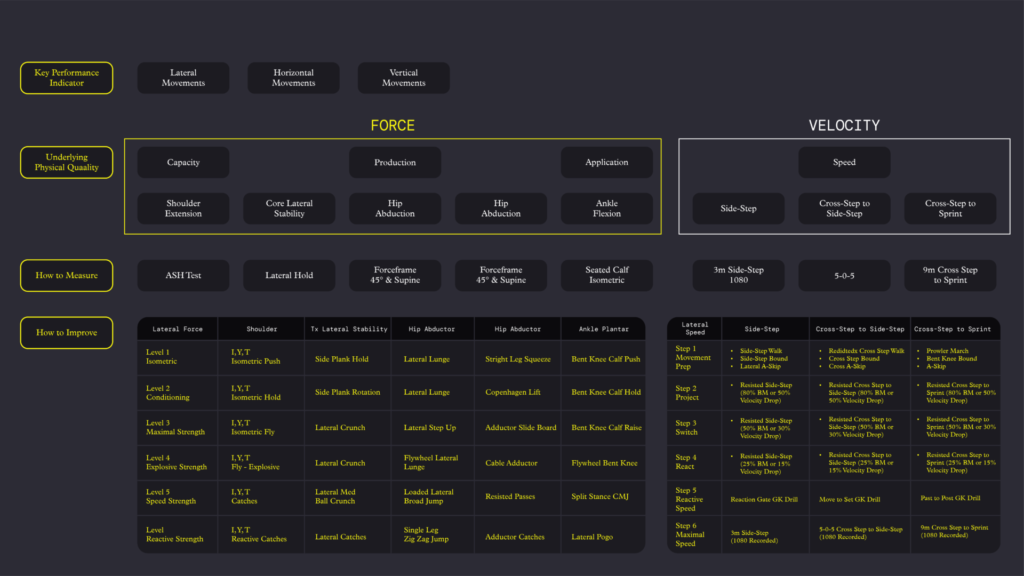
For a lateral day, lower body work focused on abduction and adduction of the hip; and upper body activation is targeted towards the position to block a shot and impact the ground: shoulder flexed and elbow extended.
Tweet ThisThe physical theme of this model can be outlined as lateral, horizontal, vertical, and recap. This suggests the types of movements the goalkeeper is required to perform on that day. Lateral, incorporates movements that support diving to make saves.
Craig Musham
Crafting the S&C programme
Table 3 outlines goalkeeper strength training 3-5 days before a match, which allows for full recovery. Power sessions may be completed on MD-2. If there is a busy fixture schedule, there may be a modified strength session post-match.
Pre-season screenings for goalkeepers are similarly specific to their position. This lets us target the appropriate ranges of motion and movement control that provide the basis to maximise strength capacity, production, and application. The physiotherapy department leads Pilates-style sessions toward this goal.
Capacity, Production & Application
Capacity is the ability of a muscle or muscle group to maintain strength output. It is a guidepost for players with a low training age or a low strength level. Capacity-based work allows the athlete to learn the movements and prepares them to lift heavier or faster. It also comes into play after an extended break, such as the off-season, to reintroduce strength training before focusing on production and application.
Production refers to maximal force output training: what you would expect in a typical in-season strength session. Application is the rate at which force is produced, akin to a traditional power session.
| Progression | Capacity | Production | Application | |||
| Isometric | Conditioning | Maximal | Strength-Speed | Speed-Strength | Reactive | |
| Push 70% MVIC 6 x 10s | 30 Reps 20% | 80% 3-6 Reps 0.5 > 0.75 m.s | 60% 1 RM 0.75 > 1.0 m.s 3-5 Reps | 30% 1 RM 1.0 > 1.3 m.s 6 Reps | BW-5% 1RM >1.3 m.s >5 Reps | |
| Push 85% MVIC 8 x 5s | 20 Reps 30% | 85% 3-5 Reps 0.5 m.s | 70% 1 RM 0.75 > 1.0 m.s 3-5 Reps | 40% 1 RM 1.0 > 1.3 m.s 6 Reps | 5-10% 1RM >1.3 m.s >5 Reps | |
| Hold 5% BW 30s | 15 Reps 40% | 90% 3-4 Reps 0.3 > 0.5 m.s | 80% 1 RM 0.75 > 1.0 m.s 3-5 Reps | 50% 1 RM 1.0 > 1.3 m.s 6 Reps | 10-15% 1RM >1.3 m.s >5 Reps | |
| Hold 8-10% BW 6 x 10s | 12 Reps 65% | 95% 3 Reps 0.15 > 0.5 m.s | 60% 1 RM 1.0 > 1.3 m.s 6 Reps | 15-20% 1RM >1.3 m.s >5 Reps | ||
| Hold 10-12% BW 6 x 10s | 10 Reps 75% | 20-25% 1RM >1.3 m.s >5 Reps | ||||
| Hold 12-15% BW 6 x 10s | 8 Reps 80% | 25-30% 1RM >1.3 m.s >5 Reps | ||||
Lower body strength and power
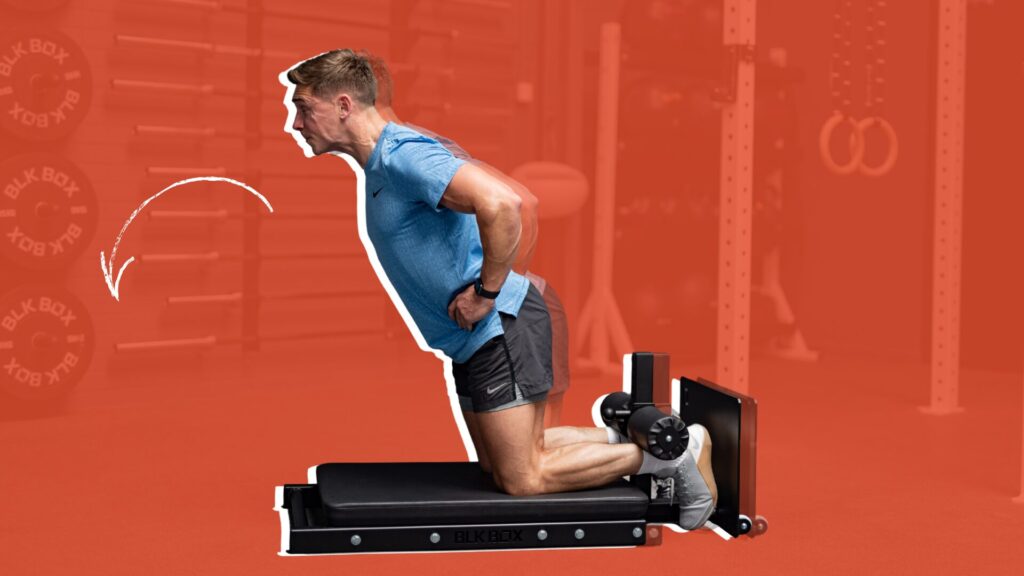
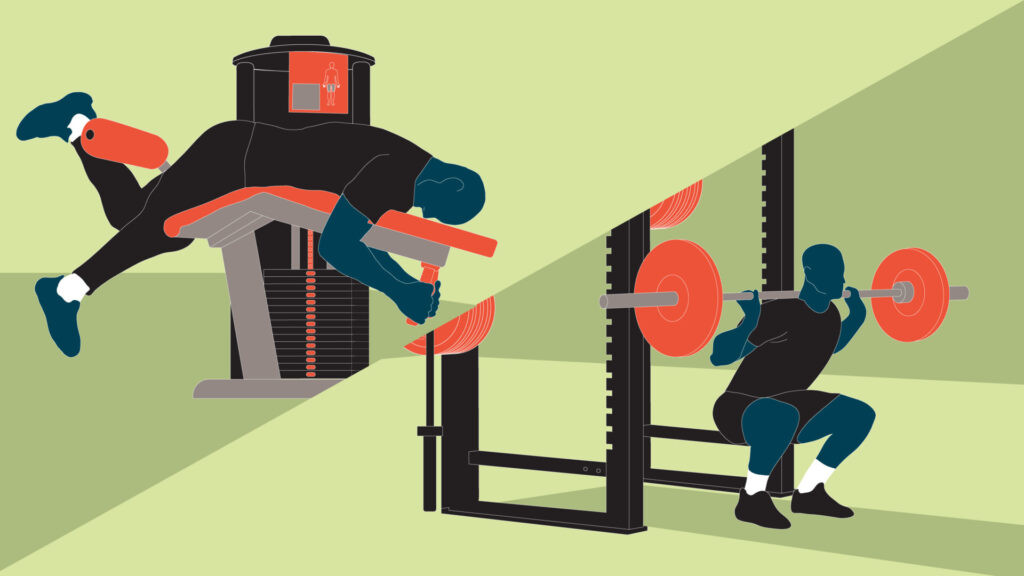
A standard lower body strength programme for a goalkeeper normally includes eight exercises (Table 6). These break down into specific muscle dominant exercises, but as much as possible should cover multiple planes of movement.
| Lower Body Strength Training Layout | ||
| Order | Exercise Type | Additional Information |
| A1 | Anterior Dominant Lift | Quad dominant exercise |
| A2 | Posterior Dominant Lift | Hamstring dominant exercise |
| B1 | Lateral Hip Abductor Lift | Glute dominant exercise |
| B2 | Lateral Hip Adductor Lift | Groin dominant exercise |
| C1* | Individual Dependent | Area of Development |
| C2* | Individual Dependent | Area of Development |
| D1 | Calf – Standing | Gastrocnemius dominant exercise |
| D2 | Calf – Seated | Soleus dominant exercise |
| A, B & D – Are areas I would plan an exercise for all Goalkeepers. However, Group C exercises are additional exercises depending on profiling, injury history and / or player preference. | ||
Figure 3 shows a lower body strength programme for a goalkeeper. The rear foot elevated split squat is a key lift (RFESS), as goalkeepers take a split stance position while blocking shots. The RFESS also resembles the early phase of a kicking position.
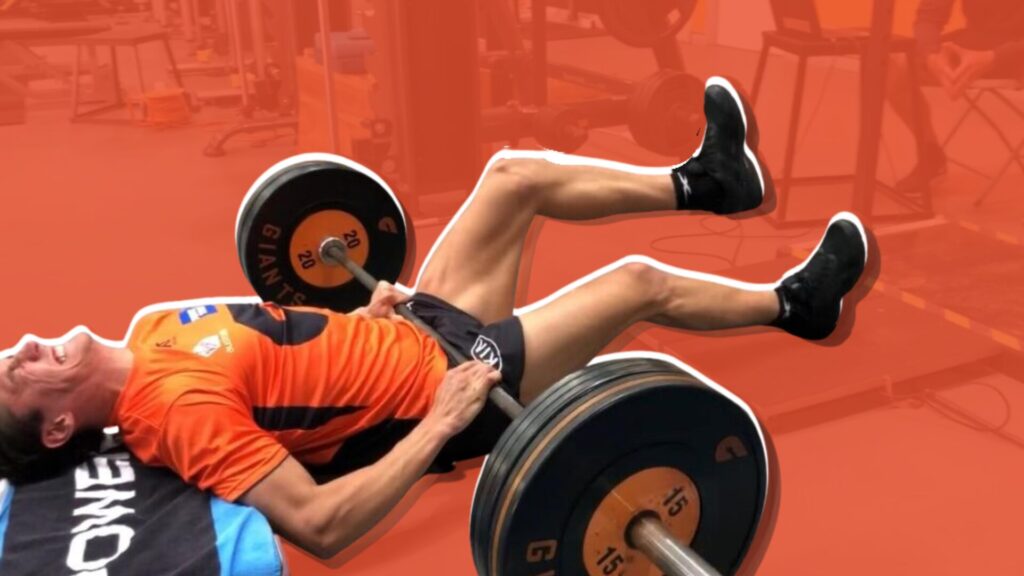
A split stance RDL builds hip-dominant hamstring strength, which is important when goalkeepers are sprinting. Lateral step up and slide board adductor movements help develop the step and drive phase during a dive.
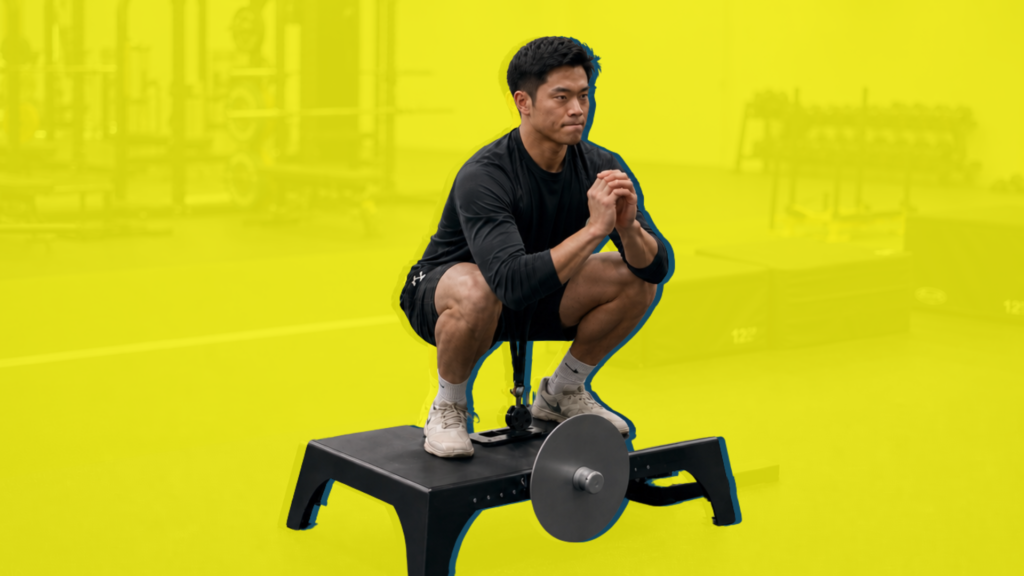
Flywheel squats improve the force output in a knee-dominant position. We look for improvements to show up during individual profiling on a countermovement jump. Single leg hamstring bridge sliders target single leg hamstring strength for players with an asymmetry in their hamstring profiling. Finally, both seated and standing calf strength exercises are relevant to how goalkeepers engage the calf in the push off position when diving and jumping for the ball.

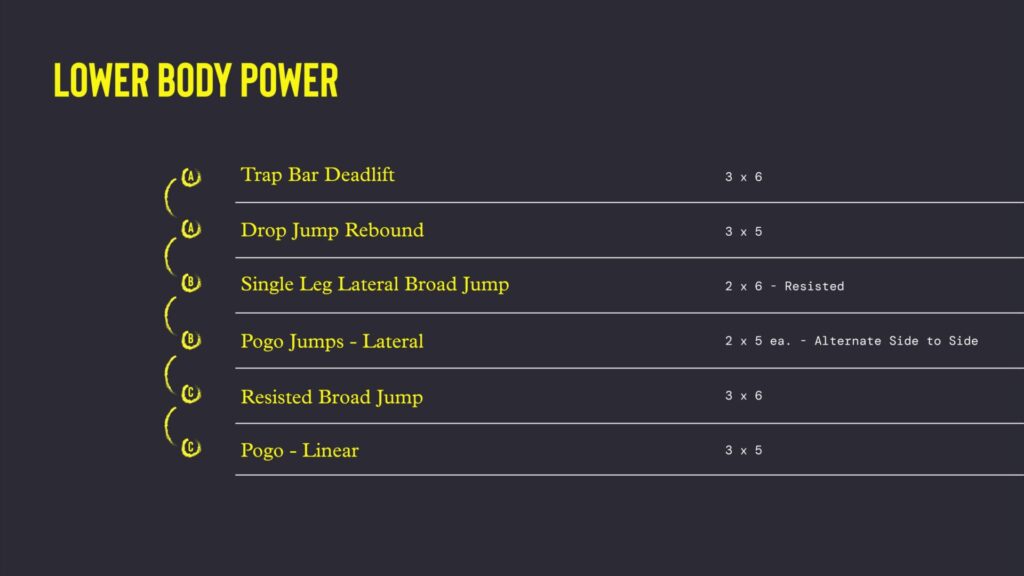
The power programme follows a similar outline, but now shifts to developing triple extension of the lower limbs (Table 7). This programme still includes vertical (jumping), lateral (diving), and horizontal (accelerating) actions.
For each plane of movement, the programme includes a speed-strength and reactive strength exercise. That combination targets both force and velocity within that movement plane. However, this may change based on a given player’s profiling and injury history.
| Lower Body Power Training Layout | ||
| Exercise Orientation | Lift Dominance | Exercise Type |
| Vertical 1 | Vertical Dominant Lift | Speed-Strength exercise |
| Vertical 2 | Reactive Strength exercise | |
| Lateral 1 | Lateral Dominant Lift | Speed-Strength exercise |
| Lateral 2 | Reactive Strength exercise | |
| Horizontal 1 | Horizontal Dominant Lift | Speed-Strength exercise |
| Horizontal 2 | Reactive Strength exercise | |
Lower body power sessions typically have six exercises, a blend of double- and single-leg work. The goalkeeper’s training age, history, and movement competence will determine the balance of double or single leg variations and at what resistance, if any. Force plates and velocity-based training equipment provides performance feedback for both strength and power work.
Tweet ThisFor each plane of movement, the programme includes a speed-strength and reactive strength exercise. That combination targets both force and velocity within that movement plane. However, this may change based on a given player’s profiling.
Craig Musham
Upper body strength and power
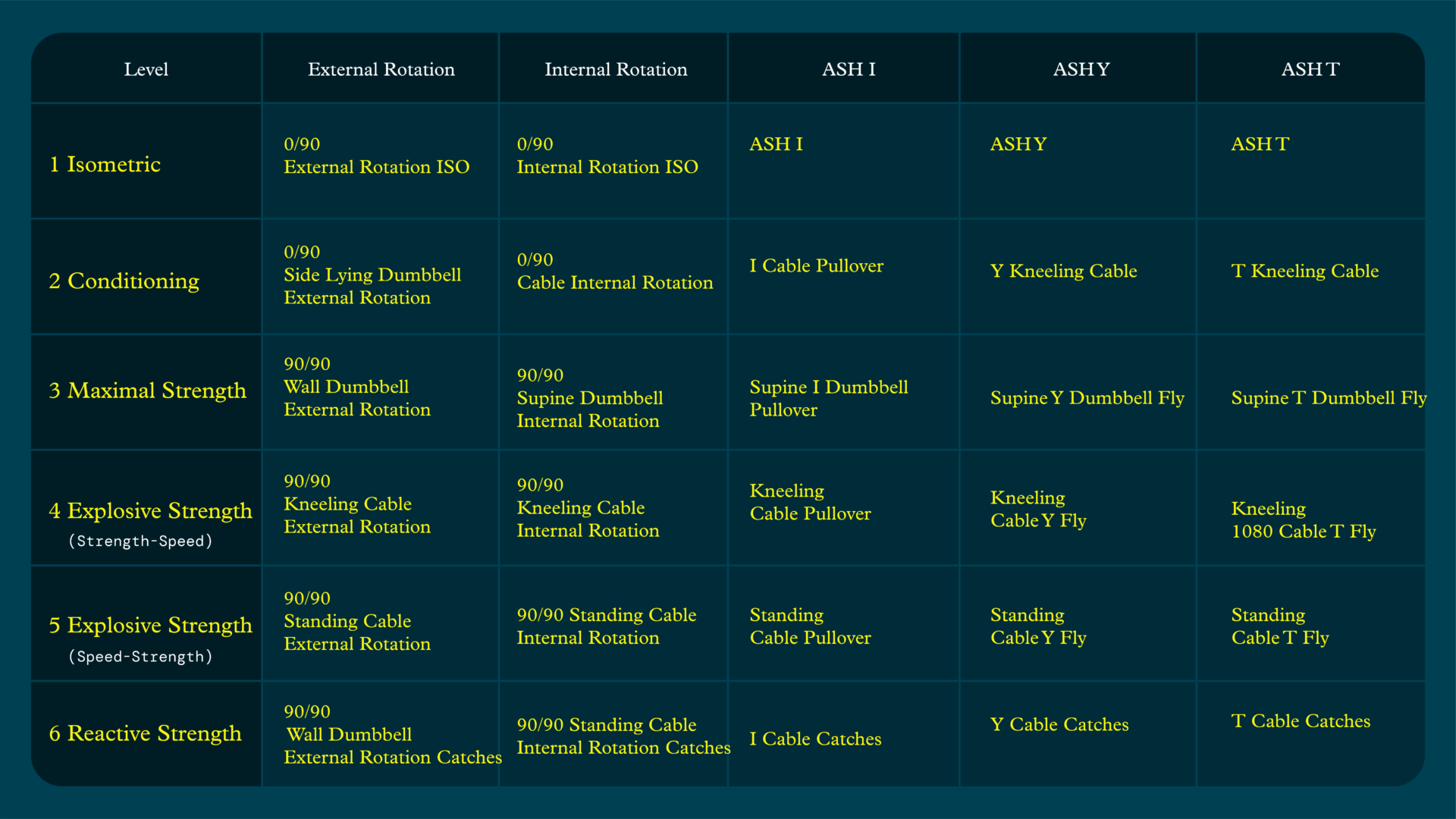
Goalkeepers face unique demands and injury risk to their upper body. Table 9 outlines the tests we use to profile our goalkeepers and prescribe upper body exercises. One such test measures posterior and anterior shoulder endurance, that is, the force capacity of the upper limbs in a position relevant to making saves (Table 10).
| Flexion | Extension | Abduction | Internal Rotation | External Rotation |
| Link the Vald DynaMo device to an iPad. Set Manual Range of Motion Testing (Settings > RoM Settings > Toggle Auto Detect Range of Motion ‘On or Off’). Open the DynaMo App, Click the plus icon and a select a profile from your test. Select ROM, then select the Movement > Select the position for the assessment > Select the side > Click Ready to test Perform the test for the selected side, following on screen prompts > Perform test for required number of repetitions > Click Next Side once ready to test other side Once all testing is complete > Click Finish testing | ||||
| Start with DynaMo in the athlete’s hand. Sitting at the edge of a chair with arm by the side, elbow extended and forearm in neutral. The athlete should flex the shoulder as far as they can, keeping the DynaMo as still as possible. | Start with DynaMo in the athlete’s hand. Sitting at the edge of a chair with arm by the side, elbow extended and forearm in neutral. The athlete should extend the shoulder as far as they can, keeping the DynaMo as still as possible. | Start with DynaMo in the athlete’s hand. Stood with non-testing side perpendicularly and flat against a wall with their hand rested by their side with the elbow extended and forearm in neutral. The athlete should abduct the shoulder as far as they can, keeping the DynaMo as still as possible. | Start with DynaMo in the athlete’s hand. Supine with shoulder abducted to 90° and elbow flexed to 90°. Rotate arm inwards as far as they Rotate arm outwards as far as can, keeping the DynaMo as still as possible. | Start with DynaMo in the athlete’s hand. Supine with shoulder abducted to 90° and elbow flexed to 90°. Rotate arm outwards as far as they can, keeping the DynaMo as still as possible. |
| Benchmark | ||||
| Flexion | Extension | Abduction | Internal Rotation | External Rotation |
| 180° | 50° | 180° | 70-90° | 55-60° |
| Pass | Pass | Pass | Pass | |
| Testing Battery | Type of Test | |||
| Force Capacity | Force Production | Force Application | ||
| Isolated | Anterior shoulder endurance test IYT | X | ||
| Posterior shoulder endurance test IYT | X | |||
| Athletic shoulder test IYT | X | X | ||
| Isometric shoulder internal rotation test (90° abduction) | X | |||
| Isometric shoulder external rotation test (90° abduction) | X | |||
| Integrated | Push up | X | ||
| Inverted row | X | |||
| Countermovement push up | X | |||
| Grip | Grip Strength | X | ||

Goalkeeper conditioning
The underlying aerobic and anaerobic capacities for goalkeeper-specific movements can be trained both on and off the pitch, and in ways that underpin the technical and tactical needs of goalkeeping actions. This allows us to periodise training demands relative to the types of actions, so that the physical demands are developed at the right time and can be tapered towards match performance.
| Training Performance Actions | ||||
| Action Type | Better Actions | More Actions | Maintain Better Actions | Maintain More Actions |
| What does this look like? | Improve the quality of technical & tactical actions | Increase the number of effective actions in a short time | Sustain high-intensity performance over-time | Sustain high-quality actions under fatigue or pressure |
| When does this Occur? | MD -4 > MD-1 [Technical Out of Possession / Skill In Possession] | MD-4, MD-3 [Technical Function] | MD-4 [Small Sided Game] | MD-3 [11v11] |
| Energy System in use | Neuromuscular Power | Anaerobic Power | Aerobic Power | Aerobic Capacity |
GPS, heart rate, and the player’s rating of perceived exertion (RPE) provide data on the impact of pitch-based training. Data shows that the highest reported RPE scores are for a lateral and longitudinal day, which are usually the days furthest away from the game, with RPE scores decreasing towards match day. The heart rate data shows a similar trend (Table 13).
| Lateral Day | Lateral Day | Longitudinal Day | Vertical Day | Recap Day | |
| RPE | 5.0 | 4.6 | 3.4 | 3.2 | |
| Max Heart Rate (%) | 80-85% | 13 Minutes | 8 Minutes | 6 Minutes | 7 Minutes |
| 85-95% | 8 Minutes | 7 Minutes | 5 Minutes | 5 Minutes | |
We also look at RPEs for the goalkeeper-specific part of the session and the part of the session spent with the team.
For instance, on a longitudinal day the work with the goalkeeper coaches can be intensive. But when they go into an extensive team practice (11v11), the goalkeepers can be inactive for long periods of time. This can influence the perception of intensity for the whole session.
We have also recently started collecting differential RPE (dRPE) with one of our goalkeepers. This may be more appropriate for the constraints of the goalkeeping sessions, as it considers not only aerobic load but muscular and cognitive demands.
However, we need to educate the players around these different tests, and how to recognize and report on their internal states along these different dimensions.
Fitness development in goalkeepers also includes a blend of on-feet and off-feet conditioning. The off-feet option helps reduce the load on individuals who are not necessarily used to running drills, and who may have a high impact load from diving and jumping within the session.
Off-feet conditioning should align with a specific physical outcome or a specific type of day (Figure 5). The framework profiles players and identifies needs for individual development. This framework also has a place in rehabilitation when returning a goalkeeper back to training and match performance.
For example, more intense off-feet anaerobic work should fall earlier in the training week, with lower intensity aerobic or recovery work closer to match day (Table 14). However, individual programming decisions have to consider which goalkeeper is playing in the upcoming game.

| MD+1 | MD+2 | MD+3 | MD-3 | MD-2 | MD-1 | MD | |
| Training Outcome | Off | Recovery | Supra-maximal or Anaerobic Capacity | Off | Recovery or Lactate Threshold | Off | Off |
Tweet ThisOff-feet conditioning should align with a specific physical outcome or a specific type of day. For example, more intense off-feet anaerobic work should fall earlier in the week, with lower intensity aerobic or recovery work closer to match day.
Craig Musham
Extra layers of specificity
Most outfield players in training and on the match day squad can expect to play in the next game. This, too, is different for goalkeepers.
Senior teams will likely carry up to four goalkeepers. As goalkeepers are rotated less frequently and only one can play at a time, generally each goalkeeper will have a specific role within the team (Figure 6).
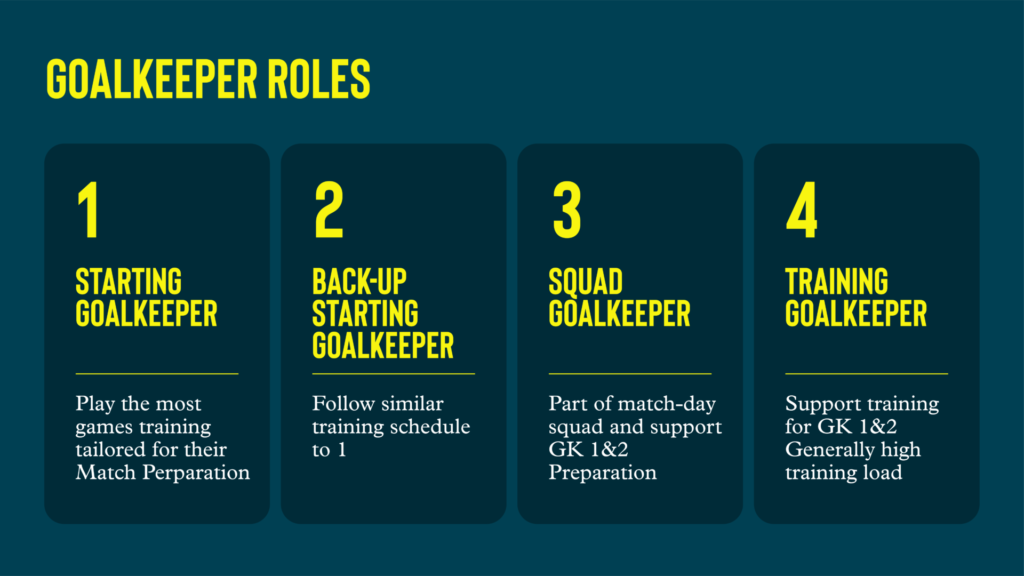
Understanding the role of each goalkeeper will be important when planning their training week and managing load.
The training schedule is set to prepare the starting goalkeeper for the next match. The back-up starting goalkeeper will also follow a similar schedule. However, the squad and training goalkeeper will have different demands. They will support the goalkeeper sessions by rotating in with the starting and back-up goalkeeper, as well as taking part in goalkeeper drills and team drills, allowing us to better manage the starting and back-up goalkeepers’ training loads.
Consequently, their training load will likely not taper towards a game. Their primary role is not to play at the weekend, but they must be available for all training sessions and drills. Therefore, the squad and training goalkeepers need a high durability for goalkeeper actions such as diving and kicking.
| Lateral Day | Training Duration | Dive Count | Jump Count | Kick Count | GK Intensity | GK Volume | RPE |
| 1 | 75 | 40 | 20 | 85 | 3.3 | 200 | 4.4 |
| 2 | 80 | 45 | 20 | 100 | 3.4 | 285 | 5 |
| 3 | 80 | 55 | 20 | 100 | 3.1 | 250 | 4.7 |
| 4 | 80 | 55 | 15 | 110 | 3.5 | 250 | 4.1 |
| Recap Day | Training Duration | Dive Count | Jump Count | Kick Count | GK Intensity | GK Volume | RPE |
| 1 | 50 | 25 | 15 | 60 | 3.4 | 125 | 3.6 |
| 2 | 60 | 40 | 18 | 70 | 3.9 | 230 | 2.8 |
| 3 | 60 | 50 | 20 | 90 | 3.9 | 270 | 3.4 |
| 4 | 60 | 50 | 20 | 90 | 3.1 | 260 | 3.6 |
One game per week
The strength training schedule when there is one game in a week is similar for the starting goalkeeper and back-up goalkeepers. The only difference is the addition of a post-match conditioning session or a lower body strength or power session.
Moving the main strength session for the squad and training goalkeepers to the end of the week compensates for the higher on-pitch training load during the week. The starting and back-up goalkeeper will usually begin their physical taper towards the match, allowing an opportunity for recovery. Even though they wouldn’t complete a full strength session on a MD-3, they could still complete profiling (jumps) and individual development exercises such as blood flow restriction.
| MD+3 | MD-3 | MD-2 | MD-1 | MD |
| Upper Body Strength | Lower Body Profiling / Individual Development Programme | Upper Body Strength | Rest | Lower Body Strength |
| Off-feet Conditioning | Lower Body Strength | Off-feet Conditioning |
Two games per week
Our target is one strength stimulus every 10 days. Therefore, when we are going through a period of two-game weeks, we will generally not have an MD-3 strength session for the starting and back-up goalkeepers. Instead, we look to have a strength stimulus within 48 hours of the previous match, depending on the time between games.
Table 18 shows a potential training schedule for a two-game week for each goalkeeper. This highlights a potential outcome of maintaining a strength stimulus alongside emphasising appropriate recovery and preparedness.
| Goalkeeper Rank | MD-1 | MD No.1 | MD+1/ -3 | MD+2/ -2 | MD-1 | MD No.2 | MD+1 |
| Starter | Training | Match Day | Recovery Lower Body Strength | On-Pitch Active Recovery Upper Body Strength | Training | Match Day | Rest |
| Back-up | Training | Training Lower Body Power | Training Upper Body Strength | Match Day Lower Body Strength | |||
| Squad | Training | Training Individual Development Programme | Training Upper Body Strength | Match Day Lower Body Strength | |||
| Training | Training Upper Body Strength | Non-squad training | Training Lower Body Power | Training | Training Upper Body Strength | Non-squad training Lower Body Strength |
Tweet ThisOur target is one strength stimulus every 10 days. Therefore, when we are going through a period of two-game weeks, we will generally not have an MD-3 strength session. We look to have a strength stimulus within 48 hours of the previous match.
Craig Musham