
Six experts all working within elite soccer were asked this question. Here are their responses:

Peter Gorka
Performance Coach, Charlotte Football Club
Thirty-four league matches, the US Open Cup, Leagues Cup, for teams high enough in the standings, playoffs, and the CONCACAF Champions Cup. Major League Soccer can stretch from mid-January into December, the longest professional sports season in North America.
Over a season that long, it can be challenging to build physical qualities off the pitch. But that’s also far too long to simply tread water and hope six weeks in the off-season can make up the difference.
There’s no single “in-season program.” Match minutes, fixture congestion, positional demands, training age, stage of the season, travel, results, and player age all shape what we can and should do. The job is about finding windows of opportunity, moments where we can apply a stimulus that pushes the needle forward.
First, let’s talk about age, minutes, and fixtures. Younger players generally recover faster. When match minutes are low and turnarounds are longer, we can lean harder into physical development.
A good rule of thumb: prescribe heavier strength work earlier in the week, further from the next match: MD+1 through MD+3, depending on the microcycle and recent workload. As the week progresses, shift toward power and speed-velocity work, which deliver a stimulus without the recovery cost of heavy, slow strength training.
Properly dosed, power and reactive strength work can be valuable for both performance and development in the days leading up to a match.
Exercise selection matters as much as timing. High force does not require heavy lifting. Traditional strength work still has a place, but it isn’t the only tool.
Isometrics expose players to high force with far more controlled mechanical demands. That is especially useful when pitch load or fixture density limits traditional training. Velocity-based training (VBT) helps manage fatigue while targeting specific adaptations; minimum velocity thresholds or velocity-drop methods keep volume in check while still hitting speed and power goals. Ballistic and flywheel movements, weighted jumps, medicine ball throws, and dynamic sled work round out the toolkit, delivering high-force actions with lower eccentric demand.
Think in micro-doses, not sessions. Rather than planning single, isolated workouts, treat the week as a series of small exposures: isometrics, light plyometrics, and ballistic jumps before training; power-based VBT, flywheel work, heavy isometrics, or weighted jumps after.
No single exposure needs to be large. Small, consistent progressions collectively add up to a meaningful stimulus across a week or weeks.
Tweet ThisA good rule of thumb: prescribe heavier strength work earlier in the week, further from the next match: MD+1 through MD+3, depending on the microcycle and recent workload. As the week progresses, shift toward power and speed-velocity work.
@Pete_Gorka

Chris Murphy
Fitness Coach, Atlanta United
Maintaining strength and power is often considered the realistic goal during a congested season. However, targeted exercise selection and frequent low-volume exposures can allow practitioners to continue developing both qualities without compromising football training.
Within our countermovement jump monitoring, we examine concentric impulse through two phase-specific metrics: P1 and P2.
P1 represents impulse produced during the earlier portion of the concentric phase, while P2 reflects impulse produced later as the athlete accelerates toward take-off. Separating them helps us understand how a player produces the jump, not simply how high they jump.
We interpret these metrics alongside countermovement depth. A player can increase early concentric impulse by using a deeper countermovement and extending the time available to produce force. Conversely, a shallower strategy may reduce P1 while placing greater emphasis on producing force rapidly toward take-off. Depth, therefore, provides important context: a change in P1 or P2 may reflect a different movement strategy rather than a true change in physical capacity.
P1 tends to behave like a slower-changing strength quality, reflecting the ability to establish force early in the concentric action. P2 can be more responsive to recent training and competition, reflecting the ability to continue accelerating through the latter portion of the movement.
During congested periods, we frequently use concentric-only quarter squats from pins. The exercise limits eccentric stress and soreness while exposing players to high forces at joint angles that complement sprinting and jumping. These exposures can help maintain P1 while providing a strong stimulus for P2, without creating fatigue that negatively affects field performance.
When the schedule provides greater recovery, we use deeper squats to emphasize P1 development. The larger range of motion provides a stronger foundational strength stimulus. This is especially important for younger players, whose season should remain part of a multi-year development process rather than becoming an extended maintenance phase.
Our broader approach is to polarize training stimuli. Players already receive substantial moderate-force, football-specific loading on the pitch. Our limited gym time prioritizes qualities the field provides less consistently, including high-force strength and explosive actions performed with maximal intent.
Our primary strength exposures typically occur on MD-4 and MD-3. We integrate 2–4 sets of squats, Olympic lifting variations, jumps, or medicine ball throws within a 20-minute activation block before field training.
The gym develops the capacity to produce force. Resisted accelerations on the 1080 Sprint V2 help orient that force toward the field through horizontal force projection in acceleration-specific positions.
Following the taper, an MD-1 primer reintroduces a brief, high-intent neural stimulus. Overcoming isometric pulls or low-volume loaded jumps can excite the nervous system without adding meaningful fatigue.
In-season development does not require large volumes. P1, P2, and countermovement depth help identify both the required adaptation and the strategy behind the outcome, while strategically placed microdoses develop qualities football alone may not provide.
Tweet ThisIn-season development does not require large volumes. P1, P2, and countermovement depth help identify the required adaptation and the strategy behind the outcome, while strategically placed microdoses develop qualities football alone may not provide.
@coachcmurphy

Kyle Porter
Director of Player Performance, Colorado Rapids
At the Colorado Rapids, we use a systematic approach to strength and power development during a competitive season. Our foundational principles are consistency and specificity.
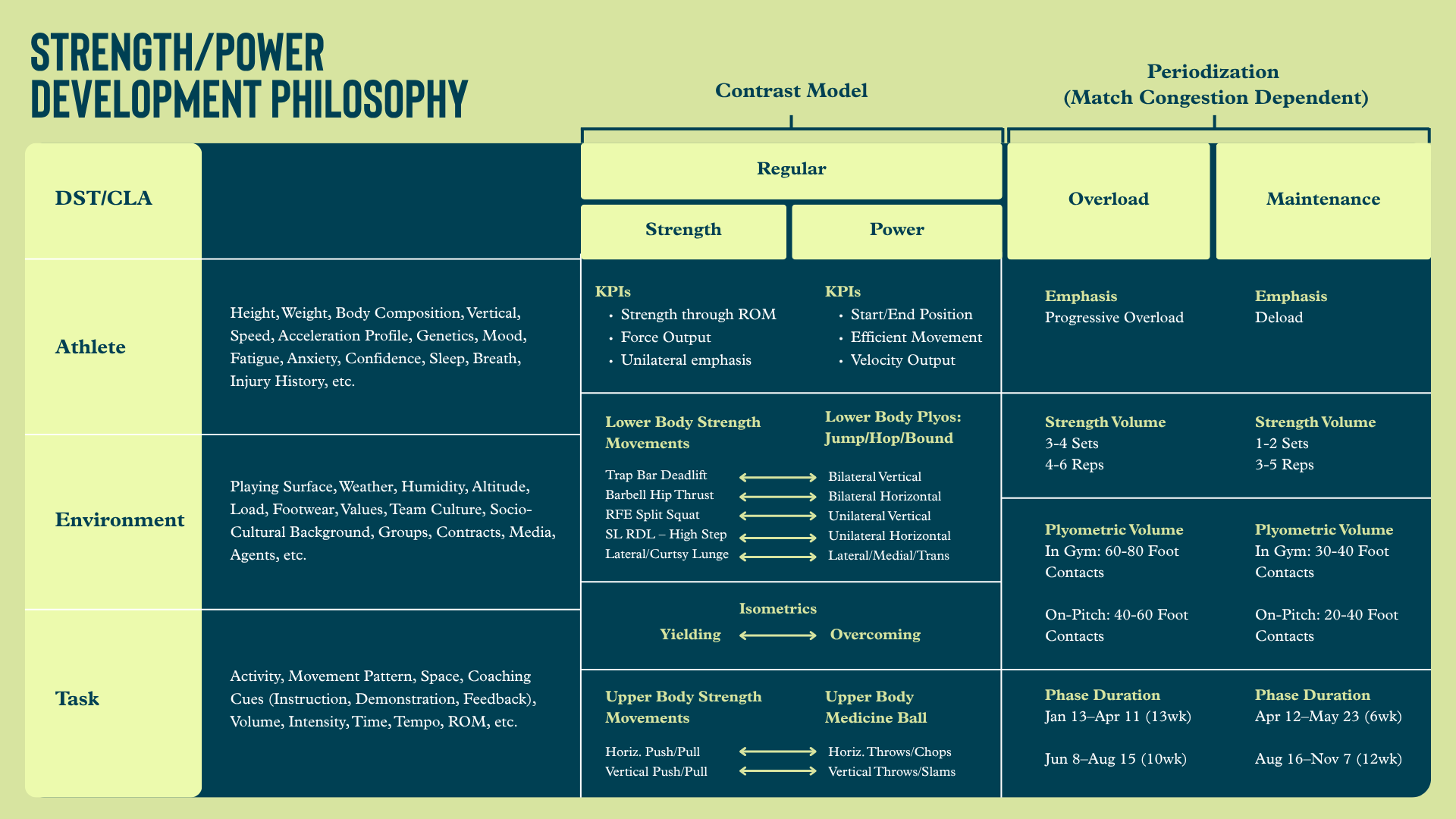
The 10-month MLS season presents many challenges: travel, match congestion, individual circumstances. As such, our athletic development program consists of elements from contrast training, Dynamic Systems Theory (DST), and the Constraints Led Approach (Figure 1), plus plyometric prescription with high transfer to sport and consistent maximum velocity sprint exposure.
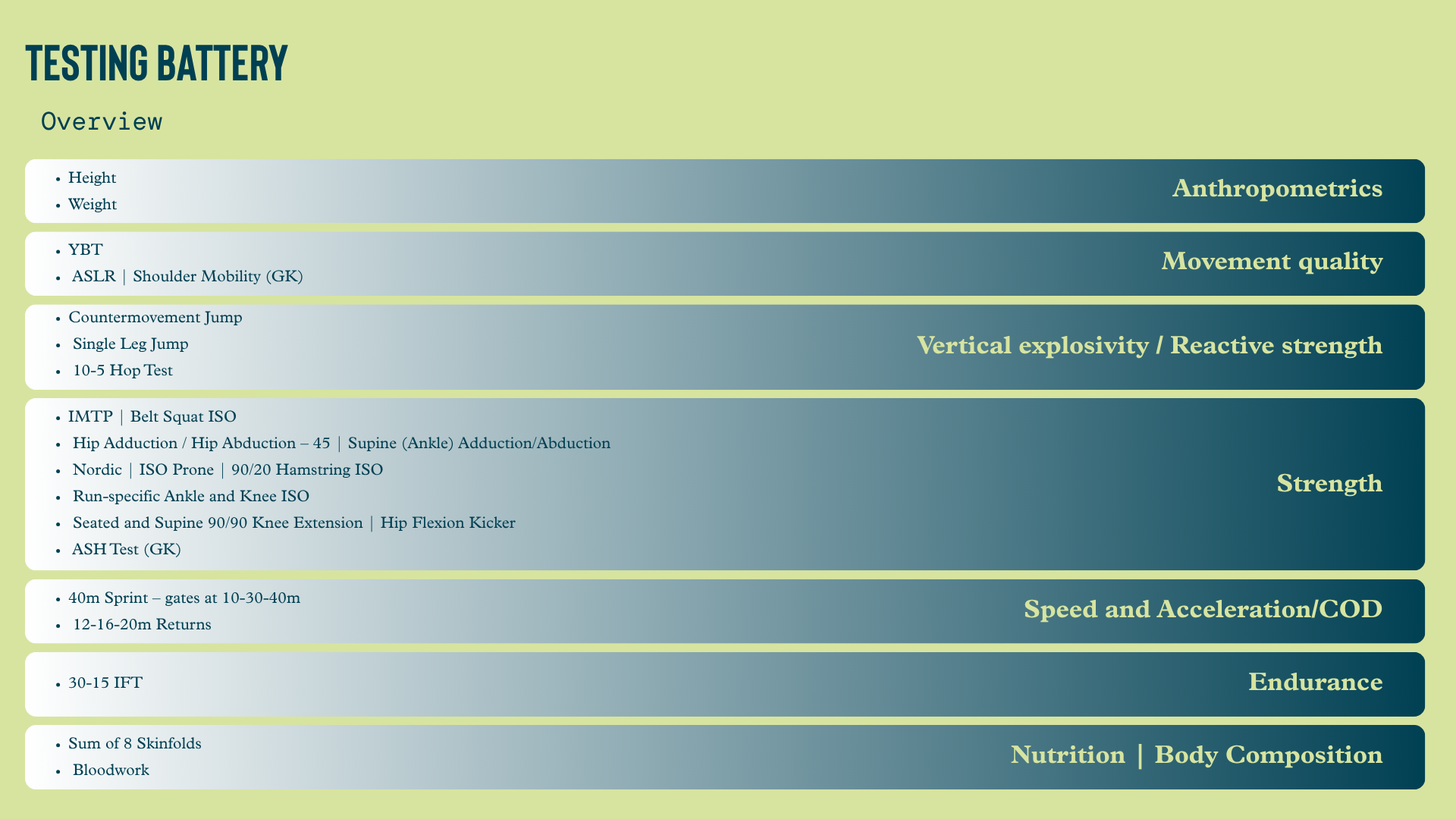
Athlete profiling is an essential piece of our developmental process. We use a robust baseline testing protocol as a needs analysis of individual potential. We conduct this pre-, mid-, and post-season to identify and address strength deficits, asymmetries, and opportunity for growth. We view this as a report card on individual player status to build athletic development plans.
Our training philosophy is built upon the EXOS methodology, specifically, Position-Pattern-Power.
Position looks at whether the athlete can achieve and own the required joint positions under control. Positions ensure joint integrity, which pays off through fewer non-contact injuries.
The patterns emerge if the athlete can coordinate those positions through soccer-relevant movements. Patterns ensure force is safely distributed during deceleration moments.
And power tells us how much the athlete can express force rapidly and repeatedly (capacity) in those patterns under load and fatigue. Power ensures tissue tolerance during match intensity and volume.
To facilitate movement quality and efficiency, we use Gray Cook’s 3 Rs: reset, reinforce, reload. Reset entails tissue quality and dynamic mobility through manual therapy, joint manipulation, and soft-tissue work. We reinforce via static and dynamic stability to coordinate movement patterns that “protect the reset,” exploring maximal ROM using corrective exercise to establish the desired beginning and end ROM control. Reload means loading movement patterns, creating resilient and strong motor patterns and programs.
What is good for rehab is good for performance, and vice versa. The best ability is availability. We cannot optimize performance if a player is unavailable for selection.
With that said, there are opportunities during the MLS season to push hard and times when we must back off and allow for recovery. We push to increase strength and power at the start of the MLS season (13 weeks) and post-World Cup break (10 weeks). Once match congestion hits, we back off and go into maintenance mode with intensity, volume, and density, while sticking to our core principles.
This process, repeated year over year, has improved player availability >90%. Strength and power testing data, and maximum velocity exposure have also contributed to the increased match performance from 2024 to the present.
Tweet ThisWe push to increase strength and power at the start of the MLS season (13 weeks) and post-World Cup break (10 weeks). Once match congestion hits, we back off and go into maintenance mode with intensity
Kyle Porter

Anton Matinlauri
Head Performance Coach, Los Angeles Football Club
The reality of long seasons and increasingly congested and unpredictable schedules challenges traditional approaches to periodization in modern professional football. If we want to develop, rather than simply maintain, strength and power in-season, programming needs to be flexible enough to navigate these demands while respecting the key principles that drive adaptation.
However, the opportunity for development is not the same for every player. A high-minute starter may have longer periods where maintenance is the realistic objective, while players with limited or no match minutes have greater development opportunities.
Consistent exposure can maintain these qualities and provide the foundation to progress when the schedule opens up.
Given the sport’s dynamic nature, rather than relying on predetermined phases and planned progressions, we need to understand what stimulus football has already provided, what may be missing, and what we can realistically add. Match minutes, schedule, training history, player feedback, and supporting data can help guide the individual dose.
Long-term development should guide short-term planning. But the reality of professional football will sometimes require us to temporarily prioritize readiness and performance.
Microdosing might provide part of the solution. Instead of searching for where a 45-minute gym session might fit, we can look for smaller windows. The athletes bank small training exposures that accumulate over time: 15 minutes across four days provides an hour per week, potentially 40 hours across a 10-month season.
Importantly, frequent 15-minute exposures are not the same as one 45-minute session, which is partly the benefit.
Smaller doses can help manage fatigue and soreness, preserving the quality of football training while maintaining frequent strength and power exposure. Intent remains high, while volume, load, and contraction type can be manipulated according to the player’s needs, with velocity-based feedback in selected exercises helping inform those decisions.
With limited staff resources, grouping players by match exposure can make individualization more manageable. A regular starter may receive a minimal “effective” dose of strength and power, while players with less accumulated load may benefit from greater strength volume and eccentric loading. The desired adaptation should guide the content while considering its cost in fatigue, soreness, and recovery.
The aim is to provide structure without making planning too rigid in an environment often driven by the urgency of the moment. Consistent exposure across the week allows us to adapt the load, or even give a day off, without losing sight of the longer-term objective.
Ultimately, we can work toward developing strength and power in-season by finding small windows to provide the right stimulus consistently and with intent, while recognizing when maintenance may be the realistic objective without compromising performance on the pitch.
Tweet ThisImportantly, frequent 15-minute exposures are not the same as one 45-minute session, which is partly the benefit. Smaller doses can help manage fatigue and soreness, while maintaining strength and power exposure.
A_Matinlauri



Enrique Martinez
Head of Strength & Conditioning, Inter Miami FC
In high-performance football, one of the main challenges to developing strength and power during the season is the high density of competitive fixtures. In competitions such as MLS, where league matches, Leagues Cup, CONCACAF, the U.S. Open Cup, and the FIFA Club World Cup may coexist, congested periods considerably reduce the opportunities to provide sufficient stimuli to drive adaptation.
Therefore, load management is fundamental to balancing stimulus, adaptation, and fatigue. This requires integrating competitive load through the distribution of minutes and player rotation when possible; on-field load through the distribution of daily objectives and weekly undulation of training demands; and strength and power load through strategic adjustments in volume, intensity, and frequency.
During weeks with more time between matches, there is an opportunity to develop, rather than simply maintain, different qualities across the force-velocity continuum. This can include maximal push and pull isometrics targeting high force production; individualized power training using velocity-based training (VBT); and functional actions such as jumps and changes of direction, where the stretch-shortening cycle (SSC) plays an important role.
Exercise selection should reflect the multidirectional nature of football by integrating force application across vertical, horizontal, lateral, and rotational vectors.
Performing these stimuli before the on-field session not only provides an opportunity to develop these qualities but may also potentiate subsequent actions and enhance the quality of the field session.
When the calendar becomes congested, these opportunities decrease, making it necessary to identify alternative windows for development and maintenance.
A first window appears on MD-1, with low-volume microdoses as part of post-activation potentiation (PAP) strategies providing a high-intensity neuromuscular exposure with a low fatigue cost before competition.
A second window appears immediately after the match for players with limited or no competitive exposure. When only a few days separate matches, players can perform complementary strength work without taking up recovery time over the subsequent training days. This can be particularly valuable for young or developing players who require greater exposure to strength or hypertrophy stimuli, with the dose adjusted according to individual match exposure and accumulated load.
A third option is the compensatory session, for example, on MD+2. Players with limited or no match exposure can receive an additional strength and power stimulus. Practitioners should adjust its magnitude based on the proximity of the next match to minimize residual fatigue.
Developing or maintaining strength and power in-season does not mean using all these windows. We have to identify which window is a possibility given the schedule and which is most appropriate for each player. Then select the timing and dose that optimize the strength and power stimuli according to individual needs and competitive exposure without generating residual fatigue that could compromise preparation for the next match.
Tweet ThisA first window appears on MD-1, with low-volume microdoses as part of post-activation potentiation (PAP) strategies providing a high-intensity neuromuscular exposure with a low fatigue cost before competition.
Enrique Martinez

Charles Burdick
Head Performance Coach, Portland Timbers FC
Ask most staff what strength and power training looks like in-season and you’ll hear the same answer: hold the line. Don’t lose ground.
That instinct isn’t wrong. But it’s a planning default, not a physiological ceiling, and the two get confused.
The maintenance work everyone cites showed that one lifting session a week held maximal strength and 40-meter sprint across 12 in-season weeks, while one session every second week did not.[1] That is a floor for retention, with no non-lifting control. It says nothing about a ceiling. Somewhere along the way, the minimum needed to not lose ground became the most we expect to gain.
The evidence for pushing past that floor is thin, but it points one way. A season-long study in young professionals ran a twice-weekly flywheel program, one upper body day and one lower body day, with 1–2 sets per exercise. Half-squat power climbed 3–14% and sprint times improved 1–2%.
No control group, no injury tracking, and a squad aged 16–19, where some of that gain is just growing up. Read it as possibility, not as transfer to your first team. But note the dose: one lower body exposure a week, and they got more powerful while competing.
Intensity, not volume, moves the needle. Part of why is easy to miss: the match already trained the legs.
Match day is the biggest lower body session of the week, and the eccentric braking of deceleration still shows up 72 hours later in soreness and reduced jump and sprint output.[2] Program as if the lower body is untrained and you’ve misread the week. Stop sets when bar speed drops off, i.e., 10–20% velocity loss if you have VBT or Keiser. Don’t train to failure.
Development in-season is a player-day problem, not a team-week problem.
For starters, the match is the primary stimulus, so preserve upper body development and minimize lower body novelty. That is also the answer to the risk objection: a few percent on a force metric does not buy back a starter missing week 14.
For reserve players there is less match load, so morning-after exposure to a new stimulus is defensible. This assumes access to GPS and injury history. Without it, sort by minutes played, which is cruder but provides the same signal.
Anchor the week with one meaningful heavy exposure. When the schedule compresses to three matches in a week, return to the minimum effective dose and introduce nothing unfamiliar.
The season isn’t a nine-month holding pattern. It’s a long developmental phase interrupted by uneven recovery. The constraints are real: congestion, travel, playing minutes. But maintenance is usually the first thing we decide, not the last thing the calendar leaves us.
Tweet ThisProgram as if the lower body is untrained and you’ve misread the week. Stop sets when bar speed drops off, i.e., 10–20% velocity loss if you have VBT or Keiser. Don’t train to failure.
@coach_burdick