Unlike the professional game, the women’s collegiate soccer season compresses preseason, conference play, and the post-season tournament into 19 weeks. This results in dramatic and unpredictable changes in physical demands. Following a team’s schedule and programming across a full season illustrates a core lesson: the best periodization model is the one that adapts weekly, sometimes daily, without losing sight of the players’ wellbeing.
Tweet ThisFollowing a team’s schedule and programming across a full season illustrates a core lesson: the best periodization model is the one that adapts weekly, sometimes daily, without losing sight of the players’ wellbeing.
Elena Cantú
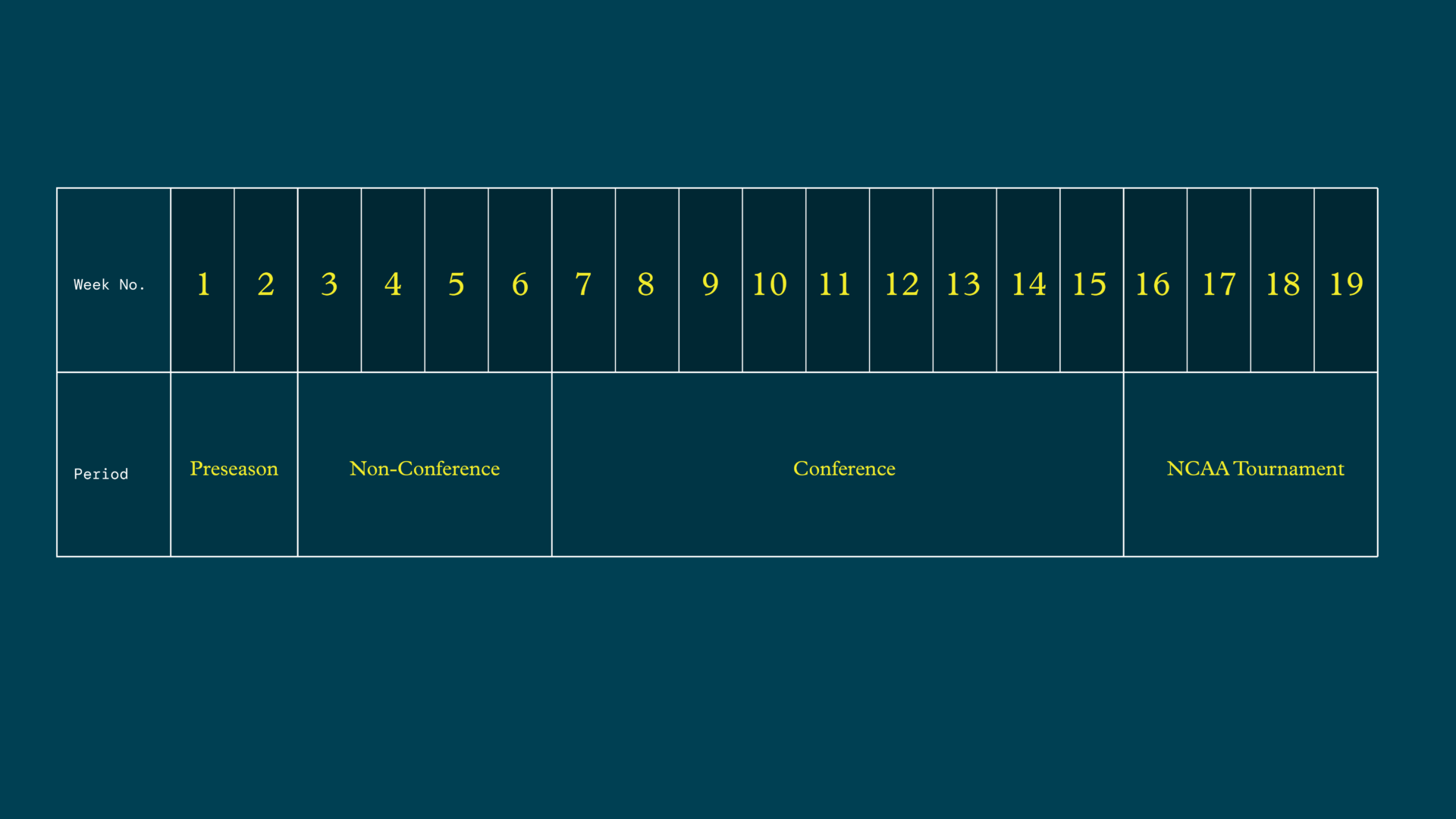
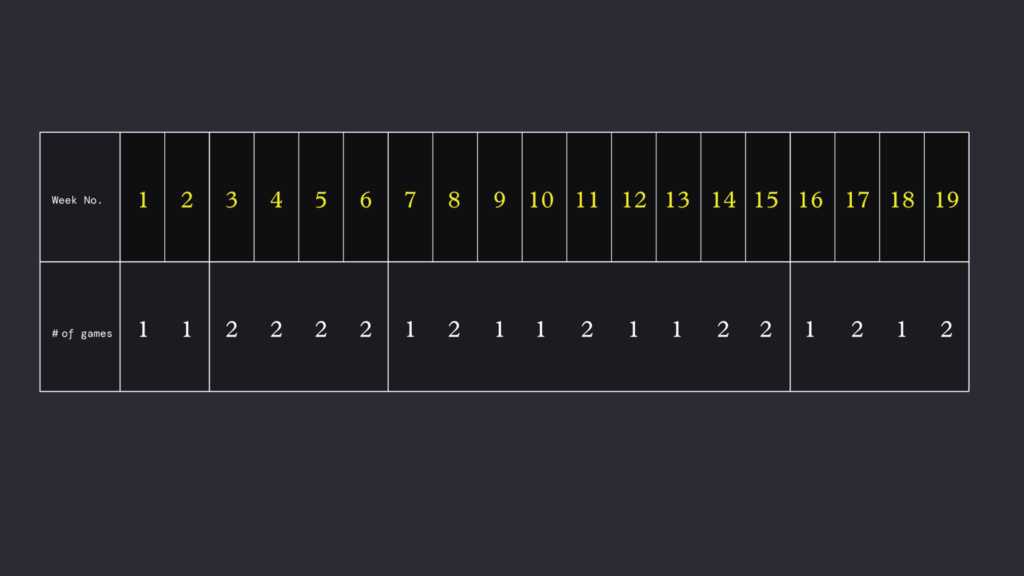
The women’s college season lasts 13 weeks, and extends up to 19 weeks if the team reaches the NCAA tournament.
Before the season are two weeks of preseason training followed by four weeks of non-conference games. The non-conference games physically prepare the players for the start of the conference play, where game demands increase. The conference play portion entails 10 games over eight weeks, with the conference tournament in the final week of this span. The year finishes with the NCAA tournament, a 64-team competition spread over four weeks.
A typical week during the college season includes two match days, two MD-1 sessions, one MD-2 session, and a mandatory day off.
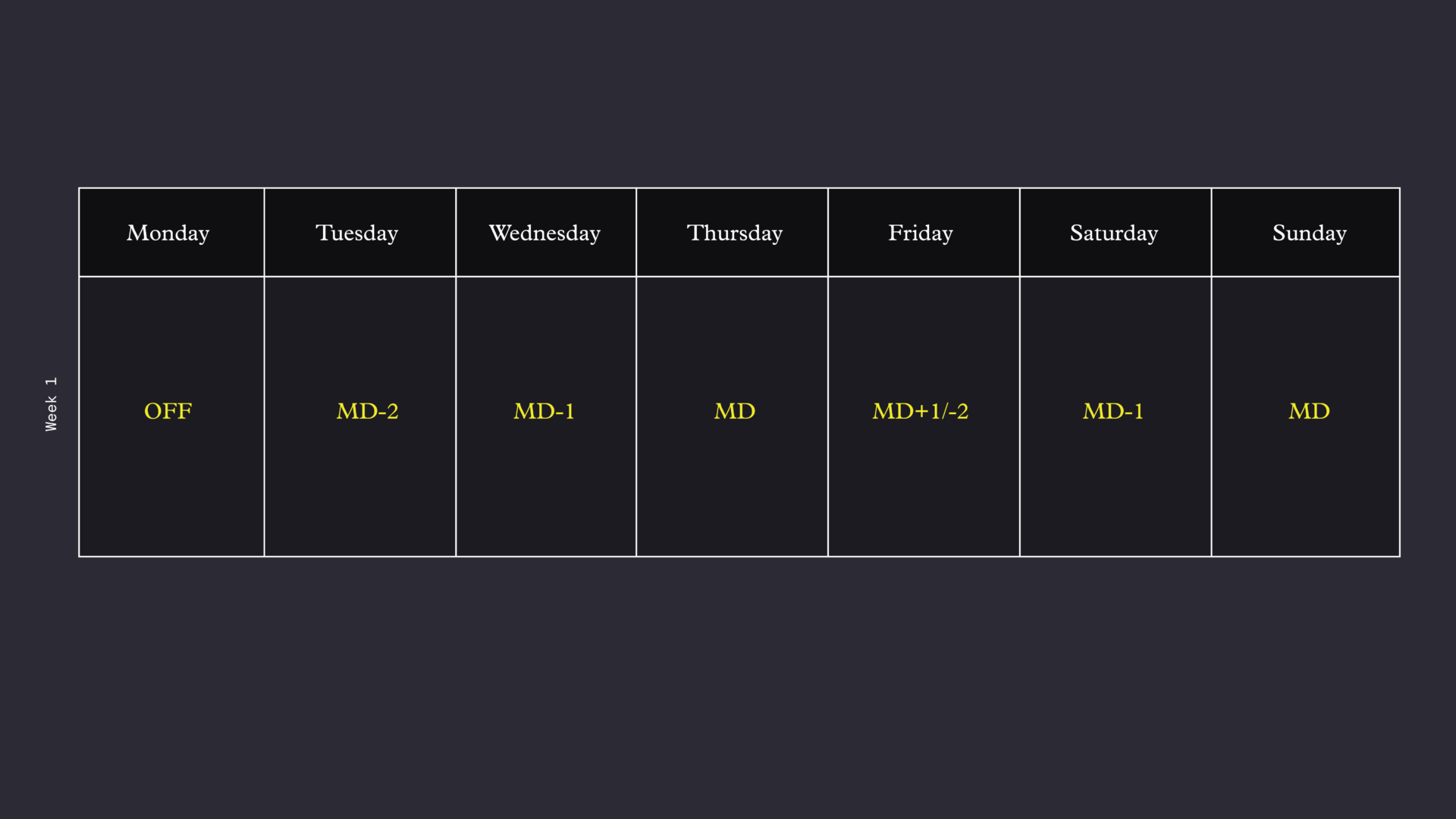
Maintaining this schedule can be tricky, especially during the pre-season non-conference games.
Tweet ThisThe year finishes with the NCAA tournament, a 64-team competition spread over four weeks. A typical week during the college season includes two match days, two MD-1 sessions, one MD-2 session, and a mandatory day off.
Elena Cantú
Programming revolves around the upcoming match
Our broad programming structure keeps the physical engine consistent even when the competition schedule isn’t. Lighter weeks progressively overload key positional match metrics: high intensity running for center midfielders and sprint distance for strikers and wide midfielders. A deload week after a congested week promotes recovery.
During the non-conference period, for example, the players need to get fit and ready for conference play, but they are already being exposed to significant playing time. MD-2 becomes a valuable high volume day for all available players to make sure we reach our goals without overloading the athletes.
In a previous iteration of our programming approach, the players would have high deceleration loads on MD-1. This resulted in a slower match tempo and greater soreness on game day.
We re-organized the schedule to emphasize high quality volume on MD-2, specifically increasing high speed running (>19 kph) and acceleration volume. These manifested as better match tempo over the course of the season. Consequently, MD-2 training is built around tactical strategy and setting the tone for the next game, while MD-1 is about total load consistency and individual target intensity.
Once conference play starts, different weekly training schedules might provide more opportunity to train, but at the potential expense of disrupting the players’ rhythm if we don’t manage loads. During the 2024 season, the team followed the same system every week during conference play: target at least 50% of HSR demands by position on the furthest day away from the game. If that is MD-2, the target is 50% of match demands.
Due to the increased intensity demands in collegiate soccer, the NCAA extended the season by one week in 2025, which allowed for more one-game weeks and more time to recover between games. When the team only plays once, the temptation is to rest, but too much rest can cause the players to lose game fitness over time.
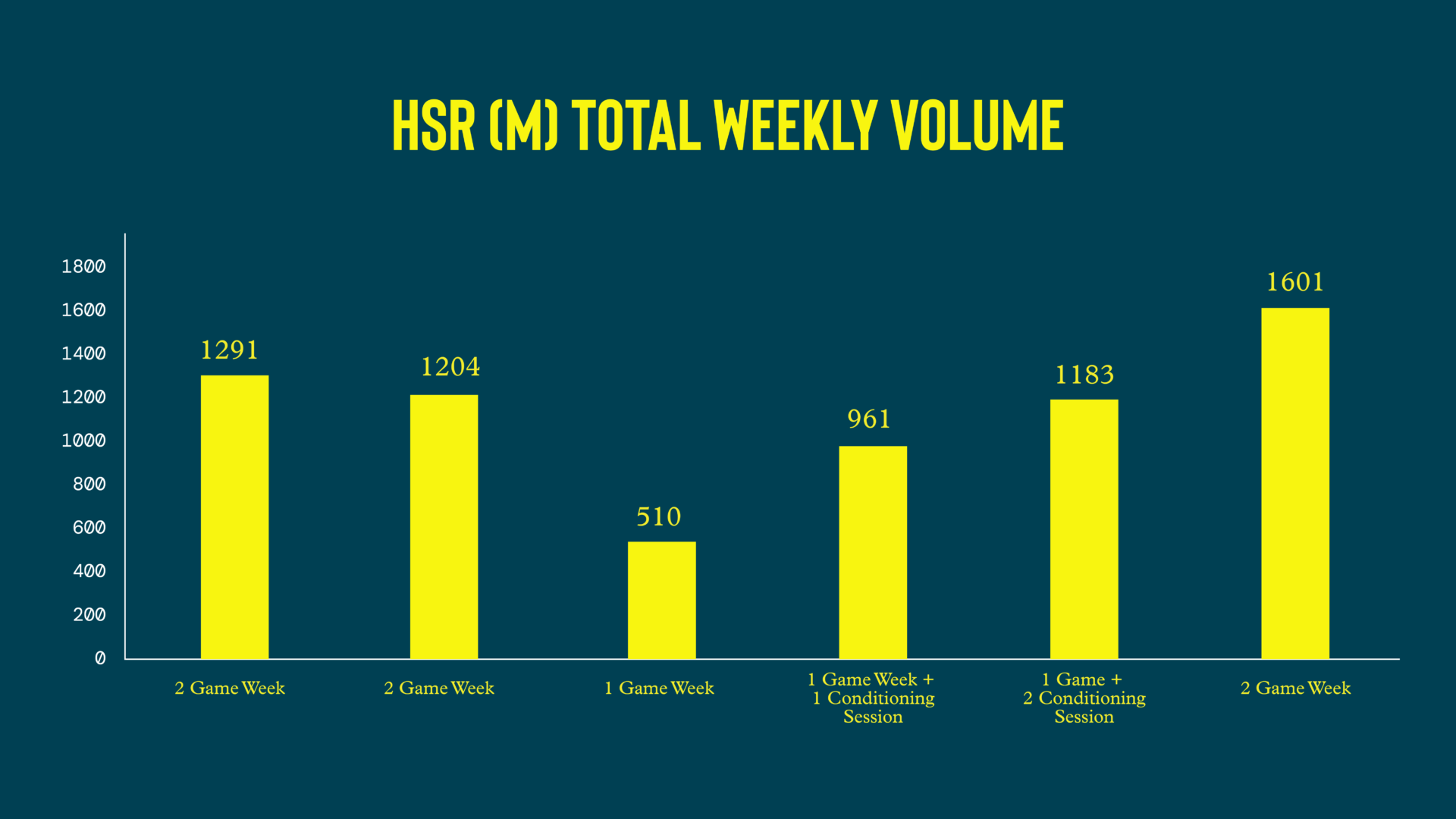
When we compared total weekly high speed running loads across different scenarios, we saw that two-game weeks naturally provided the highest total HSR. But when we inserted a short bout of HSR work during one-game weeks—typically on MD-4, to allow time for fatigue and inflammation to resolve before match day—the players maintained similar total HSR across the month, with the players reporting that they felt fitter at the end of the season.
Figure 3 shows the weekly volume of high speed running for a center forward who typically played the entire match. Over the last six weeks of conference games, we progressively overloaded her high speed running, as that was a key performance indicator for her position and individual profile.
| Week number | Number of games | Number of conditioning sessions | Target | Additional Information | |
| 10 | 2 | 0 | Optimize recovery | N/A | |
| 11 | 2 | 0 | Optimize recovery | ||
| 12 | 1 | 0 | De-load, optimize recovery | Manage high-speed running volume during practice | |
| 13 | 1 | 1 | 50-60% of highest weekly load | MD-4 5x80yd in 12sec, 10sec rest | Target volume: 400yd |
| 14 | 1 | 2 | 70-80% of highest weekly load | MD-5 3x 5min 6v6 (52x40yd) 2min rest | MD-2 4x80yd in 12sec, 10sec rest |
| 15 | 2 | 2 | Maintain fitness | N/A | |
Tweet ThisOur broad programming structure keeps the physical engine consistent even when the competition schedule isn’t. Lighter weeks overload key positional match metrics: high intensity running for center midfielders and sprint distance for strikers.
Elena Cantú
| Exhibition | Non-Conference | Conference | Conference tournament | NCAA tournament | |||||||||||
| Position | Distance | HSR | SD | Distance | HSR | SD | Distance | HSR | SD | Distance | HSR | SD | Distance | HSR | SD |
| 2 | 7,579 | 170 | 18 | 10,663 | 430 | 57 | 11,112 | 663 | 164 | 10,754 | 552 | 305 | 10,402 | 508 | 279 |
| 3 | 10,803 | 540 | 197 | 10,733 | 671 | 172 | 10,676 | 628 | 167 | 10,476 | 537 | 304 | 10,561 | 610 | 294 |
| 4 | 10,239 | 369 | 271 | 10,166 | 417 | 100 | 10,098 | 389 | 104 | 10,679 | 505 | 317 | 10,516 | 529 | 334 |
| 6 | 11,058 | 439 | 166 | 11,225 | 493 | 173 | 11,446 | 553 | 177 | 9,720 | 460 | 235 | 12,086 | 722 | 296 |
| 10 | 9,829 | 454 | 206 | 10,304 | 401 | 81 | 11,313 | 494 | 156 | 12,043 | 767 | 345 | 10,127 | 406 | 167 |
| 7 | 9,765 | 550 | 384 | 10,271 | 675 | 193 | 12,063 | 778 | 740 | 12,010 | 661 | 388 | |||
| 11 | 11,095 | 584 | 260 | 11,091 | 754 | 272 | 10,646 | 645 | 495 | 11,793 | 729 | 531 | |||
| 9 | 9,279 | 525 | 433 | 10,007 | 652 | 195 | 10,457 | 626 | 313 | 11,630 | 868 | 648 | 9,077 | 560 | 481 |
| Average | 9,798 | 416 | 215 | 10,495 | 525 | 178 | 10,808 | 598 | 193 | 11,001 | 639 | 424 | 10,821 | 590 | 346 |
Note: All metrics are for players that competed for >85 minutes. Distance (m), High-speed running (HSD [m]; >19kph); Sprint Distance (SD [m]; >22.5 kph)
By contrast, Table 3 shows the conditioning program for a low-minute outside back through the first block of the season.


Tweet ThisDuring the 2024 season, the team followed the same system every week during conference play: target at least 50% of HSR demands by position on the furthest day away from the game. If that is MD-2, the target is 50% of match demands.
Elena Cantú
Strength and sprint training
Ideally, the players would lift twice per week. However, between travel, classes, and recovery needs, that’s not always possible. The goal is consistency and intent.
Working under these time constraints, we would rather have one well-executed 20-30 minute lift than two inconsistent sessions. Gym sessions on MD-3 or MD-2 emphasize heavier or power-focused lifts to maintain strength and mitigate lean mass loss. [6] Later in the week, usually MD+1, we shift to lighter, stability-based sessions, focusing on each individual athlete’s needs.
Players who regularly reach near-maximal speeds not only perform better, but are less likely to suffer hamstring injuries. [9]
During preseason, we progress sprint exposure gradually starting with controlled 15–20 m efforts. We then build the intensity, distance, and complexity of the runs. Once players test for top speed, we maintain a 90% maximum sprint exposure every 3-4 days to keep the neuromuscular system primed. If a player reaches a new top speed during the season, we adjust the speed target accordingly.
MD-1 is the best day to accomplish these goals. The session is already high intensity and low volume, so short sprint bouts fit naturally without compromising freshness.
As the season evolves and the games become more intense, we aim for one exposure roughly every four days, including match days. Players who did not reach sufficient volume greater than 90% maximal speed during the game will do sprint work during the subsequent MD-3 or MD-2 sessions. During taper or recovery weeks, one sprint exposure per week has proved sufficient.
Tweet ThisGym sessions on MD-3 or MD-2 emphasize heavier or power-focused lifts to maintain strength and mitigate lean mass loss. Later in the week, usually MD+1, we shift to lighter, stability-based sessions, focusing on each individual athlete’s needs.
Elena Cantú
Finding a sense of balance across all demands
Other factors that require adequate planning are recovery modalities like ice baths, manual therapy, dry needling, and physical therapy. [10]
Balancing physical preparation with tactical demands requires planning, flexibility, and communication across the staff.
Sometimes practice plans change. Maybe the coach needs more time to work with certain positions, or practice numbers change due to player availability. Change and unpredictability are defining characteristics of college sports, and practitioners have to adjust accordingly. Using systems instead of plans allows for more flexibility and easier decision making. Putting data into the context of this team in this season is necessary to ensure that you don’t get bogged down by inapplicable or inappropriate ideas of what is “normal” or normative.
Finally, the season is not the time to overcomplicate things. Keep it simple and work with the athlete’s feedback.
Smart periodization allows players to peak at the right time, stay healthy through the grind, and give themselves the best chance to perform deep into the postseason.
Tweet ThisUsing systems instead of plans allows for more flexibility and easier decision making. Putting data into the context of this team in this season is necessary to ensure that you don’t get bogged down by inapplicable or ideas of what is normative.
Elena Cantú