





Six experts on speed and jump development were asked this question by us, and this is what they said.
Dan Tobin
Head of Strength and Conditioning, England Rugby
With all 3 jump variations I’ve selected fast stretch-shortening cycle (SSC) exercises. So much of the gym content athletes complete is contractile dominant and for me, the value in jump training is with true elastic plyometric exercises with short ground contact times (<250ms).
Jump Variation 1: Rudiment Jump Series (ALTIS)
The ALTIS rudiment jump and hop series is a great way to teach rhythm, technique and specifically condition the calf-achilles complex for fast SSC activities. I use it as an extensive series to lay the foundation for higher intensity jumps. Focus on a full foot landing with a neutral ankle throughout the ground and flight phases and appropriate relationship between yielding and rebounding at the ankle, knee and hip. I would normally programme 10-15 reps in each direction bilaterally and then unilaterally.
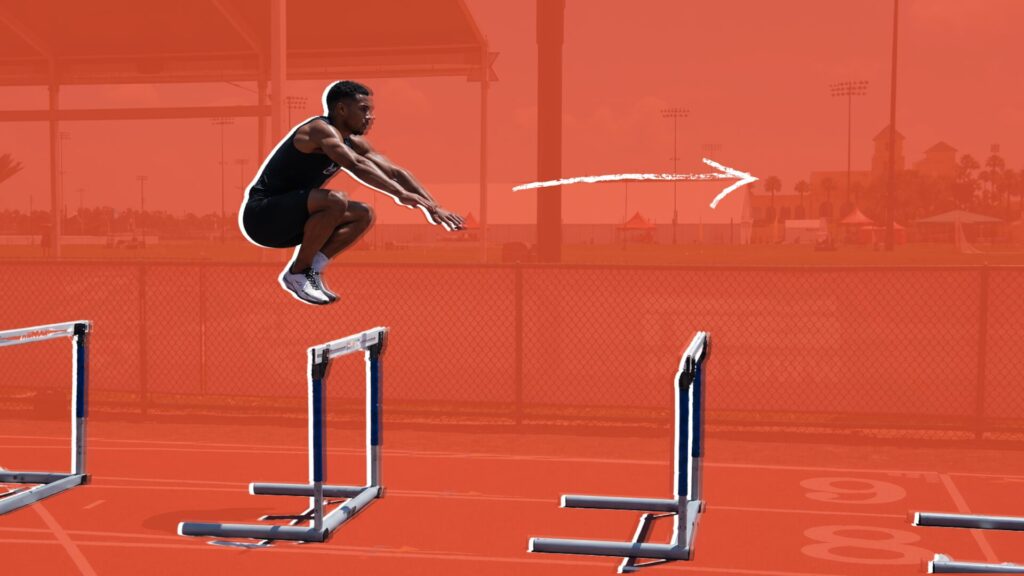
Jump Variation 2: Drop jump into a hurdle jump
The challenge when athletes begin drop jumping is marrying the jump height and ground contact demands to optimize the reactive strength index. Feedback on the contact time at this early learning stage is vital as a learning tool. I use a drop jump into a hurdle jump with monitoring of the contact time on the optojump. The hurdle provides a task constraint, and keeps the jump height demands constant. This simplifies the instructions to the athlete to minimize the contact time. I like to see athletes get consistently below 170ms on this exercise before progressing the hurdle height. I would normally programme 5-8 reps of this early in a training session.
Jump Variation 3: Repeat hurdle jumps
Once the athletes have a foundation of extensive practice with the rudiment jump series and are accustomed to producing fast SSC actions with the drop jump to hurdle jump we progress to a rhythmic activity with repeat hurdle jumps. The focus in the execution is the same as the previous exercises – we want to see a fast, elastic, reactive contact on the floor while completing the task of clearing the hurdles. Once the athlete shows consistency and some rhythm with one hurdle height, we’ll increase the challenge by increasing the hurdle height. Therefore we start promoting the jump height part of the reactive strength index equation once we are confident that the ground contact phase is a true plyometric. I would usually programme 4 to 5 sets of 5 hurdle jumps in a plyometric session.
Tweet ThisThe challenge when athletes begin drop jumping is marrying the jump height and ground contact demands to optimize the reactive strength index. Feedback on the contact time at this early learning stage is vital as a learning tool.
@Dan Tobin
Christopher Chase
Director of Performance, Memphis Grizzlies
I am choosing to keep my 3 go-to jump variations as specific as possible to basketball performance training. Strength and conditioning coaching for professional basketball players in the team setting is all I have known for the past 10 years, so I will try to stay in my lane. Choosing 3 is also a rough constraint considering how expansive the plyometric exercise menu is. Staying specific to basketball can narrow it down a bit and hopefully force a more nuanced explanation of the why.
Jump Variation 1: Approach Jumps, Hops, and Bounds
Starting with approach jumps, hops, and bounds gives me an opportunity to introduce a primary emphasis in the sport of basketball. Many of the jumps, hops, or bounds that players execute during games are initiated from a transit movement. In other words, a player must manage horizontal entry velocity and a horizontal force vector that they must redirect to some semblance of vertical force to execute the plyometric effort. It is common for this to be 1 effort where the player takes off and lands without having to repeat the plyometric effort. With all of this in mind, I am using the term “approach” to denote that entry velocity is occurring before the jump, hop, or bound. This entry velocity is usually from common basketball specific movements or actions like running, sliding, cross-over running, retreating, curvilinear running, etc. These efforts can be progressed by adding resistance, increasing entry velocity, and decreasing the time allowed for the player to decelerate. Instead of lingering in the general space of repeated hurdle jumps, for example, it may be worth getting to approach work and other more sport specific plyometric efforts sooner rather than later.
Jump Variation 2: Forward Repeated Jumps, Hops, and Bounds
Forward repeated plyometric efforts are meant to emphasize that the sport may be characterized by more horizontally directed forces than we commonly appreciate. Vertical jump normative data is common knowledge, yet I would contest that this capacity to produce vertically directed force is not as much a part of the game as what is demanded horizontally. The terms invasion and evasion are fashionable to use to describe how we create advantages on the court through spacing, movement, etc. Whether invading or evading, players are relying on more horizontally directed force production to accelerate, decelerate, and change direction. These sorts of movements that challenge a player’s reactive strength at a high intensity can happen multiple times per possession. On the contrary, it may be rarer that a player has to execute a vertical jump at a comparable intensity to the horizontally directed challenges.
Jump Variation 3: Short coupled Jumps, Hops, and Bounds
Short coupled is meant to describe work that facilitates a fast stretch shortening cycle, high peak forces, high rates of force development, and is more often than not directing stress to the foot and ankle more so than to the hips and knees. It is fashionable to say that professional sports have a “reactive strength problem”. Although I believe this is a more complex problem than the internet would suggest, I do think the sport is telling us where we may be undertraining players. Maintaining a thread of reactive strength work via plyometric efforts throughout the year is essential, and maybe under-appreciated. We also know that basketball demands high levels of force production in very little time in a variety of body shapes and joint positions. Steadily decreasing your ground contact as you move closer to the competitive season is key. This is something that is commonly not done soon enough in the off season to accrue enough time to adapt before the sport takes over in the pre and competitive portions of the season. Exercises that are usually described as intensive “pogos” or short coupled, fast SSC jumps, hops, bounds can be characterized by ground contacts certainly less than 0.3 sec and down towards 0.1-ish sec. Even though basketball players do not hit high speeds often, dosing high speed running would also be a great way to get at this sort of vertical and horizontal fast SSC work.
Tweet ThisMaintaining a thread of reactive strength work via plyometric efforts throughout the year is essential. Steadily decreasing your ground contacts as you move closer to the competitive season is key.
@Christopher Chase
Thomas Barbeau
Return to Play Coordinator & Assistant Strength and Conditioning Coach, Carolina Panthers
When developing explosive qualities and returning athletes to performance, I find myself returning to some version of the same three jump variations. These target a variety of physical qualities, and together they cover the spectrum from foundational prep to high-intensity expression. The goal isn’t necessarily to do the most advanced variation; it’s to match the athlete’s needs.
Jump Variation 1: Bounds
Bounding can provide a highly specific tool for building horizontal force production, coordination, and stiffness. They’re a great tool because of the variations available: power bounds with a double-arm swing emphasize a powerful strike and projection, while speed bounds can train rhythm and stiffness. Changing the angle can increase change of direction and braking demands, as does adding more vertical jumping components. Cueing postural alignment, pelvic control, and negative foot speed makes bounding a highly effective tool for transferring to sprint performance. Athletes should be coached to apply large forces in the right direction, driven by intent, timing, and rhythm.
Jump Variation 2: Hurdle Hops
Hurdle hops offer a high return on elastic reactivity while being very easy to progress and regress. Manipulating the constraint of hurdle height will help to shift the focus between longer and shorter ground contact times, while spacing can bias either vertical or horizontal force production. Changing the athlete’s ground contact between hurdles is a great strategy to modulate intensity, moving between a stick, double contacts, and repeated single contacts. A key coaching emphasis should be on hip height more so than hurdle height. It’s not how high an athlete can lift their legs; it’s about projecting the center of mass. Cueing intent with phrases like “attack the floor” helps drive the kind of stiffness and reactivity that will hopefully transfer to sport.
Jump Variation 3: Rudiment Hops
Rudiment hops are a great jump variation for general physical preparation, particularly when training foot and ankle stiffness, rhythm, and proprioception. They allow for high volumes of ground contacts at lower impact, making them ideal for warm-ups and early stages of return to play. There are nearly an endless number of variations, from single and double-leg hops to zig zags and alternating versions, offering variety and complexity without needing to increase intensity. These fancy pogos help “raise the floor”, training the system to be reactive and efficient under submaximal conditions, while laying the groundwork for more advanced plyometric work.
Developing explosive qualities and returning athletes to form requires targeted strategies that address both foundational and high-intensity demands. Hurdle hops, bounds, and rudiment hops each offer unique benefits, building elastic reactivity, horizontal force, coordination, and stiffness, making them exercises I consistently return to.
Tweet ThisBounding is a specific tool for building horizontal force production, coordination, and stiffness. Cueing postural alignment, pelvic control, and negative foot speed makes bounding a highly effective tool for transferring to sprint performance.
@Barbeautraining
Joel Smith
Athletic Performance & Movement Coach, Just Fly Sports
When it comes to plyometrics in sport, we need to look at base abilities that complement and enhance the multitude of ground contacts, jumps and cuts already happening in a team sport environment. Although there are a wide variety of potential movements available, my 3 movements I program for the broadest spectrum of athletes are as follows: Jump Rope, Altitude Drops, and Speed Russian Lunges.
Jump Variation 1: Jump Rope
Nowadays, small repeat hops are called “extensive plyos”, but in the past history of training, it was tied to something called a “jump rope”. The main factors separating jump-roping from extensive hopping, is rhythm and an external task. Athletes who can hop with the rope swinging forwards, backwards, and hop with double, single and alternating feet, will cultivate not only stronger ankles, but also full-body rhythmic qualities that simply hopping around will not provide. Tap dancing and Irish dance have been used by elite athletes to develop the feet and ankles, a testament to the external, rhythmic elements that go beyond simply jumping up and down repeatedly.
Jump Variation 2: Altitude Drops
Altitude drop landings are one of the most basic forms of plyometric, and is a precursor to other vertical plyos, such as depth drops. These should always be targeted to the skill and ability of an athlete, otherwise they can become dull and not stimulating enough to move the needle of performance. For younger athletes and plyometric novices, a “standard” drop is one that can be performed with a relatively “silent” landing, as well as the ability to land in different positions (tall, squatted, or spinning in the air prior to landing). Advanced athletes can drop from higher boxes, but generally I prefer the drop and landing itself carries a more dynamic quality, such as a single leg drop, or a leg-tuck to bilateral landing, inspired by the likes of Jay Schroeder. I love programming depth jumps, but not every athlete group needs that intensive jumping movement, where drops are more general and universally applicable.
Jump Variation 3: Speed Russian Lunge
There are many bounds, skips, and hops that help build horizontal power, but in most cases, the more intense versions are better suited for track athletes than team sport players. To ultimately simplify a plyometric from a perspective of angular, horizontal movement, the Speed Russian Lunge is a base exercise, which involves the switch of the legs from a low position. This motion captures a low hip height, an explosive “switching” action desired for sprinting, braking actions, as well as working long muscle lengths in the hip flexors and adductors. It can be done at a variety of speeds, rhythms and even vertical projection heights of the hips. Ultimately, the Speed Russian Lunge offers a broad general base of unilateral ability that can work into a variety of more specific sporting actions.
Tweet ThisThe main factors separating jump-roping from extensive hopping, is rhythm and an external task. Hopping with the rope on double, single and alternating feet, will cultivate not only stronger ankles, but also full-body rhythmic qualities.
@JustFlySports
Alex Beljic
Assistant Director of Sports Performance, University of Southern California
Jump Variation 1: Depth Jumps
In a world dominated by concentric muscle contraction focused exercises, the depth jump stands out because of its potential for high eccentric (braking) forces and high rate of force production. This is quite like a change of direction in sports – in an instance – the depth jump teaches our body how to absorb and re-apply force effectively and within a safe environment. It is the precursor to an important part of athletic performance without the added reactionary stimulus you would otherwise get in the real world. This, combined with one of the highest potentials to overload these braking forces does enough to cause a potent stimulus to significantly improve athletic performance. Therefore, it’s no surprise that this exercise is at the foundation of many programs including Verkhoshansky’s “Shock Method”. Lastly, a Depth Jump can be a very agile exercise that can be progressed and regressed accordingly but due to it’s extreme volatility and high force production– use with caution!
Jump Variation 2: Countermovement Jump (measured)
With a jump, just like with any other movement, intent is the driver behind adaptation. A countermovement jump (CMJ) with a measuring apparatus allows us to introduce the variables of intensity, effort, and sometimes even competition; which all correlate to successful skills necessary to not only improve our physiology but to win. A simple yet powerful exercise, a well executed CMJ with intent can teach us how to improve body awareness, maximize neural adaptation, and drive purposeful progression. Not to mention the value of tracking and extracting information for both monitoring and performance purposes.
Jump Variation 3: Bounding
Unlike the first two variations, bounding is the end game plyometric that relies heavily on the strength shortening cycle (SSC), rapid force production, unilateral strength, stability, and motor control/coordination. A bound has a similar time to force application to an acceleration and/or a sprint. Additionally, it requires a high degree of tendon and tissue stiffness to store and release energy effectively with each repetition. Due to the overwhelming complexity and demand on the body, it’s no surprise this jump variation operates on a higher level of a progression chart of most coaches.
Tweet ThisWith a jump, just like with any other movement, intent is the driver behind adaptation. A countermovement jump (CMJ) with a measuring apparatus allows us to introduce the variables of intensity, effort, and sometimes even competition.
@Alex Beljic
Rich Pruett
Director of Performance, Exos
Any discussion regarding the implementation of jumping variations, must be prefaced with our duty as performance specialists to ensure the athlete’s objective and/or subjective movement assessment(s) do not display any significant red flags (i.e. significant asymmetry). For the purpose of this discussion we’ll define jumps as a plyometric action where the individual uses both legs during the take off and landing phase. When people hear the term jump the most common example that comes to mind is a CMJ. However, most sports exist in a multiplanor environment requiring variations of chaotic changes of direction, hurdling, decelerations and accelerations to mention a few. Therefore, we must include various jump variations in order to obtain the adaptations needed to perform said demands.
Using a simple to complex lens my top three are as follows:
Jump Variation 1: Linear – Diagonal Pogo Jumps (LDPJ)
Some of the best exercise variations are the most simple. This is one of them. Used in a foundational program, RTP, or microdosed in movement prep sessions, LDJPs can be used to begin building tissue tolerance needed for movements requiring higher GRFs (i.e. high intensity 45 – 180 degree cuts). This variation helps teach young athletes how to create aggressive angles in their lower limbs and can act as a foundation for more progressive plyometrics.
Jump Variation 2: Approach Vertical Jump
This is a jump variation that is most commonly associated with basketball however when you break down the movement you will observe complex coordination, acceleration, deceleration and change of direction components that complement required athletic tasks. These can be used for high intensity days as a stand alone plyometric or as a contrast pairing. Less commonly used is the continuous rhythmic approach with moderate intensity in a movement preparation session where the athlete is gradually exposed to progressive tissue demands, such as in a soccer warm up where we are preparing the athlete to receive headers. Lastly, these jumps require the athlete to orient themselves in patterns that teach them how to load their lower body, carry momentum, and obtain triple extension.
Jump Variation 3: Depth Jumps (DJs)
Depending on the height of the box used, DJs can expose athletes to GRFs close to or greater than those obtained on the field or court of their sport. Work from Hunter Eisenhower and the like, have clearly demonstrated these required GFRs through their work on force plates. Such forces are rarely obtained during traditional performance training and therefore should be dosed appropriately. One of the primary reasons DJs are a must is they can be used three fold; assessing, monitoring, and within training. When dosed appropriately, DJs can be used in a late offseason or RTP phase to help athletes prepare for the force demands of their sport not only decrease risk of overload but enhancing their ability to produce higher forces and shorten ground contact time.
Tweet ThisUsed in a foundational program, RTP, or microdosed in movement prep sessions, Linear – Diagonal Pogo Jumps can be used to begin building tissue tolerance needed for movements requiring higher GRFs (i.e. high intensity 45 – 180 degree cuts).
@PruettRich