
Pre-training preparation sessions aim to prepare the player to cope and perform at the highest level during the subsequent training session or match.
But we have probably all been there and seen it… Let’s be honest, at some point we’ve probably all laid mats out in the gym next to the foam rollers and mini bands, set up hurdles in the corner, and checked in on the medical room full of players requiring soft tissue work that they believe will “get them ready for training.”
These so-called “pre-activation sessions” and the environments that we create for them are nowhere close to providing the players what they need to successfully prepare themselves to subsequently perform out on the pitch.
Elite football has progressed significantly and has become more intense, with greater demands upon the players in order to perform at the highest levels. Unfortunately, the industry has become “safe” and “comfortable” in how we design physical work. Relying on the argument that “we’ve always done it this way” is not consistent with the high performance culture we want to cultivate, nor the level of athletic preparation and performance that we should be optimising.
Tweet ThisElite football is more intense, yet we’ve become ‘safe’ and ‘comfortable’ in physical training. Saying ‘we’ve always done it this way’ won’t cut it. We need to break this mindset for high performance.
@MWillmott90
Pre-training sessions are there for the taking

A typical match week breaks up into three parts: recovery, conditioning and match prep.
Ideally, the players would complete an extended recovery session on Monday, where those who logged significant match minutes on the previous Saturday go through a football-specific active recovery protocol. The remaining players take part in small sided possession games plus some conditioning.
The main training exposures come on Tuesday and Wednesday, the “adaptation” training days. These are either intensive or extensive, with specific tactical properties to target the different physical needs. The focus then completely turns to recovery and physical and tactical preparation for the upcoming match on Saturday.
Unfortunately, we are rarely in an ideal world. The big issue when it comes to physical performance arises when we have more than one game per week.
Out of the 42 match weeks in the 2022/23 season, including the extended international break for the World Cup, 17 weeks (40%) had a midweek game. During October and November, there was only one week that had a single game, in which we could do our “ideal” training scheme. During the six weeks prior to the international break, the team played 10 games.

The performance staff has to adjust to suit those demands. A typical training periodisation in these scenarios starts with splitting the team into two broad groups: the match starters and the rotation players.
The players with significant match minutes follow a recovery-match-recovery cycle, where their on pitch training time is oriented almost entirely around tactical training with very little, if any, additional or specific physical stimulus. The players with less match exposure will achieve the necessary chronic load largely through additional small group training on the pitch and conditioning sessions post-training or match.

As you can see, there is a clear reduction in football specific training as a large group, and a significant loss of opportunity for post-training strength and power exposures. Practitioners have to optimise the time we do have in contact with the players, and one of the biggest windows of opportunity we have to develop and affect the players’ physical performance is before training.
A standard season may last 45-50 weeks, depending on preseason start dates and post-season playoffs. With an average of three sessions per week, we have 125-150 total sessions. At 30-45 minutes per session, we accumulate 75-90 hours of total contact time. That is more than enough to create change and develop specific physical qualities despite the potential for high match load exposures throughout the in season macrocycle.
Tweet ThisA typical match week splits into recovery, conditioning, and match prep. But with midweek games, our ideal training plan often crumbles. Flexibility and smart periodization are key to thriving under such demands
@MWillmott90
Aligning physical and technical training
If performance practitioners are designing our sessions to adequately prepare the players for the demands of the upcoming training, we must at least be informed about the technical coaches’ session design and content. Even if we’re not included in planning discussions, ideally we’d have the chance to give input and feedback. Being part of the process will help the entire team – technical and physical – where everyone’s contribution fits within both the smaller weekly microcycle and also the larger seasonal macrocycle.
The two main training days are Tuesday and Wednesday: MD-4 and MD-3, respectively. They should differ in terms of session design and physical demands.
MD-4 is more intensive, featuring large acceleration-deceleration load and change of direction demands, performed on smaller training areas and pitch sizes. MD-3 is an extensive session: maximal sprint speed frequency and total load, covering large training areas and pitch sizes.
Working back from there, we can identify the actions the players are likely to perform and can then design the optimal preparation session.
Tweet ThisMovement prep targets patterns similar to game actions. From hip hinges for accelerations to animal flows for mobility, it’s about more than warming up—it’s priming performance
@MWillmott90
Structuring a pre-training preparation (PTP) session
Players have time pre-session to complete any general preparation that they personally feel they would like to do. This is unstructured and player led, typically involving low intensity exercise (usually on a spin bike) with some banded or general mobility patterns they like to do or believe prepares them for our pre-training preparation.
We split our pre-training prparation (PTP) session into three distinct, structured areas.

Movement prep
This section delivers a range of movements and flows that target specific patterns across planes of movement, similar to what they will experience in the upcoming training sessions and, of course, in games. Games and animal flows are two common ways to meet this goal. Preparing for an extensive session that will have a lot of linear accelerations and maximal velocity mechanics, for example, we’ll prime the posterior chain through an array of hip hinges.
These movements increase soft tissue temperature and joint mobility in a controlled environment that still has a lot of leeway for players to progress intensity, intent, competitiveness and movement expression.
Specific prep
Specific prep focuses on developing the specific physical qualities and exposing the players to physical actions that will be required in the upcoming pitch session. This typically includes some technical elements to target general mechanics and cue body position, but also microdoses an element of strength and power.
An important method for hitting these goals is incorporating some pre-training isometric exercises. They can be a combination of stimuli, e.g., push / pulls or holds, across varying muscle lengths. We can effectively generate a different adaptation at each session throughout the week and facilitate optimal transfer of physical performance, but without any underlying fatiguing effects.
Even during extended recovery days, players complete low volume isometrics as part of the PTP session to maintain continuous exposure to that stimulus. During our two main training days, a typical PTP session would be:
Intensive prep (MD-4)
| Intensive Prep: Aim = Prep accel/decel – Change of direction | |||
| Exercise | Sets x Reps | Notes | |
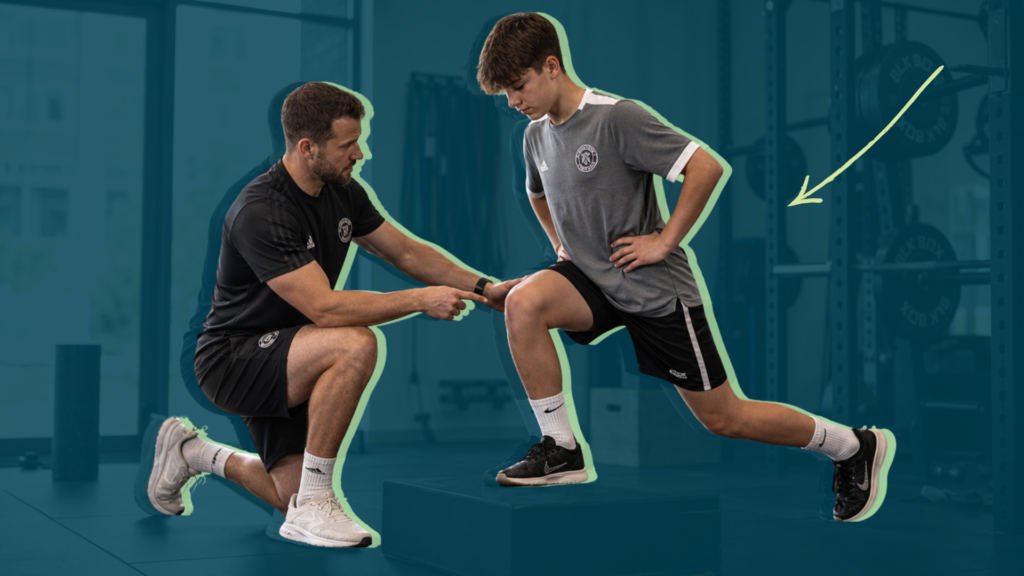
| 1a | Split squat isometric pull | 3×5 (each side) | ISO pull – 80-90% effort |
| 1b | Med ball split squat drop catch | 3×3 (each side) | Med ball overhead finish |
| 2a | Banded lunge step | 3×3 (each side) | Decel strength |
| 2b | Banded hop & catch | 3×3 (each side) | Decel strength |
| 3 | Skater jumps (med ball) | 3×3 (each side) | Reactive bounds |
| 4 | Box drop catch – hurdle jump | 3×3 | Eccentric strength (decel – power) |
| 5 | Lateral box drop catch – mini hurdle jump | 3×3 (each side) | Eccentric strength (lateral decel – power) |
During an intensive prep session, we’re looking to develop the players’ eccentric strength and force absorption capabilities. These come through various drop catches, and banded lunge steps in all planes to allow the player to absorb force through ankle, knee and hip flexion.
We can then progress these by increasing the velocity and, therefore, the eccentric load that the player needs to overcome and absorb. A player must have the capabilities to absorb these forces safely and effectively, so they must be competent in their landing mechanics before we can increase the eccentric load.
Following a deceleration, players need to initiate a propulsive force, e.g., to change direction. We program reactive strength exposures through skater jumps and hurdle jumps, allowing the players to complete the stretch-shortening cycle and produce a greater physical action.
Extensive prep (MD-3)
Previously on Sportsmith, Alan Murdoch said: “Running is the interaction between the athletes’ ability to generate unique and massive forces down into the ground, resist them, recycle them, and prepare rapidly to do it all over again. And do it all in the necessary postural requirements that permit it to happen efficiently and repeatedly.”
This sums up the basis for our extensive prep design. Players will develop the ability to generate force, particularly into the floor, while having the correct postural mechanics and stiffness to repeat this many times and do it as quickly as possible.
| Extensive Prep: Aim = Prep linear accel & max velocity | |||
| Exercise | Sets x Reps | Notes | |
| 1a | A-frame isometric push | 2-3 x 5-10s | ISO push – 80-90% effort |
| 1b | A-frame reactive switches | 2-3 x 5s (each side) | Accel mechanics |
| 2a | Hamstring bridge | 2-3 x 5-10s | Posterior chain ISO hold |
| 2b | Hamstring bridge switch | 2-3 x 2 (each side) | Posterior chain ISO switch |
| 3 | Overhead med ball plate switches | 2-3 x 2 (each side) | Switching |
| 4 | Banded leaning pogos | 2-3 x 6-8 | Stiffness |
| 5 | Banded accel step | 2-3 x 3 (each side) | Propulsion |
| 6 | Run rocket (resisted) accels | 1-2 x 5m | Accel runs |
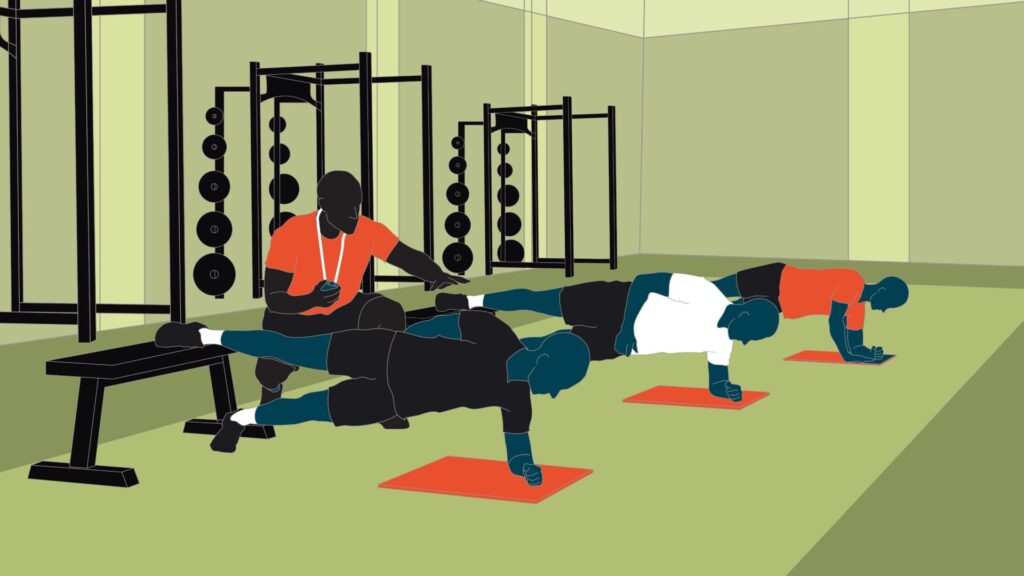
We first prime the posterior chain through exercises such as hamstring bridge isometric holds, progressing from no external load to adding some additional load and then performing some dynamic switches. We also aim to develop correct technical postures and reinforce correct thigh angular positions and velocity through A frame isometric holds and dynamic switches.
Exercises such as plate switches cue the players to create pre-tension through ankle dorsiflexion and rapidly generate force into the floor while holding a strong postural position. Banded pogos and exercises that increase stiffness, and banded acceleration steps or banded broad jumps, can develop the propulsive horizontal forces.
We have also probably all been there when a player arrives on the pitch feeling “stiff” and “leggy” despite being “pre-activated.” We then spend 15-20 minutes taking them through what we would typically describe as a traditional warm up.
To avoid this, we finish by incorporating some resisted acceleration sprints, typically 5m efforts at a variety of loads depending on the individual player needs. Finally, the players do unresisted acceleration sprints that carry over to the pitch session.
By getting a player working at higher intensities via specific actions during our PTP sessions, we eliminated time wasted on the pitch. The players can then begin technical practices more quickly, completing drills that aim to develop high intensity, high quality, position specific movements and actions.
Individual prep
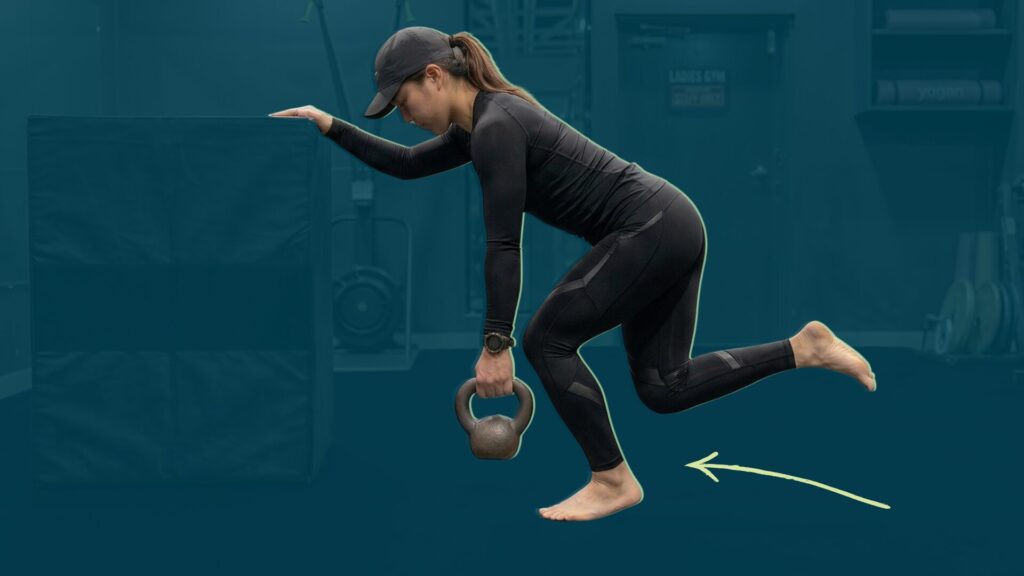
The last section is exercises and protocols programmed for individual players based on their individual needs. It is largely linked to a player’s previous or current injuries, but may also stem from our profiling and screening measures. For example, a player may have successfully rehabbed a tendon problem and are back into full training, but still have a loading protocol before any training or match session.
Depending on where the player is within their own chronic loading scheme, we can also target specific area of their force velocity curve. Although this typically would be part of the post-session strength and power sessions rather than pre-training, those opportunities may be rare and so we need to microdose specific exercises anywhere we can.
Tweet ThisAligning physical and technical training is crucial. Tuesday’s intensive MD-4 session boosts acceleration and deceleration. Wednesday’s MD-3 focuses on max sprint speed and load. Tailoring training for peak performance
@MWillmott90
Pre-training preparation = Pre-training data collection
If we can also program exercises that give rise to objective data, then we can track performance longitudinally. That lets us assess each athlete’s progress in a particular physical quality, and screen for potential red flags indicating increased fatigue and injury risk.
Our pre-training monitoring assessed the countermovement jump on MD+2, RSI via a drop jump or 10-5 pogos on MD-4, and single leg isometric push on MD-3.
Objectively monitoring performance during PTP sessions allowed us to gather relevant data even during periods of high match exposures where we could not complete the usual post-training strength and power training and testing protocols. That allowed us to track physical performance and individually adapt the training plans, using the objective data to adjust the intensity and intent of each exercise. Through velocity based training or force platforms that output a simple and easy to understand measure of performance (jump height or force per kg), we created competition, drove intensity and increased velocity of movement.
Pre-training preparation is just the beginning
The strategies we put in place are primarily aimed at developing the physical capabilities of our players to cope and perform under the demands of the style of play. The best ability, however, is availability. We must provide stimuli that develop robustness and allow the players to consistently perform. There are many factors that practitioners must consider when developing these processes and deciding whether to progress or regress an exercise: match minutes, chronic training load, management of current or previous injury, to name a few.
Each player must also be accountable for their own development and preparation. Practitioners must strive for a culture where each player is educated and understands the reasoning behind each aspect of the session, including why and when they must complete certain exercises, and the individual differences in load and volume.
Creating this environment takes time and a collective and unified effort from all performance related staff. The “cultural architects” must have the time to drive the delivery of the sessions, and the backing of senior leadership amongst the performance and technical staffs. The best programmes are those that complete the most effective and efficient work in a culture that enjoys and, therefore, works hard in support of this process.
Tweet ThisPre-training prep equals data collection. By programming exercises that generate objective data, we track athlete progress and spot fatigue or injury risks. Monitoring ensures each player gets what they need
@MWillmott90