
After seven years in professional rugby union, I left and found that speed development was still this mythical beast which “takes too long to develop,” “is too dangerous to train” and “can’t be coached.”
Scarily, those quotes come from the world of elite, professional rugby. Hence this article.
Creating maximum forces in minimal times
Building on the excellent research of Ken Clark, Peter Weyand, Ryu Nagahara, JB Morin, and Jurdan Mendiguchia, among others, we can begin to break down different components of the running cycle into more detail. This has helped form the lens through which I see running (Figure 2).
Running is the interaction between the athletes’ ability to generate unique and massive forces down into the ground, resist them, recycle them, and prepare rapidly to do it all over again. And do it all in the necessary postural requirements that permit it to happen efficiently and repeatedly.
In short, it’s about creating time to create force.
Understanding that running fast(er) requires the application of big forces in short timeframes in the right direction helps us narrow down the technical requirements to do so.
Ken Clark and Peter Weyand [1] showed that running fast is synonymous with large spikes in ground reaction forces (Figure 1). Elite sprinters show an ability to impart a greater amount of force earlier in ground contact, demonstrated by a steeper initial peak of greater magnitude compared to their less proficient counterparts.

The force/time relationship in Figure 1 for elite sprinters showcases an early spike (green circle), compared to the bell-shaped curve of sub-elite sprinters or athlete non-sprinters. This early spike in ground reaction force is a key contributing factor to the increased velocities attained by elite sprinters.
The application of the necessary force earlier in the ground contact permits elite sprinters to minimise their ground contact time and recover their thigh into early flexion (Figure 1) sooner than if they had a more gradual increase in ground reaction force during the initial contact.
Figure 2 is a map to identify how an athlete may achieve this, and where they may have technical gaps that we can identify and address.

Coaches should not rank these factors. Rather, treat them as a mental checklist when assessing an athlete who is sprinting. Similarly, these components do not function in isolation. They coexist and have knock-on effects on each other. They are all interlinked, and the best coaches do a great job of appreciating this and identifying the root cause of any issues they attempt to change.
The same goes at the anatomical level. The limbs do not act in isolation. They interact with one another and transfer energy and torque across the pelvis. Posture plays a critical part, which is why I will refer to it consistently when discussing each component while still giving posture its own section.
Putting that into practice requires, like so much else, repetition. Coaching is a skill, and it takes a lot of frequency to master it. Get some footage of one of your athletes sprinting, and assess him or her next to this blueprint. That will give you some context and guidance to understand what makes him good or not so good.
Tweet ThisCoaching is a skill, and it takes a lot of frequency to master it. Get some footage of one of your athletes sprinting, and assess him or her next to this blueprint
@SpeedworksBath
Since there is no true starting point, let’s begin with thigh angular velocity (TAV).
Thigh angular velocity
Thigh angular velocity (TAV) is the velocity at which the thigh travels throughout the gait cycle. We can distinguish sub-segments during early and late flexion / extension.
Increases in TAV elicit increases in the velocity of the foot prior to ground contact. That sets the stage for larger and earlier spikes in force, which we have already seen correlate with higher velocity.
The majority of current literature on TAV applies to upright running, but the same principles apply to analyzing acceleration.
Before I go into any detail on the following profile, we should remember that kinetics and kinematics are objective snapshots of what we see during the run as a whole. They do not tell us the intricate and fascinating story of the “how.” What we see with our eyes is the king of coaching. The data is merely there to back us up, or direct us through the mist if we get lost!
Video 1.
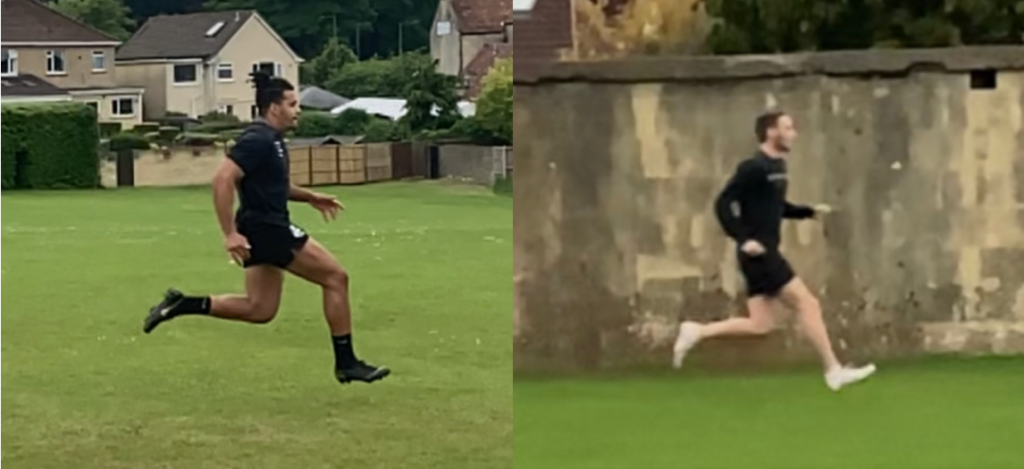
The video shows a Premiership rugby player who demonstrated a clear improvement in TAV during the “good” run, which we see in the shortened duration of thigh motion and a subsequent increase in velocity.
On closer inspection, we can see that this increase in TAV occurs during the extension phase (red) only. This was as a result of asking the athlete to “attack early” and “get back to the floor to strike,” as we had identified that he was slightly passive in his exchange from late flexion to early extension. This came from noticing the prolonged segments during extension in the “bad” example. This passivity resulted in a longer ground contact time and a restricted range of motion at the hip. His strategy lacked frequency, and he was unable “to throw a bigger punch” with the shortened wind-up!
During this coaching session, range of motion was not a primary focal point. However, we can see a clear increase in ROM and TAV during the improved rep.
Tweet ThisWe should remember that kinetics and kinematics are objective snapshots of what we see during running. They do not tell us the intricate and fascinating story of the “how.” What we see with our eyes is the king of coaching.
@speedworksbath
The athlete’s intent to generate more TAV may have allowed him to increase the ROM through the pelvis and between the thighs. Additionally, the increased limb velocity during extension influences the ROM generated at the flexing limb’s hip towards thigh block, i.e., the final point of late flexion. This is due to reciprocal energy of the contralateral swing leg, and revealed itself when the athlete commented “the more I attack, the more I feel like I can launch forwards.”
“Whip from the hip”: unlocking thigh angular velocity and footspeed
Thigh angular velocity correlates strongly with foot speed (Figure 3), which you would expect given the foot is attached to the leg!

“Whip from the hip” is a digestible term to describe the mechanism and intent behind TAV and tangential foot speed, initiated at the hip. This proximal initiation of force transmission to the distal areas of the body can also be known as sequential acceleration, or simply as efficient movement, whereby energy transfer costs less.
When reviewing footage of upright sprinting, we first need to determine if the athlete has created the conditions necessary to effectively whip from the hip.
The first step is examining the height of thigh block. If the athlete blocks the thigh low, they have neither the time nor space to generate the highest possible TAV during early extension. If the athlete has blocked their thigh in a way that creates sufficient space to attack the ground from above, do they display an ability to differentiate thigh and shank (Figure 4)? Or, do they retain a large degree of knee flexion and are therefore reluctant to recruit their hamstrings eccentrically?
More often than not, retaining greater knee flexion comes from an inhibition or a lack of agonist-antagonist coordination of the knee flexors / extensors. This limits the hamstrings’ ability to conduct their key role of doing negative work during the transition between late flexion and early extension, which appears paramount for creating the pretension necessary to spike ground reaction force (Figure 4).
Interestingly, I have seen a strong relationship between this phenomenon and athletes who have been subjected to what I call “max-strength overdosing,” an all too familiar problem within modern day S&C.
Why might this be? One possibility is that heavy strength training induces antagonist coactivation, or the activation of opposing muscles [3]. That doesn’t mean athletes shouldn’t maximally strength train. They should, but it should be balanced with higher velocity work and technical speed training that helps them coordinate muscle activity appropriately to express force and minimise risk during running.
Pre-tension
If all goes to plan and the athlete has demonstrated an ability to whip from the hip, how do we know they have the best chance to transfer those forces in a way that will spike their ground reaction force? For this I’ll look at the pre-tension strategy: an increase in muscle activation in preparation for ground contact.
The easiest way to think about it is the classic boxing analogy. A heavyweight is ready to throw the big punch, but even if he does everything right, if the forearm and wrist are not engaged, the force he generates through the hip and down the arm will leak, and all that effort will go to waste. Same for sprinting!
Is the athlete pre-tensed and anticipating the floor, or are they soft and passive so the imminent collision with the floor dominates them? A key area to look at is active dorsiflexion. A soft or limp foot searching for the ground will not be conducive to spiking ground reaction force.
The video below shows a professional rugby union athlete who took his maximum velocity from 8.9 m/s to 9.6 m/s during a six-week off-season period. Previously, he had an issue creating pretension around both feet and ankles, although it was more pronounced on the left side. The lack of pretension led to him absorbing force and decelerating upon landing, necessitating an excessive push through the ankle from late extension to early flexion. That subsequently impacted his ability to generate good thigh ROM (referred to as thigh amplitude) and higher TAV.
Notably, this athlete has a substantial history of hamstring strains. The strategy he had adopted was certainly linked to inhibition around striking the floor aggressively with high foot speed, and the consequences that has on the eccentric demands on his hamstrings. He protected his hamstrings by landing softly and “pushing” himself forwards with his quads and calf muscles. Not ideal!
With this in mind, and using external cues and video feedback, we made some pretty significant changes in six weeks.
A lot of the language we used addressed his “dipping the toe in the bath water” strategy at touchdown. Instead, I asked him to “smash his foot down under the bathwater and pull it back out as fast as possible with as much water as possible.” Other cues revolved around “balancing a football on his laces” and “showing me his studs” when running toward me. I combined those with progressive exposure to dribble mechanics to influence his confidence in increasing TAV and “whipping from the hip;” plus video review and comparison with other elite performers to provide more context and create positive changes.
Video 2.
Stiffness
Once the athlete has displayed good thigh angular velocity and pre-tension strategies, it is imperative that they display adequate levels of stiffness upon ground contact.
Stiffness is “the extent to which an object resists deformation in response to an applied force.” In a sprinting context, it’s the ability to resist deformation, yielding or collapsing on touchdown and throughout ground contact. Of course, some deformation is necessary to elicit desirable spring-mass qualities. But by watching footage and reviewing data trends it becomes quite apparent when someone is unable to withstand the forces realised during stance. This is particularly evident when someone adopts a new strategy, one that induces a steep onset of vertical force.
Here it is crucial to discuss the importance of the foot / ankle and calf complex alongside the eccentric qualities of the knee and hip. Too much of the S&C industry focuses on (concentric) force production, with athletes squat number prowess often considered at the top of the tree. However, this comes with pitfalls, especially if we are also encouraging them to “whip from the hip” and strike the floor with ever increasing force. Negating or disrespecting the eccentric and elastic qualities necessary at the ankle, knee and hip necessary to tolerate this increased force will only lead to problems further down the line. You can’t drive a sports car on flat tyres.
Tweet ThisToo much of the S&C industry focuses on (concentric) force production, with athletes squat number prowess often considered at the top of the tree
@SpeedworksBath
I’ll look for deformation all the way up the chain, from foot to neck. It’s not the level of flexion, but the degree of change to the existing level of flexion as the athlete passes through to midstance. This truly gives an idea of an athletes’ stiffness, or ability to tolerate their generated ground forces. If I see large amounts of deformation, I am immediately thinking about how I can cue them to resist it, as well as how I can chronically influence this with physical training around eccentric and isometric qualities in running-specific joint angles and contraction types.
Due to the negative effect excessive deformation can have on the athlete’s ability to use the elastic qualities of musculotendinous structures in the lower limb, ground contact time represents a key performance indicator of stiffness.
Understading slack within the system
Video 3.
This video provides a clear example of system stiffness in the same athlete during upright running. Note the influence that increased stiffness has on stride length, air time and contact time in the bottom video. The athlete described the bottom rep as “aggressive and floaty” versus “soft and low” in the top rep. This is a great example of an athlete translating the relationship between TAV, pre-tension, ground reaction force, stiffness and air time into their own language.
We can see a lack of stiffness during acceleration though the same portions of stance as in upright sprinting. During initial acceleration, the shin angle should remain relatively consistent from touchdown to toe off. The degree of change between these two points is known as shin roll (see Video 4). Further evidence for lack of stiffness comes when the shin rolls forward excessively throughout stance, and contact times elongate to generate and orientate the necessary force for forward propulsion.
Should contact distance (distance between touchdown and toe off) remain within an acceptable bandwidth, a lack of stiffness will more often than not result in difficulty raising the centre of mass smoothly throughout the run, thus limiting velocity (Video 4 and Figure 5).
Video 4.
Ground reaction forces: spike hard or go home
Next is understanding and visually identifying the influence on ground reaction force of improvements in all of or some of the previous components: thigh angular velocity, negative foot speed, pre tension and stiffness. Below is an example of another professional rugby union player who showcases an alteration in kinematics that could elicit a desirable GRF spike. Please note that this is hypothetical, as providing it would require a strip of force plates, which sadly I do not have!
Video 5.
When we consider the top video, the combination of increased horizontal orientation, decreased touchdown distance and a sizeable increase in stiffness at the knee and ankle suggest that this individual has both spiked their ground force more appropriately and orientated it in a way that permits them to impart more horizontal force compared to that of the top image. This relative contribution of horizontal force is known as ratio of force (RF), which J-B Morin proposed to be a primary contributing factor to acceleration performance. As a result, the athlete is able to recover the stance leg quicker, giving himself more preparation time to impart more force into the floor earlier in stance versus later.
The GRF-time curves alongside the videos suggest hypothetical but likely relationships. When we are looking at GRF, we are actually considering impulse, the amount of force expressed within a given time frame. The impulse required to initiate or continue forward propulsion at a given angle is determined by many factors, such as body weight and force production capability. If force is not spiked early in the ground contact, then the athlete will have to generate it later in stance, often by utilising an excessive amount of knee and ankle extension that incurs excessive vertical displacement.
To contextualise this to athletes, I tend to talk about “pushing harder and earlier” to “earn the right” to prepare sooner.
So, does what we see with our eyes match up with the kinetic and kinematic data?
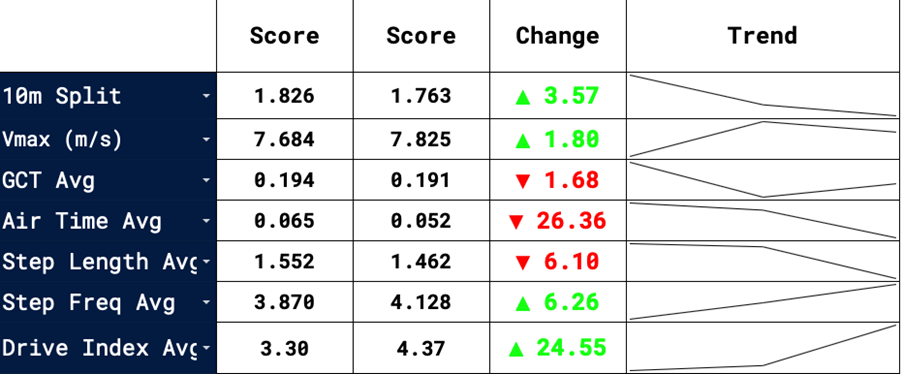
The time to cover 10 meters decreased. Second, the velocity at the end of the run increased, indicating enhanced efficiency.
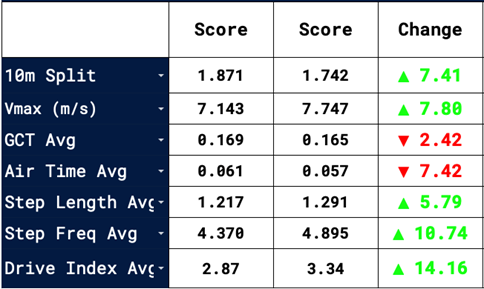
The data suggests that the technical changes (decreased touchdown distances and more horizontal orientation) have allowed him to attack the floor harder, spike his forces and subsequently spend less time on the ground, as shown by a 2% reduction in ground contact time. This reduction in contact time has allowed an increased stride frequency (10%), which facilitates the ability to gradually raise the COM with each step from a more horizontal angle. The 14% increase in drive index (ground time relative to air time) suggests improvements in RF, a key determinant in improving acceleration performance.
A crucial consideration with team sport athletes is that there is more to sprint performance than just velocity over 10 meters. Consider a rugby player achieving their personal best over 10m. They have demonstrated the requirements to accelerate through a gap, but do they have the necessary posture required to influence continued acceleration or make game-breaking decisions? More often than not, these athletes must respond to their environment to influence the game. Maintaining a sense of balance and efficiency is key when we are determining success within our training. How they manage their COM throughout a run can often be as important, if not more so, than their velocity alone.
Centre of mass displacement
The next element to consider is centre of mass displacement. During acceleration, this is how far an athlete can travel horizontally, within a bandwidth that allows lower limb rearrangement and a smooth climb in height. It’s all about balance. Can the athlete launch themselves forward and still have time to rearrange their limbs and attack the floor with an adequate level of pre-tension and stiffness that will permit the early stance recovery needed to do it again? There is no point throwing yourself forward to such a degree that you fall over (known as over-rotation)!
How do we determine COM displacement?
“Although not accurate to the exact placement of the COM, measuring the centre of the hip and how this relates to performance is a good proxy” (Dodoo, 2021). How far the hip travels through each stride is a sufficient indicator of the displacement of the COM during any phase of the run.
During both acceleration and upright running, I will look at both the amount of horizontal displacement and any noticeable changes in oscillation between right and left. While not strictly COM displacement alone, their influence combined with hip height (the height of the hip from the floor) will give me a good indication of whether the athlete has chosen a strategy that is both efficient and sustainable. Differences between limbs may also give me information about the symmetry, coordination and force-producing qualities an athlete possesses, all of which may influence future training modalities.
Video 6.
In the above example, we can see two different strategies and COM displacement from a professional footballer. It is immediately apparent that the distance he covers in each stride is greater in the top example.
If we draw our attention to the initial step, we see that the top example displays more horizontal displacement. In the bottom example, we see the red line initially travelling vertically, indicating that the athlete’s COM has displaced relatively more vertically. This has not only resulted in a decreased distance covered, but has negatively influenced distance covered for the remainder of the run.
In the top example, we see that the athlete can maintain a better displacement and smoother climb, as indicated by the gradual rising of the blue dots. This is due to a contribution of factors that I described above, but is perhaps most influenced by the clear intention to launch forwards using a proximal-to-distal, hip-dominant strategy.
If we look at the frequency value (Hz) in the bottom of the box, we can see that this strategy resulted in a decreased frequency. This does not mean he is doing anything bad or good. It simply reflects a trade-off between stride length and frequency.
Any athlete learning to displace himself further forward with associated increases in range of motion will almost certainly show initial decreases in frequency. It is our job as practitioners to gradually build towards a strategy that increases COM displacement while bringing stride frequency back up. This “whack-a-mole” strategy, where we whack the biggest mole before dealing with the smaller moles that no doubt rear their heads as a result, is synonymous with speed coaching. It’s a task that I enjoy immensely!
Range of motion: maximal is not the optimal
The amplitude of range of motion the athlete can generate relates to COM displacement. I want to see large ranges of motion, but only under the constraint that the athlete can still generate high levels of thigh angular velocity.
Although we are looking for large ROM, maximum range of motion is not optimal range of motion. There is no point in having huge ROM if you are slow to switch. That will harm your TAV and, most likely, result in a lack of foot speed, impact force and overall velocity.
Tweet ThisAlthough we are looking for large ROM, maximum range of motion is not optimal range of motion
@Speedworksbath
This connects to posture and optimal length-tension relationships around the pelvis. Does the athlete have the required co-coordination, strength and rate of force development to be able to switch limbs through a larger ROM?
Once again, Ken Clark’s work around thigh oscillatory frequency and amplitude (Figure 7) gives us a good reference point. He reported that faster sprinters had greater amplitudes (greater ROM); and that the ROM manifested itself in front of the COM (positive distribution), as indicated by the limbs’ increased degree of flexion (see secondary axis in Figure 7). This is often referred to as “frontside” running, and is another key marker when assessing an athletes’ technique.
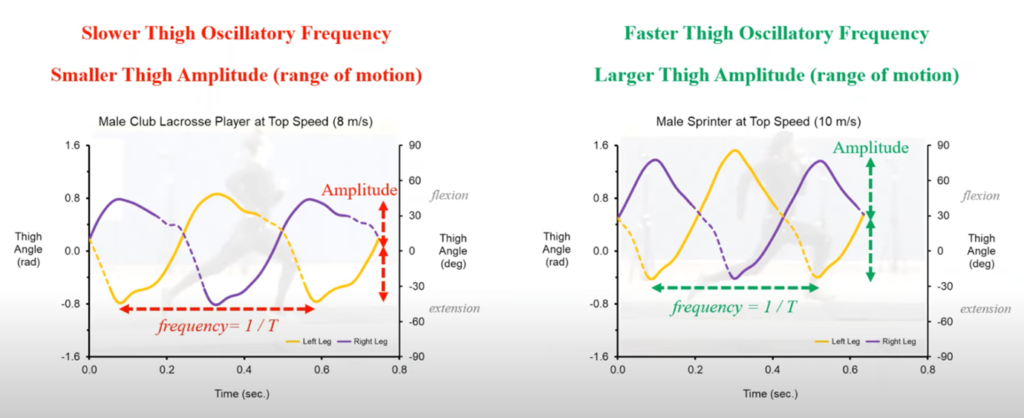
The video below highlights this point. In the top video, we can see a more “frontside” strategy: the ROM of the thighs operates more in positively distributed angles, as displayed by the blue shape.
The increased flexion or range at thigh block permits the athlete to generate higher TAV and subsequent stride frequency, resulting in a higher velocity.
Where an athlete completes this ROM is dependent on many qualities, including flexibility / mobility, force-producing qualities of the anterior and posterior chain and how they interlink with an athlete’s postural stability. Therefore, it is not simply a case of demanding and coaching every athlete to remain as frontside as possible. Fast and efficient running is a combination of both backside and frontside running, and an optimal ratio of both combined with increased amplitude is desirable. When I consider the vast majority of athletes I coach, most need to distribute their ROM to a more frontside approach. Consequently, two of my key technical markers to observe are the amplitude and distribution of ROM.
Video 7.
None of these components operates in isolation. I look for increased ROM operating more towards the frontside of the body because it is directly related to the athlete’s ability to create time to create force, resulting in higher velocities.
Switching and scissoring
Once the athlete’s foot leaves the floor following the end of ground contact and he can no longer apply force, the question is how quickly can he reverse the limbs’ momentum from the outer ranges they have reached? This applies to transitioning from both extension to flexion and flexion to extension. The ability to switch effectively will have a large effect on thigh angular velocity and stride frequency. As long as this is combined with adequate pre-tension and stiffness, it will have a large impact on velocity.
Common issues that influence switching are a lack of coordination; lack of ability to turn the right muscles on or off at the right time; and needing to push off the ground longer because they did not spike the ground reaction force high enough.
”Over-pushing” means that the thigh continues to travel away from the centre of mass longer than necessary, resulting in a less advantageous length-tension relationship and slower switch. This has a knock-on effect at thigh block, causing a lower angle of thigh flexion, which minimises the athlete’s ability to create a more “frontside” strategy and robs them of time and space to create force. A recent study by Kakehata et al (2021) [4] investigated the influence of switching on stride frequency and velocity. They found that an athlete’s ability to reverse the motion of flexion to extension correlated with the ability to turn off the rectus femoris and turn on the bicep femoris in individuals with greater frequency. Those who did not have good stride frequency showed co-contractions, that is, the concurrent activity of both the agonist and antagonist. That pattern slowed thigh reversal and negatively influenced velocity.
Video 8.
In this example, the athlete – an international rugby player – has absolutely no fear of throwing herself forward and using a large range of motion at the hip. However, this results in an over-rotation and gives a feeling similar to that of falling forwards.
This over-rotation is linked to the visibly large touchdown distance, which provides a breaking component synonymous with reductions in horizontal reorientation of ground reaction force. Thus, she has to re-angle the shin (shin roll) in order to continue distributing force horizontally.
Her strategy and physical qualities may amount to a fast 5-meter time. Indeed she is ranked first in the squad. However, the real question is whether this is a good strategy to facilitate a smooth and continuous climb in velocity, in order to achieve the highest maximum velocity. And, perhaps more importantly to a team sport athlete, does it result in postures suitable for decision-making options? The answer is probably not.
If we take a look at a profile generated using thigh angular velocity (Figure 8), we clearly see that this athlete has some deficiencies during early flexion and extension. She is clearly well-versed in launching herself forwards, but not necessarily good at re-organising, switching and attacking the ground to do it again. This athlete would benefit from “attacking earlier” to “earn the right to prepare sooner.”

Posture: the great unifier
Anyone who follows me on Instagram knows that I am obsessed with posture.
What do I mean by posture for sprinting? It is the positioning and action of the pelvis, spine and diaphragm to optimally transfer energy across the pelvis and into the ground.
If we think about muscle dynamics and the length-tension relationships, there are specific lengths at which muscles function optimally in terms of force and velocity. Maximal range is never optimal range. My objective with posture is to help the athlete feel the maintenance of good posture while running, so that the big force producers around the hips can function forcefully and safely, in a way that encourages a proximal-to-distal patterning of force production.
Video 9.
A recent study by Mendiguchia et al. [2] looked to identify whether a multi-factorial approach of therapy, strength & conditioning and technical sprint training could influence anterior pelvic tilt, a postural position associated with increased hamstring injury risk (Figure 13). They reported that, over a six-week period, reductions in anterior tilt occurred alongside changes in various performance markers including toe-off distance, thigh amplitude and touchdown distance. These three markers are key determinants of sprint success, as shown by the experimental group’s improvements in sprint speed. Maybe more importantly, these improvements help minimise the risk of hamstring strain while running.
Mendiguchia’s study hammers home the point of postural control being vital during sprinting. Multiplanar pelvic control not only allows optimum function of the major force producers – the hip flexors and extensors – but also assists transfer of force between contralateral swing leg and ipsilateral stance leg via increases in lumbosacral torsional torque [5].

Issues surrounding posture and COM displacement often converge to form characteristic toe-off positions pictured in Figure 9. We see a relationship between postural control strategies biased towards posterior or anterior trunk position, resulting in excessive length of hip flexors / extensors and unnecessary air time; or a lack of space to create necessary forces in hip flexion / extension, respectively.
As ever, fixes require a holistic, varied approach to discovering the language, stimulus or physical qualities the athlete needs to feel their way to the desired change.
Navigating the sprinters’ blueprint
This blueprint should remain exactly that: a blueprint. Each component influences the other or others to some degree, and none lie in isolation.
To understand everything we just went through, go watch hundreds of reps to begin to see exactly how certain strategies influence the points I’ve raised here. Repetition is the necessary ingredient to having a good coach’s eye .
Then ask yourself: How do I know if what I’m doing is making positive change?
The answer: Record, analyse and time your athletes. If their velocity is going up, and technically they are adhering to what I’ve laid out above, then you can rest easy. You’re doing a better job than most, especially given that speed development “takes too long to develop,” “is too dangerous to train” and “can’t be coached!”