
The increasing physical demands of contemporary elite football requires a high level of aerobic fitness and general physical preparedness to allow the players to perform across the highly congested season. Keeping the whole squad fit and available is of paramount importance to the physical preparation department. The team is only set up for success when the head coach and his staff have the best available options when selecting the match day squad.
However, the entire squad of available players cannot get sufficient game time, even with multiple games a week. Some players are regular substitutes, week in and week out.
This is obviously a problem, as these players will begin to detrain as a result of the reduced volume of work that they receive compared to the regular starters. Clever programming from the physical preparation and coaching staff becomes essential to improve this group’s loading patterns.
“Top ups” are important in these situations. They provide a window of opportunity to overload the substitute players with key physical targets that will help them stay as fit as possible, ideally on par with the starting group.
Each team has their own structure and process that suits their context and environment. The typical plan is to use MD+1 as a highly demanding training session to overload the non-playing group. These sessions typically are intensive and overload the players’ cardiovascular system through pass and move patterns, small sided games and some form of repeated sprints. This process, then, allows all players to rest and recover on MD+2. By MD+3 / MD-4, all players are available to train to suit the requirements of the coaching staff.
Tweet ThisIn elite football, ‘top up’ runs post-game are crucial to maintain squad fitness. Tailoring these sessions based on individual player needs ensures consistent performance across a congested season
@tomnoon89
What is the main focus of the post-game top up?
Non-starters generally display lower total weekly load than starters. This holds true for most variables with the exception of explosive actions, mainly accelerations and decelerations. This is probably because the MD+1 top up session is generally more intensive, allowing this group of players to catch up on these metrics.
The problem typically lies with volume metrics, mainly total distance and higher intensity running velocities such as high speed and sprint distances.
High intensity interval training can elicit very positive aerobic adaptations despite a comparatively low training volume and time. HIIT is also a great tool to help compensate for high speed running load or mechanical work that players miss due to the lack of match time. That’s a strong rationale to use HIIT as a form of targeted running that provides a high cardiovascular load in a short amount of time, ultimately delivering a potent aerobic conditioning stimulus.
The physical preparation staff has to design the session so the players can accumulate high intensity running volume similar to what each player would receive in a typical full length game. We need to prepare all the players for the high intensity running demands of match play, which entails adequate weekly exposure and a stable high speed loading pattern.
Tweet ThisOur top up sessions are simple enough that we can do them home or away, which is part of building consistency and expectations for the players
@tomnoon89
Designing the individual top up
To design the top up and add the layer of detail required, we identified the typical high intensity running demands by taking the average outputs of 10 games. We classify high intensity running as all distances above the individual’s maximum aerobic speed (MAS).
To assess MAS, we use a 1 kilometer time trial, which is time and resource efficient. The time trial doubles as a monitoring tool and an up to date fitness assessment, letting us adjust the current training program accordingly.
Athletes perform the time trail in shuttle format using basic pitch dimensions. This allows us to assess the whole squad very easily within a short amount of time. This format is also easily reproducible. To account for any changes in the individual’s physiological profile and allow us to update our information on each player, we assess MAS monthly, usually on our extensive training day or MD-3.

We can easily update each player’s relative GPS bands using the information from this assessment, as well as their maximum sprint speed. That allows us to accurately program post-match running – the top ups.
All speeds above MAS – that is, velocity bands 4, 5 and 6 – are classified as high intensity running. More specifically, band 4 is high speed, band 5 is very high speed and band 6 is sprint distance.
Velocity band 4 is the individual’s MAS plus 30% of the anaerobic speed reserve (ASR). Band 5 is MAS plus 30-60% of the ASR. Velocity band 6, then, is everything above MAS plus 60% of the ASR.
These GPS thresholds are based on practical experience, discussions with other coaches and also research on using ASR to prescribe individualized high intensity running. ASR helps reduce the performance variability between and within athletes that would occur if we used absolute values. This, more individualized, approach ensures that we provide each player with similar physiological demands across the season to facilitate appropriate adaptations.
Simple, consistent top ups for performance and buy-in
For simplicity, all players do the same session, but we design each run so every player can accumulate the desired amount of volume within each velocity threshold to “fill in” their individual profile. Software that provides live updates from GPS data lets us track volume and intensity in real time. That way we verify each player’s intensity levels and have the ability to adjust reps as required.
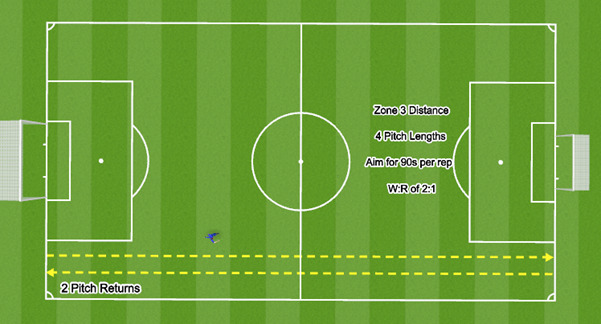
Our top up sessions are simple enough that we can do them home or away, which is part of building consistency and expectations for the players. All players, on average, end up doing roughly 12-15 runs of varying velocities with an average session time of around 10-15 minutes. This accommodates the constraints during the post-match period, where generally you are limited to 15 minutes on the pitch with only straight line running allowed.
All players who play less than 45 minutes fall into the top up group. Live GPS data lets us tweak their individual running based on their specific outputs during the game.
For example, a player who played 45 minutes may have produced half of the typical positional high intensity running demands during the game. We’ll make sure his top up session provides an additional aerobic conditioning stimulus, in addition to hitting the volume targets. This way, we keep pushing their limits and induce steady improvements in fitness across the season.
| Position | Individual average distance in band 4 (MAS – MAS + 30% ASR) | Individual average distance in band 5 (MAS + 30-60% ASR) | Individual average distance in band 6 (MAS + 60-100% ASR) | Total high intensity running distance above MAS |
| Full back | 650m | 350m | 150m | 1150m |
| Central midfielder | 500m | 200m | 50m | 750m |
| Forward | 550m | 300m | 100m | 950m |
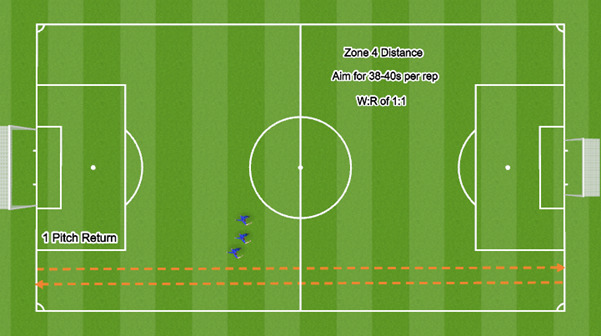
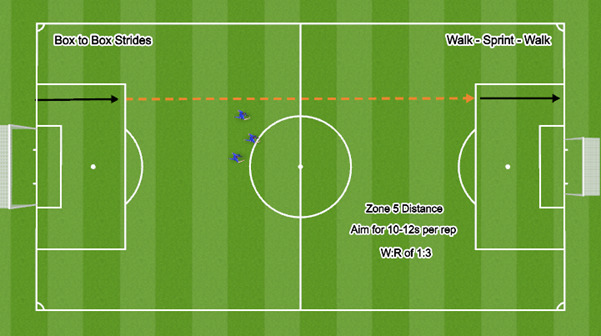
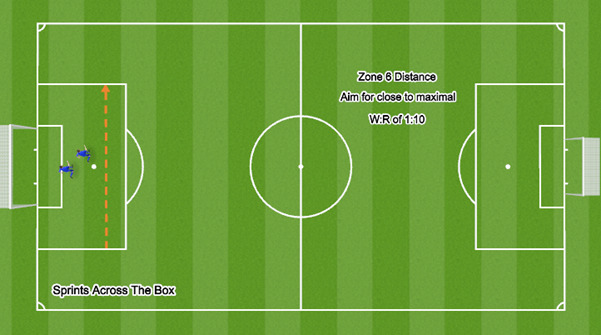
| Sets | Reps | Total distance | Zone 4 | Zone 5 | Zone 6 | Total high intensity distance | |
| Run 1 (Z4) | 1 | 4 | 840m | 600m | 0m | 0m | 1130m |
| Run 2 (Z5) | 1 | 6 | 630m | 80m | 300m | 30m | |
| Run 3 (Z6) | 1 | 3 | 160m | 10m | 20m | 90m |
| Player match output and required top ups | |||||||
| Zone 4 | Zone 5 | Zone 6 | Total high intensity running distance | ||||
| In-game volume | 480m | 300m | 80m | 860m | |||
| Required high intensity running top up | 150m | 50m | 70m | 270m | |||
| Top ups prescribed | |||||||
| Sets | Reps | Total distance | Zone 4 | Zone 5 | Zone 6 | Total high intensity distance | |
| Run 1 (Z4) | 1 | 1 | 210m | 150m | 0m | 0m | 1130m |
| Run 2 (Z5) | 1 | 1 | 105m | 10m | 300m | 30m | |
| Run 3 (Z6) | 1 | 2 | 100m | 5m | 20m | 90m | |
| Run 4 (Z3) | 1 | 3 | 1260m | Zone 3 distance | 1000m | ||
Top ups improve substitutes’ fitness across season
Table 4 shows our regular starters in white and the typical subs in grey. We assessed MAS roughly every four weeks. This approach across the season helped us keep the substitutes – as a group – at a similar fitness level as the starters, despite the significantly reduced game time and global distance and volume accrued. We see a steady improvement in physiological adaptation from matching the aerobic stimuli both groups receive
| Player | Pre-season | In-season | Pre-season best | In-season average | |||||||||
| MAS 1 | MAS 2 | MAS 3 | MAS 4 | MAS 5 | MAS 6 | MAS 7 | MAS 8 | MAS 9 | MAS 10 | MAS 11 | |||
| 1 | 4.8 | 5 | 4.9 | 5 | 5.1 | 5 | 4.9 | 5 | 4.9 | 5.1 | 5 | 5 | 5.00 |
| 2 | 4.7 | 4.9 | 4.8 | 4.9 | 4.9 | 4.8 | 4.9 | 5 | 4.9 | 4.8 | 4.9 | 4.9 | 4.90 |
| 3 | 4.7 | 4.8 | 4.7 | 4.7 | 4.8 | 4.9 | 4.8 | 4.9 | 4.8 | 4.9 | 4.9 | 4.8 | 4.90 |
| 4 | 4.6 | 4.7 | 4.7 | 4.8 | 4.8 | 4.9 | 4.8 | 5 | 4.9 | 5 | 4.9 | 4.7 | 4.90 |
| 5 | 4.7 | 4.9 | 4.8 | 4.7 | 4.8 | 4.9 | 4.9 | 5 | 4.9 | 4.8 | 4.9 | 4.9 | 4.90 |
| 6 | 4.6 | 4.7 | 4.7 | 4.8 | 4.8 | 4.7 | 4.9 | 4.9 | 4.9 | 4.8 | 4.8 | 4.7 | 4.81 |
| 7 | 5 | 5.2 | 5.1 | 5.1 | 5.1 | 5 | 5.2 | 4.9 | 5 | 5.1 | 5.1 | 5.2 | 5.10 |
| 8 | 4.7 | 4.9 | 4.8 | 4.9 | 4.8 | 4.8 | 4.7 | 4.9 | 4.9 | 4.8 | 4.9 | 4.9 | 4.83 |
| 9 | 4.8 | 4.9 | 4.9 | 4.7 | 4.7 | 4.9 | 4.8 | 4.9 | 5 | 5 | 4.9 | 4.9 | 4.90 |
| 10 | 5 | 5.2 | 5.1 | 5 | 4.9 | 5 | 5 | 5.1 | 5.1 | 4.9 | 5 | 5.2 | 5.01 |
| 11 | 5 | 5.3 | 5.2 | 5.1 | 5.2 | 5.1 | 5 | 5 | 5.1 | 5.1 | 5.1 | 5.3 | 5.10 |
| 12 | 4.7 | 4.7 | 4.8 | 4.7 | 4.6 | 4.8 | 4.8 | 4.9 | 4.9 | 4.8 | 4.9 | 4.7 | 4.80 |
| 13 | 4.6 | 4.8 | 4.8 | 4.8 | 4.8 | 4.7 | 4.9 | 4.9 | 5 | 4.9 | 5 | 4.8 | 4.90 |
| 14 | 4.6 | 4.8 | 4.7 | 4.8 | 4.8 | 4.7 | 4.8 | 4.9 | 4.8 | 4.8 | 4.8 | 4.8 | 4.80 |
| 15 | 4.9 | 5.2 | 5.1 | 5.2 | 5.2 | 5.1 | 5.2 | 5.1 | 5.1 | 5.2 | 5.1 | 5.2 | 5.14 |
| 16 | 4.6 | 4.9 | 4.9 | 4.8 | 4.8 | 4.9 | 4.9 | 5 | 4.9 | 4.9 | 4.9 | 4.9 | 4.90 |
| 17 | 4.9 | 5.2 | 5.1 | 5.1 | 5.1 | 5.2 | 5.1 | 5 | 5.1 | 5.2 | 5.2 | 5.2 | 5.12 |
| 18 | 5 | 5.2 | 5.2 | 5.1 | 5.2 | 5.2 | 5.1 | 5.1 | 5.2 | 5.2 | 5.2 | 5.2 | 5.17 |
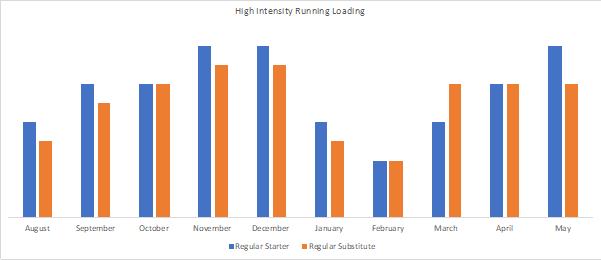
The consistent approach and the demonstrable results also helps with athlete buy in. They know what is expected of them, and so have developed a solid amount of accountability. The substitutes have noticed that this approach is keeping them at a good fitness level relative to the playing group, which increases motivation for these sessions.
Tweet ThisStrategically designed ‘top up’ sessions for substitutes are key in elite football, focusing on high intensity runs and sprints to match the physical demands faced by starting players
@tomnoon89