
The following Sportsmith Six article relates to two recent publications by Tyler Collings and Matthew Bourne et al:
- Reconsidering Exercise Selection with EMG: Poor Agreement between Ranking Hip Exercises with Gluteal EMG and Muscle Force
- Hip Adductor Muscle Forces During Strength Training and Rehabilitation Exercises
Your study highlighted that EMG-based exercise rankings do not always agree with muscle force rankings. What should practitioners understand about the limitations of relying on EMG alone when choosing exercises?
Electromyography (EMG) is often misinterpreted as a direct measure of how much force a muscle produces or how effectively an exercise targets a muscle.
EMG measures the electrical activity generated by active motor units beneath the recording electrode. When appropriately normalised, it provides an estimate of voluntary muscle activation. However, it does not quantify mechanical output, muscle force, or the magnitude of training stimulus.
For strength training and rehabilitation, the key variables are generally muscle force output, mechanical tension, or muscle stretch. These parameters are closely linked with hypertrophy, strength gain, and muscle-tendon strain that drives muscle adaptation. These mechanical variables are influenced by factors such as joint position, moment arms, and the force-length relationship.
EMG amplitude does not reflect any of these.
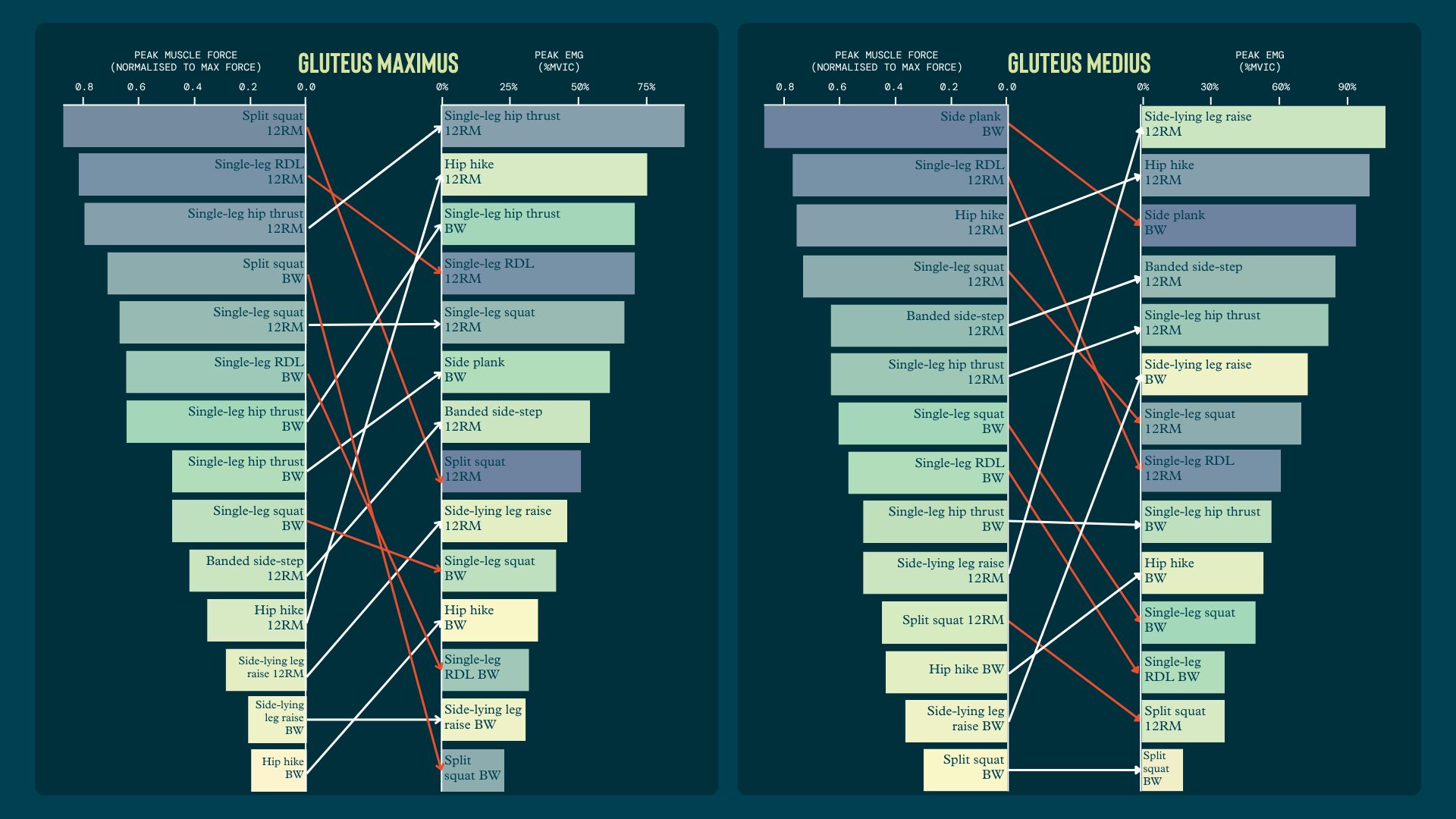
EMG-based exercise rankings can differ substantially from rankings based on muscle force derived from computational models (Figure 1; from Collings et al., [1]).
For example, a muscle can show high EMG activity at short muscle lengths but still produce relatively low force because of the force-length relationship. Conversely, at longer muscle lengths, EMG activity may be lower while total muscle force remains high because of passive tension from non-contractile tissues stretching.
Therefore, practitioners should be cautious about relying on EMG alone when selecting exercises.
EMG can be useful for understanding neural activation patterns. But, where possible, practitioners should interpret it alongside biomechanical modelling data to more accurately infer mechanical loading.
Tweet ThisWhen appropriately normalised, EMG provides an estimate of voluntary muscle activation. However, it does not quantify mechanical output, muscle force, or the magnitude of training stimulus.
@TylerCollings3 and MBourne5
Your results showed the Copenhagen short-lever consistently ranked just below the long-lever version. When would you recommend practitioners choose one over the other, and is the short lever under-appreciated as a stepping stone?
The long-lever Copenhagen requires relatively high levels of strength to perform and generates high adductor force with body weight only. It can also create large valgus forces at the knee, which may be uncomfortable for some athletes. Therefore, a regression may be useful for developing athletes or those undergoing rehabilitation.
The short-lever Copenhagen lowers the entry point while still providing a substantial adductor loading stimulus. Our findings indicate that it is not so much a low-loading exercise as a useful progression from early-stage adductor rehabilitation.
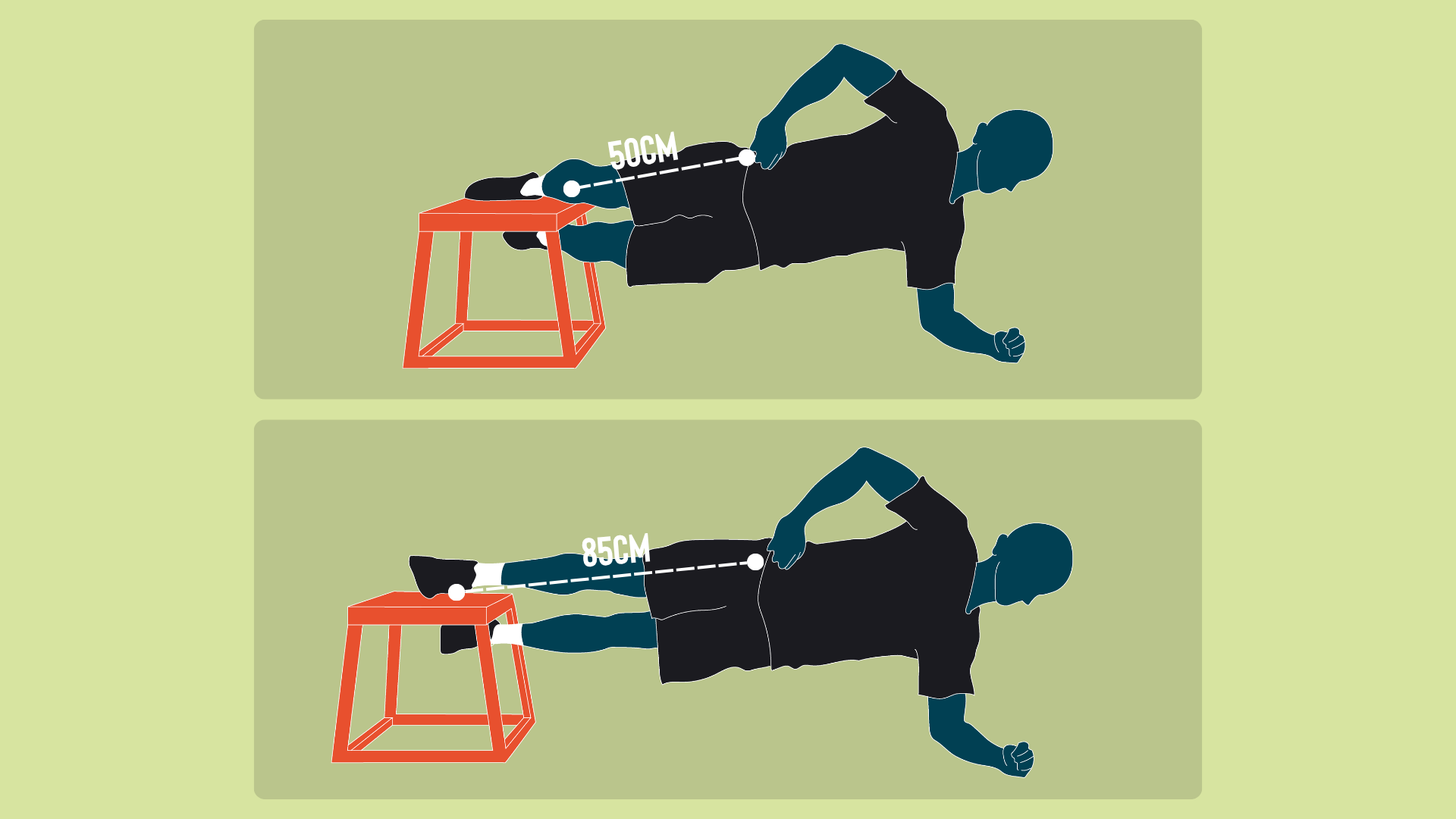
The distance from the hip joint to the point of support, termed the external lever arm, is the key parameter for adductor loading in the Copenhagen adductor exercise (Figure 2). Practitioners can progress the Copenhagen exercise by gradually increasing the support distance.
Taller athletes will have longer limbs and therefore require greater adductor forces. Practitioners can approximately impose the same adductor loading on two athletes of different heights by using a set distance between the hip joint and support point (e.g., 50 cm), rather than the same anatomical landmark (e.g., ankle malleolus).
Tweet ThisThe short-lever Copenhagen lowers the entry point while still providing a substantial adductor loading stimulus. Our findings indicate that it is not so much a low-loading exercise as a useful progression from early-stage adductor rehabilitation.
@TylerCollings3 and MBourne5
If you could only measure or monitor one thing to help a practitioner make better decisions about adductor loading in their athletes, what would it be and why?
Current measures, such as dynamometry, training volume, on-field running metrics, or self-reported symptoms, only provide indirect information about internal tissue loads. They are useful, but they do not tell us the actual load the adductor muscles experience during specific gym exercises, running, kicking, change of direction, or sport-specific tasks.
A more useful metric would be a tissue-level estimate of adductor force across training and competition. While such a measure is not yet routinely available in applied settings, recent progress in wearable sensors, computer vision, artificial intelligence, and musculoskeletal modelling are moving us closer to this capability.
In the meantime, practitioners might be able to use the information from this study to monitor exposure to high force adductor tasks each week. This could provide a proxy for cumulative adductor loading across a week, and may allow coaches and practitioners to make more informed decisions around progressing or regressing loads for performance or injury prevention.
Tweet ThisCurrent measures, such as dynamometry, training volume, on-field running metrics, or self-reported symptoms, only provide indirect information about internal tissue loads. They are useful, but they do not tell us the actual adductor load.
@TylerCollings3 and MBourne5
When building a return to play program for an athlete with adductor-related groin pain, how do you think about exercise progression from early rehabilitation through to full training? Do the tier rankings from your study give practitioners a ready-made framework?
Generally speaking, there are two main ways to progress adductor loading in rehabilitation: increase load / weight, and change exercise.
Increasing the external load is the more controlled option, with a high certainty of increasing muscle loading. By maintaining the same exercise, the movement remains consistent, and the only changing variable is the total force output required to move the heavier weight.
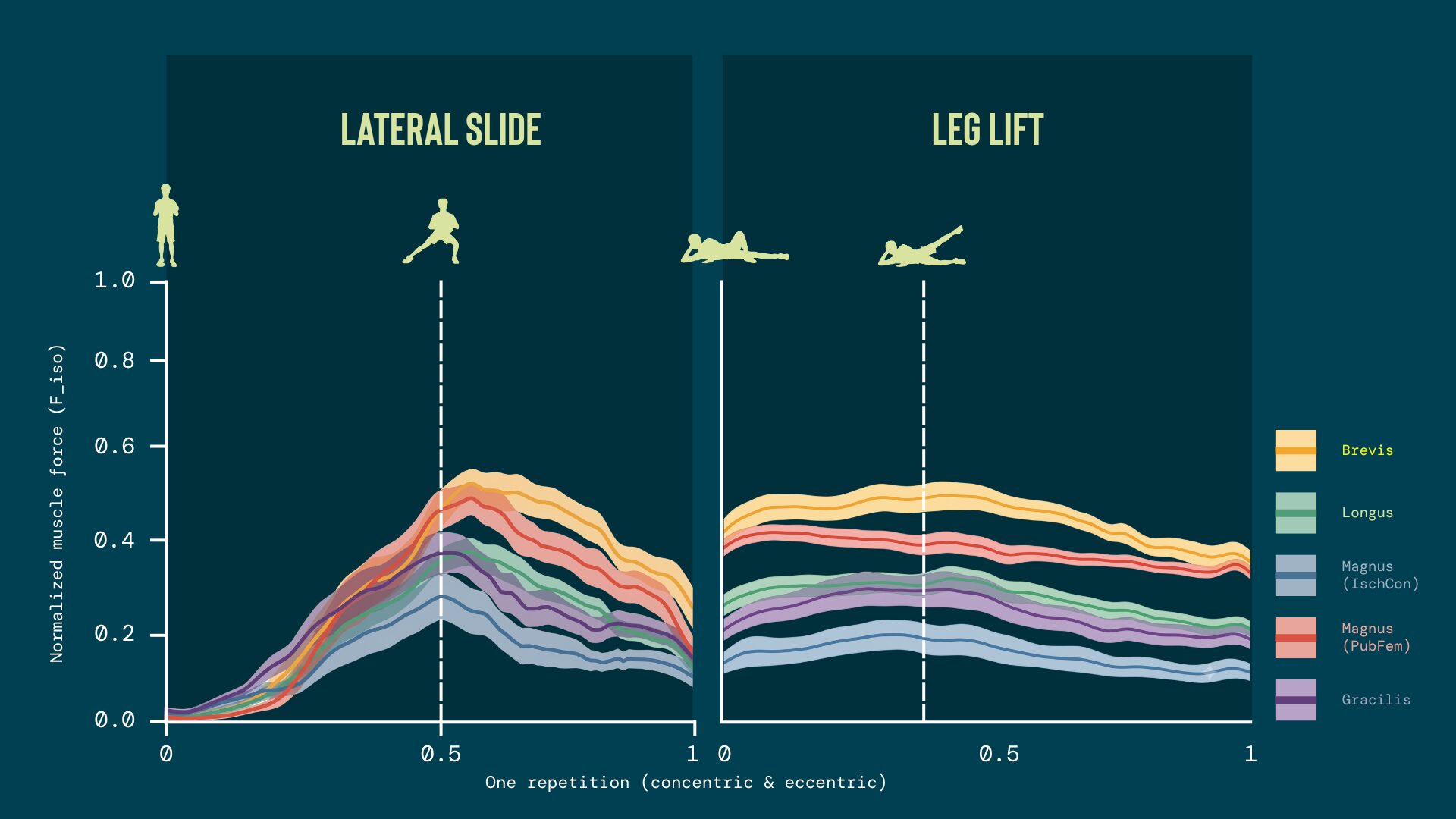
Changing exercise is more complex because it affects all biomechanical variables. For example, different exercises will have different body positions, joint angles, and force vectors. This results in different muscle lengths, muscle moment arms, neural drive, and muscle force / loading. Additionally, the weight the athlete lifts also changes in order to achieve a set number of reps at a relative intensity.
Changing exercises to progress loading is not straightforward: Is changing from a lying-leg lift with 5kg at the ankle to a lateral slider with 20kg at the chest a progression?
Our tier system gives practitioners a framework for understanding how different exercises compare at a similar relative intensity (approximately 8RM effort). It can help practitioners make more informed decisions when selecting exercises and deciding whether changing the exercise might progress adductor loading.
Tweet ThisChanging exercise in rehab is more complex because different exercises will have different body positions, joint angles, and force vectors. This results in different muscle lengths, muscle moment arms, neural drive, and muscle force / loading.
@TylerCollings3 and MBourne5
Do you think your findings around adductor loading and injury risk translate well to other populations, such as female athletes?
Our study included both male and female participants, with musculoskeletal models adapted to body dimensions and muscle-tendon unit characteristics. We derived muscle forces from biomechanical data that captures individualised movement patterns, force production, and muscle activation.
Therefore, we anticipate that our findings on exercise loading are generalisable among males and females.
However, key questions remain regarding how different individuals respond to the same training stimulus (e.g., muscle force) and how this ultimately affects injury risk.
Tweet ThisOur study included both male and female participants, with musculoskeletal models adapted to body dimensions and muscle-tendon unit characteristics. We derived muscle forces from biomechanical data that captures individualised movement patterns.
@TylerCollings3 and MBourne5
If you could get every S&C coach and physio in the world to change one thing about how they currently approach the adductors, based on everything your research has taught you so far, what would it be?
This research raises important points regarding how much total loading the adductors may experience across on-field and off-field training.
Many exercises prescribed for other purposes also place substantial load on the adductors. For example, practitioners may select single-leg squats, lunges, RDLs, and other hip-dominant or single-leg exercises primarily to target the quadriceps, hamstrings, or glutes, but they can also generate high adductor forces.
Athletes are often exposed to additional adductor loading through running, kicking, cutting, and change of direction work on the field. When gym-based adductor loading is added on top of this, the total adductor load may be significantly higher than the performance team realises.
Tweet ThisAthletes are often exposed to additional adductor loading through running, kicking, cutting, and change of direction work on the field. When gym-based adductor loading is added on top of this, the total adductor load may be significantly higher than the performance team realises.
@TylerCollings3 and MBourne5