Adolescent athletes sustain significantly different injuries than adults. However, despite most practitioners working with young athletes, particularly at the beginning of their careers, S&C and physiotherapy courses rarely focus on the unique injuries athletes encounter as they grow and develop.
Our experience within male academy football has shown how the injury landscape changes from Foundation phase athletes (aged 9-11) to Professional Development phase athletes (aged 17-22). This article aims to provide some context on why these injuries occur, what we can do to mitigate the changing risk profile, and how we manage them.
How physical development sets the stage for injuries
To understand how and why injuries vary, it’s important to consider the key stages of adolescence.
The first is peak height velocity (PHV), the time commonly described as the “growth spurt.” This normally happens in boys around age 14 and in girls closer to 12. The second important phase is peak weight velocity (PWV). This occurs roughly 6 months to a year post-PHV. In boys, this phase involves large gains in muscle; whereas in girls, there is a greater increase in both fat and muscle.
These stages are often described as “stretching out, before filling out” with the former representing PHV and the latter PWV. However, these changes don’t occur simultaneously throughout the body, which makes the injury picture more complex. [1,2]
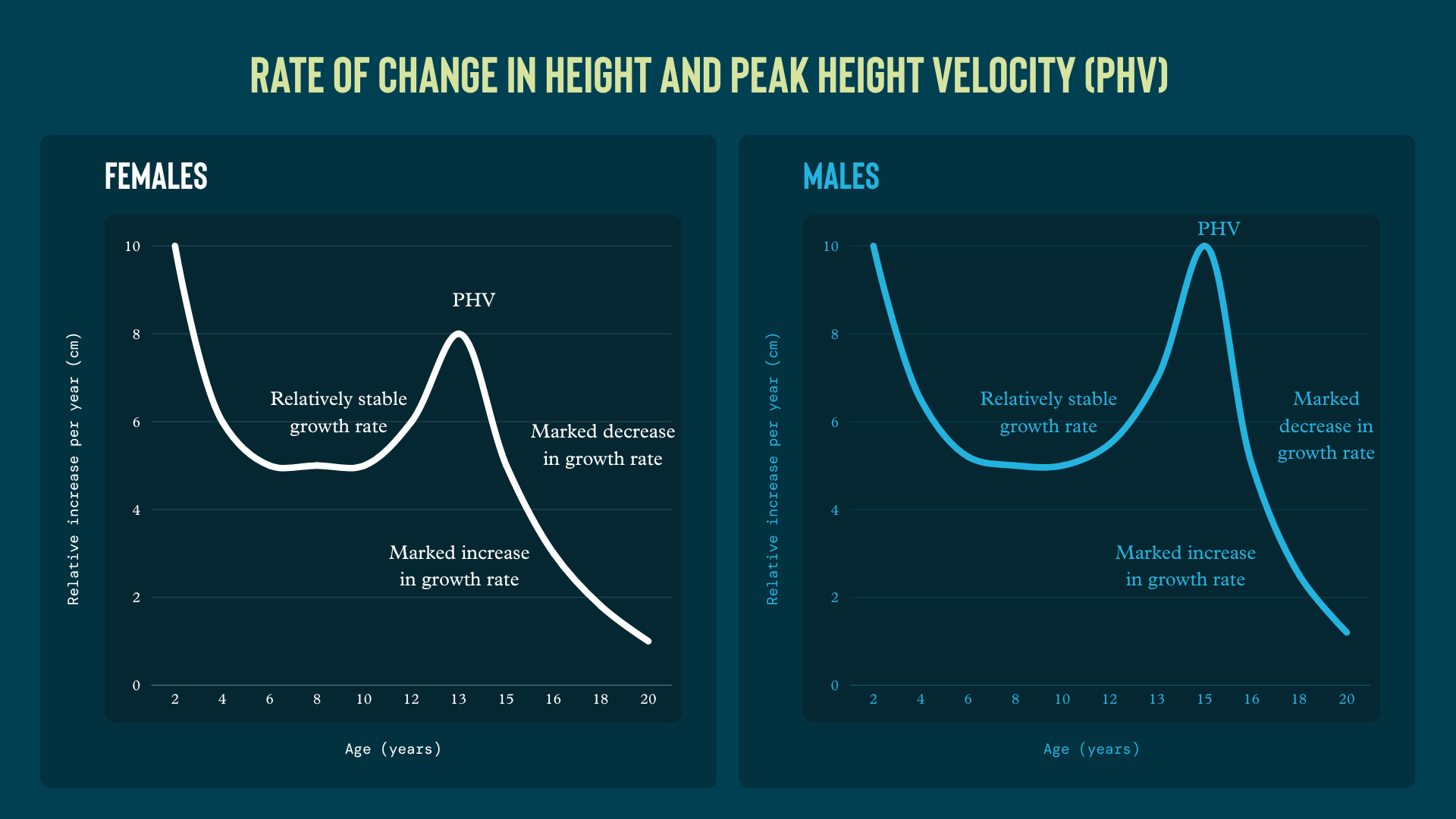
Adolescents develop distally to proximally (from the hands and feet inwards). This growth occurs through increases in bone length. New bone develops at the growth plates at the ends of the bone. However, as this occurs, the growth plates are vulnerable to injury, specifically at the secondary ossification centres and at the bone-tendon interface, known as the apophysis. The apophysis runs perpendicular to the growth plate and is susceptible to traction forces due to its orientation and muscle-tendon attachments. [3]

Tweet ThisAs this occurs, the growth plates are vulnerable to injury, specifically at the secondary ossification centres and at the bone-tendon interface, known as the apophysis.
Ed Clarke and @NiallMacSweeney
Each apophyseal site can be affected by two main injury types: traction apophysitis and apophyseal avulsion.
Traction apophysitis is the classic slow-burning injury, e.g., Osgood-Schlatter disease. A gradual onset of pain can develop over days or even weeks, and players will typically play through it until it affects their performance.
Apophyseal avulsions have a sudden, traumatic onset with immediate pain and a far more significant functional impairment.
In football, this may follow a shot or a long pass, or involve a high intensity physical action such as a sprint or deceleration. These injuries are often more significant, presenting with significant impairment and requiring more prolonged rehabilitation. We can think of them as the adolescent equivalent of a tendinopathy vs. a tendon rupture. They represent a key injury factor unique to highly active adolescents.
It is not just the growth plates that are susceptible to injury, though. As bone length increases, muscle mass and muscle forces increase, which strengthen the bone itself. As this occurs sequentially from outwards to inwards across the body, different body areas experience unique stresses and strains that vary as footballers grow and develop.
Figure 3 shows the specific injury landscape at each phase of academy football.
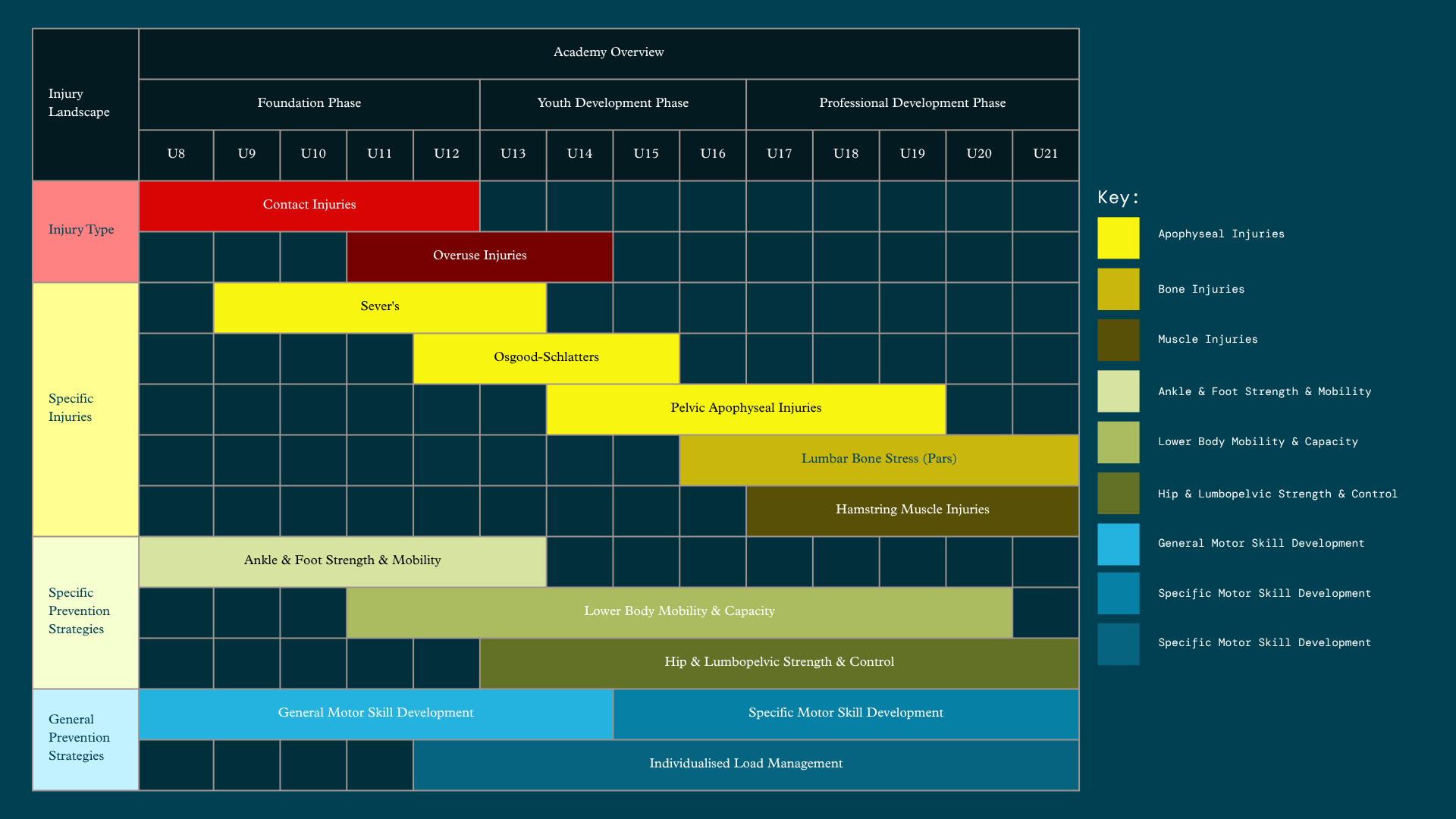
Tweet ThisTraction apophysitis is the classic slow-burning injury, e.g., Osgood-Schlatter disease. Apophyseal avulsions have a sudden, traumatic onset with immediate pain and a far more significant functional impairment.
Ed Clarke and @NiallMacSweeney
Foundation phase (U9-11)
At this age, the data suggests that most injuries are minor knocks often caused by contact with other players or losing balance, and the players tend to bounce back quickly. The major growth-related issue in this stage, and progressing into the younger ages of the youth development phase, is calcaneal apophysitis, commonly known as Sever’s Disease.
Players will present with pain at the posterior aspect of the heel, at the Achilles tendon insertion, which can be reproduced with palpation. They will also report difficulty or pain with running, jumping, and changing direction, which can limit performance.
Players don’t tend to miss a large amount of time with these types of injuries, but they can flare up sporadically over a long period.
Load management and injury prevention
This age presents a key stage for the development of motor skills, and this can work not just as a performance enhancer but also as an injury prevention strategy.
Young players who can be adaptable movers may be able to better adjust to the game and bounce out of difficult contact situations.
As with any apophysitis injury, managing load is important to prevent injuries such as Sever’s. Specifically, taking breaks between intense exercise (within the same day and between days) can give the apophysis more time to adapt to the stress and strain. Repetitive actions that place stress on the Achilles, such as running and plyometrics, may aggravate this area more than others; therefore, the amount of this activity may need to be managed more carefully.
While Sever’s doesn’t tend to keep players out of activity for overly long periods, it is still important to manage this injury, as it can lead to long-term changes in movement patterns.
Some useful activities for managing Sever’s Disease are: heel raises for symptom relief; isometrics, e.g., single-leg calf raise hold; ankle and 1st ray mobility; foot intrinsic strengthening; exposure to different surface types in barefoot; 1st MTP joint / FHL strength; and calf strengthening.
A word on delivery. Everything in that list is simple to prescribe and can be surprisingly hard to get done.
In our experience, this work lands far better when it is framed as a game with a competitive edge rather than a programme. Barefoot exposure across different surfaces becomes an obstacle course. Foot intrinsic work becomes a race to pick up as many objects as possible in thirty seconds. Isometric calf holds become a challenge against a teammate, or against their own time from last week.
Tweet ThisSome useful activities for managing Sever’s Disease are: heel raises for symptom relief; isometrics, e.g., single-leg calf raise hold; ankle and 1st ray mobility; foot intrinsic strengthening.
Ed Clarke and NiallMacSweeney

Youth development phase (U12-16)
This is the busiest phase for growth-related injuries, as most players reach their peak height velocity and enter peak weight velocity. Osgood-Schlatter disease (OSD) is the most well-known growth-related injury and tends to occur earlier in this phase, from U13–U14 (approximately 85–92% of adult height). Diagnosis should be based on localised tibial tuberosity pain, tenderness on palpation, and pain on quadriceps stretch or contraction.
According to Premier League data and our experience, time loss from OSD is lower than from apophysitis and apophyseal avulsions around the pelvis.
These pelvic injuries tend to occur slightly later, generally in the U15–U16 age range (92–96% of adult height), as growth-related issues migrate proximally.[4,5] This region matures last. As it does so, it must coordinate and control the increasing mass of the growing distal body, which helps explain why pelvic apophyseal injuries affect players quite differently from the Sever’s and OSD they may have played through earlier in their academy career.
Pelvic apophysitis is considerably more limiting in a high volume running and kicking sport like football; and typically leads to greater time loss than the more distal apophyseal injuries seen earlier in the phase. The more intense, full-time training schedules that players enter at this age likely compound this.
Avulsion fractures are also considerably more common around the pelvis than around the knee and ankle. These are far more significant injuries that require prolonged rehabilitation and, in cases of large bony displacement, occasionally surgery. Symptoms can present at any of the many apophyseal sites around the pelvis: anterior, lateral, or posterior (Figure 5).

Apophyseal injuries generally occur when the apophyseal growth plate faces sustained stress and strain without sufficient time to recover. Basic schedule management, such as taking a day off during the week and longer breaks between double sessions (such as on day release days), can dramatically reduce the risk of these injuries.
However, the realities of elite-level football academies make it unrealistic to eliminate these injuries entirely.
One key element in reducing the injury burden from these types of injuries is identifying symptoms early and implementing proactive injury-reduction strategies. Using maturation-related data, such as players’ growth rates or the percentage of adult height, can help identify players with a high likelihood of these injuries. These players should be educated about where the pain from these injuries might occur. When it develops, coaches and practitioners should reduce their training load. This time can be used to implement specific management strategies, such as knee isometrics.
It is important to ensure these injuries are treated properly. Although players can continue to play, acute management of the joint and surrounding structures remains warranted. Without this, players may develop compensatory movement strategies that can further influence injury risk later on. For example, players with a history of Osgood-Schlatter disease who alter their movement strategies may increase strain on the lower back.[1]
Tweet ThisApophyseal injuries generally occur when the apophyseal growth plate faces sustained stress and strain without sufficient time to recover. Basic schedule management can dramatically reduce the risk of these injuries.
Ed Clarke and @NiallMacSweeney
Managing Osgood-Schlatter disease
Having reduced the aggravating load as above, the physical priority in the short term is reducing pain and maintaining knee function.
Knee specific strengthening and isometrics support these goals and can progress into more dynamic deceleration and movement strategy work as the symptoms start to settle. In addition, it is worth considering developing strength and capacity in the lumbo-pelvic region, as the vulnerability within this area will increase following this stage of development.
| Exercise | Sets | Reps / duration | Purpose |
| Warm-Up | |||
| Bike | 1 | 5 min | General mobility and increased blood flow. |
| Bent-knee calf stretch | 2 | 30 s / side | Increase soft tissue extensibility at the ankle. |
| Banded ankle dorsiflexion mobilisation | 3 | 10 reps / side | Improve ankle joint mobility in weight bearing position. |
| Band assisted couch stretch | 3 | 2 min/ side | Reduce tightness around quadriceps |
| Dynamic walking quad stretch with reach | 3 | 10 reps/side | Reduce tightness across kinetic chain |
| OSD-specific | |||
| Terminal knee extensions (band) | 3 | 15 reps | Maintains quadriceps activation without compressing the tibial tuberosity. |
| Isometric wall sit (60° knee angle) | 4 | 30–45 s hold | Maintains / improves quadriceps function in a pain free position. |
| Movement prep | |||
| RDL with stick | 3 | 8 reps | Trains ability to hinge at the hip. |
| Band-resisted backwards walk | 3 | 15 steps | Encourages player to load quadriceps in deceleration specific position. |
| Band-assisted SL pogo | 3 | 8 reps / side | Trains foot and ankle stiffness to assist knee from “ground up.” |
Professional development phase (U17-Loans)
The last area to reach full skeletal maturation is the lumbar spine, and this is the site of the pars interarticularis, where lumbar bone stress injuries most commonly occur. Usually, these present as progressively worsening, unilateral low back pain, and classically have pain on lumbar extension during clinical assessment.
Sports that have a surveillance system of regular lumbar spine MRIs for high-risk populations, such as cricket fast bowlers, can catch these earlier. But in academy football, you are more likely to have to rely on regular symptom monitoring and players’ self-reporting.
Once the diagnosis has been confirmed, the severity of the bone stress and the presence or absence of a fracture line on imaging will help determine the timescale. This can range from several weeks to several months depending on the severity of the initial injury and the rate of fracture healing during recovery.
The professional development phase is also where we start to see a higher likelihood of muscle injuries. This occurs because the game’s physical intensity increases as players transition into adulthood, and hamstring injuries can be particularly problematic for players at this stage.
Hamstring management is especially complex in this population because of the context in which it occurs. A player may be training with the academy, turning out for the U21s, called into a first-team squad, and representing their national age group, all within the same month. Managing load across multiple squads, each with competing priorities, is one of the biggest challenges of working with players at this level.
Tweet ThisThe last area to reach full skeletal maturation is the lumbar spine, and this is the site of the pars interarticularis, where lumbar bone stress injuries most commonly occur.
Ed Clarke and @NiallMacSweeney
Preventing and managing injuries across the squad
Bone injuries such as pars stress injuries are similar to those listed above, in that periods of rest are highly beneficial for bone healing. However, bone injuries can also be influenced by inadequate nutritional intake. This has been well documented in academy footballers [7] and may prevent the bone from having enough energy to sufficiently recover from the microdamage that occurs during athletic activity. Other factors to consider include vitamin D levels and sustained periods of growth.
Academies should consider how they can support adequate nutritional intake for their players to enable the necessary energy for both growth and tissue healing.
Players with a hip extension-dominant pattern may also be more likely to experience these injuries.
Goalkeepers are at particularly high risk for this type of injury due to the high intensity spinal extension with rotation required during long range ball striking and during saves while stretching. They also jump and land at significantly higher volumes than outfield players, increasing axial load on the spine. Goalkeepers also tend to be taller and therefore experience higher growth rates.
Ensuring goalkeepers are subject to load management protocols similar to those of outfield players is an obvious way to prevent these injuries.
Muscular injuries are harder to prevent and less predictable than overuse injuries. Hamstring injuries in football are particularly prevalent. Sprint work and hamstring strengthening should be carefully programmed to provide a consistent stimulus for hamstring development and preparation for in-game high intensity actions, while allowing adequate recovery before matchday.
Managing this loading cycle is more complex for soft tissue injuries than for the overuse injuries seen earlier in the pathway. One approach is microdosing. Another is to schedule hamstring strengthening after the higher speed on-pitch work, which limits neuromuscular fatigue before sprinting and preserves the recovery purpose of lower intensity days.
As with all injuries, biomechanical factors may also influence injury risk. Anterior pelvic tilt, reduced hip flexion, and backside mechanics while sprinting all alter hamstring loading during high-speed running. Weekly programmes need to be consistent with work to improve and maintain running efficiency.
Managing pars stress injuries and hamstrings
When rehabilitating a pars bone stress injury, the time away from impact activities during the offload period must be used to address the biomechanical factors that contributed to the injury. There are three main areas to focus on to improve the player’s capacity to tolerate the higher loads that will come as they transition into professional football: improving lumbo-pelvic strength and control, thoracic mobility, and hip strength.
While it is hard to quantify optimal lumbo-pelvic control, trunk capacity tests are a useful way to identify in which direction of movement the player is weaker.
Likewise, testing the hip in 360° will give you further information as to which parts of the joint complex need to have greater focus during the rehabilitation and return to sport periods.
Thoracic mobility is an area that benefits players on the pitch and in the gym and can be easily improved with a targeted mobility and strength programme.
Making rehab seem less clinical and more athletic
Everything described so far is the straightforward part. Recognising an apophyseal injury and writing a sensible loading plan is within reach of any competent practitioner. Getting a 13-year-old to diligently follow the plan, week after week, while their friends train without them, is the hard part. It is also the part that decides whether any of it works.
Motivation is not a soft skill
We would go as far as to say that, in this age group, adherence is the single biggest variable we control. A good programme completed consistently will outperform an excellent programme completed sporadically every single time. That makes the motivational side of rehabilitation part of the clinical reasoning rather than something that sits politely alongside it.
A few things have consistently helped us. The first is to give players choices inside your framework. The player does not get to decide whether they do their isometrics. They can absolutely decide whether they do them before or after the session, in the gym or out on the grass, alone or with a teammate. That autonomy costs you nothing and buys you a great deal.
The second is to make progress visible and keep the feedback loop short. Adolescents are, developmentally, poor at working towards a reward sitting eight weeks away. That is not a character flaw; it is simply how the brain works at that age. Find something you can measure every week and let them watch the number move. A hold time, a jump height, a rep count on a whiteboard.
What you measure often matters less than the fact that it changes.
The third is to be honest about the timescale, and to be honest early. Players cope far better with being told this will take 12 weeks, and there will be some bad days in the middle, than they do with vague reassurance that later turns out to be wrong.
Set an expectation you cannot keep, and you spend the rest of the rehabilitation rebuilding trust rather than building capacity.
Psychosocial is as important as musculoskeletal
Being injured at an academy is a social problem as much as it is a physical one. These players are not only missing football, but they are also missing their group, and they are watching the pecking order rearrange itself without them.
A treatment room, however well equipped, is a lonely place to spend weeks and months.
Wherever it is clinically reasonable, we would rather do the work alongside the group. Being visible to teammates and working hard at the same time as the group can change how the player experiences the whole process. It also changes how the coaching staff perceive them, which matters more than most practitioners care to admit.
Beyond that, involve the ball or competition wherever you can. For a lot of these players, ball involvement is the entire difference between an exercise and football. Low level technical work can be an easy way to progress low velocity speed and change of direction progressions when carefully considered alongside the overall rehab progression.
Dealing with things going wrong
Things won’t always go to plan. It might take longer than expected to get back to playing. Symptoms may flare.
The most useful thing you can do is manage expectations in advance. Tell the player at the start that there may well be bad days, and that rehab doesn’t always mean linear progress. When a bad day arrives, it means you adjust the plan rather than start it again. Honesty is what helps prevent a setback from feeling like a failure for everyone involved.
Helping them understand that discomfort is part of the process is another important step. As well as guiding them through the clinical progression of the injury, it helps the player develop greater body awareness and a deeper understanding of soreness versus pain. Simple visual charts or numerical scales are a useful way to frame that discussion, and they give you something concrete to work from when deciding whether to adjust the programme or the loading. The exact cut-offs will vary by injury type and by the individual athlete.
Younger players have little reference for what they are reporting against, so expect high numbers at times and interpret them in context rather than reacting to them in isolation.
That last point only matters if you act on what you hear. If a player reports soreness and nothing changes, they will stop telling you. Drop back a level, say plainly why, and build it up again. A player who sees the plan flex around them keeps reporting honestly, and that is what makes them possible to help.
Youth athletes (and their injuries) are not mini-professionals
The injury landscape of the adolescent athlete is not simply a scaled-down version of adult sport medicine. It is a distinct and evolving picture, shaped by the same biological processes that are turning a child into an adult.
As the skeleton stretches, fills out, and matures from the extremities inwards, the sites of vulnerability shift accordingly: from the heel in the Foundation phase, to the knee and then the pelvis through the Youth Development phase, to the lumbar spine as players approach professional football.
What this means in practice is that the practitioners working with young athletes need to be as developmentally aware as they are clinically skilled. Load management is a thread running through every phase described here. This should be seen and used as a deliberate strategy for keeping players in the game and developing, both physically and technically, while their bodies catch up with the demands being placed on them.
While we can’t change the biological process of maturation itself, we can absolutely influence how well the athlete moves through it: protecting the vulnerable sites, maintaining fitness and technical development, and building the physical capacities that will serve them when full skeletal maturity arrives.
Do not lose sight of the fact that these are children first and athletes second. The clinical reasoning matters enormously, but so does whether the 12-year-old sitting in your treatment room still loves the game by the time they walk out of it.
The transition into the Professional Development phase, and the emergence of a more adult injury profile, is not a clean line. Players at this stage straddle two worlds: still maturing skeletally but facing the physical demands of senior football. The staff around them need to appreciate these realities simultaneously.
Ultimately, the greatest service we can offer our players is not just treating the injuries that arise, but understanding why they arise, anticipating when and where they are most likely to occur, and building programmes that give every player in the group the best chance of navigating their development without unnecessary interruption.
Tweet ThisThe injury landscape of the adolescent athlete is not simply a scaled-down version of adult sport medicine. It is a distinct and evolving picture, shaped by the same biological processes that are turning a child into an adult.
Ed Clarke and @NiallMacSweeney