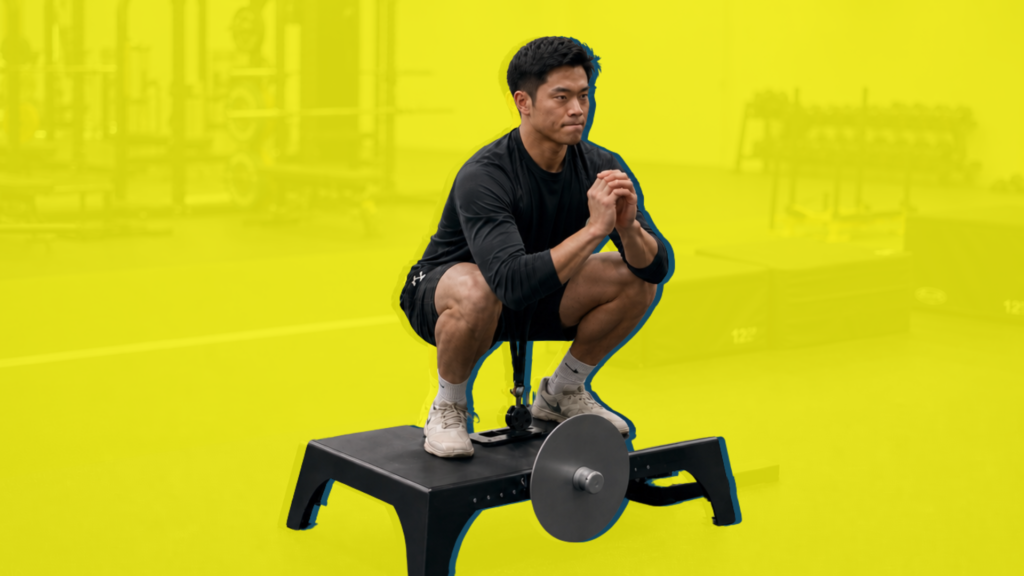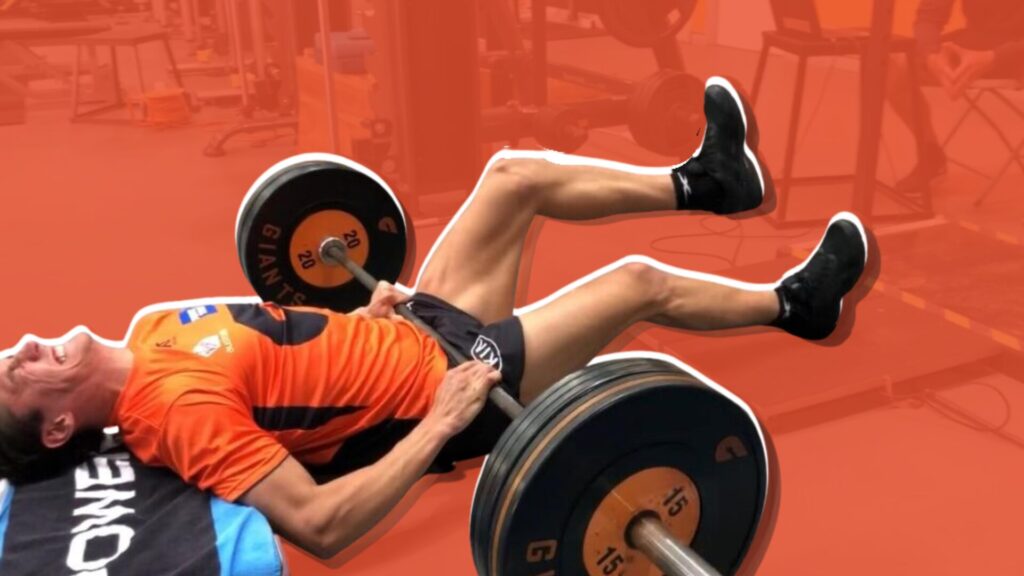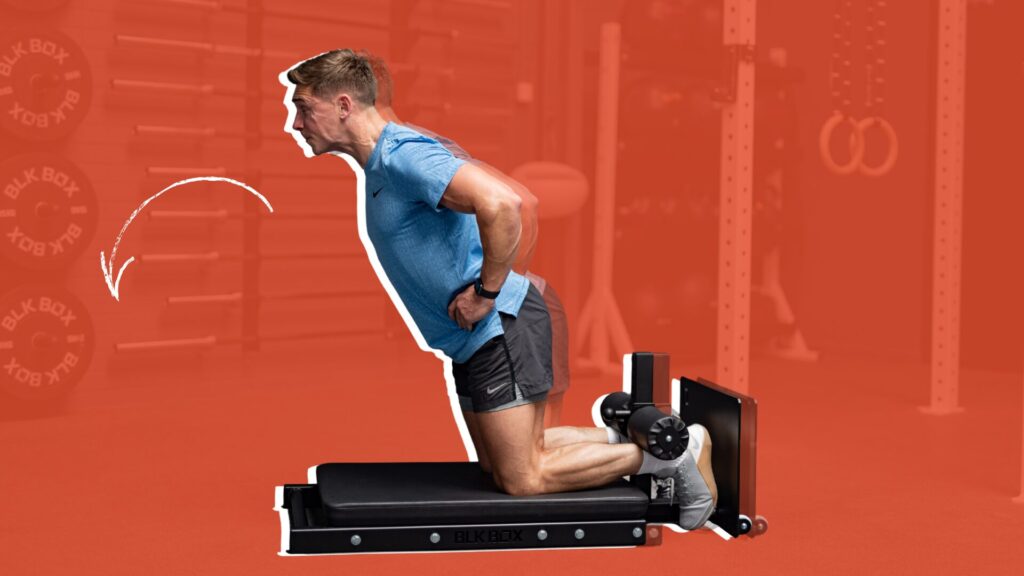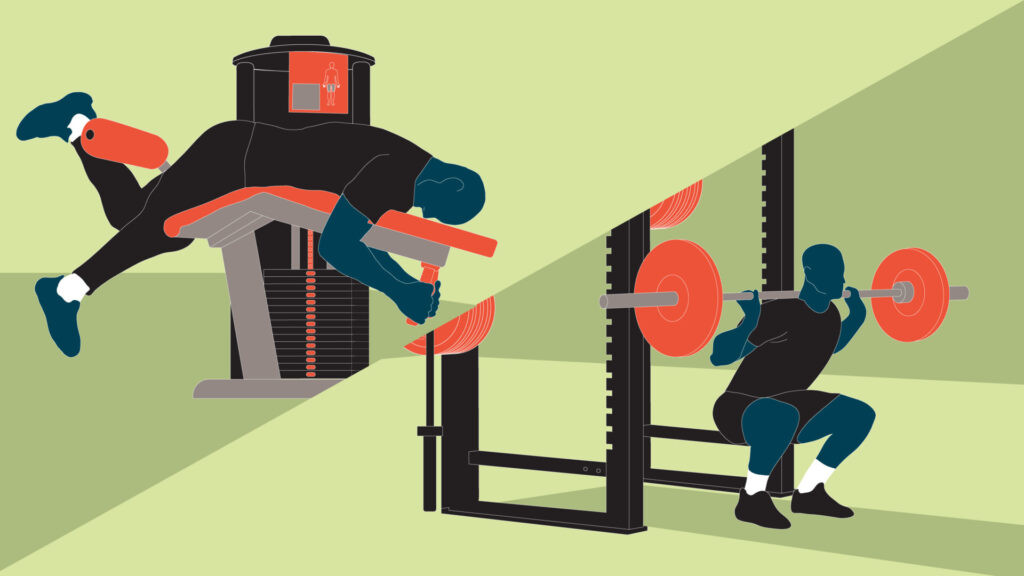

Reflexive eccentrics are weighted eccentric contractions performed as fast as possible. Think of the catch portion of a hang clean, or the landing of a loaded jump. Both tasks require high forces at high speeds. Related terms are “fast eccentrics” [1] and “drop catch methods,” where submaximal loads are used to target eccentric rate of force development.
Placing eccentrics on a spectrum, accentuated eccentrics using heavy loads for longer duration tempos are at one end and reflexive eccentrics are at the other. We can compare this to the strength (i.e., brightness) of a light vs. how quickly one can turn the light switch on and off. Knowing that athletes have to make in game decisions in split seconds, how quickly someone can recognize, reorient, and readjust may be the difference between success and failure.
Traditional eccentric training may improve muscle cross-sectional area (CSA), while simultaneously improving tendon tolerance and stiffness [2]. Additionally, training induced changes in fascicle length are correlated to eccentric rate of force development [3].
Force is important, and rate of force development perhaps even more so. RFD matters both in performance measures and physiological adaptations. In non-athletic populations, fast eccentrics (<70% 1RM) resulted in greater improvements in 1RM strength and isometric RFD leg press compared to slow eccentrics (90% 1RM).
Reflexive eccentrics have a variety of benefits for strength & conditioning coaches.
Strong braking, with a quick, aggressive counter, appears to mimic the tendon-muscle system that optimizes the stretch-shortening cycle (SSC). Reflexive eccentrics minimize delayed onset muscle soreness during the competitive season, and are a simple way to train stiffness and eccentric rate of force development for more advanced athletes. Eccentric rate of force development strongly predicts jump performance in well trained baseball, basketball, and football players [4].
Tweet ThisReflexive eccentrics are weighted eccentric contractions performed as fast as possible. Think of the catch portion of a hang clean, or the landing of a loaded jump. Both tasks require high forces at high speeds, optimizing the stretch-shortening cycle
@AnthonyDonskov
Reflexive eccentrics offer something new to experienced athletes
Athletes who are just starting weight training and have an underdeveloped frame and skill set do not need advanced training means. They need a basic program with progressive overload, appropriate progressions, and great coaching. Foundational performance training is critical. For these athletes, traditional linear periodization and progressive overload are appropriate, and we manipulate both volume and intensity over time until adaptation stalls.
Our definition of an advanced athlete is one who has trained in a structured, well coached strength & conditioning program for about six years or more. The majority of elite hockey players we train make their living playing the game and have been exposed to progressive overload for a large period of their training careers. These players have both a high training age in the weight room and sport mastery on the ice.
There are no strength standards, cut off points, or indices. But for high caliber players to continue to refine the skills they need to play, they need to spend a larger proportion of their time in an enriching environment: deliberate practice on the ice.
The challenge for the performance coach is to thread this needle so the athlete is focusing on specific tasks most relevant to sport improvement.
As an athlete progresses in training age, they can no longer sustain continuously increasing volume and load. They need larger loads to disrupt homeostasis and induce adaptations, so appropriate rest becomes a necessity.
Time also plays a factor. The time it takes to increase a 1RM back squat may be better spent on sport specific skills.
Variation becomes an important variable. Specific performance factors fit this requirement. Training adaptations follow either an increase in the training load (volume or intensity) or changing the drill [5]. The latter is optimal for more advanced athletes.

Yielding and overcoming isometrics target the isometric contraction. The former provides a post-activation potentiation prior to heavy loading; while the latter taxes high threshold motor units at the conclusion of each weighted set to fatigue the muscle.
Oscillatory lifts force the muscle to contract and relax. This improves rhythm, coordination, and efficiency between eccentric and concentric demands, all centered around the amortization phase.
Changing the equipment — e.g., using specialty bars such as fat bars, neutral grip bars, safety squat bars — or stance introduces variation and accesses a different pool of motor units while enabling sufficient load.
Adaptations from reflexive eccentrics
The goals of reflexive eccentrics are to increase eccentric rate of force development and improve stiffness. This enables players to change direction more efficiently whether on the ice or the field.
One of the most important acute programming variables that we can manipulate to improve stiffness is velocity.
Reflexive eccentrics enable coaches to couple high load with high speed. This increases collagen cross links, which thickens the tendon. In traditional slow, accentuated eccentric training, the series elastic component (or tendon) stretches slowly as the muscle contracts. This slow stretching creates a shearing effect that breaks down collagen cross-links. If we break down more than we re-synthesize, the tendon becomes less stiff. However, if we increase the speed of contraction, this shearing is less intense, the collagen moves like a sheet, and the body lays down more cross-links than the movement breaks.
The outcome is a stiffer tendon. Velocity makes this particular adaptation happen.
As Keith Baar said, “When we do really fast exercise, we don’t break cross-links. We are adding more cross links, we are getting stiffer… [We have the biggest effect on tendon stiffness at] 0-30% of your 1RM, as fast as you can move it.”
The research is mixed regarding a shift in fiber type. Non-trained populations experience a decrease in Type I muscle fibers while their Type IIb fibers increase during fast eccentric programming [1], along with increases in muscle fascicle length [3].
Tweet ThisReflexive eccentrics minimize delayed onset muscle soreness during the competitive season, and are a simple way to train stiffness and eccentric rate of force development for more advanced athletes. Eccentric rate of force development strongly predicts jump performance in well trained baseball, basketball, and football players
@AnthonyDonskov
Integrating reflexive eccentrics into an S&C program
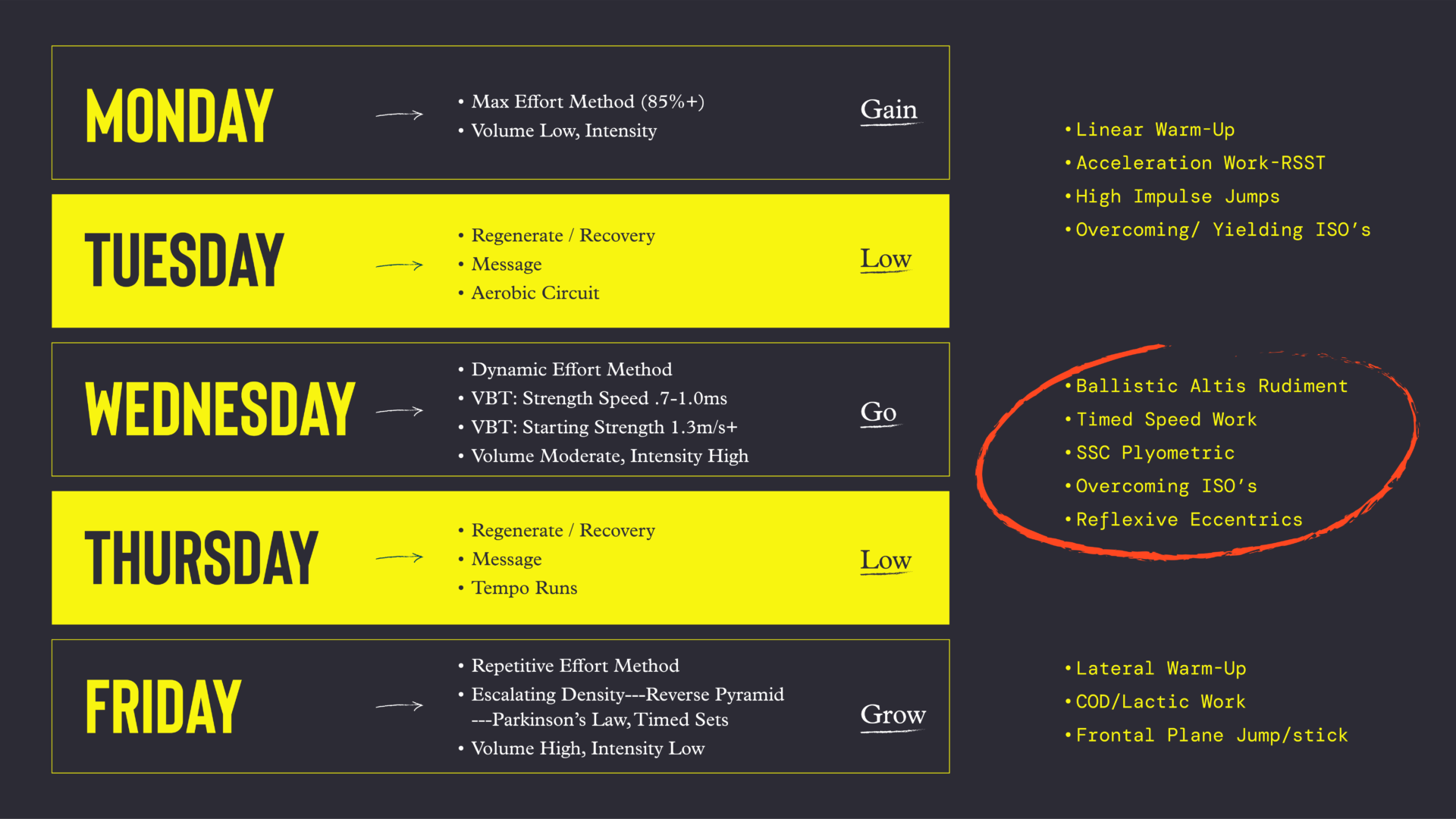
We use a three day, undulating, rollover program: “Gain, Go, Grow.” An example is lifting heavy things slowly for “gain” day (max effort); lifting submaximal weight as quickly as possible for “go” day (dynamic effort); and lifting submaximal weight for time on “grow” day (repeat effort). Reflexive eccentrics fit on “go day.”
The goal of great programming is to complement training means. Our “go” day theme revolves around speed and stiffness. We strive to complement foot contacts in warm up with jump training, sprinting, and weight room exercises. This includes Altis’ Rudiment series warm up, stretch-shortening plyometrics, timed sprint work, and strength-speed and speed-strength work using Tendo units.
Foundational loaded patterns such as squats, split squats, rear foot elevated split squats, trap bar deadlifts, pushing and pressing patterns are appropriate for this method. They provide the coach with foundational patterns to load, while reinforcing eccentric speed of movement.
The more coordination a movement pattern requires, the less load the athlete can apply while maintaining speed.
We always start reflexive eccentrics with foundational patterns. However, we are experimenting with other shapes and coordinated patterns more specific to sport performance and injury prevention: posterior chain work for field based sports (hamstring) and hip work (adductors) for hockey players. Athletes typically do these with minimal to no load in the off season.
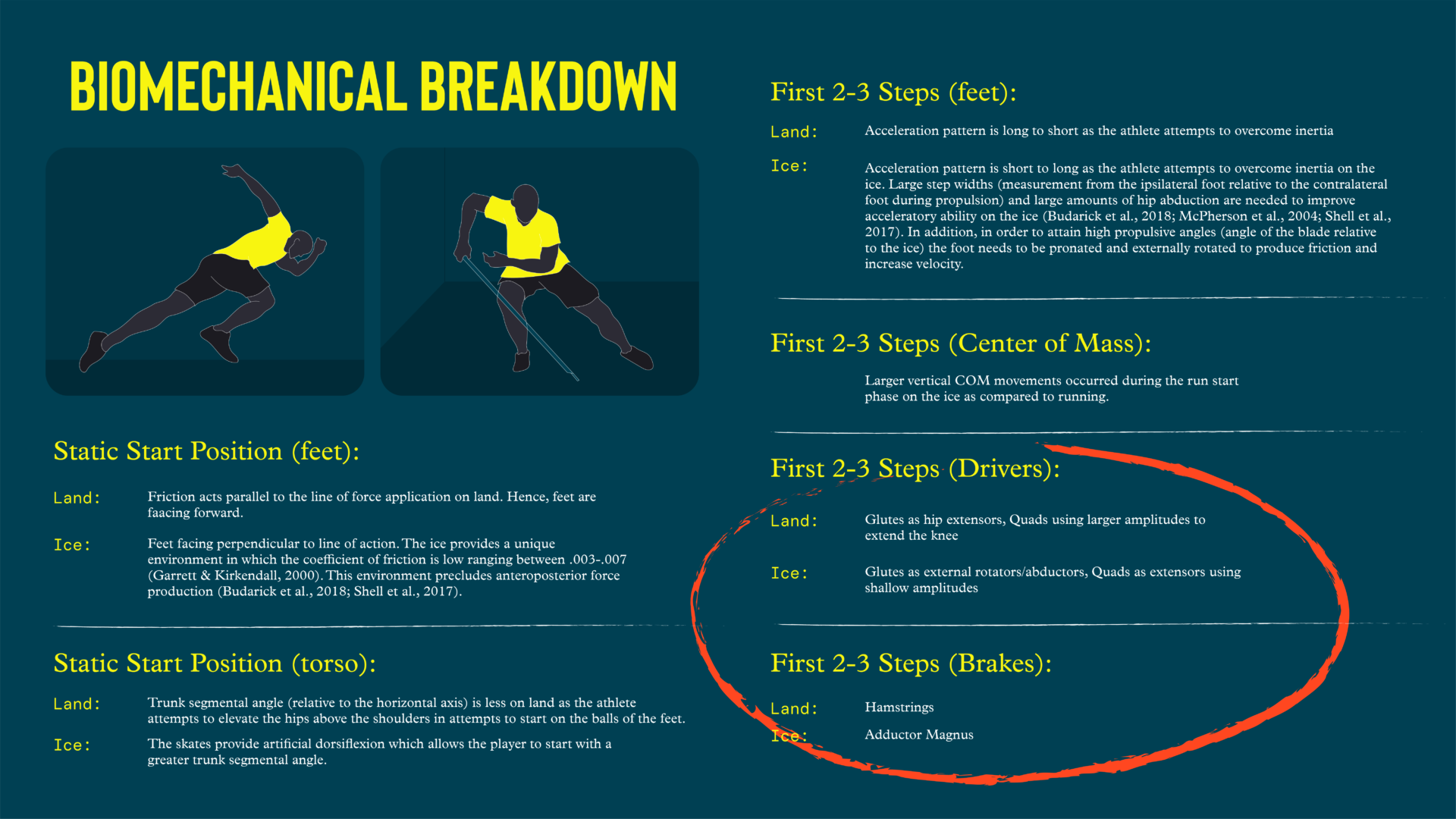
We program reflexive eccentrics in season and during the off season with several field based athletes and hockey players.
The standard heavy, slow, accentuated eccentrics cause delayed onset muscle soreness, as maximal voluntary force production is highest for eccentric contractions. However, reflexive eccentrics cause minimal muscle soreness. That makes them a viable alternative during the season, especially as we approach game days in seasons that can run up to 82 (regular season) games. Post workout stress scores are always on the low end with this method.
Tweet ThisThe standard heavy, slow, accentuated eccentrics cause delayed onset muscle soreness, as maximal voluntary force production is highest for eccentric contractions. However, reflexive eccentrics cause minimal muscle soreness. That makes them a viable alternative during the season
@AnthonyDonskov
Building out an S&C program with reflexive eccentrics
The acute programming variables guide training programs towards specific adaptations. These variables are: choice of exercise, exercise order, resistance or intensity (bearing in mind the effect on velocity), number of sets, rest, and tempo.
Reflexive eccentrics may take the place of loaded jumps or Olympic lift variations. Exercises such as reflexive eccentric split jerks build coordination and eccentric rate of force development. At the beginning of a “go day,” these can take the place of loaded jumps.
Reflexive eccentrics can also substitute for foundational patterns such as knee dominant squats and hip dominant deadlifts. These lifts are typically programmed immediately following loaded jumps or Olympic lifting variations.
Reflexive eccentrics make sense in multiple places during in season or off season training. Reflexive eccentrics are priority exercises, coming at the very onset of the program; or as a paired exercise, complementing other rate of force development work.
For example:
A Series
A1.) Loaded jump / Olympic variations or reflexive eccentric
A2.) Corrective exercise
B Series
B1) Foundational lift or reflexive eccentric
B2) Auxiliary lift
B3) Auxiliary lift
B4) Auxiliary lift
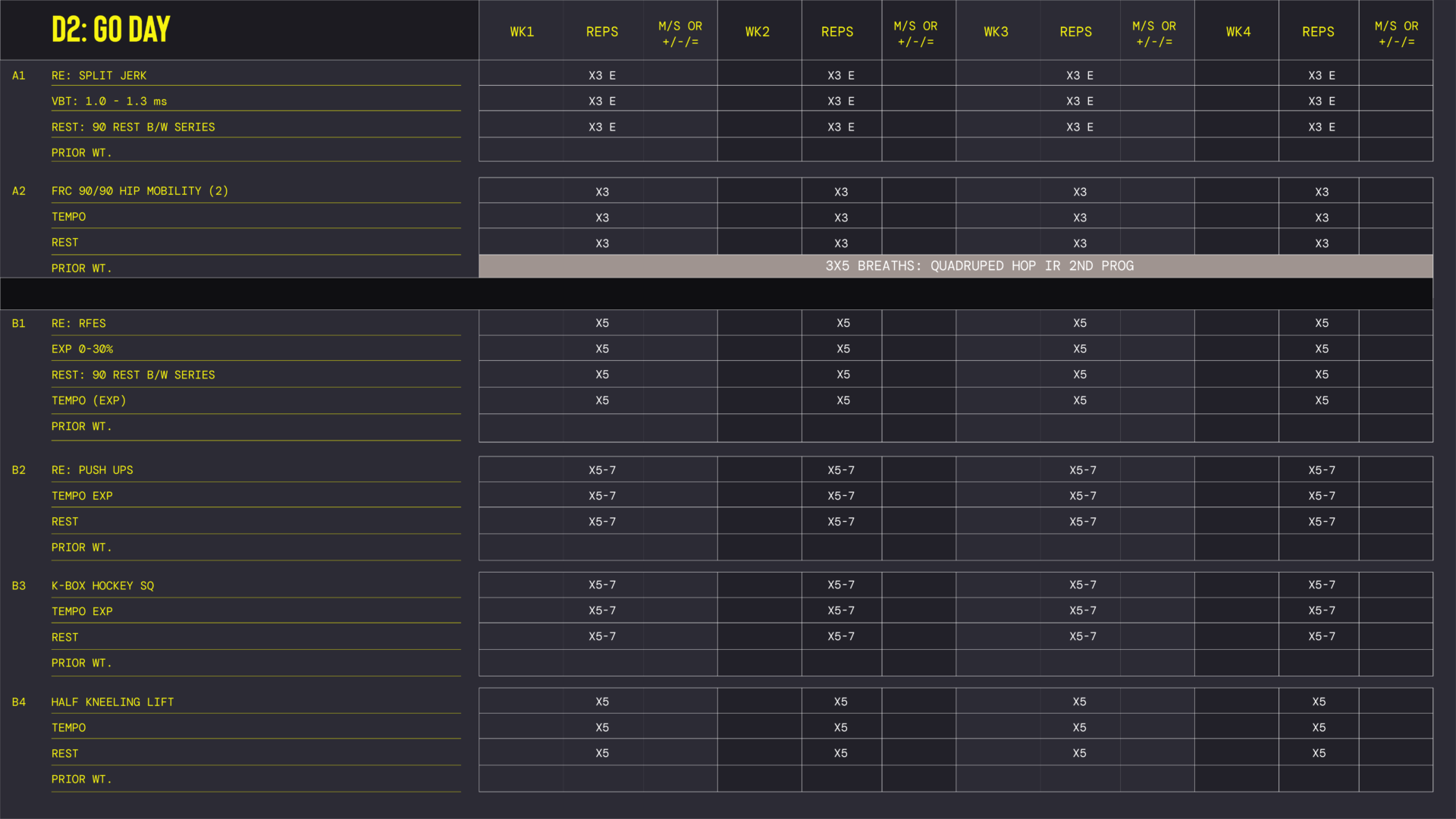
In addition to exercise order, we scale and progress our foundational reflexive eccentric means as the training cycle evolves. Typical progression involves changing load, stance, volume, and implement.
The goal is to slowly advance over time. Our progressions for foundational reflexive eccentrics are very similar to how we progress traditional lifts. We progress variation, load, and stance for each microcycle of training. Below is a typical progression for single leg, knee dominant reflexive eccentric split squat variations.
Here is another progression for the trap bar deadlift. This progresses from a top-down approach (proximal hamstring) to a bottom–up approach (distal hamstring).
Specific performance means are typically auxiliary lifts for high performance hockey players. We progress these reflexive eccentrics via lever length and speed of contraction.
Reflexive eccentrics use loads from 0-30% 1RM. Foundational performance exercises such as squat variations and deadlift variations are loaded closer to 30%, while specific performance exercises, such as hip and adductor exercises, are loaded toward the middle and bottom, respectively.
The number of reflexive eccentric sets depends on the intended adaptation and the number of total reps. The neural – metabolic continuum (Poliquin, 2012) guides both variables.
First, determine the training effect — in this case, stiffness. Then select the rep range that suits the goal. For stiffness, 3-5 reps in each leg. Finally, program the sets that suit the goal.
Reflexive eccentrics use loads from 0-30% 1RM. Foundational performance exercises such as squat variations and deadlift variations are loaded closer to 30%, while specific performance exercises, such as hip and adductor exercises, are loaded toward the middle and bottom, respectively.
The number of reflexive eccentric sets depends on the intended adaptation and the number of total reps. The neural – metabolic continuum (Poliquin, 2012) guides both variables.
First, determine the training effect — in this case, stiffness. Then select the rep range that suits the goal. For stiffness, 3-5 reps in each leg. Finally, program the sets that suit the goal.
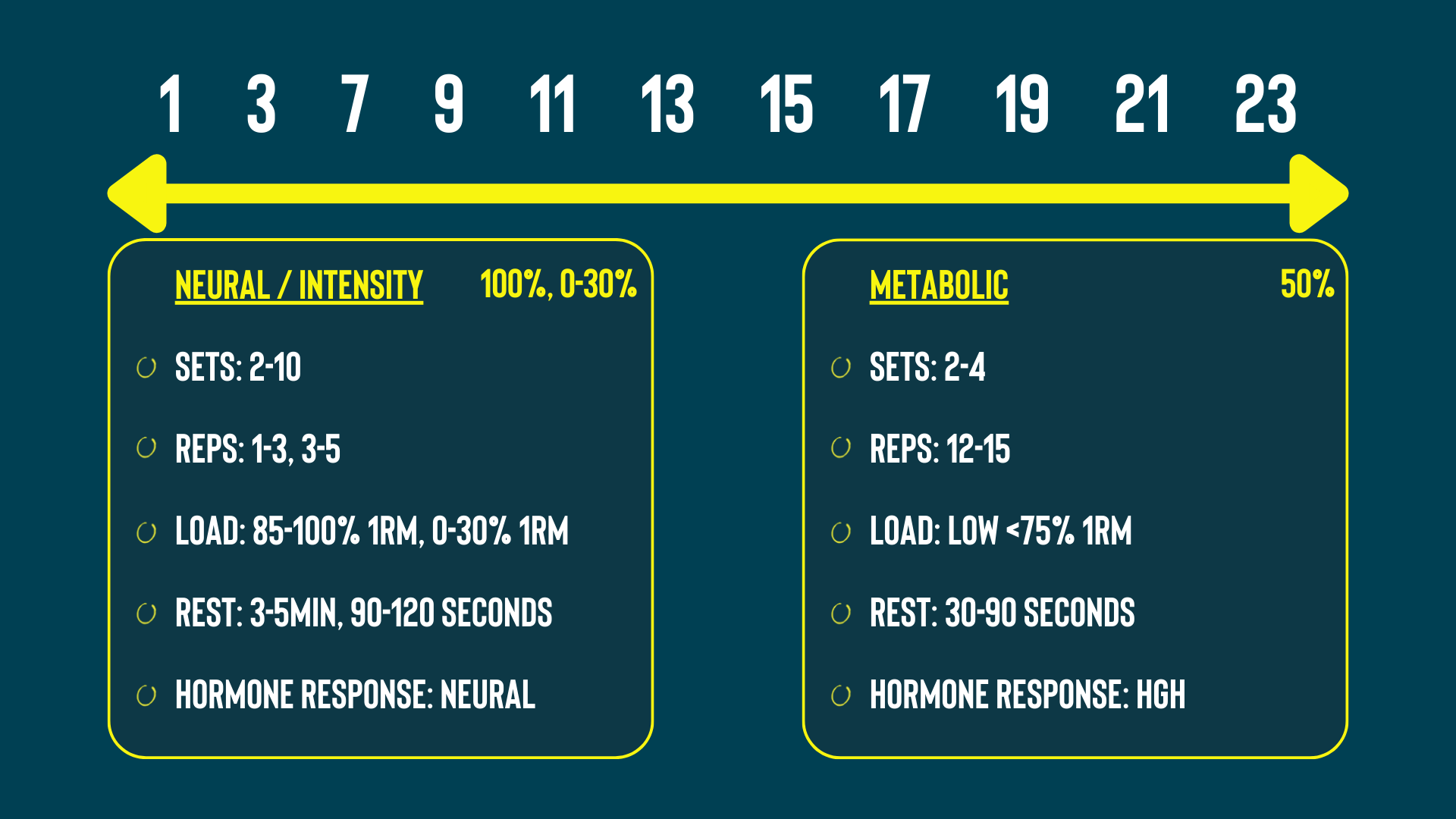
There is minimal rest between sets of reflexive eccentrics if they are part of a sequence, and a 90-120 second rest when they are at the end of a series. Longer rest intervals elicit more of a neural response, while shorter rest intervals increase blood lactate and accelerate the production of growth hormone. Reflexive eccentrics fall much closer to the neural side of the continuum.
Proper communication drives intent. We use external cues when coaching reflexive eccentrics. A few favorites are: “Emergency brakes on a Ferrari,” “grab the floor,” “be the statue,” and “stick in the mud.”
The goal with these cues is to reinforce intent: turning on the brakes as fast as possible.
Tweet ThisProper communication drives intent. We use external cues when coaching reflexive eccentrics. A few favorites are: “Emergency brakes on a Ferrari,” “grab the floor,” “be the statue,” and “stick in the mud.” The goal with these cues is to reinforce intent: turning on the brakes as fast as possible
@AnthonyDonskov