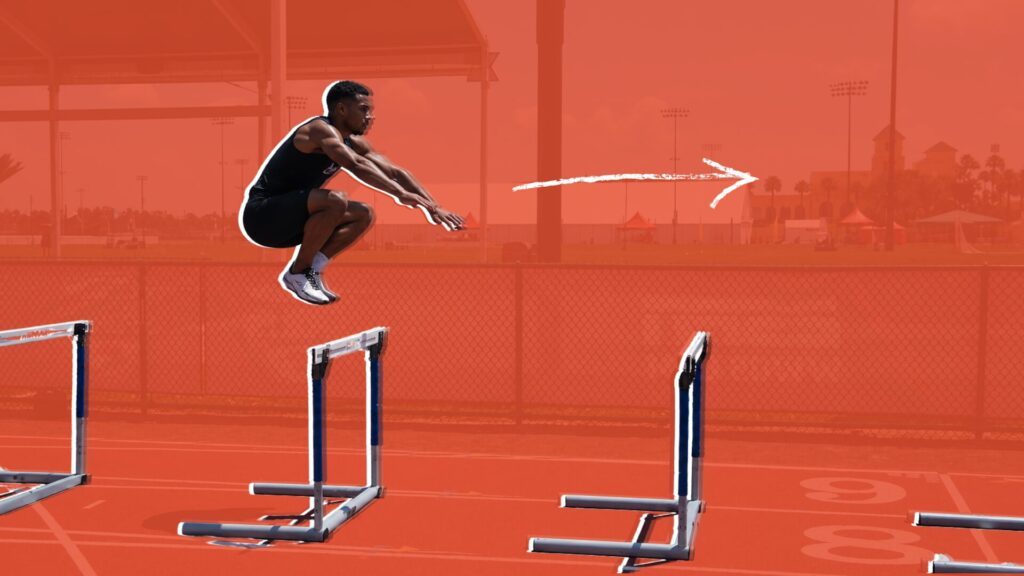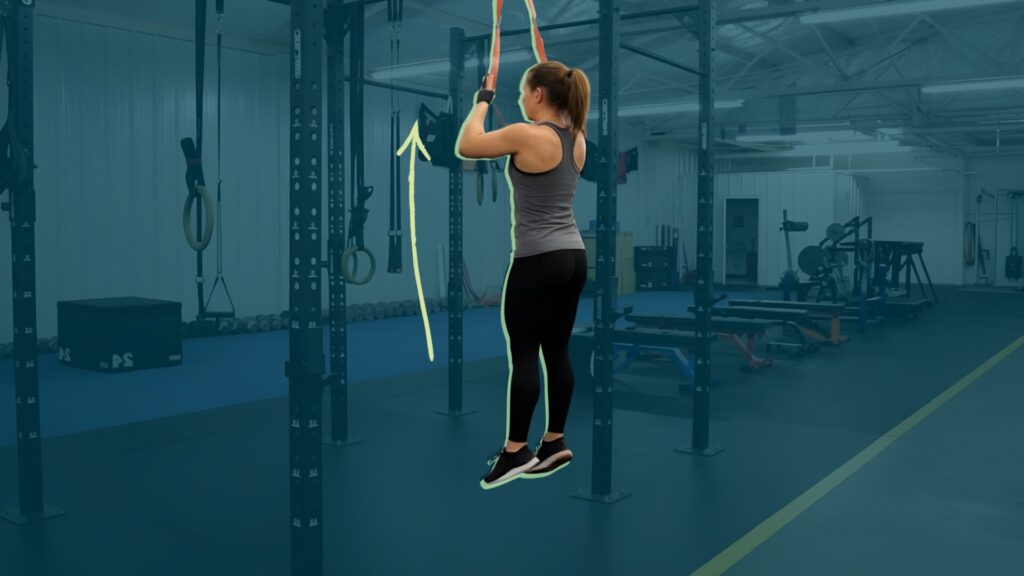

Accentuated eccentric loading (AEL) is a newly popular strength & conditioning technique based on the idea that muscles can withstand more force when they are lengthening (the eccentric phase) than when they are isometric or shortening (concentric phase).
Between the brilliant design of the human muscle and S&C coaches doing what S&C coaches tend to do, coaches have looked for ways to add even more weight during an exercise. Hence the creation of AEL, which employs a greater eccentric load via accessories like weight releasers (J Hooks) or specialized equipment like leg presses during a coupled eccentric-concentric exercise such as squats and bench press. By changing load during the exercise, the muscle works maximally throughout both the eccentric and concentric phases, maximizing the main benefits of eccentric training: building strength and muscle mass.
Lowering large weights might be the first thing that comes to mind when we describe AEL, but the concept of imposing a greater eccentric load during the eccentric phase of an exercise can also apply to movements that benefit from less weight. Some coaches combine “traditional” AEL with jumping based movements, reasoning that a greater eccentric load could enhance the concentric (propulsive) phase of a jump.
Plyo-AEL stands apart by combining AEL with jumps
Researchers have given various terms to the combination of AEL and jumping: submaximal AEL, jumping AEL or augmented jumps. Or, as we did in our review in the Strength and Conditioning Journal, Plyo-AEL.
We developed a new, specific term because “submaximal AEL” is used for anything under <100% of 1RM, and does not differentiate between jumping movements that employ AEL and other isoinertial movements. Plyo-AEL clearly describes what the training method is. Ultimately, practitioners can call it whatever they want, provided everyone understands what they are doing and talking about: a jumping based movement that employs a greater eccentric load to enhance performance.
Manipulating forces to increase movement intent
The logic for Plyo-AEL is the same as any other AEL technique: increasing the eccentric load to acutely enhance the concentric phase through increased force, velocity and power, leading to higher jumps compared to bodyweight jumps. However, there are some key points to understand.
Your system mass (body mass + added mass) increases during the eccentric phase of a jump. This requires higher braking forces to decelerate, because of the increased momentum (mass x velocity), compounding the need for a greater braking force. As a result, we may see an increase in force at minimal displacement, that is, a higher force output at the bottom of the jump. However, when the athlete releases the eccentric load prior to the propulsion phase, they reduce the system mass to just body mass.
The beauty of applying AEL to jumping is that the body still thinks it has to propel a system mass consisting of body weight and the external load. This induces greater intent, but since the athlete dropped the extra load, the extra intent converts to a quicker movement and, therefore, a higher jump.
Within the stretch shortening cycle, a larger braking force with a constant amortization phase results in a greater propulsive force. This is why metrics such as propulsive force, velocity at take-off and jump height can all increase with AEL.
Tweet ThisPlyo-AEL is the same as any other AEL technique: increasing the eccentric load to acutely enhance the concentric phase through increased force, velocity and power, leading to higher jumps compared to bodyweight jumps
@handford_matt
What goes up must come down
Our research indicates that Plyo-AEL increases jump height compared to BW jumps, but we can’t forget that landing will also create physical adaptations.
A higher jump implies a greater landing impulse to decelerate. This is another eccentric stimulus, so you are getting two for one, as in a dumbbell release during a countermovement jump. You can also cue the landing phase to increase metrics such as force values by instructing a person to decelerate as quickly as possible on landing.
Tweet ThisOur research indicates that Plyo-AEL increases jump height compared to BW jumps, but we can’t forget that landing will also create physical adaptations. A higher jump implies a greater landing impulse to decelerate
@handford_matt
Key exercise points: timing is everything
- Movement competency: The main rule of AEL is not to mess with the motion of the exercise. The extra eccentric load should not alter the exercise technique to the point it becomes something other than what the athlete would do with just bodyweight loading. Common issues are flexing at the spine or hinging in a way the athlete never would under bodyweight alone.
- Timing the release: Timing is everything. Release too soon and you won’t get the benefits, release too late and you will compromise the propulsion phase. Athletes need to release the load at the end of braking or just slightly prior to the bottom of the jump.
- Familiarisation: Athletes won’t nail this the first time. Practitioners need to perform familiarisation sessions with athletes to ensure that they learn when and how to release.
- Releasing the weight: Poor weight release increases the risk of injury. For example, if the athlete is doing a dumbbell Plyo-AEL exercise and drops the weights into the landing zone, they could land on them. Instruct the athletes to drop the weights away from themselves and others; jump forwards so they fully clear the weights’ “drop zone;” or have foam pads where the weights land so they can’t roll into the athlete’s landing zone.
Basic equipment for accentuated eccentric loading
Practitioners can adapt AEL loading strategies in many different ways to suit their equipment, space or environment.
Dumbbells are the most common equipment for AEL exercises because they are easy to implement and are usually available in most S&C training facilities. Resistance bands are a great bit of kit to use, but apply a slightly different logic and need a place to anchor to. Overspeed eccentrics are a common use case for resistance bands. We termed the use of resistance bands during AEL as ACEL (Accelerated Eccentric Loading), on the premise that bands can accelerate a body in motion when they retract, coinciding with the downward motion of a jump.
By doing so, centre of mass acceleration will increase and there will be an increase in eccentric velocity. This increases momentum, once again requiring a larger braking force to decelerate.
Weight releasers enable AEL with barbells, as do chains. Chains pose some interesting possibilities and could be a simpler method with less landing risk compared to dumbbells.
Hexbars are another tool that allow for greater loads. My MSc thesis showed that participants loaded with 30-50% of body mass on the hexbar increased force production.
Tweet ThisWeight releasers enable AEL with barbells, as do chains. Chains pose some interesting possibilities and could be a simpler method with less landing risk compared to dumbbells.
@handford_matt
Integrating Plyo-AEL into existing jump-based programs
Practitioners should implement Plyo-AEL as they would normal loaded jumps (Table 1). Some coaches follow one AEL countermovement jump with a bodyweight repeated CMJ, banking on the original AEL potentiating the repeated CMJ.
| Exercise | Volume | Loading |
| DB release CMJ | 5 x 4 | AEL 20% of BW |
| DB repeated CMJ | 4 x 3 (1 rep = AEL and repeated CMJ) | AEL 10% of BW |
| Plyo-ACEL jump squat | 6 x 3 Cluster sets (30-45 s rest between sets) | ACEL Red Band (15-20% band tension at the top) |
| Plyo-AEL jump squat | 4 x 4 | AEL (J hook) 50% of BW) barbell load (20% of BW) |
As with any training method, coaches need a solid reason for implementing Plyo-AEL within their programme – not just because we think it looks good. If your athletes’ jumping motions are sub-ideal, it would be better to get that sorted before looking for ways to add load or velocity to their jumps (Table 2).
| Athlete | Reason to implement AEL |
| “Coach, I feel I can’t slow down quickly enough.” | Plyo-AEL would likely increase braking rate of force development. |
| “I don’t feel like I jump that high.” | Plyo-AEL could be a way to get your athletes to give a maximal intent and bring those jump height numbers up. |
| “Coach, my athletes don’t put in the intent when they jump.” | This method demands intent or the eccentric load can take over. |
Expected performance alterations
Plyo-AEL should improve performance during sports with significant jumping demands like volleyball, basketball and certain athletics events. However, there is little in the way of longitudinal research around this method. From the literature we do have, we expect to see the following changes:
- Enhancement in braking (eccentric) force. Over time, we would likely see athletes able to decelerate more quickly, resulting in a faster jump but also an increase in jump height.
- Improved eccentric rate of force development, also leading to a quicker deceleration.
- These could then transfer to deceleration abilities during change of direction among athletes in sports / tasks where eccentric strength capabilities correlate with enhanced performance. Note, though, that there is no conclusive data on this.
Exploring the right frequency and volume of Plyo-AEL
Coaches should implement Plyo-AEL over 4-5 week periods. This balances the benefits of Plyo-AEL against the athletes’ other needs, ensuring no one method overwhelms holistic athletic development.
Sheppard et al., [2] implemented a 5-week AEL training programme in volleyball players who were accustomed to jump based training. These athletes needed two weeks of familiarisation before they performed the correct technique and could obtain the subsequent physical enhancements. Building on their results, coaches can program a dumbbell loaded jump superset with two reps of the dumbbell release method for one cycle, then the subsequent cycle can implement Plyo-AEL.
With regards to increasing load during the exercise, again, there is little in the way of research (hope you are seeing a trend here). Most of the research has looked at 10-30% of body mass, so an application could be a 5% increment from week 1 to week 4 (Table 3).
| Exercise | Volume | Intensity | Cues |
| A1: DB release CMJ onto box. | 4 x 3 | 20% of body mass | Maximal deceleration into max jump height, land soft. |
| A2: Pogo jumps | 4 x 8 | BW | Jump as high and fast as possible (ankles stiff) |
| B1: Box squat | 4 x 5 | 80-90% of 1RM | Sit pause for 1 s, explode off the box. |
| B2: Copenhagen holds off bench (yielding isometric). | 3 x 10-20s holds | BW | Stay tight, don’t allow knee to collapse in. |
| Exercise | Volume | Intensity | Cues |
| A1: Standing broad jumps | 4 x 2 | BW | Jump as far as possible. |
| A2: J hook jump squat | 4 x 2 | AEL 20%, bar 20% of BW. | Unload, maximal stop and jump. Land hard. |
| B1: Hexbar deadlift | 5 x 3 | 80-90% of 1RM | Push hard and fast. |
| B2: Single leg calf raise (full extension) yielding isometric. | 3 x 10-20 | BW | Ankle extension, hold set position. |
Key takeaways for the Plyo-AEL beginner
As with a lot of strength & conditioning methods, Plyo-AEL requires more research before we can fully understand the potential and limits of this technique, and how to optimize it for athlete performance. From what we do know, we reasonably say:
- Plyo-AEL can increase jump height over bodyweighgt jumps, though we need to look further at aspects such as depth displacement when using AEL to see if they impact jump technique. Coaches should only prescribe Plyo-AEL as appropriate: when they assess the athlete will benefit from it, and that the athlete is able to perform bodyweight jumps properly. Bodyweight or regular loaded jumps must be the priority before stepping up to Plyo-AEL.
- Program Plyo-AEL for 4-5 week mesocycles, increasing load on a weekly basis provided the athlete can tolerate it.
- Plyo-AEL can be used in a warm-up to get a PAPE response, but this is even more athlete-, sport- and context-specific than the points above.
- Program Plyo-AEL along the same dimensions as normal loaded jumps, with exercises consisting of countermovement jumps, drop jumps and jump squats.
- Dumbbell release is the most frequently used method, but chains pose an interesting topic to explore.
- Loading has gone up to 30% of body mass, but we need to start looking at larger loads during all the Plyo-AEL methods.