

Before an exercise goes into the program, what process do you follow to ensure it’s the right fit?
Exercise selection starts with the adaptation we’re chasing, not the exercise itself.
I first ask what I’m trying to add, subtract, or change with this athlete. Then I look at the person in front of me: their training age, anthropometry, movement capabilities, injury history, sport, the time of year, what else they’re doing, how they move, and what they’re telling me.
I don’t want to make assumptions based on what an athlete should look like on paper or some ideal textbook version. I want to see the whole, actual person; then come up with a solution for them based on how they move and where they are at in their training.
I’ll give them a movement pattern and observe how they respond. That information feeds into a better overall analysis, leading to my decision on how I’m going to load them through that pattern or what changes I need to make to the pattern if it’s faulty. Sometimes the initially-planned exercise is a great fit, sometimes not.
There is also the cost of an exercise. On top of the physical risk, there is the learning time, technical complexity, fatigue, recovery, coaching attention, and opportunity cost. This might be one of the more over-looked attributes of exercises and programming.
Being in a college setting, if I can’t effectively teach an exercise in three sessions or less, I have a hard time justifying including it in my program. Complex exercises are not bad, but I have a limited amount of time with these athletes. If I have an athlete for six months and there’s a simpler way to create a comparable adaptation, why would I spend six weeks teaching the more complicated option?
Ultimately, I want to know: Does this exercise actually solve the problem I’m trying to solve for this athlete, at an appropriate cost? Will it really give them what they need?
If I can’t answer that clearly, whatever exercise it is, it probably doesn’t belong in my program.
Tweet ThisIf I have an athlete for six months and there’s a simpler way to create a comparable adaptation, why would I spend six weeks teaching the more complicated option?
Ashley Kowalewski
Give an example of an exercise you’d rate highly in general but wouldn’t program for a specific athlete right now. What’s the deciding factor?
Olympic lifts are absolutely the easiest example, and I used to worship them as the end-all be-all.
Cleans and snatches are excellent exercises. I have a tremendous amount of respect for athletes and coaches who are really good at them.
But “excellent exercise” and “necessary exercise” are not synonymous. Executing those lifts takes an enormous amount of skill.
Take a tall, lanky volleyball player who has difficulty getting into and maintaining an aggressive front-rack catch position. I could spend a significant amount of time teaching her to clean well. But then I have to ask: What am I actually trying to get from the clean?
If I’m trying to develop rapid force production, I have other options. I’m not going to ask an athlete to learn an entire additional sport (yes, Olympic lifting is indeed a sport itself) to satisfy my training demands.
A hang clean pull, loaded jump, throw, or another ballistic derivative may give me what I need without making the catch position part of the equation. I’ve even used a hang power clean from a landmine with a Viking handle as a substitute. This induces a lot of the same intent and triple extension qualities without the demands or learning curve of a front-rack. Less time learning, more time training.
I’m not saying the clean is wrong or bad, nor that we should throw it away.
My concern is whether this athlete in front of me needs the clean and will benefit from it as soon as I need them to.
If the adaptation is the destination, I’m not going to be emotionally attached to the vehicle just because it’s my favorite and traditionally a “chosen movement”.
Tweet ThisI’ve even used a hang power clean from a landmine with a Viking handle as a substitute. This induces a lot of the same intent and triple extension qualities without the demands or learning curve of a front-rack.
Ashley Kowalewski
An athlete asks you to swap in (or drop) a specific exercise. Walk us through how you decide whether that request changes the program.
My first question is usually: “Why?” The reason matters much more to me than the request.
If an athlete tells me, “I hate rear foot elevated split squats,” that’s information, but it doesn’t necessarily mean the program needs to change. If they tell me, “Every time I get into this position, I feel pain in the knee of the support leg,” that’s a completely different conversation. One is preference. The other is information that may change my understanding of the problem and what the athlete is experiencing.
The athlete is inside the movement. I’m not. Practitioners should give athletes enough ownership to tell us what they’re experiencing, because that feedback can make us better coaches and help us make better, more informed decisions.
That doesn’t mean the athlete gets to write the program, at least not always. It sometimes just creates the illusion of choice. If I allow them to choose a single leg squat pattern exercise, I still have control over the constraints: tempo, speed, and so on.
Sometimes I’ll change the exercise. Sometimes I’ll explain why I don’t think changing it makes sense. Sometimes we’ll find a third option that accomplishes the same thing but with adaptations that athlete needs to succeed that day.
But I want the athlete to understand what we’re trying to accomplish and why we’re doing it. That’s more important to me than my own personal movement preference.
I don’t want athletes who are just good at following instructions. I want athletes who are capable of making better decisions and helping me get them into the correct positions, postures, and patterns to create the desired adaptations.
Tweet ThisThe athlete is inside the movement. I’m not. Practitioners should give athletes enough ownership to tell us what they’re experiencing, because that feedback can make us better coaches and help us make better, more informed decisions.
Ashley Kowalewski
What’s the exercise, modality, or system you reach for most often? And when did you last deliberately program a session without using it?
Probably isometrics. No, definitely isometrics.
I use overcoming, yielding, and quasi-isometrics throughout the year, but for different reasons and differently for different athletes.
Overcoming isometrics provide a very intentional way to produce high levels of force at a specific joint angle or position. Yielding isometrics can be useful for positional awareness, rep integrity, muscular and positional fatigue, and exposing athletes to positions that may otherwise be difficult to control. Quasi-isometrics can be useful as preparatory or restorative work depending on how they’re applied and when.
Isometric testing is also how I know what’s actually there on a given day. When an athlete is fatigued, it’s the most valuable thing I have for seeing what they’re able to actually produce and generate.
If an athlete’s numbers are trending down, maybe she gets a little bit more long-duration isometric or eccentric work to be a little more restorative, rather than heavy jumping or heavy lifting.
More data is not better. Sometimes I’ll go every two weeks, sometimes every three, sometimes monthly, depending on what the loads are and what I really need to monitor. That is where Whistle Performance helps flag things for me automatically so nothing slips through the cracks.
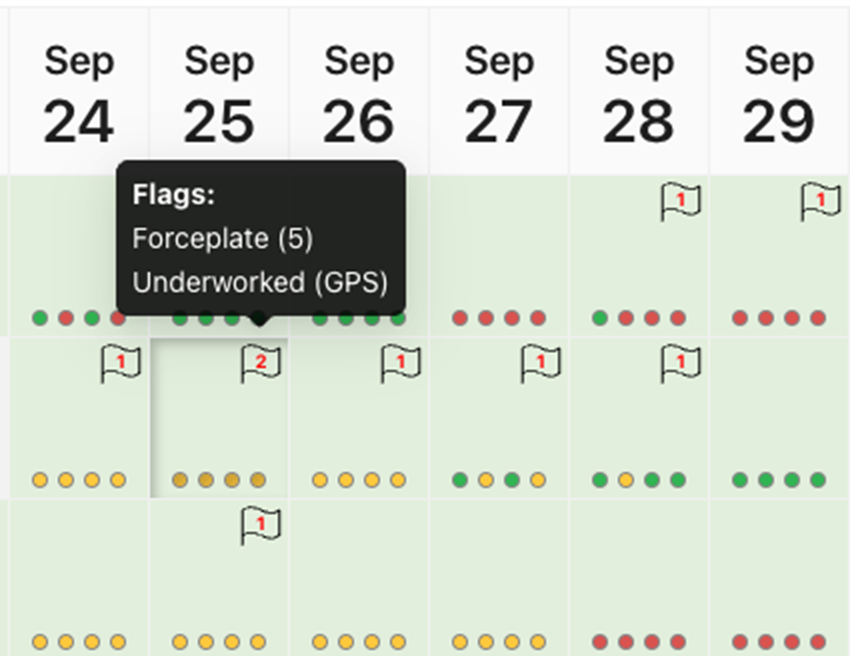
Figure 1. Force plate and GPS flags, displayed in the Whistle Performance dashboard.
(See clip below from a recent webinar where Ashley speaks about flags and data reporting)
But I also have to be careful because I really like isometrics, and I know that they aren’t always the only answer to the problem at hand. I don’t want to put them into a program just because they’re one of my favorite tools, easy to use, easily understood by the athlete, and so on.
I’ve deliberately taken them out of sessions when they weren’t the best tool for what I was trying to accomplish that day, or on days when I want the athletes thinking outside the box or solving a new movement problem. Isometrics don’t require that.
A good test for any coach is: can you take your favorite tool away and still solve the problem?
If I can’t live without a tool, movement, or modality, maybe we’re programming the modality for comfort or using a movement for tradition’s sake instead of prescribing exercises specific to the athlete’s needed adaptation.
Give us a real example: three exercises that could all train the same quality. How do you actually choose between them?
Let’s take lower body force production, strength, however you want to frame it.
I could use a bilateral barbell back squat, a Pit Shark or belt squat, or a leg press.
This is where exercise selection gets really interesting, because we’re not asking which one is the best. Instead we’re looking at which constraints are useful for this athlete and this adaptation.
The barbell back squat gives us a lot. But it also asks the athlete to manage the bar, their trunk, balance, external load, and a particular movement strategy. Like the Olympic lifts, it’s a skill in another sport (power lifting).
A belt squat changes some of those constraints. We can load the lower body heavily without making the trunk and axial loading as significant a part of the exercise. Is that always best? Not necessarily. Sometimes the athlete needs that axial load, some trunk stability and bracing, and other qualities.
And yes, sometimes I’ll use a leg press. If the goal is simply to build lower body strength and nothing else, it and other machines are superior in every way.
If we’re trying to create a lower body strength or hypertrophy stimulus and we don’t need balance or trunk stabilization to be part of that particular adaptation, choosing something other than the back squat is not a disadvantage. In fact, that may be exactly why I chose it.
If a constraint isn’t contributing to the adaptation I’m chasing, why does it need to be the thing that limits the exercise?
That doesn’t make a leg press better than a squat. It makes it a different tool. As practitioners, we know there are 15 ways to squat an athlete. Why we worship and revere one modality over the other baffles me.
The answer can change based on the athlete, the phase of training, or what we need that day. Some athletes are great candidates for a barbell squat, while for others the belt squat makes more sense. The goal is always to find the most appropriate exercise for the athlete in front of you. Meet them where they’re at and progress them in accordance with where they want to go and where they need to be to stay healthy and available.
Tweet ThisIf we’re trying to create a lower body strength or hypertrophy stimulus and we don’t need balance or trunk stabilization to be part of that particular adaptation, choosing something other than the back squat is not a disadvantage.
Ashley Kowalewski
What’s your go-to answer when someone asks for your “favorite exercise?”
“Favorite for what?”
I have exercises I use frequently. I have exercises that I really like to use. I have tools and tricks that I think are incredibly useful.
But I don’t have a favorite exercise independent of context.
Tell me the athlete and their history. Tell me about the adaptation we’re chasing. Tell me the time of year, how much they’re competing, and the constraints. Now we can have a conversation.
That’s probably one of the biggest things that has changed as I’ve progressed further into coaching. I was brought up in this profession believing there was a right progression for everything. You squat this way, then this way, then this way. Then you earn the right to progress. You learn this lift. Then you progress to that lift. And so on and so on.
The more athletes I’ve seen, and the more skilled coaches I’ve watched make completely different decisions and still get really good outcomes, the more curious I’ve become.
Maybe the goal isn’t to find the answer because maybe there isn’t a definitive answer. Just ask a better question or better questions: observe, ask, repeat.
The ideal athlete in a textbook doesn’t exist, so they can’t be the basis of our programming. We serve the person standing in front of us, and they deserve a specific solution just for them.
Curiosity drives that process, and that’s what keeps coaching interesting.
Tweet ThisThe ideal athlete in a textbook doesn’t exist, so they can’t be the basis of our programming. We serve the person standing in front of us, and they deserve a specific solution just for them.
Ashley Kowalewski