
Six experts all working within NFL organizations were asked this question. Here are their responses:

Jon Hernandez
Director of Rehabilitation, Los Angeles Rams
While return-to-play (RTP) decisions after a hamstring strain are inherently multifactorial, one objective marker consistently gives me the most confidence: the athlete’s ability to tolerate an entire NFL practice weeks’ worth of high-speed running exposure.
It’s relatively easy for a player to complete a single practice or hit an isolated sprint speed target. What’s far more challenging, and far more representative of practice demands, is repeatedly exposing the hamstring to high-speed running across multiple days while maintaining tissue tolerance and performance.
Every NFL position has normative high-speed running demands that accumulate over the course of a practice week. Those demands aren’t achieved in one session, they’re distributed across several practices with varying intensities and volumes. As clinicians, our goal shouldn’t simply be asking, “Can they sprint today?” Instead, we should ask, “Can they repeatedly tolerate the exact high-speed running demands that their position will experience throughout a full practice week?”
This means monitoring both the quality and quantity of high-speed running exposures. The athlete should consistently reach target velocities. Just as importantly, they should do so in ways that directly translate to their positional demands.
For example, a wide receiver may perform curvilinear weave runs to replicate special teams’ gunner responsibilities, or a defensive back transitions from a backpedal into a sprint to simulate covering a vertical route. They must demonstrate the ability to tolerate these position-specific exposures across consecutive practices without pain, compensatory movement patterns, a decline in performance, nor an increase in symptoms during or after an RTP session, including the following day.
The repeated exposure component is critical. Consistent exposure to high-speed running helps maintain hamstring fascicle length, preserves sprint-specific tissue capacity, and protects against the deconditioning that occurs when athletes spend prolonged periods below their normal running intensities. Hamstring injuries often occur under conditions of accumulated fatigue and spikes in cumulative load rather than during a single maximal sprint. Demonstrating resilience across an entire practice block provides valuable insight into the muscle’s ability to recover, adapt, and tolerate the repeated eccentric loading required for their sport.
Tweet ThisWhile return-to-play decisions after a hamstring strain are inherently multifactorial, one objective marker consistently gives me the most confidence: the athlete’s ability to tolerate an entire NFL practice weeks’ worth of high-speed running exposure.
@JonHernandezDPT
No single metric should dictate RTP. Strength testing, sprint mechanics, athlete confidence, clinical examination, and coaching input all remain essential pieces of the decision-making process.
However, when an athlete has successfully completed multiple position-specific practice exposures while achieving normative weekly high-speed running loads without adverse response, my confidence in their readiness increases substantially.
Ultimately, we aren’t returning athletes to one practice, we’re returning them to the demands of an NFL season. Replicating the cumulative workload they’ll encounter each week provides one of the strongest objective indicators that they’re prepared for what’s next.

Mohamed Almubiadin
Physical Therapist, New Orleans Saints
The objective marker that gives me the most confidence that a player is ready for full NFL practice after a hamstring strain is pain-free, objectively measured full-speed sprinting. The athlete needs to hit true maximal sprint velocity and handle that exposure without pain, altered mechanics, or a symptom flare-up later that day or the next morning.
While strength testing, MRI, and flexibility all provide valuable information, none of them truly replicate the demand that caused the injury in the first place. Sprinting does.
One of the biggest shifts in hamstring rehab over the past several years has been moving away from searching for a single “magic” strength number or a completely normal MRI. We now know that many elite athletes successfully return with small residual strength deficits, and MRI abnormalities often persist long after they are clinically recovered. Those findings do not necessarily predict who will reinjure their hamstring. On the other hand, if a player cannot confidently sprint at 100% effort, they are not ready for the unpredictable demands of an NFL practice, much less game day.
Sprinting is not the only criterion. Return-to-play is always multifaceted. Before clearing a player, I also want to see acceptable eccentric hamstring strength, near-normal range of motion, repeated sprint tolerance, and position-specific football movements without hesitation. For tendon-involved injuries, I’ll lean more heavily on imaging because those cases carry a different risk profile.
GPS and 1080 Motion technology make the sprint evaluation process much more objective. We gradually progress a player through specific percentages of their maximal recorded speed to correlate with their current phase of rehab until we reach 95–100%. That provides more confidence that the tissue can tolerate the stresses it will face when practice intensifies and efforts reach maximal.
No single test can guarantee a safe return. The research does not support that. But pain-free, objectively measured full-speed sprinting is the closest thing we have to a real-world stress test for an NFL hamstring.
Tweet ThisThe objective marker that gives me the most confidence a player is ready for full NFL practice after a hamstring strain is pain-free, objectively measured full-speed sprinting.
Mohamed Almubiadin

Connor Whicker
Associate Head Athletic Trainer, Minnesota Vikings
Restoration of eccentric hamstring strength to at least 90–95% of the uninjured side, measured under standardized testing conditions, gives me the most confidence that a hamstring strain is ready for full NFL practice. The reason is simple: football places enormous eccentric demand on the hamstrings. Players are rarely injured while slowly contracting the muscle.
Most hamstring strains happen during high-speed running, sprint deceleration, or terminal swing phase mechanics, situations where the hamstring is lengthening while producing force. If the athlete cannot tolerate that eccentric load, returning to full practice becomes a risk management problem rather than a performance decision.
But we should not rely on strength in isolation. Hamstring strain RTP decisions work best as a layered model. Imaging findings in conjunction with the player’s table exam help guide the decision-making process. However, they often hide asymmetries. Eccentric force production and output, on the other hand, give a quantifiable measure that directly connects to the tissue’s job in football. I have the most confidence when the eccentric strength result is paired with successful exposure to progressive sprinting, especially repeated sprint efforts above 90–95% of max velocity without symptoms.
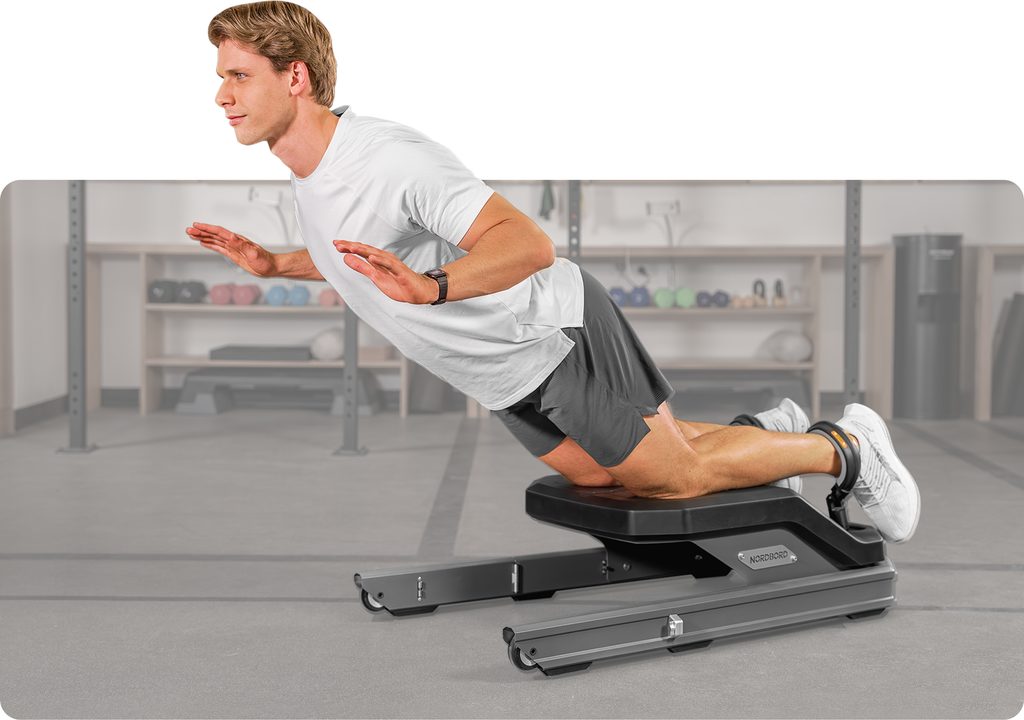
The goal is near-symmetrical eccentric output while completing a full Nordic eccentric hamstring test, with consistency across repeated efforts, not just one good rep. If an athlete can produce normal force but fatigues quickly or shows asymmetry after several efforts, confidence drops.
This marker rises above others because it reflects both biological recovery and functional readiness. A healed MRI does not guarantee the athlete can sprint. Full range of motion and isometric strength does not guarantee tissue tolerance. Even top-end speed numbers can sometimes be achieved through compensation.
But restoring eccentric capacity suggests the athlete has regained the specific ability the hamstring needs to survive practice demands.
Tweet ThisEven top-end speed numbers can sometimes be achieved through compensation. But restoring eccentric capacity suggests the athlete has regained the specific ability the hamstring needs to survive practice demands.
@Connor_Whicker

Bobby Gragston
Assistant Athletic Trainer, Los Angeles Chargers
The key question in hamstring strain RTP is not whether the hamstring is strong in a controlled testing environment, but whether it can repeatedly tolerate the exact demands that caused the injury in the first place. No Nordic hamstring test, isometric dynamometry assessment, nor limb symmetry index fully recreates these neuromechanical demands. These measures quantify force production under controlled conditions, but they cannot determine whether an athlete can coordinate force absorption at the speeds and loading rates experienced during competition. Recent evidence has questioned the ability of eccentric strength or limb symmetry alone to predict successful return to sport or future hamstring re-injury.
Progressive exposure to high-speed running directly challenges the tissue under sport-specific conditions. More importantly, it evaluates the integration of strength, coordination, timing, tissue capacity, and athlete confidence in a way that tests in controlled environments cannot.
GPS-derived running loads, repeated sprint ability, and position-specific physical demands are the main components of RTP decision making.
The most overlooked concept might be repeatability. A single sprint at 95–100% of maximal velocity demonstrates capacity. Repeated exposures over multiple sessions demonstrate robustness. This distinction is particularly relevant in the NFL, where most skill-position players are rarely asked to perform a single isolated maximal sprint. Instead, they must repeatedly accelerate, decelerate, and sprint throughout practices and games while maintaining movement quality under accumulating fatigue.
If performance deteriorates only after several high-speed efforts, isolated strength tests and single sprint assessments may fail to identify the deficits that matter most.
This does not diminish the value of strength testing. Rather, it redefines its role. Eccentric strength, long length loading tolerance, and pain-free function should form the foundation for progression to maximal sprinting. However, repeated exposure to near-maximal velocity should be the final performance-based confirmation that the athlete is prepared to tolerate the true demands of competition.
Returning to play should ultimately reflect demonstrated robustness, not simply restored strength.
Tweet ThisThe most overlooked concept might be repeatability. A single sprint at 95–100% of maximal velocity demonstrates capacity. Repeated exposures over multiple sessions demonstrate robustness. This distinction is particularly relevant in the NFL.
@BGragston

Ali Ghaisarnia
Assistant Athletic Trainer, Green Bay Packers
The objective marker that yields the most utility to answer the clinical side of RTP is high-speed run volume. High-speed running volume encompasses the yards run above 80% or 90% of an individual’s maximum speed. Assuming all other foundational impairments have been resolved (pain, range of motion, strength), sprint exposure becomes imperative.
The internal forces of the hamstring complex substantially increase as running speed increases above 7 m/s. Angular velocity demands on the hamstrings during sprinting also require extremely high eccentric strength capabilities and long muscle fascicle length capabilities.
No other task or exercise will place more stress or strain on the hamstring complex than sprinting. High speed running volume is an appropriate proxy for practice tolerance and illustrates the athlete’s repeated sprint capability. This metric can be further extrapolated to compare the volume during a rehab session at specific percentages to pre-injury volumes during a typical practice. Furthermore, we can compare the rehabbing athlete’s output to his peers in his position group to satisfy positional norms.
High speed running volume also gives the athlete opportunities to report their confidence for reintegrating into practice. This adds to the clinician’s peace of mind and gives the practitioner valuable information on the physiological state of the hamstring complex.
Tweet ThisNo other task or exercise will place more stress or strain on the hamstring complex than sprinting. High speed running volume is an appropriate proxy for practice tolerance and illustrates the athlete’s repeated sprint capability.
@alighaisarnia8


Alyssa Lee
Assistant Athletic Trainer, Buffalo Bills
To confidently rehab an athlete through a soft tissue injury such as a hamstring strain, one of the objective measures we use to guide progression throughout rehab is GPS tracking.
The athletes wear GPS trackers throughout practices in season, during their off-season training throughout OTAs when they are in the facility, and during rehab sessions.
Maximum speed, high-speed running volume, high acceleration and deceleration efforts, and total distance aid with programming and periodizing practices and rehab sessions. Each on-field rehab session looks different based on the demands of the program that day. These numbers act as a consistent goal that the clinician and the athlete can work towards and monitor throughout the sessions.
Because we track these metrics throughout the season and during off-season training, we have a historical record for each athlete over the years he has been on the team. The historical data helps accurately program their rehab and RTP, as we can assign individualized targets based on percentages of their maximum speed and their positional demands with differing volumes of high acceleration / deceleration efforts and high-speed running. These are important because football has a variety of positions that demand different outputs in different areas. Skill players, for example, accumulate many more high-speed yards than the offensive and defensive lines.
During a rehab session, we use a percentage of the athlete’s individual max speed to create a target goal for the day. As the athlete progresses, so does their target.
We will also use the high-speed volume, total running volume, and high acceleration / deceleration efforts to ensure the clinician does not overwork the athlete during a specific session. We use these objective markers in conjunction with the athlete’s subjective responses to determine whether
it is safe and appropriate for the athlete to progress within their rehab and eventually back to sport.
Tweet ThisMaximum speed, high-speed running volume, high acceleration and deceleration efforts, and total distance aid with programming and periodizing practices and rehab sessions.
Alyssa Lee