

What led you to build submaximal testing into your program?
We implemented submaximal testing with our squad during the 2025/26 season. We had investigated the topic in our research lab, and then tested the same protocol in our academy and rehab. The promising results encouraged us to implement it across the board during the last season.
Our main intent was to have an endurance test within our training structure on a weekly basis. Previously, our warm-ups included a short running portion, but we didn’t test anything during that time. It was a stable part of our weekly microcycle. And, of course, everybody was wearing heart rate and GPS devices. Now we more or less do the same thing, but we take away from it an extra level of output.
Integrating “invisible” submaximal testing does not mean that we will not do every other performance diagnostic. We still do our yearly anaerobic threshold / aerobic threshold testing at the beginning of the season. This gives us valuable data for planning preseason, and determines how we progress and plan our first training weeks. But that only gives us a snapshot of one moment in the beginning of the season. We could test this more often, but doing so would interfere with our training schedule and would not be possible for the whole squad.
With integrated submaximal testing, we can see progress over the whole season.
And this was exactly our goal: to find something that helps us during the season without being too time-consuming or annoying for the coaching staff and our players.
Training time on the pitch should always be the main focus. With our set up, we found a way to test and prepare our players for the training. From the beginning of the season, we’ve been consistent in how we work, which makes it easy for everybody to prepare and adapt to our way of training. It is also showing how research and practical training applications can work together in the same direction.
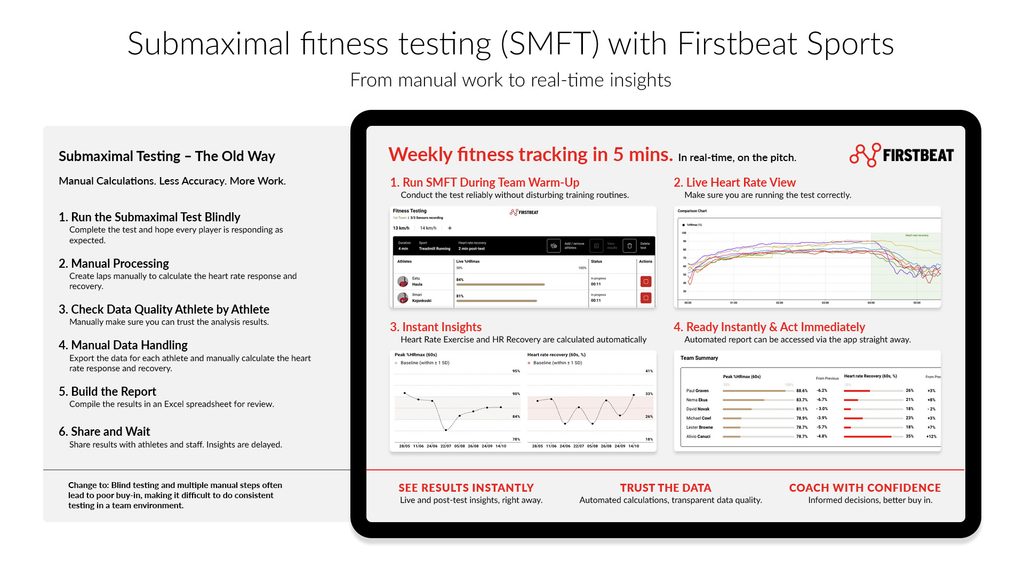
Figure 1. Submaximal fitness testing overview inside the Firstbeat application
Tweet ThisIntegrating “invisible” submaximal testing does not mean that we will not do every other performance diagnostic. We still do our yearly anaerobic threshold / aerobic threshold testing at the beginning of the season.
Philipp Lussi
What does a typical testing session look like for a squad, from set-up to the numbers you record?
If we have one game in the week, we normally test on MD-4. The players are in three groups of 6–8 players and start on different parts of the pitch, while running in the same direction. The players run a figure-8, with a pole in the grass every 50m. We blow a whistle every 15 seconds so the players get feedback about whether their speed is correct: they should be running 12 km/h.
Overall, the test takes about 5 minutes: 3 minutes of running followed by a 2-minute pause.
During the pause, the players walk to the second part of the warm-up for some coordination, acceleration, deceleration, and hip mobility work. That work takes another 10 minutes, and then the players start their football-specific training.
This protocol aligns with what we did during our research, but there are also protocols that do 4 minutes of running followed by 1 minute rest.
We start the test on our iPads and download the data from the players’ heart rate tracking devices after training. That gives us the results 5 minutes after the training ends.
We focus on the average heart rate of the last 60 seconds (HRex). Other values of interest are the peak heart rates after 30, 45, 60, 120, and 180 seconds.
We do the same test with rehabbing players on a weekly basis, using a protocol on the bike if the player is not able to run.
Next season, we will face the challenge of playing more often with greater fixture congestion. Traveling and time zone changes can influence the submaximal test due to the effects on the circadian rhythm. We will have to adapt our style of testing a bit and be more flexible, we will likely test on MD-2/MD+2, which will most likely be Tuesdays.
What specific metrics or insights do you pull from the results, and how do they shape your decision-making process?
HRex is our central value. It shows the heart rate during a fixed speed threshold, expressed as a percentage of each player’s HRmax.
We determine HRmax at the beginning of the season where we test our players to exhaustion. If a player reaches a new HRmax during the season, we automatically adapt the value.
We calculate the standard deviation and the z-scores from every test. After 3–5 tests we have the first reliable values to see each player’s individual development. That informs our initial training suggestions. The literature suggests that a change of 3–6% in HRex indicates an actual change in player fitness. We look for a change of 4–5%, and interpret values below that as noise.
Each player’s historical line graph from the Firstbeat software clearly shows his progress (or lack of progress). Progress does not show up every week. Sometimes the HR was a little higher or lower during the test than the weeks before. The main focus should be the development over time, don’t over-weight any one value in either direction. But it is always great as a conversation starter or chance to put more focus on the player in the following weeks.
If a player’s HRex rises over 2–3 weeks, we try to adapt the training stimulus and put in some extra aerobic work. We mainly add around 60–90 minutes of aerobic work on the bike to eliminate the load on the lower limbs. However, we make the full range of interventions: more training, less training, different training, or no training. If nothing is working, there is the possibility that the player is a non-responder to the test, which is well described in the literature. We only had a few such players: their curves went up and down every week. We also account for the weather and the specifics of training in our evaluation.
We discuss all of the results with the coaching staff and try different training interventions. The head coach is always in the loop if important trends are developing. Our focus is on the individual player values and not the team average, since the team might change slightly from week to week due to injuries or illness.
How do you explain the results to players and coaching staff?
We communicate the results openly and plainly to the players. We are showing them their development and give them suggestions for their weekly training plan.
We mostly do these talks one-on-one in informal conversations. Most players are really interested in their results, and every player has the chance to get as much information as possible. It is always a great exchange and you get the best insights from those conversations. Those talks offer the best understanding of how the player feels, what he might need, or if something is affecting him.
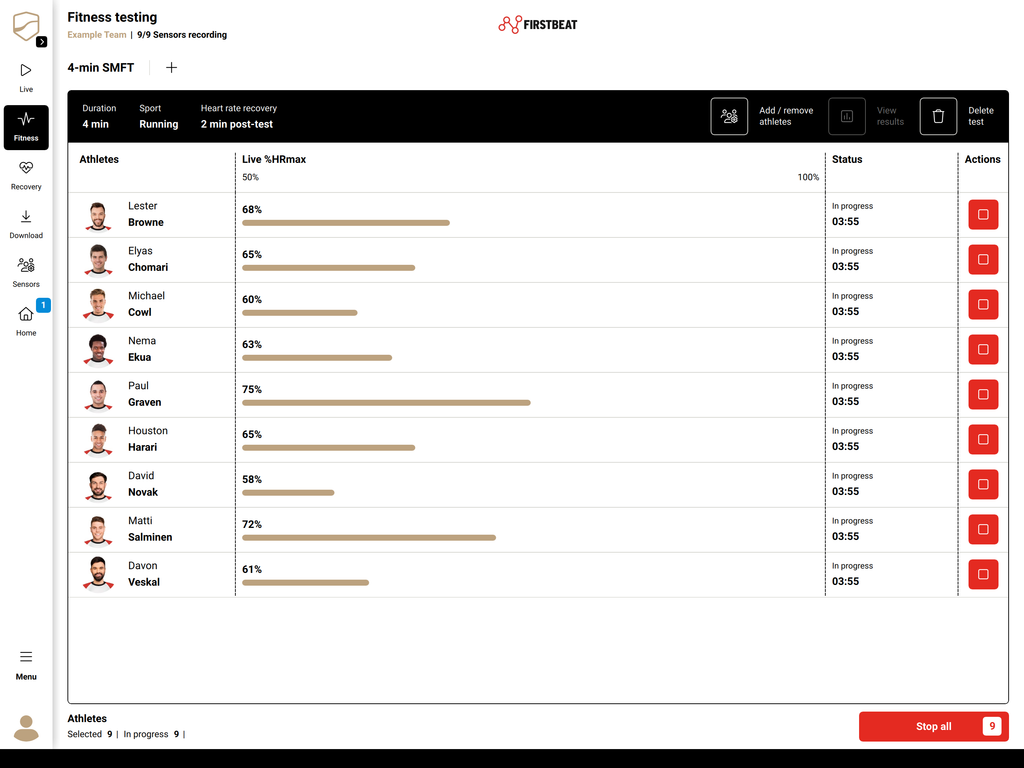
Figure 2. Submaximal fitness testing report generated in the Firstbeat dashboard
There have been numerous examples of seemingly inexplicable variations in heart rate responses to the test, and without the one-on-one conversation, I wouldn’t have had the answer as to why the variation occurred.
Most players intuitively know their body and their training status. It is great to have a diagnostic to back that up or to help them develop this understanding of their body better. But the conversations are crucial even if everything is going in the right directions.
We keep things very simple and straight-forward for the coaching staff. Mostly, it is a conversation in the coaching office if something occurs. Of course, if there are developments we have to address, we put more focus on the communication. But overall we have a great trust in our staff, so we do not need to explain every training intervention.
Tweet ThisWe communicate the results openly and plainly to the players. We are showing them their development and give them suggestions for their weekly training plan.
Philipp Lussi
What are the biggest limitations or sources of error you’ve had to manage when testing athletes in a team sport setting?
Heart rate is a highly sensitive signal, which makes it meaningful but sometimes also variable. Some research shows a 1% increase in %HRmax for every 10°C. Wind and the playing surface can also make a small difference. Heart rate may be higher in the afternoon due to the circadian rhythm, which might also show up in our results, especially since we mostly train in the morning. If we train in the afternoon, the prior day was likely a day off and the players may have been travelling that morning.
Next to time and travelling, dehydration, caffeine ingestion, and sleep quality can influence the results. I also suggest not having any balls on the pitch during the test. The players seem to be magically attracted to the ball, and dribbling or passing the ball while running will raise the heart rate.
We also deviate a little from the standard by testing on MD-4. Typically you test after a low intensity training day, which would be MD-3 in most set ups. The reason for this is that the plasma volume might rise after a hard training stimulus, which would lead to a lower heart rate. This could be interpreted as a positive development. Our MD-4 training is intense and our warm-up structure on MD-3 is not the best for a submaximal run, therefore we go with MD-4.
We mostly test after a day off, which can lead to a lower plasma volume and therefore a slightly higher HR. But overall, the most important thing is to stay consistent.
Most teams will have a few non-responders to the test. They were about 5–10% of our squad. The curves from those players will be very different every week, or won´t change at all. It is important to know and understand this. To try to adapt the training to evaluate if the player is a non-responder or if the training was not ideal, is also still important.
Tweet ThisTypically you test after a low intensity training day, which would be MD-3 in most set ups. The reason for this is that the plasma volume might rise after a hard training stimulus, which would lead to a lower heart rate.
Philipp Lussi
We had one player whose curve was not moving over several months. He then had a tournament in which he did not play and train much, which became a sort of a deload phase. After this training block, the results from the test got much better. We interpreted this as a kind of supercompensation, which was pretty interesting to see in actual diagnostic data.
Practitioners have to ensure the players are properly wearing the heart rate sensor and strap. During the winter, the strap is too dry at the beginning of the training, which could reduce data quality. Our software can quality assure the data to ensure the tests are valid. Over time, I’ve learned which players tend to have a lower data quality, so I try to help them before we start with the test. Over a season, we’ll have 2–3 tests we cannot use from some players.

Figure 3. Live heart rate tracking during submaximal fitness testing provided by Firstbeat
How has retesting across a season changed how you think about a player’s progress or your own coaching decisions?
We have a better understanding to trust the long term trend, and not over-interpret short time periods. The data also validated our training style and the development of the whole squad. It was great to see how a training reduction after a hard training block can lead to overall better fitness levels. It´s also great to see how different training methods lead to varying improvements. Those results are great arguments when telling a player to go on the bike after a hard session.
The rehab process also showed great insights. We underestimated the effects of 1–2 weeks of reduced training due to an injury. We needed much more time to regain pre-injury fitness levels. The data helped us optimize rehab and put more focus on aerobic training during rehab. It´s something we did before, but now we can be much more specific and effective with it.
For long term injuries, the data provided encouraging looks at how players regained their usual fitness levels. We did not use the submaximal tests as a hard return to play criterion, but we always kept looking at it over the whole rehab phase.
On the team level, it is also good to see if the overall average is moving in a good direction, although we have to be careful with that team average. Now that we are using the test for a second season, we can see how most players are regaining their HRex values from the end of the last season.
My tip for every coach would be to put a of lot work into planning the test and communication. This keeps a great tool relevant and easy to understand. Make minimal changes from the first set up so you can keep things consistent.
If done correctly, it´s a great test to evaluate your gut feeling. But it also shows that data without context is mostly worthless.
Tweet ThisWe have a better understanding to trust the long term trend, and not over-interpret short time periods. The data also validated our training style and the development of the whole squad.
Philipp Lussi