
Hamstring strain injuries (HSI) are one of the most common time loss injuries in sprint based sports. High rates of recurrence impose great physical and economic burden on elite athletes and sporting clubs [1].
One of the biggest challenges surrounding reconditioning an athlete from HSI is the high variability in recovery time. A related element is their ability to sustain high intensity athleticism during a prolonged and uncertain period away from high threat tasks such as sprinting and high load stretch positions. These are particularly relevant during rehab from high grade injuries and injuries that affect the aponeurotic tissue [2,3].
This article will explore the reconditioning process for an athlete following high grade HSI and provide practical steps for the clinician to facilitate optimal return to performance.
Tweet ThisA related element is their ability to sustain high intensity athleticism during a prolonged and uncertain period away from high threat tasks such as sprinting and high load stretch positions.
Justin Richardson
Hamstring injuries start with hamstring anatomy
The hamstrings are biarticular muscles spanning both the hip and knee joints, with distinct roles at each.
The biceps femoris long head (BfLH) and the semitendinosus attach to the pelvis via a conjoined tendon at the ischial tuberosity. Unlike the semimembranosus and semitendinosus, the BfLH possesses an additional attachment to the sacrotuberous ligament, directly connecting it to the sacroiliac joint (SIJ). This attachment suggests the BfLH may contribute to, and be influenced by, pelvis and SIJ stability. Thus, alterations in pelvis and SIJ kinematics will likely impact the strain distribution through the BfLH.
Distally, the semimembranosus and semitendinosus attach to the medial tibia, merging with the medial collateral ligament, meniscus, and pes anserine. The biceps femoris descends distally, forming the biceps femoris short head that inserts on the lateral aspect of the fibula head, with fibres blending with the lateral collateral ligament, iliotibial band, and surrounding fascia.
This complex anatomy provides clear connections between the hamstrings and proximal segments (trunk and pelvis), as well as distal segments of the knee and lower limb.
The direct connections between the BfLH and sacrotuberous ligament also highlight the BfLH’s role in pelvis and SIJ stability. Therefore, the hamstrings not only serve dual roles extending the hip and flexing the knee, but likely contribute to rotational and translational stability at the knee and the hip. Mechanics at both proximal and distal segments can impact hamstring function and the applied mechanical strain.
Stretch and sprint injuries
The two major mechanisms of HSI are stretch and sprint.
Stretch type injuries usually involve some form of combined excessive hip flexion and knee extension moment [4]. These usually result in violent injuries, and may involve either the proximal or distal musculature. Connective tissue either at the free tendon or IMT level is implicated in most cases [4].
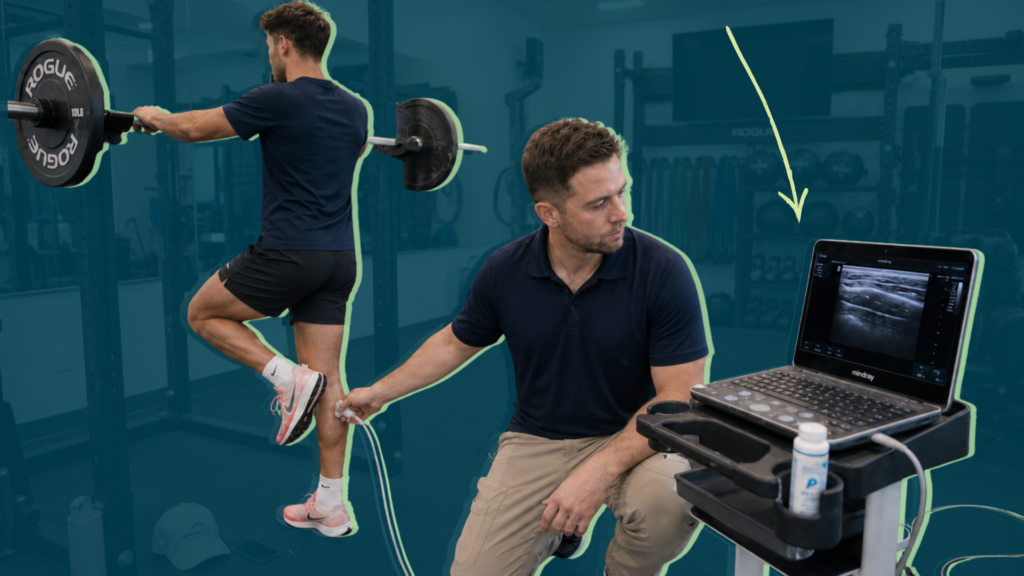
Historically, discussions around contributors to HSI investigated risk factors at a cellular level. This led to a widely popularised theory around fascicle lengths and the “quadrant of doom.”
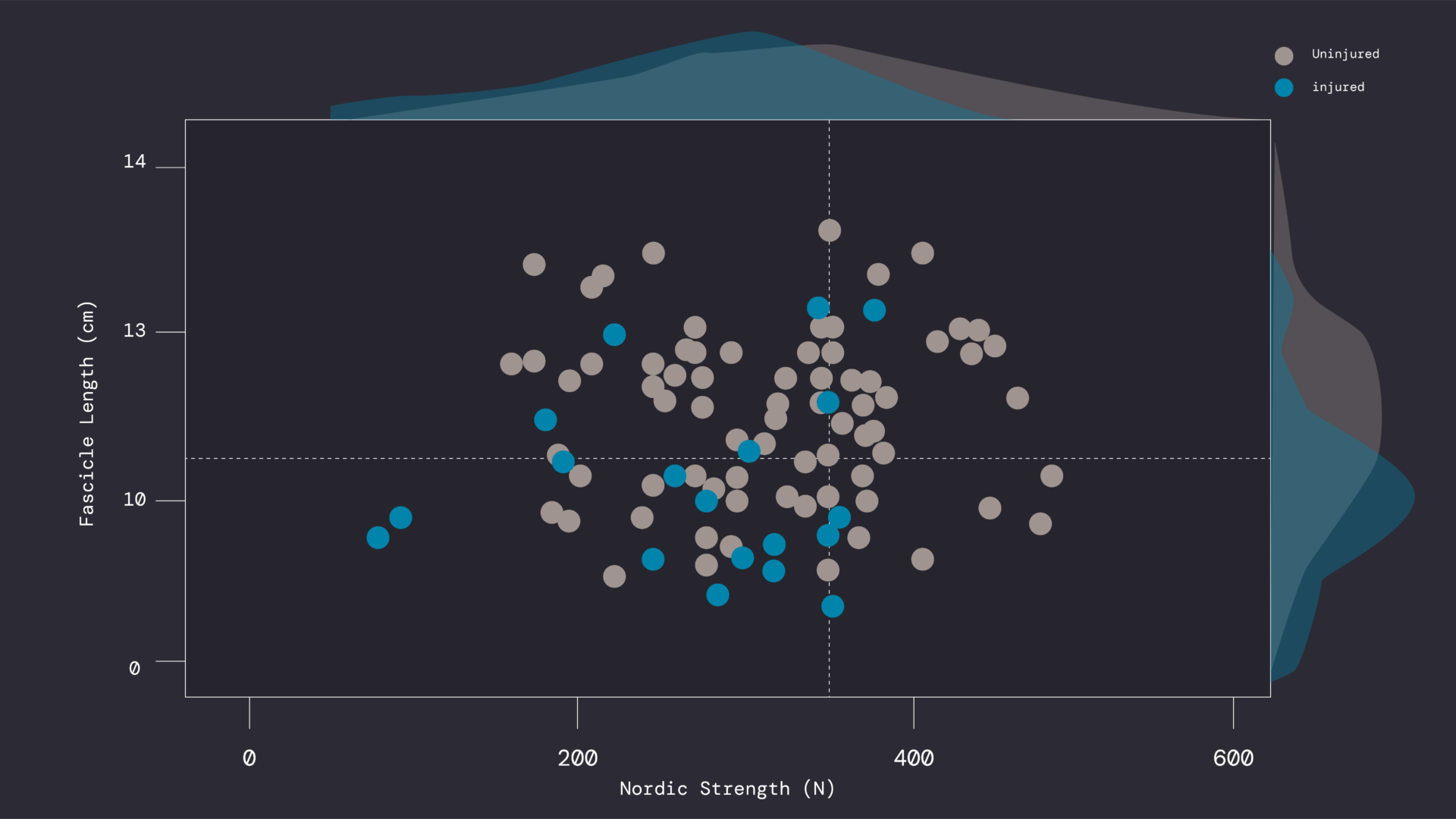
Martin Buchheit put forth two key criticisms of the model. First, the relationship between fascicle length, muscle strength, and strain during active lengthening probably depends on both the muscle head and the individual player’s characteristics. Using a single measure — fascicle length — on a single muscle (e.g., biceps femoris long head) to assess the overall injury risk of the hamstring group is therefore prone to approximations.
Second, the “quadrant of doom” is a two dimensional representation of hamstring injury risk factors. It does not leave room for other extremely important risk factors such as age and previous injury history. Those omissions bias the risk evaluation [5].
Tweet ThisStretch type injuries usually involve some form of combined excessive hip flexion and knee extension moment. These usually result in violent injuries, and may involve either the proximal or distal musculature. Connective tissue either at the free tendon or IMT level is implicated in most cases
Justin Richardson
Determining what needs to be done
When an athlete sustains an HSI, the first and most important step is gaining an accurate understanding of the anatomical location and severity of injury. MRI is critically important, in conjunction with a clinical examination, as injuries to both the intramuscular tendon (IMT) and high risk locations such as the T-Junction are difficult to diagnose on clinical testing alone [5].
Time frames of recovery may vary significantly depending on location of injury. Mean recovery times are significantly faster for type “a” and type “b” injuries than for type “c,” where initial protective periods are encouraged to allow for adequate Type III collagen formation among the tendon tissue.
Starting from an accurate diagnosis, the reconditioning process begins by outlining the requirements for the athlete at local and global levels to facilitate return to performance.
During this process it is important to look at optimal local tissue loading; global mechanism of injury contributors; general physical preparation demands; and specific physical preparation demands.
Tweet ThisWhen an athlete sustains an HSI, the first and most important step is gaining an accurate understanding of the anatomical location and severity of injury. MRI is critically important, as injuries to both the intramuscular tendon and high risk locations such as the T-Junction are difficult to diagnose on clinical testing alone
Justin Richardson
Optimal local tissue loading
Normalising mechanical function of the hamstrings is vital to ensuring an athlete can successfully navigate their return to the pitch, and for preventing chronic maladaptations that may occur in response to injury.
The three distinct phases of wound healing are:
- Inflammatory phase: rupture and necrosis of the myofibers, formation of a hematoma, and critical inflammatory reaction.
- Proliferation phase: satellite cell activation and a period of scar formation.
- Remodelling phase: Maturation of scar tissue formation towards maximal contractile strength.

Creating a framework of rehabilitation related to phases of tissue remodelling can allow the rehabilitation professional to understand and respect elements such as acute inflammatory phases. These may differ in length based on the severity of injury. They also then assist in load prescription during the regeneration and remodelling phases by aiming for restoration of type 1 collagen.
Isometric and eccentric contractions appear to provide the greatest adaptation for muscle fascicles and are favourable for tendon adaptation, so they should be high priorities.
Click here to view additional inner range exercises.


The primary difference between the three framework models above are between type “b” and type “c” injuries.
We give more leeway to the inflammatory phase of tissue recovery during these injuries. Initial exercise selection is concentric biased, before shifting to isometric loading in short muscle lengths to maintain the muscle-tendon unit (MTU). Finally, we progress to long length isometrics and supra-maximal eccentric contractions in late stage rehabilitation to challenge the MTU in a more dangerous position, while also challenging the global stability based anatomy of the trunk and pelvis.
Tweet ThisFinally, we progress to long length isometrics and supra-maximal eccentric contractions in late stage rehabilitation to challenge the MTU in a more dangerous position, while also challenging the global stability based anatomy of the trunk and pelvis.
Justin Richardson
Phases of loading during rehab
These graphics detail a strength based framework for progressing an HSI from early stages of injury to late stage rehab. Individual prescription will highly vary depending on location and tissue type involvement of the specific injury.
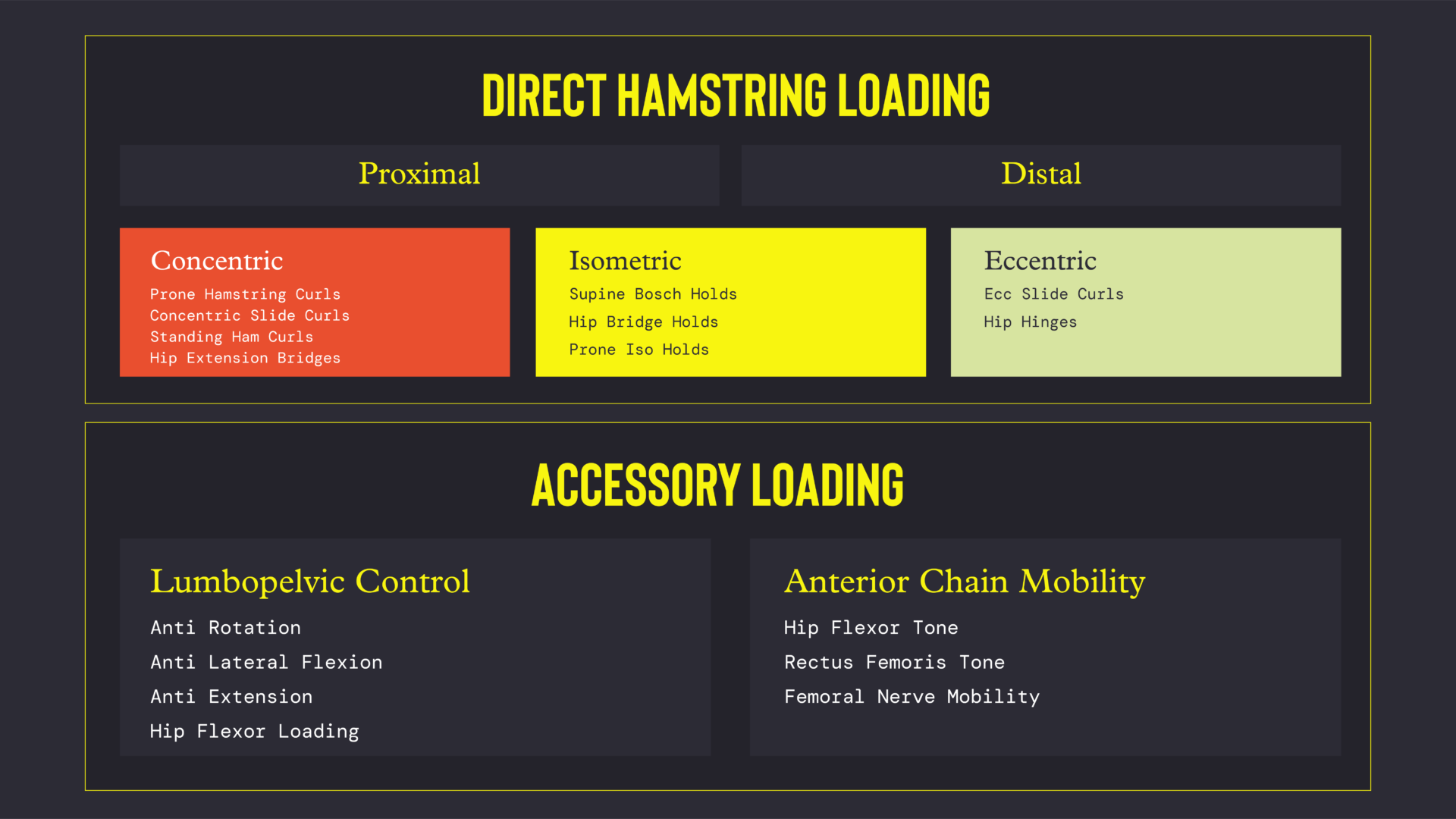
Direct hamstring loading in the protection phase of rehab should be self-limiting and geared towards providing optimal motor control throughout time under tension. During acute stages of loading, pain levels should be minimal and controlled. Athletes should be able to feel loading throughout the area of tissue that we want them to feel it in. This may be through exercise selection or body positioning during a particular drill.
Accessory loading should target control and coordination of the trunk and pelvis, beginning with static positional drills and allowing the athlete to achieve maximal range through the anterior chain.

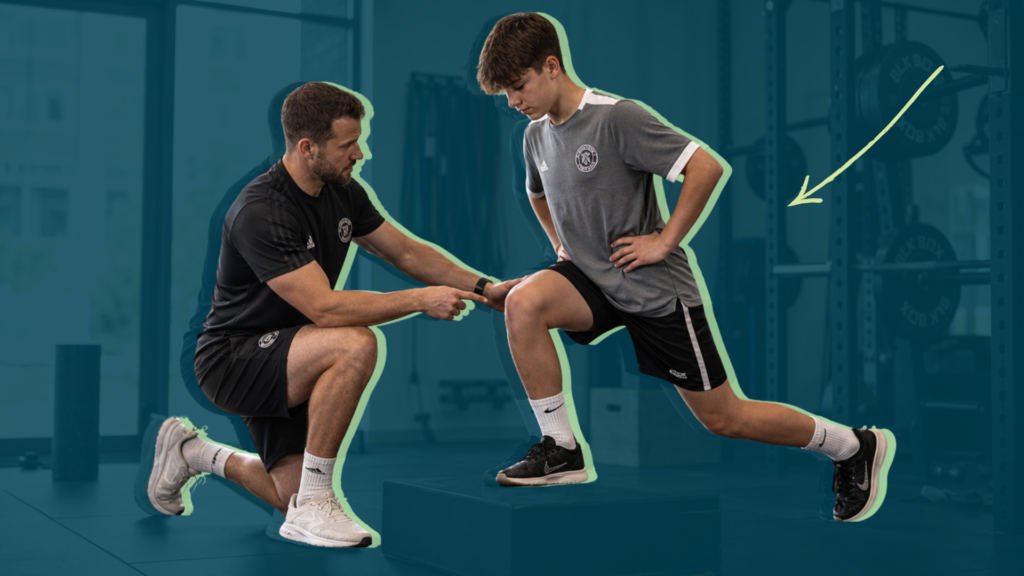
Direct hamstring loading in the load introduction phase of rehab should be geared towards combining elements of hip extension and knee flexion under increasing tensile demand. Athletes can still perform eccentric movements at either an isolated hip or knee dominant position, and with shorter times under tension or reduced ranges of motion. But the priority should be developing high isometric load specific to the position of injury.
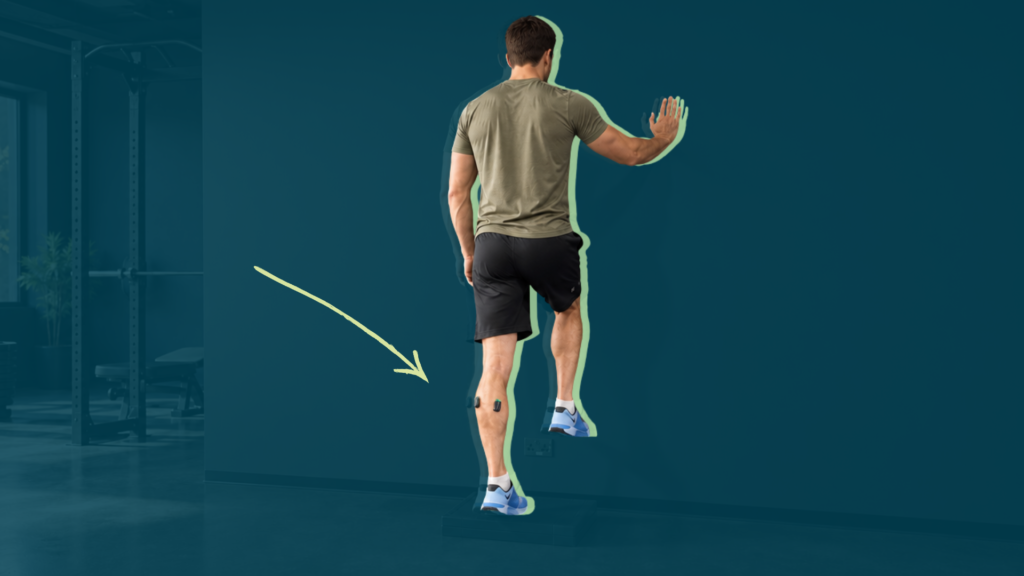
Accessory loading should target dynamic movement control in specific gait mechanics tasks. Options include wall drill positions and progress to more dynamic flow type drills. Constraints such as aqua bags, bands, and dowels can facilitate the positions we want the athletes to achieve.
However, we must be careful that the tasks do not get too far ahead of the athlete’s capacity at this stage of recovery; and that we do not make the activities complex for the sake of being complex.
Click here to view additional isometric exercises at longer muscle lengths.

In the strength accumulation phase, direct hamstring loading should be geared towards high eccentric and isometric load at long muscle lengths with large time under tension. Athletes often reach technical competency in an exercise and practitioners overlook elements of progressive overload, leaving athletes susceptible to being underloaded and poorly prepared when it comes to tensile demands of the tissue.
Accessory loading should target plyometrics and rate of forced development in the hamstrings, foot, and ankle complex. Bad things happen when athletes spend long periods of time on the ground, so we need to train their ability to express and control force rapidly.
Click here to view additional eccentric and concentric exercises.
Organizing the return to run
Running is a primary contributor to the onset of HSI, so the return to run phase of rehab is crucial. When designing the return to run program, practitioners should visualise the process as promoting athletic qualities while also protecting the athlete from high threat demands. For HSI, these threats include high speed and eccentric load.
Components of technical development should be isolated from the reconditioning element of running, but with equal emphasis on both as early as possible. Otherwise, we will find ourselves with athletes who are excellent at performing march and skip drills that minimally transfer to their running mechanics when they enter live match play situations. We need to understand the importance of not only the specific physical preparation demands related to sprinting, but also the general physical qualities that allow the expression of optimal mechanics, particularly under fatigue.
The key general physical qualities are sagittal and frontal trunk coordination, and foot and ankle stiffness.
The most efficient strategy to attack these physical qualities early in rehabilitation is stair running.
Stair running has several biomechanical advantages. It is a constrained method of controlling stride length and promoting front side mechanics. It develops high plyometric loads through the ankle whilst reducing eccentric demands. And it is self-limiting: athletes cannot persist or “power through” suboptimal mechanics when they fatigue. Central and peripheral fatigue constrain the athlete to speeds they can control.
Within an individualised approach, a useful and safe place to start is developing an athlete’s ability to produce a strong front side body position during their max velocity phase. Effectively cycling or striking their foot under their centre of mass will help to reduce the negative impacts that may occur from overstriding, back side dominant mechanics, or lumbar hyperextension.
Limb cycling, limb switching, and “bounce” or stiffness based drills are the basis of this approach.

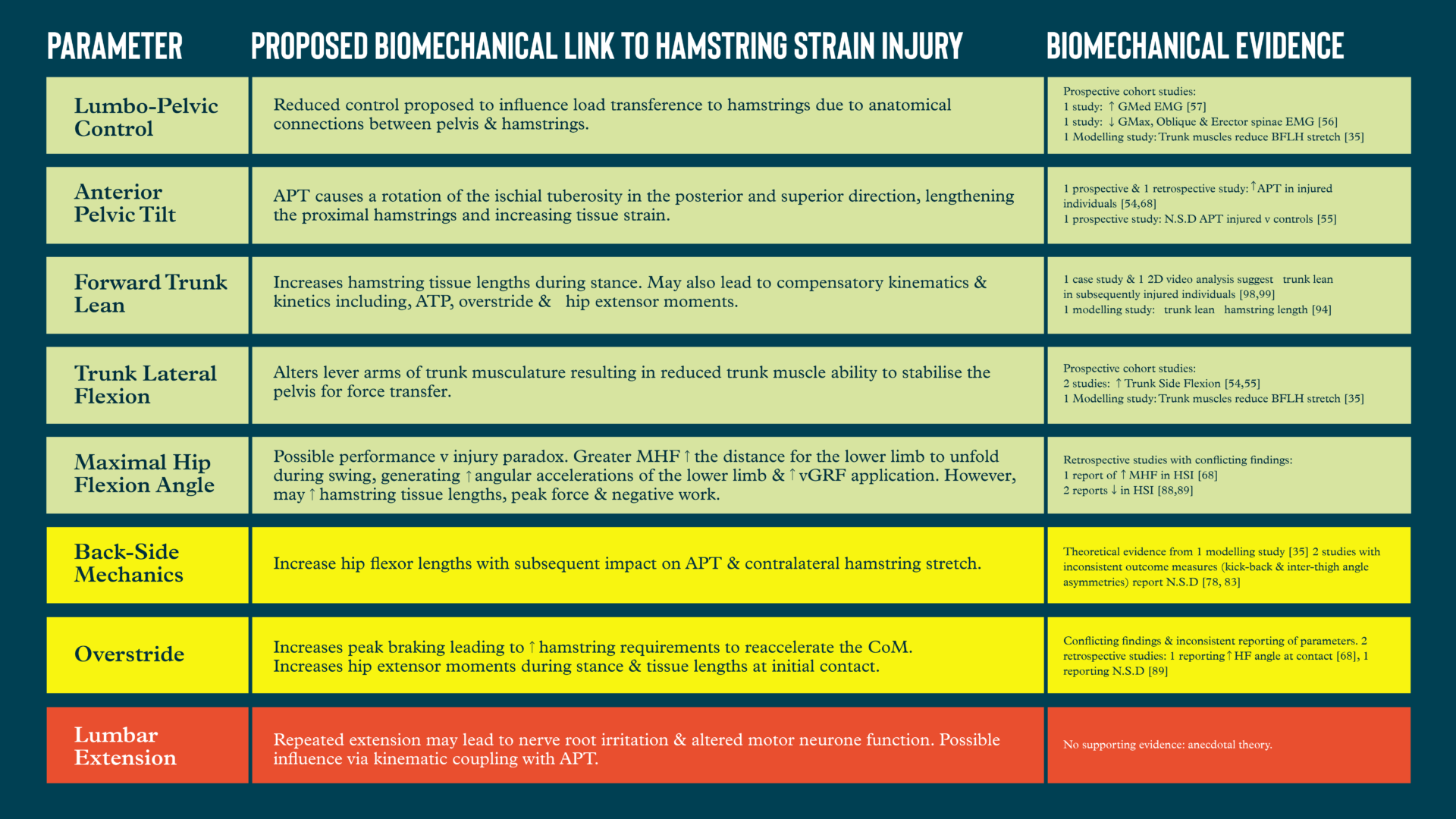
General movement control sequences geared towards trunk coordination should target an athlete’s ability to achieve and control anterior pelvic tilt, forward trunk lean, trunk lateral flexion, and adequate hip lock positioning. These directly link to biomechanical factors that contribute to HSI.
Three streams comprise the on field reconditioning for the return to running: acceleration development, max velocity development, and speed exposure / speed tolerance.

When designing on feet loading strategies, consider the end goal in terms of each athlete’s anticipated training load upon their full return to training. From there, work backwards to reverse engineer their rehab running schedule.
During the initial stages of an athlete’s return to run, day on / day off loading strategies may be the most reasonable approach to allow the athlete at least 48 hours between bouts of load. Monitoring key metrics such as overall volume, high speed running volume, very high speed running volume, and volume and intensity of accelerations and decelerations will protect against a spike in acute to chronic workload demands, particularly in the late stages of rehab running.
For most hamstring injuries, the progression of speed requires the most scrutiny. A conservative session-by-session approach is “build-build-regress,” with an increase of 5-10% vMax per session. For example:
Session 1: 50% vMax
Session 2: 55% vMax
Session 3: 50% vMax
Session 4: 60% vMax
Session 5: 65% vMax
Session 6: 55% vMax
Volume development usually isn’t too threatening on an athlete in this stage of recovery. However, practitioners should factor in the athlete’s accumulation of high speed running (>5 m/s). Running between an athlete’s maximal aerobic speed and anaerobic speed reserve is an effective way to satisfy this need.
Overall, aerobic and anaerobic reconditioning methods may facilitate this better than others. Eurofit methods of interval training and tempo running are my favoured methods for extensive conditioning, and shuttle running for intensive conditioning. The advantages are that the passive recoveries in the extensive running promotes an athlete’s ability to sustain higher aerobic power outputs, while the shuttle running options reduces the athlete’s ability to hit high speeds while under fatigue.
Tweet ThisFor most hamstring injuries, the progression of speed requires the most scrutiny. A conservative session-by-session approach is “build-build-regress,” with an increase of 5-10% vMax per session.
Justin Richardson
Periodising the return to training
When the athlete returns to team training, rehab practitioners have to account for all the loads they experience in their training week: sport training, gym, and field conditioning sessions.

Building around the competition schedule — particularly when the team or sport is not on a consistent seven day turnaround time between games — is the optimal method of periodising a microcycle.
MD+3 is primed for the heaviest loading session of the week through range of motion, and MD-2 is best for heavy isometric / reduced ROM stimulus. Similarly, speed exposure may work best on the first training day of the week during preseason, before shifting it to MD+3 during the season.
After the inflammatory / protection phase of rehabilitation, clinical measures such as range of motion, stretch tolerance, and isometric hamstring strength development allow the safest method of monitoring physical recovery. During load reintroduction phases onwards, assessments geared towards high load eccentric and isometric strength provide the most usable data.
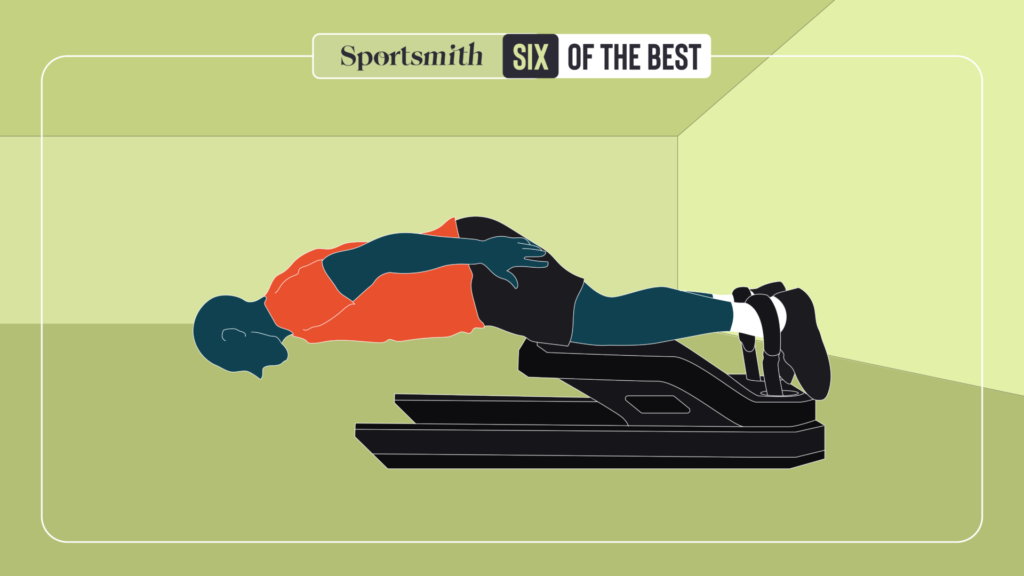
The VALD Performance Nordbord and Performance Forcedecks provide metrics of maximal torque and RFD. Key testing procedures include the Nordic on the Nordbord and long lever iso bridge on the Forcedecks.
Despite continually improved understanding of the anatomy, physiology, risk factors, and prevention mechanisms of hamstring injuries, their incidence remains high. While there is still debate about the role of direct strength training to the hamstrings, indirect strength and motor control training to the lumbo-pelvic region and exposure to high speed running are well-established contributions to healthy players with high availability.
Tweet ThisWhile there is still debate about the role of direct strength training to the hamstrings, indirect strength and motor control training to the lumbo-pelvic region and exposure to high speed running are well-established contributions to healthy players with high availability.
Justin Richardson