

Exercise prescription in groin pain cases often boils down to finding the right recipe: how can we manipulate load to achieve a desired stimulus, and how can we progressively manipulate that load until the player can perform football related actions and rejoin training without symptoms recurring?
Our two previous articles touched on exercise prescription, such as the Copenhagen Adductor Exercise (CAE), for primary prevention and utilizing pain modulation techniques for secondary prevention. This article dives deeper into exercise progressions and regressions, using test-retest, and returning (safely) to football. For example, the CAE is a useful tool for rehabilitation and primary prevention, but players with groin pain may need to start with a regressed version of adductor local load tolerance [1, 2]. Below, we consider a systematic approach to gradual progressive overload to turn isolated gym exercise into football performance.
Tweet ThisExercise prescription boils down to finding the right recipe: how can we manipulate load to achieve a desired stimulus, and how can we progressively manipulate that load until the player can perform football related actions.
Matthew Delang, Lasse Ishøi
Local load tolerance
Local exercises are exercises that directly target the injured tissue and should be prescribed to a level that is tolerable while still promoting an adaptive progressive overload. For example, we wouldn’t stick to a side lying hip adduction exercise and expect it to translate to football related actions on the pitch. The key is to find the balance. Figure 1 shows a continuum of adductor local load tolerance exercises that functionally and objectively progress the player through rehabilitation.

Practitioners can manipulate many variables to progress and regress adductor exercises. These include range of motion (small to large, mid-range to end range); contraction type; lever length, or other biomechanical variables; postural demands (supine / prone, quadruped, half kneeling, tall kneeling, split stance, standing, single leg); movement speed; and resistance. Additionally, consider not only the exercising limb but also the stabilizing limb. During a cable hip adduction exercise, the stabilizing limb is exposed to an isometric hip adduction contraction to assist with hip and pelvis stability. While these exercises are an example framework to target adductor loading, numerous functional exercises have high adductor demands to stabilize the hip and pelvis.
For each variable, practitioners move through the continuum turning each dial up or down.
If side lying hip adduction through a full arc of motion is painful, then regress to a side lying hip adduction motion with the practitioner manually assisting the concentric action, biasing only the eccentric lowering phase against gravity. If that is still too challenging, add in a stability / motor control assist with an elastic band between the player’s arms. This can both provide some proximal stability to support the distal mobility needed to perform the exercise, and shift the player’s focus from the pain in the adductor to the muscle burn in the shoulders. If the player can perform 2 x 12 side lying hip adductions with quality movement, then practitioners should progress the exercise into elastic band hip adduction or the short lever isometric CAE.
At every step, whether targeting the adductors, hip flexor or abdominals / core, manipulate load in terms of resistance versus assistance, volume, and time under tension to provide an adaptive stimulus.

Tweet ThisPractitioners can manipulate many variables to progress and regress adductor exercises. These include range of motion; contraction type; lever length, or other biomechanical variables; postural demands; movement speed; and resistance.
Matthew DeLang, Lasse Ishøi

Practitioners have hundreds of exercises to choose from and adapt—the most important aspects are understanding the stimulus and knowing how to progress/regress the movement. The key is simple: find the right one at the right time, and use test-retest to progress further along the continuum.
In the adductor and hip flexor load tolerance examples above, the “higher level” exercises shift into more velocity based actions. In addition to confirming that strength is sufficient with test-retest, practitioners should also verify that the player can perform speed based actions before introducing explosive or high intensity pitch actions.
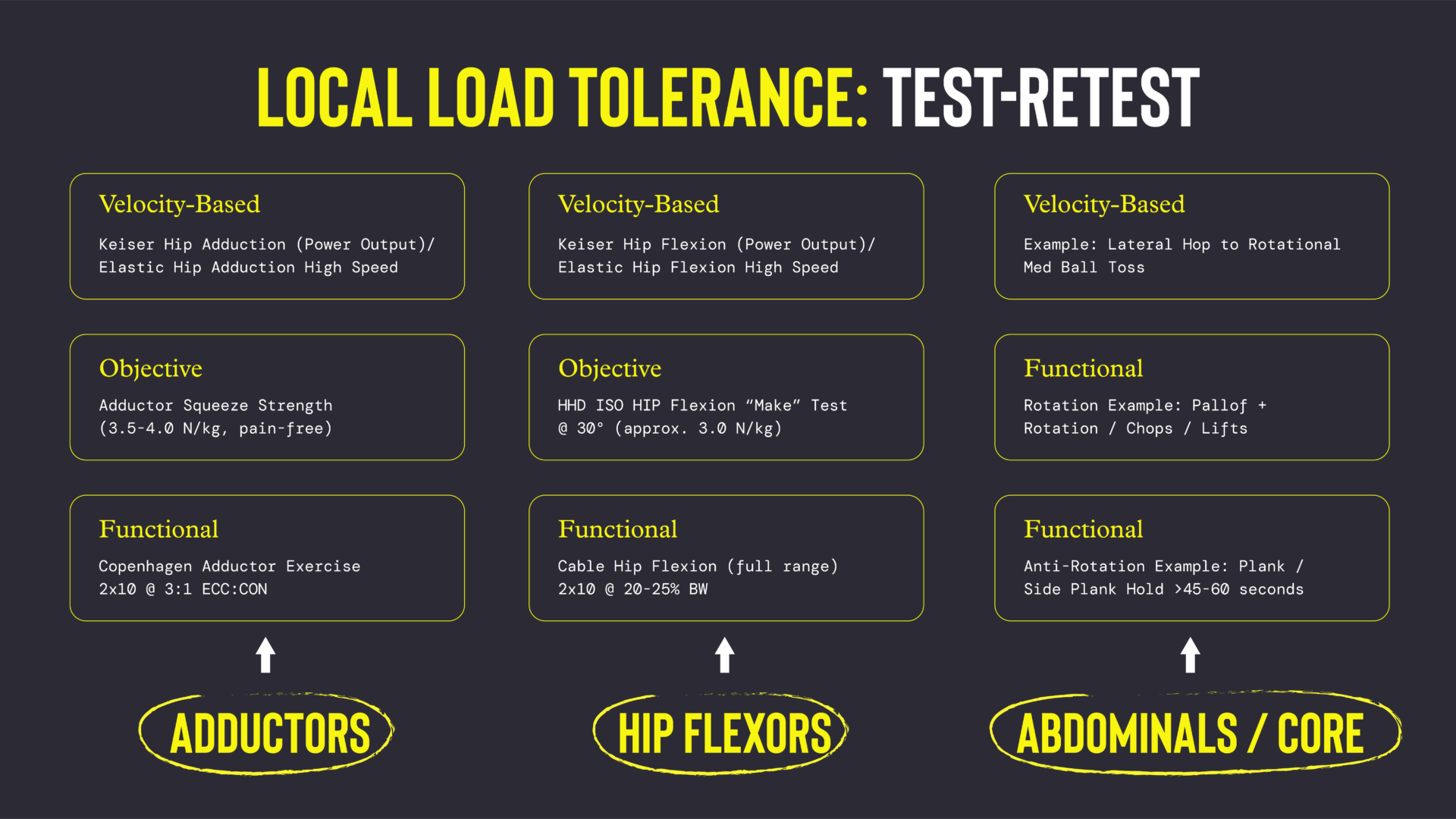
Tweet This“higher level” exercises become more velocity based. After strength sufficiency confirmation via test-retest, practitioners should verify that the player can perform speed based actions before introducing explosive or high intensity pitch actions.
Matthew Delang, Lasse Ishøi
Regional load tolerance
Often, the local load tolerance continuums apply to regional load tolerance exercise. For example, in an adductor-related groin pain case, local exercises for hip flexors and abdominals / core double as regional load tolerance exercises, particularly the core muscles, which contribute to static and dynamic pelvic stability.
Importantly, regional load tolerance for extra-articular groin pain cases must also include the antagonists: glutes, hip external rotators, and hip abductors. Again, there are numerous ways to load these tissues, which are often pain free throughout the rehabilitation process.
When loading regional structures, we still want to avoid a maladaptive stimulus for the injured local tissue. For example, a loaded single leg hip thrust exercise through a full range of motion could be painful in the adductor, hip flexor, or core at end range (i.e., beyond neutral) of hip extension.
Tweet ThisWhen loading regional structures, we still want to avoid a maladaptive stimulus for the injured local tissue. For example, a loaded single leg hip thrust exercise through a full range of motion could be painful in the adductor, hip flexor, or core.
Matthew DeLang, Lasse Ishøi
Global load tolerance
Split into two main areas—strength / power maintenance and cardiovascular maintenance—global load tolerance takes into account the last component of the overall treatment philosophy: reverse engineering football performance. We are failing our players if they are cleared to return to football from a groin injury but do not have sufficient cardiovascular capacities to tolerate the load or eccentric hamstring strength to tolerate sprinting.
Exercise prescription needs to consider the big picture as much as the local injury.
Global strength maintenance exercises target key areas for football: quadriceps, hamstrings, calves, and ankle stability. Often, players can tolerate more isolated global strength maintenance exercises early in rehabilitation. This can include a machine seated knee extension or machine prone knee extension exercise to load the quadriceps and hamstrings, respectively, while also decreasing the postural demand and strain / stress on the injured tissue. As rehabilitation progresses and local load tolerance improves, these transition into more functional, closed chain, multi-joint movements. For example, advancing to kettlebell goblet squats to maintain quadriceps function.
Practitioners can also modify these functional movements to add a stimulus to a local area: shifting to a wide stance goblet squat will increase adductor demand, while holding the kettlebell in one arm (rack carry) will increase the core demand with anti-rotation. At the end of the day, we want to maintain our players’ strength and power capacities throughout rehabilitation without adversely impacting the injured tissue.
The same concept is applied to cardiovascular maintenance. Even at the simple levels of aerobic and anaerobic capacity, there are numerous ways to address cardiovascular demand.
A player not yet cleared to run, or who cannot run with enough volume or intensity to maintain cardiovascular fitness, has recourse to air bikes and exercise bikes, hopefully with objective feedback on power output, velocity, or targeted heart rate zones.
In the interest of returning the player efficiently, safely, and quickly, global load maintenance is quite important.
Tweet ThisGlobal strength maintenance exercises target key areas for football: quadriceps, hamstrings, calves, and ankle stability. Often, players can tolerate more isolated global strength maintenance exercises early in rehabilitation.
Matthew DeLang, Lasse Ishøi
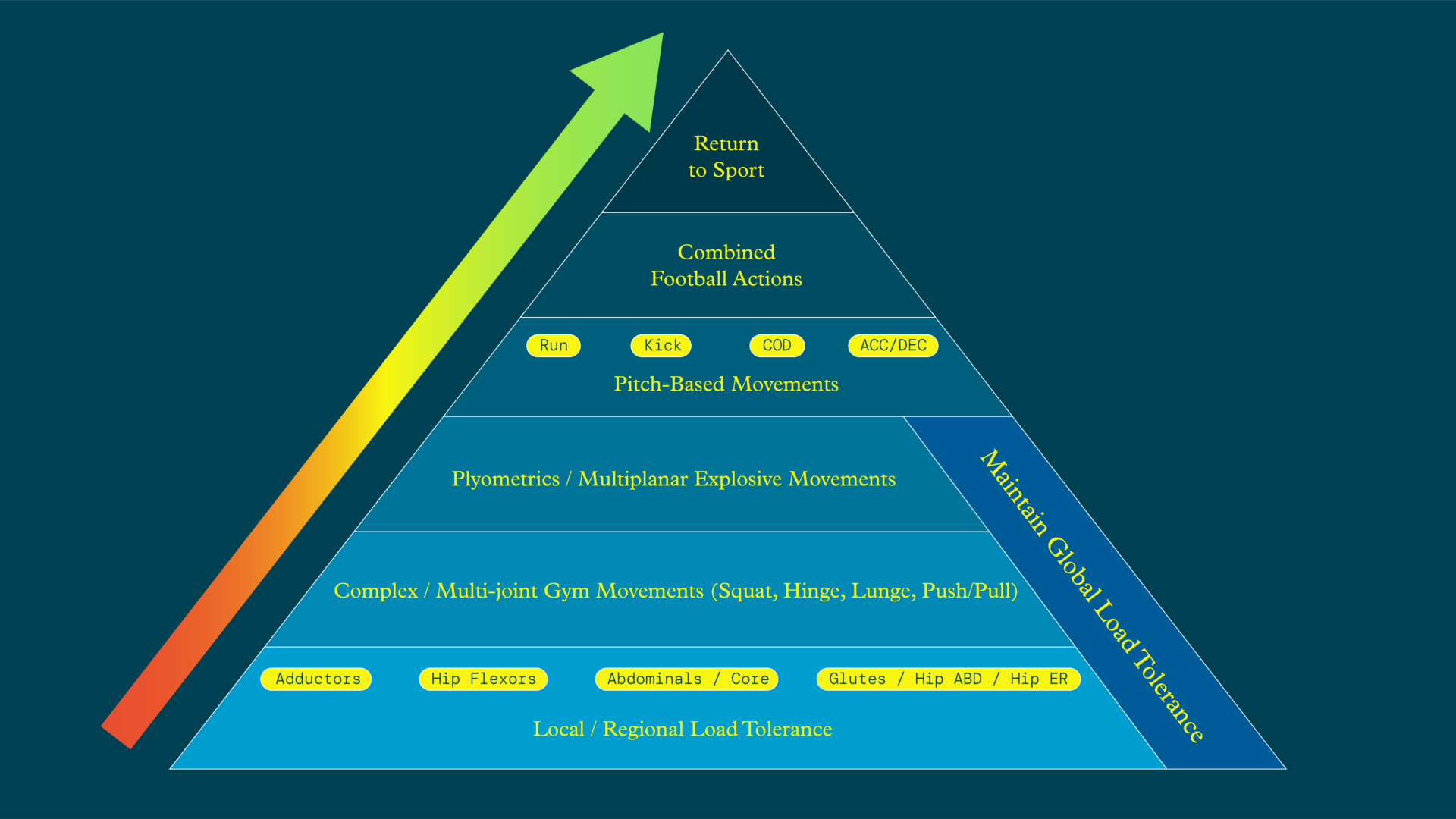
The local, regional, and global load tolerance exercise prescription are only complete when they are part of building the player for his return to sport. Gradually shift from local and regional exercises into combined and multi-joint movements. Then integrate more plyometric and explosive movements to simulate demands on the pitch.
Break things back down once on the pitch: running, kicking, cutting, and accelerations / decelerations. Then combine those actions and accumulate sufficient volume for the player to handle regular training and playing loads.
This process is not entirely linear across the board. For example, in an adductor-related case, the player will likely tolerate linear jogging before multiplanar explosive movements in the gym. In an effort to be as efficient as possible with time-loss injuries, practitioners can progress athletes further and faster up the pyramid in some areas while simultaneous working others at a more rudimentary or “more clinical” level.
Tweet ThisPlayers will likely tolerate linear jogging before multiplanar explosive movements in the gym. Therefore, practitioners can progress athletes further and faster up the pyramid in some areas while simultaneously working others at a “more clinical” level.
Matthew DeLang, Lasse Ishøi