

Original article written by Anthony Turner, Paul Read, Shyam Chavda and colleagues
Background
This article was written for the Strength and Conditioning Journal, which is a professional journal rather than reporting on new research. The aim of this article was to illustrate an evidence-based training plan for agility, designed by the process of reverse engineering, which the authors described as a process in which products are deconstructed to extract design information from them, so that they may be recreated.
What the authors did
The reverse engineering thought process uses deductive reasoning to argue that agility is underpinned by all the physical components that appear underneath agility in the pyramid shown below.

Therefore, the authors state that before athletes can be agile, they must demonstrate proficient COD ability and in turn, must first train the constituent parts in isolation; that is, develop the athlete’s acceleration, top speed, deceleration, and turning mechanics. Although the recommended sequence of training is shown by the arrow at the right, the authors indicate that various components and activities can be trained concurrently. The figure below is a nice summary of the S&C components that are believed to underpin COD performance.
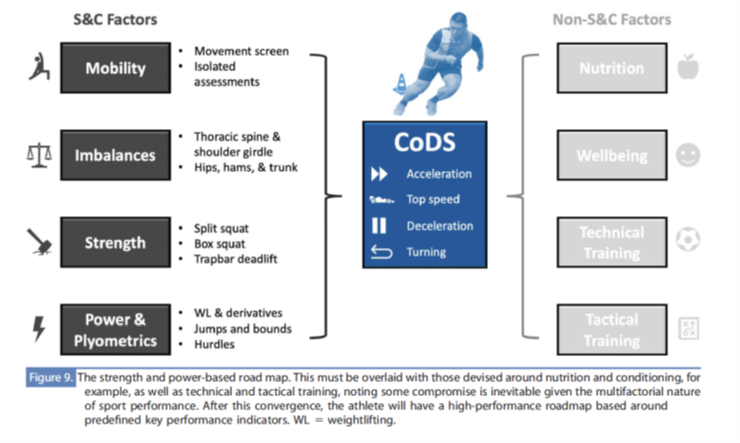
The article has a detailed explanation of training activities that are recommended, and even includes QR codes that link to YouTube videos with verbal explanations.
Limitations
The main limitation of this article is the assumption that developing COD ability will readily transfer to on-field agility performance. The authors suggested that decision making is arguably best developed through sport practice and competition, and therefore did not discuss it. In a recent Podcast with skill acquisition expert Shawn Myszka, it was suggested that agility movements should be practised with decision making included rather than in isolation, otherwise transfer cannot be guaranteed.
What this means for coaches
There is a comprehensive description of physical factors that contribute to COD performance as well as drills and exercises that the coach can implement to target the physical development for agility. There is also discussion about the ideal sequence and progression of training. Strength, power, addressing limb and muscle imbalances, and mobility are all addressed.
Reviewer’s comment
The comprehensive analysis of physical factors underpinning COD performance and practical training examples that follow make this article a valuable read.
Recommended resources
- Listen – Coaching agility using a constraints led approach – Shawn Myszka