

Resistance training is one of the most powerful tools for developing young athletes. It’s no longer a question of whether youth athletes should lift. The evidence is clear: resistance training supports maximal force production (max strength), the ability to express force across a range of velocities (strength-speed, speed-strength), maximal velocity (speed), and long term physical development [1]. Moreover, there’s no shortage of methods, from bodyweight and plyometric exercise to free weights, resistance bands, machines, and even flywheel devices.
The challenge for strength & conditioning practitioners is not deciding if they should use resistance training, but determining the right method, at the right time, for the right athlete.
One method that often flies under the radar despite offering huge potential for young athletes is eccentric training. [2, 3]
A survey of 64 strength & conditioning practitioners found that while almost all considered eccentric training important for youth athletes, particularly for injury prevention, many highlighted a lack of clear guidelines around prescription, maturation-specific responses, and recovery as barriers to consistent implementation. [4] There is also a common belief that eccentrics inevitably cause excessive delayed onset muscle soreness, leading to hesitancy around their use.
Eccentric training offers so much more than Nordics and injury prevention. With some practical guidelines, coaches can apply it effectively throughout the process of developing young athletes.
Eccentric training through a youth lens
Before we get into the detail of why eccentric training is so valuable, it’s worth taking a step back and making sure we’re clear on what it actually is. Simply, an eccentric action is the part of the movement where the muscle is lengthening under load: braking to stop from a sprint, controlling the descent of a back squat, or landing from a basketball rebound.
Eccentric training, then, is simply placing deliberate focus on this muscle action.
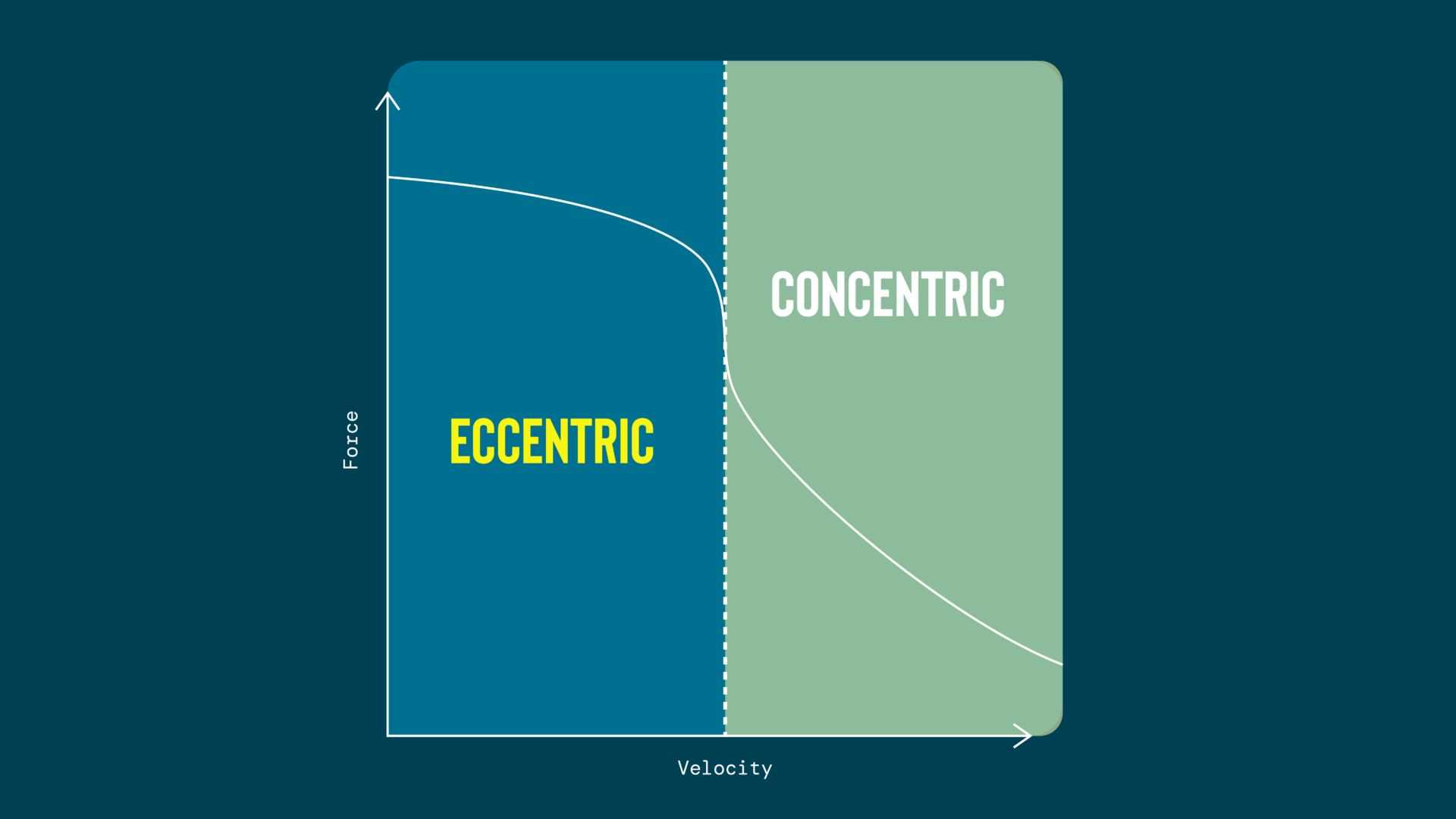
The underpinning rationale is straightforward: we can produce more force eccentrically than concentrically, and we can do so even as movement velocity increases. [6] This combination of higher force at higher speeds offers a unique opportunity to prepare athletes for the demands of sport.
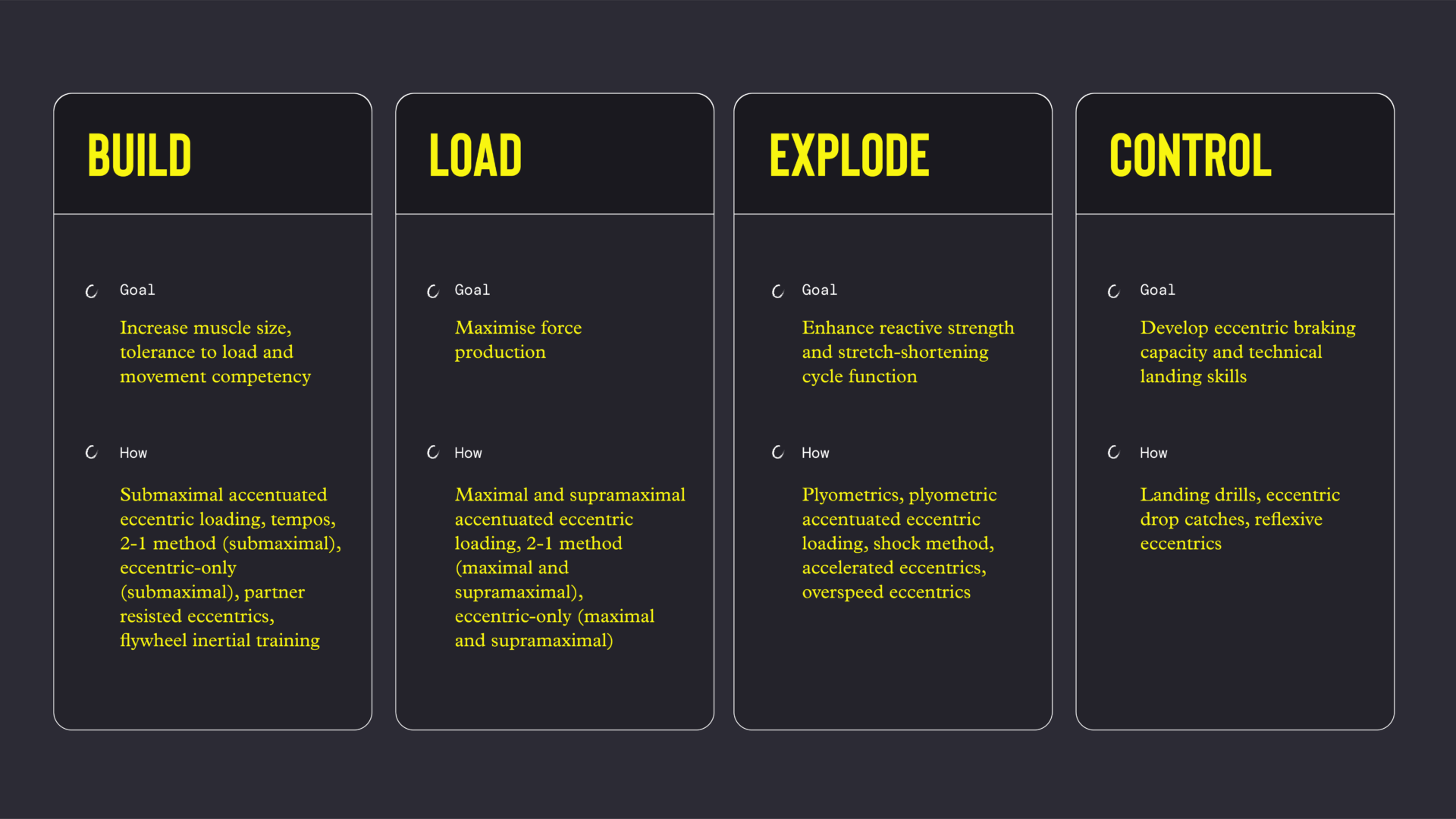
Eccentric training isn’t just one thing—there are many ways to approach it, each producing distinct results. Bundling them together can oversimplify (and confuse!) how they work, while obscuring the unique benefits each method has to offer.
The sample framework in Figure 2 is organised into four categories: build, load, explode, and control. These are not rigid definitions, but a way to differentiate the adaptations elicited by different eccentric methods. They also mirror the developmental needs of young athletes and the logical progression of eccentric demands, from building muscle cross-sectional area (build) to maximal force production (load), to higher velocity (explode) and control focused applications (control).
Tweet ThisWe can produce more force eccentrically, and we can do so even as movement velocity increases. This combination of higher force at higher speeds offers a unique opportunity to prepare athletes for the demands of sport.
@TommyEliBright
Eccentrics and physical development
Strength & conditioning coaches frequently cite recovery and muscle soreness as barriers to implementing eccentric training consistently in youth programmes. [4] This concern is well-founded: compared to isometric and concentric actions, eccentric exercise can induce greater muscle damage and requires longer neuromuscular recovery due to both central and peripheral factors. [7]
As a result, when it comes to integrating eccentric training into a young athlete’s programme, one of the first concerns raised by coaches—and sometimes parents—is the risk of muscle soreness (i.e., exercise-induced muscle damage) and the subsequent effect on performance outside of the weight room.
But soreness isn’t an inevitable outcome of eccentric training. It’s largely a by-product of novelty, or training volumes and intensities that exceed the athlete’s current tolerance. The soreness our 18-year old players may feel after eccentric training isn’t necessarily because eccentrics are inherently damaging, but because they haven’t been exposed to these actions earlier in their physical development.
In fact, youth athletes typically report less soreness and recover faster from eccentric exercise than adults. [8, 9]
The response appears to follow a maturity gradient. Pre-peak height velocity (PHV) athletes show the least muscle damage and soreness, circa-PHV athletes display intermediate responses, and post-PHV athletes experience the greatest disruption, albeit still less than adults.
This reduced susceptibility in younger athletes may reflect lower absolute forces, greater muscle compliance, and a higher proportion of slow twitch fibres compared to adults. [8] In other words, youth athletes are not only able to tolerate eccentric work, but they also adapt to it when exposed properly and progressively.
Children are already performing eccentric muscle actions every day. Catching themselves from a fall, jumping off a playground bench, accelerating and stopping suddenly in a game of tag, or landing after an acrobatic return in football-tennis all involve muscles lengthening under load. Plyometric training, which relies heavily on eccentric braking, is recommended across the developmental continuum, from childhood through adulthood. [10]
Match-play data show that U17 footballers average around 84 decelerations per game—actions that sit firmly within the bracket of eccentric training, even if they aren’t always recognised as such. [11] Moreover, across elite team sports, high intensity decelerations occur more often than accelerations, underlining just how frequently athletes are eccentrically challenged. [12]
By gradually and deliberately exposing young athletes to eccentric training in a structured way, we’re not introducing something foreign. We’re just building on what their bodies already do. Done well, this early exposure reduces the likelihood of that “shock soreness” later down the line and helps normalise eccentrics as part of the training process.
The next step is to consider how eccentric training can be embedded across long term athlete development.
Tweet ThisThe soreness response appears to follow a maturity gradient. Pre-PHV athletes show the least muscle damage and soreness, circa-PHV athletes display intermediate responses, and post-PHV athletes experience the greatest disruption.
@TommyEliBright
Eccentrics for long term athlete development
Long term athlete development models emphasise that nearly all forms of resistance training should be addressed in some capacity throughout childhood and adolescence. [10] Yet, eccentric training is often overlooked in these models or pushed back to the later stages of adolescence, if it appears at all.
The problem is that eccentric training is often thought of in its most extreme forms: heavy negatives, supramaximal loading, or punishingly high volume tempos.
But eccentric work doesn’t need to be high risk or excessively intense to be effective. Simple approaches such as tempos, basic landing and deceleration drills, modifications of plyometric training, or assisted Nordics are all eccentric in nature and can be safely introduced much earlier in a young athlete’s development.
Considering this leads us to the key question: how can eccentric methods be adapted to meet the individual needs of youth athletes?
Tweet ThisSimple approaches such as tempos, basic landing and deceleration drills, modifications of plyometric training, or assisted Nordics are all eccentric in nature and can be safely introduced much earlier in a young athlete’s development.
@TommyEliBright
Recognising individual differences
Factors such as biological maturation (pre-, circa-, and post-PHV), training age, movement competency, baseline strength, and specific sport and playing position demands all shape how, when, and to what extent eccentric methods should be applied.
Maturity status relative to peak height velocity
An individual’s maturity status is the first and main consideration. Training age and strength often, but not always, go hand in hand with maturity.
Pre-PHV athletes respond to training primarily through neural adaptations (e.g., improved motor unit recruitment), whereas circa- and post-PHV athletes demonstrate both neural and structural adaptations (e.g., increases in muscle cross-sectional area), reflecting the influence of pubertal hormonal surges. [13] This interaction between maturation and training response, often referred to as synergistic adaptation, provides a valuable reference point.
| Maturity | Pre-PHV | Circa-PHV | Post-PHV |
| Europa Conference League | Tempo bodyweight squat Eccentric drop squat to catch | Tempo back squat Soft depth land with dumbbells (moderate-high) | Submaximal AEL back squat Accelerated eccentric countermovement jump |
| Europa League | Tempo goblet squat Soft depth land (low) | Tempo front squat Stiff drop land (moderate) | Flywheel squat Plyo-AEL countermovement jump with resistance bands |
| Champions League | Tempo dumbbell split Soft depth land (moderate-high) | Eccentric-only bench press Reflexive eccentric push up | Maximal/supramaximal AEL back squat Plyo-AEL depth jump with dumbbells |
Pre-PHV athletes should spend most of their time within the build, explode, and control categories. This mirrors their natural adaptation pathways: plyometric and landing drills provide the key eccentric neural stimulus, while bodyweight and submaximal tempo work develop movement competency. There’s scope for carefully selected eccentric-only exercises where appropriate.
For example, a 10 year old footballer might complete low to moderate amplitude hops and skips, followed by tempo split squats twice per week as part of their warm-up, finishing with incline Nordics at the end of their session.
Tweet ThisThis mirrors their natural adaptation pathways: plyometric and landing drills provide the key eccentric neural stimulus, while bodyweight and submaximal tempo work develop movement competency.
@TommyEliBright
Around PHV, a potential complication is the effect of rapid growth and any temporary disruption to movement quality. In these cases, build methods take priority, supported by lower intensity landing and reflexive eccentric drills from the control category to help restore efficiency.
A great example here is a 12 year old male who has grown 8 cm and 8 kg in the past six months.
After a significant growth spurt, athletes often experience clear disruptions in eccentric actions, making this an ideal time to prioritise quality eccentric work while still providing sufficient training stimulus. During this period, we reduced the volume of landing drills and emphasised snapdowns and reflexive eccentrics, with and without resistance bands, focusing on proper positioning and rhythm, e.g., trunk control with hips, knees, and ankles working in sequence.
By the post-PHV stage, athletes are able to draw from all four categories. This might include advanced methods such as plyometric, maximal or supramaximal accentuated eccentric loading, and flywheel training.
From explode and control, strategies such as shock method, accelerated and overspeed eccentrics, reflexive eccentrics, and high amplitude / unilateral landing drills can also be integrated, particularly for athletes with greater training age and strength. Here, a 16 year old rugby player with a solid strength base could progress to handheld dumbbell loaded depth landings, higher intensity reflexive eccentrics, and unilateral hops and bounds.
Newbie or non-zero S&C training age?
An athlete’s training age strongly influences their readiness for any type of resistance training, but particularly eccentric methods. Those new to strength & conditioning need time to establish competency in fundamental movements such as squatting, hinging, lunging, pushing, pulling, and landing. [14]
Similar to pre-PHV, in this phase, tempos and simple landing drills with correct cueing (e.g., soft vs. stiff strategies) are particularly valuable.
For example, a 14 year old netball player beginning structured training might spend her first block completing these fundamental movements but with progressively slower tempos. This ensures that she builds movement competency, joint control, and general eccentric awareness before progressing to higher force methods.
In contrast, athletes who have mastered the basic movement competencies listed above are better equipped to tolerate higher eccentric demands and can progress to more advanced methods. This could include submaximal accentuated eccentric loading and eccentric-only methods, such as back squats with weight releasers and eccentric-only bench press, respectively. From the explode and control categories, we’d also start to incorporate plyometric accentuated eccentric loading, accelerated and overspeed eccentrics, and more demanding landing drills.
A 17-year old basketball player with three years of lifting experience, for example, may perform eccentric-only bench press to add upper body mass; high amplitude depth jumps to enhance braking rate of force development; and submaximal to maximal accentuated eccentric loaded front squats to increase lower-body strength. That combination reflects their readiness to tolerate and benefit from a greater eccentric stimulus.
| New to Strength and Conditioning | Basic Competencies Mastered | ||||
| Exercise | Sets x reps | Rest (s) | Exercise | Sets x reps | Rest (s) |
| 1) Eccentric drop squat to catch | 3 x 5 | 60 | 1a) Medicine ball supine catch-return 1b) Depth jump (stick landing) | 3 x 6 3 x 3 | ~30 90 |
| 2) Box squat (3 s lowering) | 3 x 6 | ~90 | 2) Eccentric-only back squat | 3 x 5 | 90-120 |
| 3) Incline push up | 3 x 10 | 60-90 | 3) Incline Nordics | 3 x 3-4 | ~120 |
| 4) Plank perturbations | 2-3 x 30 s | 60 | 4) Dumbbell bench press | 3 x 8-10 | 90 |
Whether an athlete is a novice or experienced, the goal is the same: to use eccentrics as a complement to their current stage of development. All that changes is the entry point.
Minimum necessary strength levels
How strong is strong enough? It remains one of the most challenging—and compelling— questions to answer. While the evidence highlights the importance of strength, there is no universally agreed threshold that defines when an athlete is “strong enough.” [15]
When selecting the right eccentric training method, strength is a combination of movement competency, eccentric strength, and eccentric strength expressed at speed.
Take two very different athletes: one who can back squat impressive loads but collapses forward and loses balance when attempting a reflexive eccentric split squat, and another whose absolute strength is modest yet whose movement quality is excellent. The first needs more work on control and coordination at a range of velocities before progressing, whereas the second may already be ready for submaximal accentuated eccentric loading despite a lower absolute strength level.
The key point is to dedicate time early in an athlete’s development to building eccentric strength, not just general strength. Specifically, develop their capacity to accept and generate force during eccentric actions. This foundation truly prepares them to progress safely and effectively later in the programme.
Sport and position-specific demands
While maturity, training history, and strength provide the backbone of decision making, eccentric training doesn’t happen in a vacuum. The demands of different sports, and even different playing positions within the same sport, also shape what type of eccentric training is most useful.
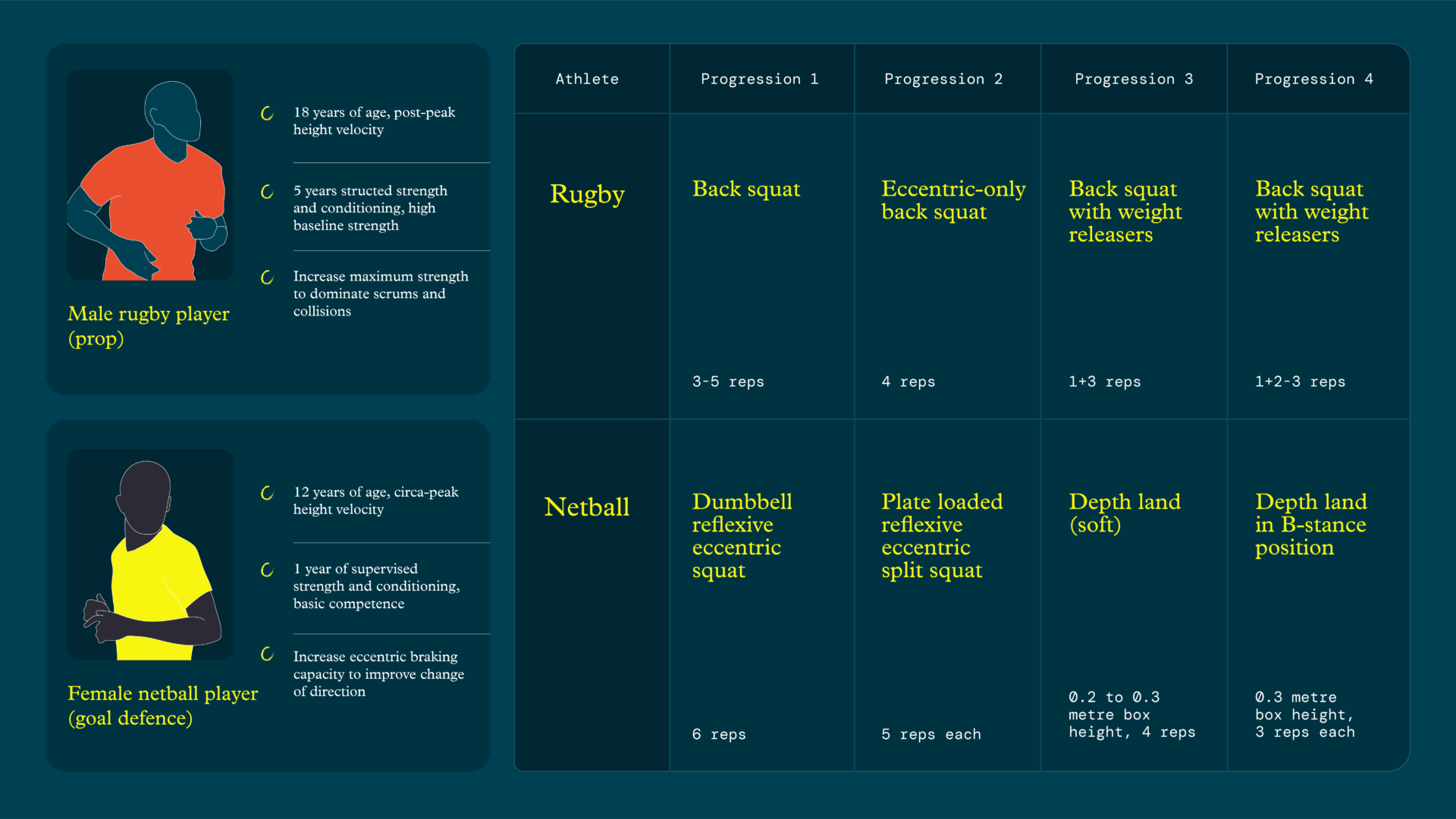
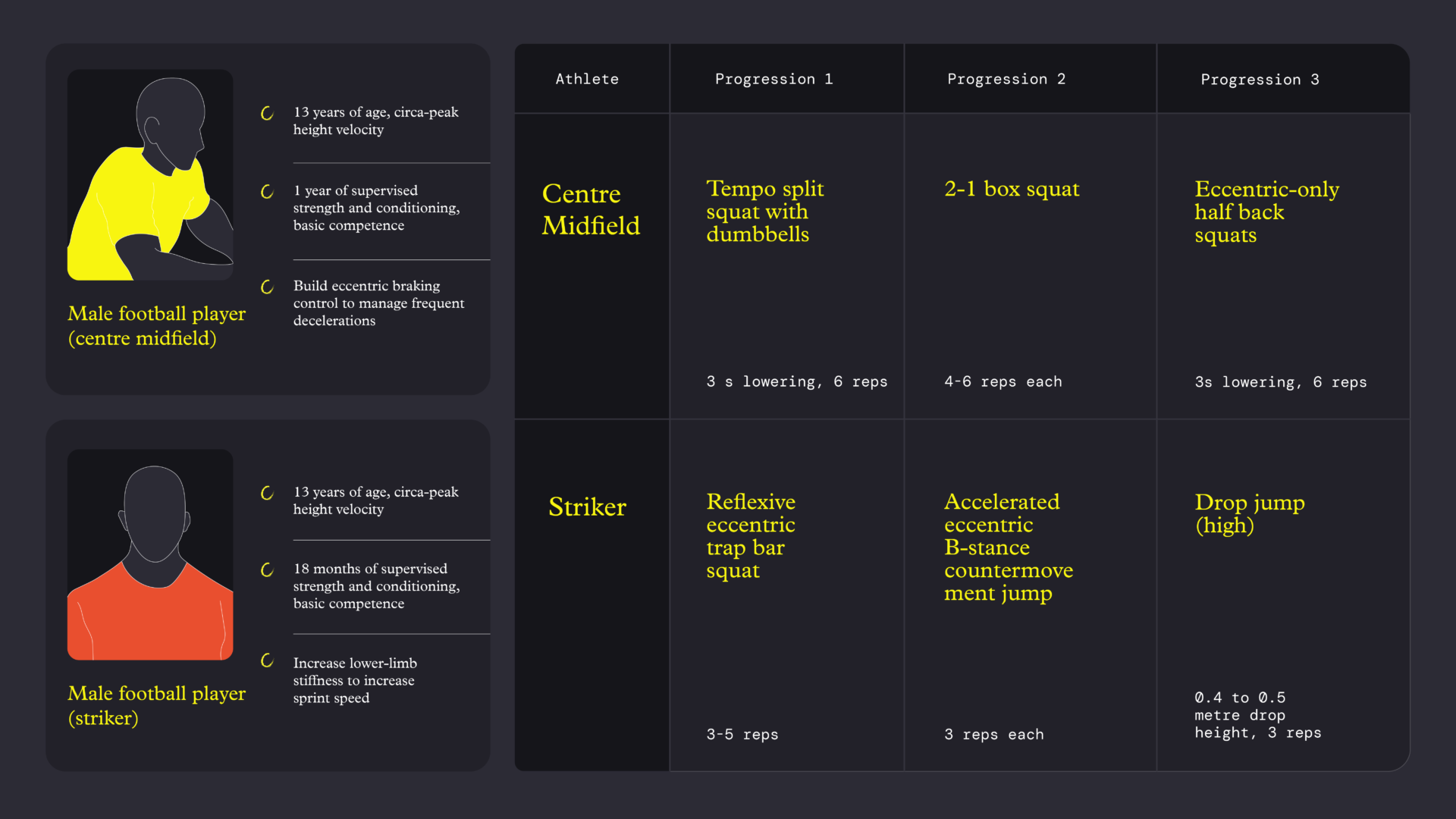
Take rugby as an example. Forwards need to tolerate repeated scrummaging, maul pressure, and collisions. Methods that develop the capacity to handle high forces, such as maximal and supramaximal eccentrics, can therefore be especially valuable for building strength, resilience, and collision tolerance. By contrast, backs rely more on high velocity sprinting, cutting, and deceleration. For them, reflexive and accelerated eccentrics, combined with high landing drills and flywheel exercises, are the priorities to improve braking rate of force development and elastic qualities.
Even within a single squad, eccentric priorities can vary widely. Some athletes need eccentrics that build control and resilience, some require methods that sharpen reactive strength qualities, while others benefit most from progressive loading strategies.
Eccentrics during the competitive season
Across a competitive season, we rotate the emphasis between eccentric, isometric, and even concentric-only methods, depending on what the athlete needs most at that moment. The bigger picture is recognising when eccentrics should take centre stage and when they should play a supporting role, ensuring the overall programme stays balanced, adaptable, and athlete centred.
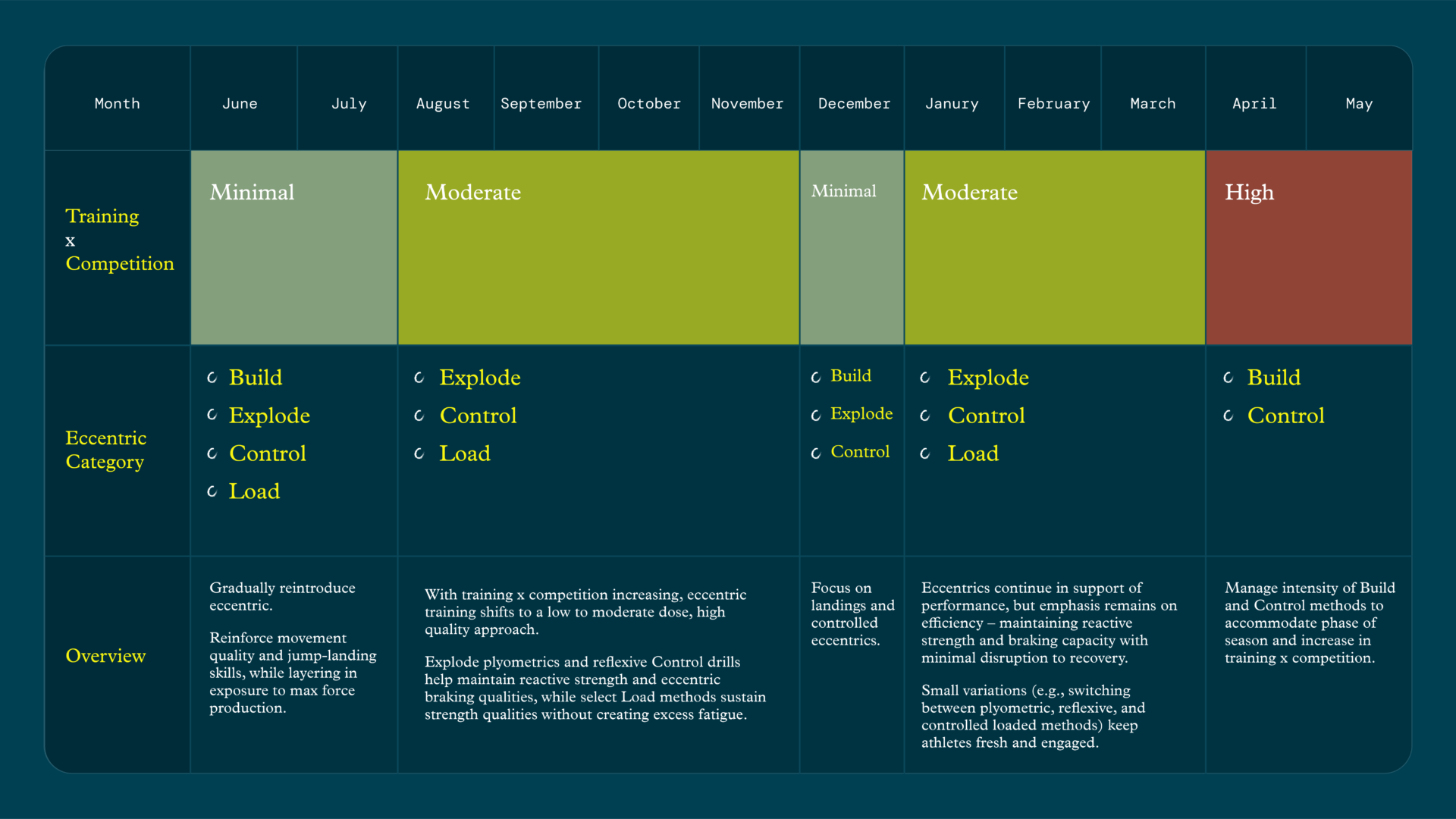
The sample plan (Figure 5) is not about prescribing exact sets, reps, or rigid progressions, but instead showing how eccentric training can ebb and flow alongside the realities of a football calendar. The aim is to balance exposure with recovery: pushing eccentrics when there is space to do so and dialling back when match demands are highest.
In early preseason, players are exposed primarily to eccentric methods that build strength, movement competency, and control, laying the foundation for later phases.
As training loads and competition demands rise, this emphasis shifts and we introduce more methods targeting eccentric speed (e.g., reflexive eccentrics and accelerated eccentrics) to better match the demands of decelerating, changing direction, and landing.
By the time the season begins, we’ve already established a foundation of resilience to recovery demands and soreness through consistent exposure. At this stage, we dial back (but not exclude) build and load methods, while control and explode become the priorities to sharpen reactive strength qualities and maintain deceleration capacity under fatigue. This approach has consistently worked well, not only in maximising performance but also in day-to-day readiness. If a player arrives to training flat or unfocused, integrating a small dose of snapdowns or accelerated eccentrics during the warm-up can quickly sharpen movement quality and intensity on the pitch.
There are inevitably periods in the season where schedules are congested and cumulative fatigue is high. In these windows, we have to acknowledge the inherent intensity of high speed eccentric methods.
While low intensity tempos or submaximal plyometrics can still feature, our emphasis often shifts towards isometric training, which provides a stimulus without the same recovery cost.
This pivot has proven particularly effective in keeping players engaged and robust during busy periods, such as Christmas or tournament phases.
Tweet ThisBy the time the season begins, we’ve already established a foundation of resilience to recovery demands and soreness through consistent exposure, maximising performance and day-to-day readiness.
@TommyEliBright
Training eccentrically outside of the weight room
While the preceding sections have focused on weight room strategies, it’s important to highlight that eccentric training can also be integrated with little to no equipment. Many environments, such as schools, community clubs, and grassroots teams lack access to full gym facilities, yet coaches can still train eccentric qualities systematically.
Targeting eccentric training in these contexts is quite advantageous and helps normalise eccentric training from an earlier stage of youth physical development.
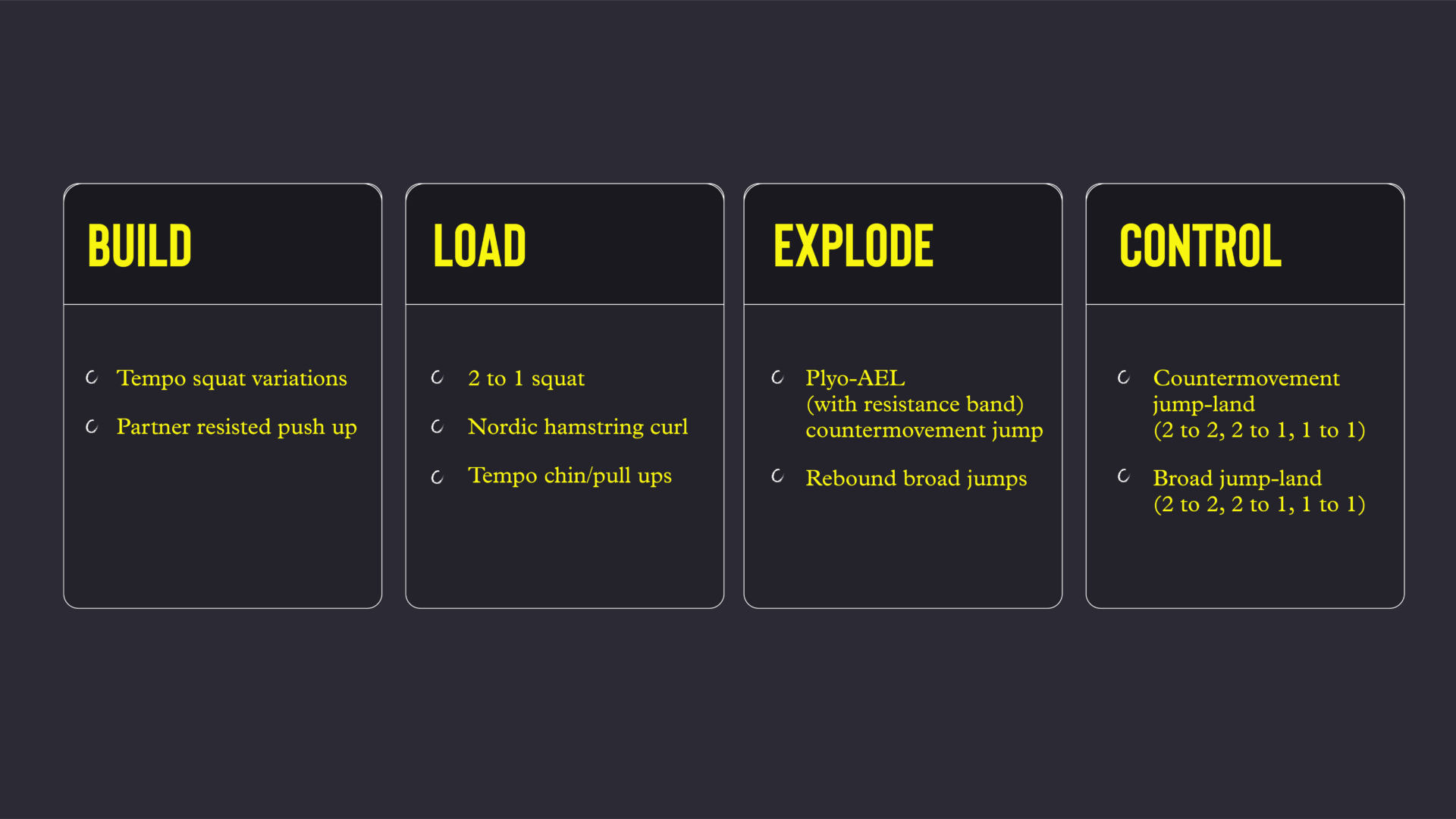
Click here for Pitch-based EXPLODE and CONTROL exercises
This modified framework shows that the same build–load–explode–control framework applies on the pitch as it does in the weight room, ensuring athletes can develop eccentric qualities systematically even with little to no equipment.
Avoiding common pitfalls
One of the best ways to learn is by reflecting on the mistakes we’ve made along the way. Eccentric training is powerful, but it’s also easy to get wrong if we aren’t thoughtful about when and how we introduce it. Below are some common pitfalls:
- Neglecting movement fundamentals
Skipping basic squats, hinges, lunges, and landings leaves athletes unprepared for demanding eccentrics. - Overlooking potentiation
Eccentrics can also prime performance, e.g., pairing a reflexive eccentric squat with an accelerated eccentric back squat. - Misusing the toolbox
Eccentric training is just one tool. It works best when integrated with all of the methods that we have available. - Introducing advanced methods too soon
Supramaximal eccentrics, flywheel, or shock methods too early can lead to poor technique and unnecessary soreness. - Ignoring individual context
Maturity, training age, strength, and positional demands must shape method and exercise selection. - Skipping progression
Eccentrics should follow a logical, stepwise progression rather than jumping levels. - Forgetting the purpose
Every eccentric method should target a clear goal, not just tick a box. - Overdoing volume or intensity
Too much, too soon undermines recovery, disrupts performance and risks turning athletes off to eccentrics.
Tweet ThisThe bigger picture is recognising when eccentrics should take centre stage and when they should play a supporting role, ensuring the overall programme stays balanced, adaptable, and athlete centred.
@TommyEliBright