

Injuries that require long term rehab often give athletes the longest layoff from competition that they will ever experience. With this extended time away from their sport, it is critical that they make as much physical progress as possible by improving their output capacities. Upon being cleared to return to sport, they must be fast, strong, powerful, agile, and all of the other adjectives that describe a well prepared athlete.
In order to improve outputs and attain these attributes, practitioners must first address the deficiencies the athlete acquired from their injury. These deficiencies may be a direct result of the injury or surgery, and can result in altered movement strategies if left unattended. Some of these deficiencies may not appear until later return to sport (RTS) phases with the introduction of new activities and movements that require greater positional control, higher force production, and increased velocity demands.
Improving outputs during RTS rehab is massively important, as an athlete who is healthy but slow and weak is unlikely to get playing time.
In addition to improving outputs, practitioners need to understand the strategy an athlete uses to achieve these outputs. If the athlete deploys an altered movement strategy, practitioners need to probe the cause. For example, a restriction in a single joint ROM can disrupt how an athlete transfers force across the entire limb, which can impact their ability to sequence multiple joint actions. This would lead to an altered movement pattern or compensatory strategy that can limit the athlete’s output ability if not addressed.
The priority during early phase RTS is to restore function at the local area of injury and the areas above or below the injury if they have been impacted. For an ACL reconstruction, periods of reduced weight bearing and overall decreased activity often result in a loss of muscle size and strength in the entire limb. Practitioners must therefore address the hip and ankle along with the knee, with the priority of regaining full knee flexion, extension, and rotation (even in its limited capacity), in addition to restoring quad, hamstring, glute and calf size / strength.
An athlete should not advance to the next phase of RTS rehab, where they’ll perform more challenging and higher velocity movements, until they first hit those foundational goals. Athletes that progress without the requisite musculoskeletal and neuromuscular qualities to jump, sprint, decelerate, and change direction often end up struggling. They tend to move with greater levels of compensation and demonstrate altered movement strategies. Even if an athlete demonstrates the prerequisites for these more demanding athletic movements, compensations and altered movement strategies may still crop up as these new activities place different demands on the body. That illustrates why practitioners must constantly assess their athletes as they progress through the RTS phases and perform new activities.
Tweet ThisAn athlete who is healthy but slow and weak is unlikely to get playing time. Practitioners must address deficiencies from injuries and ensure athletes meet physical demands for optimal performance
@resilientppt
Case study: ACLR and meniscus repairs in youth athlete
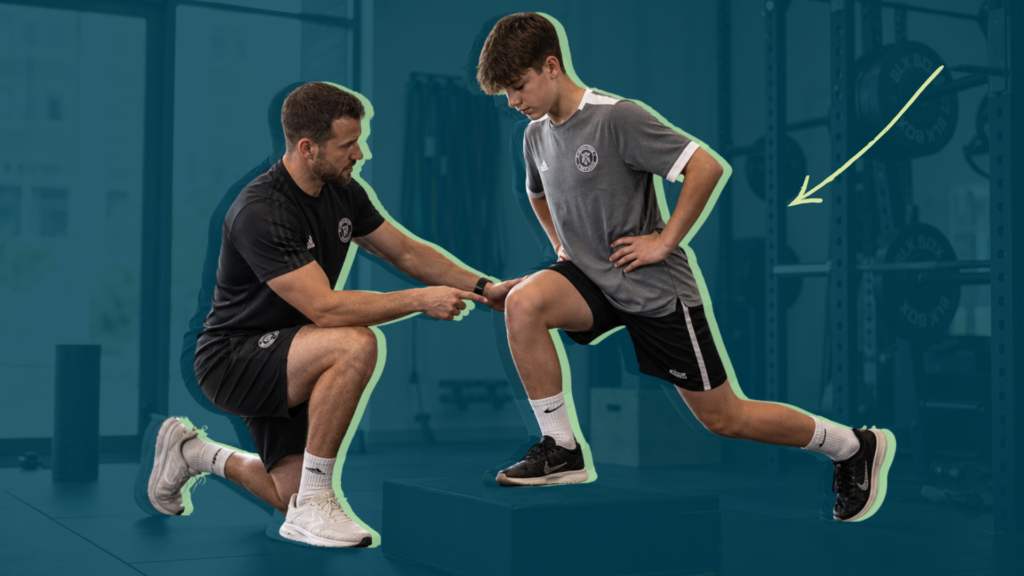
A 14 year old lacrosse and basketball player had a right ACL reconstruction with a quad tendon autograft, medial and lateral meniscus repairs, and an IT band tenodesis. His early stage rehab contained bilateral and single leg exercises, compound and single joint movements, focused on regaining his knee ROM and lower extremity strength. The early stage began with regaining competence in body weight movements like squats and lunges to ensure he loaded his ankle, knee, and hip together instead of biasing towards a hip dominant strategy. It progressed to loaded bilateral and single leg movements to increase his hip, quad, and calf strength.
This phase finished once he was “strong enough,” which he demonstrated by belt squatting 275 lbs and having great control during skater squats. Once he regained full ROM and overall strength in his right leg, he was able to progress to the mid stage of rehab.
Mid phase rehab started by prioritizing his elasticity, power, and eccentric deceleration. Double and single leg extensive plyos helped him build rhythm and timing in his movement, along with tissue volume and elasticity. At the same time, we introduced drop and stick variations like bench straddle drops and ipsilateral split squat drops to improve his eccentric deceleration and his ability to arrest his momentum.
The athlete demonstrated smooth eccentric to concentric transitions in the extensive plyos and great eccentric rate of force development (RFD) in the drop and stick variations. Often, athletes who lack quad strength do not have these qualities, resulting in them either using a stiffer loading strategy on their involved limb or biasing the load to their hip. They can limit knee flexion during the eccentric phase of an extensive plyometric activity and work to get power from their ankle. In an intensive plyo or a drop and stick variation, we would see a hip dominant loading strategy as they drop their chest and fold at the hips during the eccentric portion of the movement.
This athlete’s strength and eccentric RFD qualities allowed us to safely progress to intensive double and single leg plyos, such as the 12” to 30” double leg depth jump and single leg 12” to 24” single leg depth jump. These showed his tolerance for high levels of force with great eccentric / concentric RFD, along with the ability to transition between the two in short ground contact times. He could rapidly redirect his momentum and was more than ready for a sprint progression in the subsequent stages of his rehab.
| Early stage exit criteria |
| – No pain / swelling – Full knee ROM – Competence with bodyweight movements – Sufficient lower extremity strength (at the end of the early stage we typically want a minimum of BW trap bar dead lift for a minimum of 3-5 reps or 50% BW goblet squat for 6-10 reps, athlete will continue to strength train in later stages) – Adequate single leg control (well sequenced loading of the ankle, knee, and hip along with the ability to transition smoothly from ECC → CON) |
| Mid-stage exit criteria |
| – No pain / swelling with Introduction of plyos – Can tolerate shorter contraction times – Adequate muscular power – Good eccentric deceleration (well sequenced loading of ankle / knee / hip under the time constraints of plyos) – Ability to redirect momentum (athletes need to demonstrate the ability to alter their momentum through vertical, horizontal, and lateral plyos) – Accelerate and decelerate well |
Tweet ThisEarly phase RTS focuses on restoring function at the injury site and surrounding areas. For an ACL reconstruction, this includes regaining knee flexion, extension, rotation, and strengthening the quad, hamstring, glute, and calf for full recovery
@resilientppt
Sprint progression for mid- to late stage rehab
At this point in his rehab, his right knee flexion equalled left knee flexion (140°), but felt tighter at end range. This end range tightness did not restrict him when lifting, jumping, or cutting, as these movements did not require him to get close to 140° of knee flexion. The end range restriction became apparent as he advanced through the sprint progression and reached more upright positions that required more knee flexion for heel recovery.


The flying 10+10 challenges the athlete with different demands as they move through each phase of the sprint.
Bellon et al [1] examined the subsections of sprint acceleration in Division I soccer players during a 20m max effort sprint. They found three phases of acceleration: early (0 – 2.5m), mid (2.5 – 6m), and late (6 – 12m). After late acceleration, athletes transition towards maximum velocity. Early acceleration has the greatest change in velocity (highest rate of acceleration) and requires higher horizontal force production with the longest ground contact times (GCT). During mid acceleration, the athlete runs with both force and stiffness / elasticity as they continue to increase velocity. This coincides with an increase in stride length and frequency while GCT decreases. In late acceleration, stride length and frequency continue to increase while GCT decreases as force production becomes more vertically oriented.

Mechanically, there are more similarities between late acceleration and max velocity than early acceleration and max velocity.
Early acceleration is more force dominant as athletes run with a forward lean, longer GCTs, shorter flight times, and lower heel recovery to rapidly increase velocity. During late acceleration and when running at maximum velocity, athletes rely more on elasticity and stiffness and have a more vertical posture, shorter GCTs, spend more time in flight, and have a higher heel recovery as they now have smaller increases in velocity.
For a flying 10+10, the athlete is in the late acceleration phase as he hits the timing gates and transitions towards max velocity as he performs the flying 10.
| Acceleration phase | Key landmarks | Kinematic characteristics |
| Early acceleration (0 – 2.5m) | Low center of mass, forward lean, piston action of legs, low heel recovery | ↑ GCT ↓ Flight time ↓ Stride length ↓ Stride frequency |
| Mid acceleration (2.5 – 6m) | Higher center of mass, less forward lean, height of heel recovery increases | ↓ GCT ↑ Flight time ↑ Stride length ↑ Stride frequency |
| Late acceleration (6 – 12m) | More upright posture, circular action of legs, higher heel recovery | ↓↓ GCT ↑↑ Flight time ↑↑ Stride length ↑↑ Stride frequency |
As the athlete moves from mid to late acceleration, his posture becomes more upright, his heel recovery is faster, and his time on the ground decreases. For the heel to recover quickly after toe off, there must be rapid triple flexion of the ankle, knee, and hip as the heel comes close to the hips. This shortens the lever of the lower extremity, allowing the leg to cycle faster from the backside to the frontside in preparation for the next ground contact. Maximum knee flexion of the swing limb should occur around initial contact of the stance limb.
When knee flexion on the swing limb is limited, the lower extremity lever lengthens. This makes it more challenging to recover the limb after toe off, and increases the demand on the hip flexors to move the leg into a frontside position. It also increases the time the leg is in swing phase, which delays the next foot strike. This combination of factors will likely decrease stride frequency, which should increase as the athlete transitions from early to late acceleration.
Team sport athletes do not often have the same heel recovery as track athletes, whose heels tucked right up against their hips. But they still need a relatively high heel recovery for their stride frequency to increase.
As this athlete only showed knee flexion limitation while sprinting, we programmed running specific mobility drills along with mach running drills. All of these drills focused on improving knee flexion ROM, and how quickly the heel could recover after toe off to improve the circular leg action in an upright running position.
The heel snap uses the momentum of the lower leg to increase knee flexion while the quad pull in hip extension stretches the quad at both the hip and knee. Alternating between these two movements helped the athlete feel looser at end range knee flexion.
The athlete works on the transition of the swing leg from back to front. As there is no momentum to start, the hamstring must flex the knee maximally before the leg recovers to the front.
The athlete must strike the ground down and back, which generates the negative velocity of the foot that we want at ground contact when sprinting. From ground contact, the rapid vertical / circular heel recovery limits the time the swing leg spends in a backside position. Once the heel reaches its highest point, the athlete completes a full swing cycle by bringing the knee back to the frontside as quickly as they can.
We call these “old school” butt kicks because it’s what all of the sport coaches had us do as kids. This drill provides a greater stretch of the quad as the knee is flexed with the hip extended. The swinging of the heel up and back increases the time that the lower leg is on the backside, allowing the lower leg to generate more momentum to flex the knee. This makes the drill more passive than active to achieve knee flexion.
The “new school” butt kicks work on the vertical heel recovery after toe off and actively recruits the hamstrings more than the “old school” variation. The goal is to minimize the time spent backside and recover the heel quickly while bringing it as close to the hips as possible.
The focus is to maintain a vertical posture while working on the circular action of the legs. The sled provides resistance to decrease forward velocity, resulting in a more muscular than elastic propulsion strategy in an upright position. This provides more time to use his hamstrings to flex his knee and recover his heel as he prepares for the next foot strike.
While this drill does not have the circular motion we want athletes to perform when they are actually in an upright sprinting posture, it is a great way to work on a rapid and more vertical heel recovery. The band around the hips forces the athlete to generate horizontal force at foot strike, while maintaining a more vertical posture as they minimize GCT.
The athlete performed a combination of these drills twice per week, leading to significant changes in knee flexion during heel recovery.
The video below was four weeks later (eight months post op), performing another flying 10+10 where his heel recovery was significantly higher than at seven months.

The athlete’s knee flexion when sprinting would feel stiffer on some days and looser on others. The above drills continued to be an important part of his program and helped him have more days where his knee felt good rather than stiff.
I have noticed increased stiffness at either end range extension or flexion in other athletes who have had an ACL reconstruction with IT band tenodesis, compared to those who had only an ACL reconstruction without an IT band tenodesis. This required more time working on their ROM throughout most of the RTS process.
Throughout the subsequent months of rehab the athlete was able to maintain his improved knee flexion.

As the athlete became consistent in the positions he was able to achieve, his flying 10+10 times decreased and his velocity increased.
7 months post op 10+10: 1.251 sec, 16.35 mph or 7.3 m/s
9 months post op 10:10: 1.172 sec, 17.45 mph or 7.8 m/s
11 months post op 10+10: 1.147 sec, 17.83 mph or 7.97 m/s
The improved knee flexion allowed the athlete’s movement strategy to improve in the form of higher heel recovery. This helped him achieve a greater output which, in this case, was a higher velocity.
Practitioners should constantly assess an athlete’s movement strategy as they work along the RTS continuum. Simply demonstrating a quality, passing a test, or reaching a benchmark early in the RTS process does not always mean that an athlete will continue to demonstrate those qualities in the later phases as they layer in new movements. Athletes need repeated exposures to these activities to allow them to develop consistency in their results. There is ample time in RTS situations to address an impairment that may result in an athlete having to alter their movement strategy.
Having a model for every movement pattern athletes perform enables practitioners to determine when and where specific interventions may be necessary to improve an athlete’s movement strategy.
Tweet ThisPractitioners should constantly assess an athlete’s movement strategy during RTS. Early success doesn’t guarantee later consistency
@resilientppt