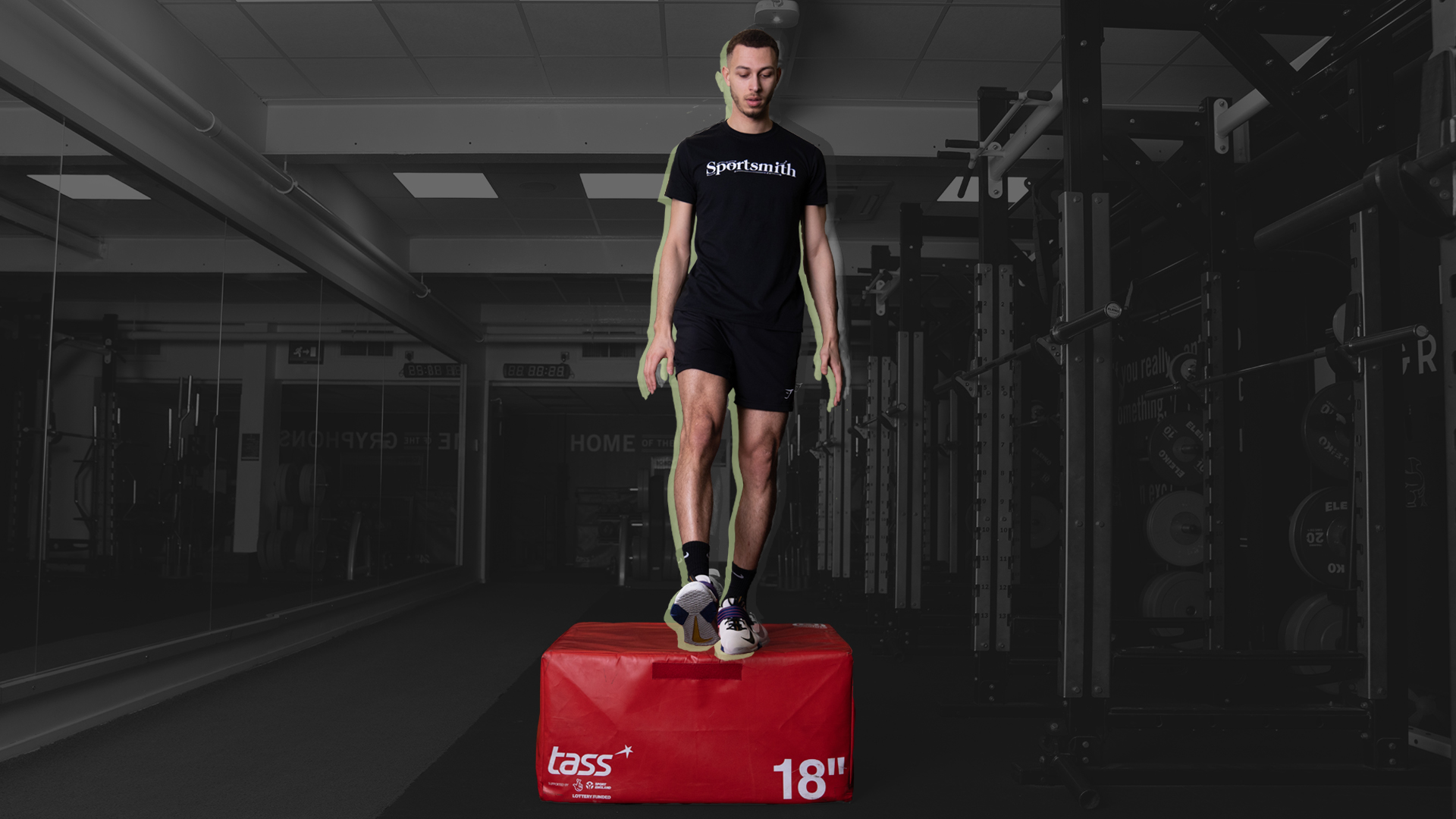
Stiffness is a physical quality that is often pursued in the hope of improving jumping ability or max velocity running, and also reducing injury risk. But is it that simple? We asked Sean Maloney six questions about this topic.
How can we define stiffness and why should we be interested in it as performance coaches?
Stiffness means different things to different people. For the general population, it has connotations with aches and pains. For sports therapists, it’s often synonymous with immobility. But in sports performance we’re typically thinking about stiffness in a biomechanical context.
Stiffness is a physical concept that describes how an object deforms in response to force. If an object is stiffer, more force is required to deform it. It’s important because most movements in sport utilise the stretch-shortening cycle (SSC).
Compression of the leg under load – such as in upright running – leads to rapid lengthening of the muscle-tendon units (MTU) of the lower limb. In theory, if the individual MTUs are stiffer during this loading phase, it should maximise the elastic energy released during shortening. During tasks where it’s beneficial to keep ground contact times short, it’s likely beneficial to be stiffer.
Let’s use the analogy of a slingshot. As we pull the slingshot back, we’re exerting a force which causes the rubber band to lengthen. This lengthening creates elastic potential energy. When we release the band, the potential energy is converted into kinetic energy. The band recoils and the object is projected. Now, the stiffer the rubber band, the more force we’ll need to exert to pull it back. But the payoff is that we’re able to transfer more kinetic energy to the projectile.
A slingshot is also a good example of how two materials of different stiffness work together. The frame of the slingshot is made from a material such as wood or metal which is stiffer than the rubber band. Therefore, when the slingshot is pulled back, the band takes up most of the lengthening whilst the frame remains relatively rigid.
In the MTU, we’re normally looking for a similar type of synergistic interaction. We want the muscle to function as the rigid frame and the tendon to serve as the primary tensile spring. This plays to the relative strengths of each component. Muscles are well suited to producing force at low velocities. Tendons are well suited to storing elastic energy. By activating and stiffening the muscle, we allow the tendon to take on the lengthening requirements of the MTU.
How do we measure it?
Stiffness is quantified as a ratio – force / length change [1] – so we need these two variables to quantify stiffness. We can obtain these in the most direct fashion by using a force platform and motion capture. However, this isn’t always possible. We can, therefore, consider using estimates of force and length change using principles of inverse dynamics. If we have measures of flight time and contact time alongside an athlete’s anthropometric data, then it’s possible to calculate a stiffness value [2,3].
Ok, that’s the overarching principle. Determine a force. Divide it by the length change. But where are we looking? We’ve got several options depending on how granular we wish to be. Global measures such as vertical stiffness and leg stiffness sit at the top of the chain and indicate how the lower limb functions in an integrated manner. Isolated measures of individual fibre stiffness sit at the bottom.
But, before you consider actually measuring stiffness, ask yourself why you want to measure it. If you don’t have a clear rationale, then push the stop button. Most of us have enough data to adequately inform our practice already.
Assuming we have passed the “yes” test, I’d argue in most instances we’re looking to get an idea of how the athlete handles ground reaction forces during locomotion. We’re therefore looking at global measures of vertical / leg stiffness and perhaps estimations of joint stiffness to provide a little more depth where needed.
Now, what’s the best task to evaluate stiffness?
Ideally, the task you want to model is the best choice for testing. So, if that’s upright running, changing direction, approach jumping, etc. that’s the one to plump for if you can. If that’s not an option, then the most common assessments are drop jump or reactive jumping / hopping tasks. Many of us will probably be using these already to determine reactive strength index. It’s probably not a big ask to add on an additional metric.
It’s important to restate that the stiffness value we calculate is a ratio. We shouldn’t interpret stiffness values without noting the constituent parts. We can present higher stiffness by increasing force, decreasing compression or by different permeations of these factors. If you’re testing stiffness, you need to look beyond the stiffness value alone.
What link does stiffness have to dynamic performance actions such as jumping and sprinting? How stiff is stiff enough?
If we look at the literature, we see pretty consistent positive relationships between stiffness variables and most measures of dynamic performance [1,4]. There is also some evidence documenting correlations between changes in stiffness and changes in sprint velocity following training in sprinters [5].
Nonetheless, as with most areas in sports science, we’re lacking longitudinal data to hang our hat on.
However, there are instances where higher levels of stiffness may be associated with reduced performance. In tasks with minimal or slow SSC requirements, a more compliant MTU may result in greater storage of elastic energy and increase the time over which force can be applied [6].
Confusing? Perhaps.
The “optimal” stiffness in each situation is hard to determine as we are talking about a dynamical system with lots of influencing factors. However, I think we can apply a general heuristic to determine the importance of stiffness to a given task.
If the task requires the maintenance of velocity, the emphasis on global stiffness is high.
The objective in these instances is to conserve momentum. Think maximum velocity sprinting or running a shallow cutting angle. We’re managing high forces and want to keep ground contact times short.
If the task necessitates a change in velocity, the emphasis on global stiffness is reduced.
The goal in these situations is to exert an impulse and change momentum. Think the initial steps in acceleration or an approach jump. If momentum change is important, we need to allow the athlete enough time on the ground to apply force.
If a task has minimal velocity requirement, the emphasis on global stiffness is minimal.
Now it’s all impulse. Think scrummaging or powerlifting. Ground impact loadings are minimal or non-existent and force generation is king. Time is no longer a factor.
However, I think it’s also worthwhile to draw attention to the specific role of ankle stiffness.
Just because the global stiffness requirement is lessened in some instances, such as acceleration, that doesn’t mean a stiff ankle complex is not beneficial. Force generated by the body must be transferred to the ground through the ankle. A stiff ankle results in more efficient transfer. This means we can apply the same impulse in short ground contact time. If the joint is acting as a force “transmitter” as opposed to a force “producer,” it’s beneficial to be stiff.
Tweet ThisIf the task requires the maintenance of velocity, the emphasis on global stiffness is high. If it necessitates a change in velocity, the emphasis is reduced. If it has minimal velocity requirement, the emphasis is minimal
@MaloneyPerform
Strategies for coaching this quality?
The most important factor for the coach to understand is the context in which they will apply “stiffness.” Start with the end in mind, and then work backwards from the task you want to affect.
Does the athlete need high levels of stiffness for the tasks they’re required to perform? Or is there a deficit at a certain joint – such as the ankle – which may be limiting performance?
We must also consider the physical profile of the athlete. However we categorise athletes – force vs. velocity, pushers vs. pullers, aerial vs. terrestrial, muscular vs. fascial, etc. – it should be clear that those at different ends of the spectrum will have a different reliance on stiffness. And there is always a risk attached when we attempt to make a change.
We can look to outline some general principles from a planning standpoint, though.
It’s reasonable to start a programme with a muscular bias. Stiffness is predicated on the ability of the active component of the MTU to rapidly generate high levels of force. It would also seem reasonable to start a programme with low amplitude, “extensive” plyometrics. We can then accustom the athlete to technical aspects, such as a stiff ankle through ground contact, in relatively easy drills. It also sets us up for a gradual progression of plyometric loading, which we can attempt to keep in line with adaptive processes such as tendon remodelling.
Now, let’s look at what we do on the shop floor.
It’s important that athletes know how to use the ground effectively for the task at hand, so we must make sure the objective of the task is clear.
Are we looking to maximise height/distance? Are we looking to minimise ground contact time? You can’t have both.
Tweet ThisJust because the global stiffness requirement is lessened in some instances, such as acceleration, that doesn’t mean a stiff ankle complex is not beneficial. A stiff ankle results in more efficient transfer
@MaloneyPerform
In most instances, we’re not at either end of the spectrum. We’re searching for a blend that looks right and feels right. Let’s consider a bounding exercise. When we get things spot on, there’s a sensation of “pop” off the ground and “floating” in the air. I’m also big proponent of auditory feedback here. If it looks right and feels right, it sounds right too.
What link does stiffness have to injury risk?
We have two arguments here. And, once again, not a lot of research to draw on.
First, high stiffness is predicated on high loading rates. It’s been hypothesised that the risk of chronic bone injury [7] (e.g. stress fractures, osteoarthritis) and chronic tendon issues [8] (e.g., tendinopathies) may rise with greater stiffness. Keith Baar and others have also theorized that high tendon stiffness relative to muscle strength may increase the likelihood of muscle strains. In contrast, lower stiffness means greater joint range of motion. Thus, athletes with lower stiffness may be at increased risk of ligament injuries [7].
Overall, it’s likely that there’s U-shaped relationship between stiffness and injury. Where this “U” sits relative to stiffness is likely to differ depending on the measure of stiffness, type of injury and physical profile of the athlete. Factors such as fatigue are likely influence this further.
As with any attempt to profile injury risk factors, it’s a very difficult task. Perhaps the best advice I can give is consider how different stiffness conditions affect tissue loading. Think about this alongside the athlete’s profile and, most importantly, their injury history.
Tweet ThisCoaching needs to be specific to the athlete and how you want them to interact with the floor during the task at hand. Does the cue provide rich context in terms of intent, amplitude, direction, etc.?
@MaloneyPerform
What are the biggest mistakes you see young practitioners/clinicians make and what advice would you give them to help?
Perhaps the biggest mistake is that coaches are too focused on concept of stiffness and not the context in which they are applying it. How much stiffness is needed for the task? More is not inherently better. Have a clear understanding of the movement demands for the athletes you’re working with.
Next is not considering the goal of an exercise. It’s not enough just to prescribe a hop, skip or bound. What is the athlete trying to accomplish with it? In your coaching, ensure that you and your athlete understand the objective of the task. Use your eyes and ears to evaluate how they execute. Encourage the athlete to feel and feedback.
Cueing is the final factor we’ll focus on. I think coaches can often overemphasise short ground contact times to the detriment of performance. “Slap the ground” may work if you just want the athlete to get off the ground, but does it take away from the force they put into the floor? Do analogies like “the floor is lava” or “hot coals” set us up to use the ground effectively? I’m not sure.
Coaching needs to be specific to the athlete and how you want them to interact with the floor during the task at hand. Does the cue provide rich context in terms of intent, amplitude, direction, etc.? Is it based on things the athlete has experience doing? Are you using the volume and tone of your voice (and other parts of your body) to help deliver the message?