

The most commonly asked question after ACL surgery is: “When can I go back to play?” We answered some of the rehabilitation aspects of that questions in an interactive infographic, but obviously there are many others. This article will highlight some of the deficits athletes face in the vertical jump test at post-ACLR discharge and focus on a progressive rehabilitation strategy to improve these.
What are we missing at discharge when testing vertical jumps?
Kotsifaki et al.[7] highlighted how athletes were passing the traditional discharge criteria for ACLR with ongoing kinetic and performance asymmetries during vertical jump testing.
During the countermovement jump (CMJ), the concentric phase showed the most asymmetries. In the double and single leg drop jumps tests, the largest deficits were in the eccentric phase (ability to absorb load), concentric phase (explosiveness) and in the performance metrics of reactive strength (jump height and contact time). Previous studies have also noted various deficits in the eccentric and concentric components, as well as inter-limb compensation strategies and reactive strength asymmetries in vertical jump testing post-ACLR [1–6].
Drop Jump test being performed with ForceDecks Dual Force Plate System
Explosiveness deficits in CMJ
Figure 1 shows a single and double leg CMJ during discharge testing post-ACLR. The rehabbing athletes were significantly different from uninjured controls in jump height and the concentric phase, especially the second part of the concentric phase [7]. A weakness in the ankle plantar flexors may underlie this deficit [7]. Therefore, adequately targeting the eccentric and concentric components, plus programming calf strength and toe-off exercises, are vital for the athlete to improve deficits in landing symmetry, force production and rate of force production.

The end goals for double and single leg countermovement jump explosiveness at discharge are:
- Restore jump height for double and single leg @ 90% limb symmetry index (LSI) or pre-op measures.
- <10% LSI for concentric and eccentric impulses
- <15% LSI for landing peak force
For strength, the discharge goals are:
- soleus strength >200% body weight
- quadriceps strength >300% body weight; <10% LSI
- hamstring strength >175% body weight; <10% LSI
Tweet ThisA key benchmark in ACL rehabilitation is achieving less than 15% Limb Symmetry Index (LSI) for landing peak force, indicating a balanced recovery and readiness for sport-specific demands
@dustin179
Reactive strength deficits in drop jump
Figure 2 shows significant deficits between controls and post-ACLR patients at discharge for drop jump testing for performance metrics like concentric impulse symmetry, contact time and reactive strength index (RSI), jump height (only SLDJ), and eccentric impulse symmetry (only SLDJ).
The significant deficits in RSI and contact time noted with drop jumps indicate the athlete needs to do greater plyometric work with a focus on progressively increasing the intensity of the exercise while decreasing contact time. Plyometric work has no negative effects on graft laxity or pain. In fact, plyometrics have positive benefits on subjective knee function [8]. In addition, drop landing from 60 cm (23 inches) has a lower ACL strain, ACL force and anterior tibial shear than ground walking [9].
Lachlan Wilmot said “A history of graded exposure to jumping and landing is the most effective way to qualify an athlete for high end plyometric exposure.” Therefore, start as early as possible to increase exposure to plyometrics post-surgery. Base the progression on technical pain free competence and the surgeon’s early weight bearing restrictions.

The end goals for RSI at discharge for double and single leg drop jump are:
- Restore thresholds: LSI < 10% for concentric and eccentric impulse and landing peak force
- DLDJ RSI > 1.3 m/sec
- SLDJ RSI > 0.5 m/sec
- < 10% LSI for knee extension moments and knee valgus moments in first landing
CMJ test being performed with ForceDecks Dual Force Plate System
Why do these deficits persist?
Only measuring at discharge will undoubtedly leave therapists potentially missing deficits in the rehab journey. Rehab practitioners should re-assess every six weeks to note progressions or identify deficits that need to be addressed in order to reach the discharge goals. If possible, having pre-op and pre-injury data, at least of the contralateral limb, can assist as a comparison goal for discharge, in addition to LSI [1].
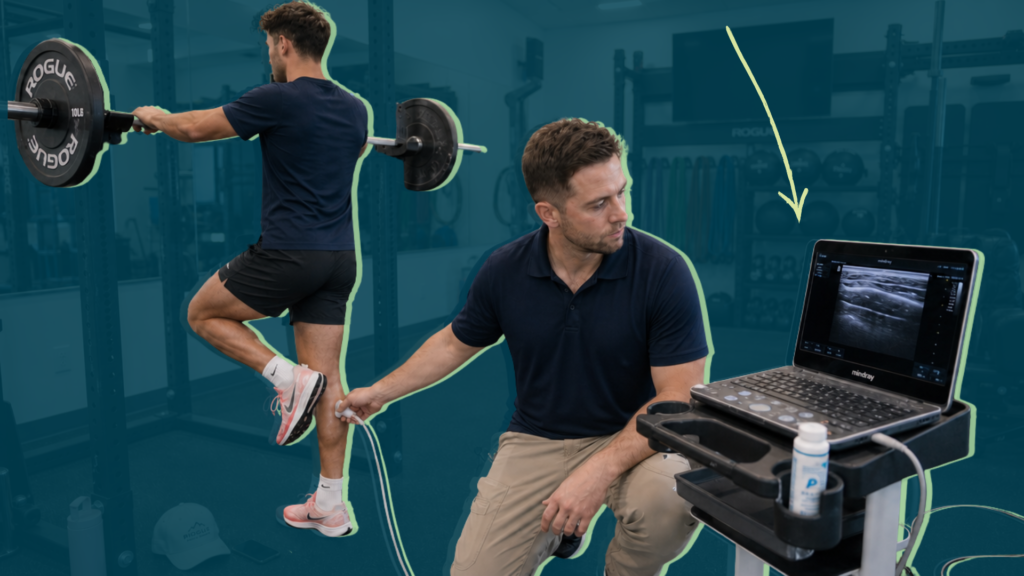
Affordable and accessible equipment like mobile phone apps, contact mats and force plates are available to assess most of the vertical jump performance metrics. These tools will help uncover where we should direct rehab in order to improve deficits in jump testing.
Previous research on force-velocity (F-v) curves highlighted the benefits of assessing an athlete’s F-v profile and creating training sessions to optimize the F-v curve [10, 11], leading to improved jump height metrics [10, 12]. It also could be worthwhile to assess where the athlete’s imbalances lie regarding force and velocity, and then incorporate individualized strategies to target underlying deficits.
Without having a clear goal on which deficits to focus on, we can’t target rehab exercises to improve jump metrics efficiently. While there are hundreds of exercises to achieve a desired outcome, many of the exercises are not being coached effectively to deliver that desired outcome. Moreover, the variety of exercises have inconsistent loads and therapists have not always fully addressed the lingering deficits (revealed through assessments) throughout the rehab journey, i.e., muscle strength, motor control or movement asymmetries.
By separating the movement, e.g., CMJ, into eccentric and concentric components, targeting each component with good technical competence and timeously progressing the exercises, we can better target the underlying deficits.
Remember, too, that while technology is a great enabler, the human touch remains irreplaceable.
For instance, if an athlete is performing landing exercises with the aim of eccentrically absorbing the load, it’s not enough for them to just “land.” If they land with minimal knee flexion and hit the ground hard, they haven’t met the objective.
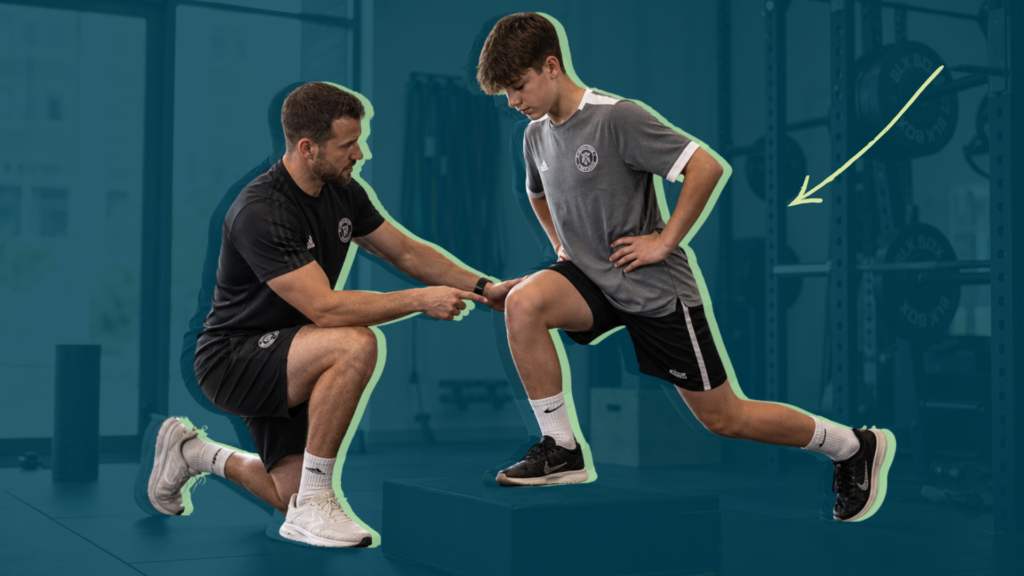
In such cases, effective coaching is paramount. The athlete might need guidance to increase the depth of their landing and produce minimal sound upon impact. The athlete needs hands on coaching, where trainers closely monitor their reps and provide real time feedback.
Tweet ThisPost-ACLR, rehabbing athletes show significant differences from controls in jump height and the concentric phase of CMJ, particularly in the second part. Targeting eccentric and concentric components and calf strength is vital for recovery
@dustin179
Using rehab to target underlying vertical jump deficits
Immediately post-surgery, focus on increasing lower limb strength as symptoms allow, respecting the ACL donor site, weight bearing and range of motion limitations. Gradually, as weight bearing becomes more comfortable, progress from double leg movements to single leg movements: squat, hinge, calf raise. Strength is one of the main foundations for explosiveness and reactive strength. Therefore, we need to address lower limb strength capacity and motor control in conjunction with the explosiveness and reactive strength rehab that are the subjects of this article.
Post-exercise monitoring is crucial. Trainers should be vigilant in observing any symptoms or reactions in the athlete, especially concerning the knee. Indicators such as pain, swelling, or decreased range of motion during the subsequent session can inform decisions on whether to regress the exercise or continue as planned.
Explosiveness rehab (eccentric component)
The entry point for when an athlete should start double leg landings should be based clinically on no pain or swelling in the knee; knee flexion >120° and full range of motion for knee extension. Additionally, the athlete should be able to front squat to 90° with good technical competence: foot, knee and hip alignment and control.

The entry point for when an athlete should start single leg landings should be based on the above clinical measures, plus the ability to single leg squat to 90° with good foot, knee and hip alignment and control. They also should be able to single leg leg press their body weight to 90° of knee flexion. Additionally, they should have a good, pain free double leg to double leg drop catch (eccentric exercise). Also consider quadricep strength, which should be >200% BW or 70% LSI.

Keep several key principles in mind during exercises involving landings. First, all landings should be both “quick and quiet.” The emphasis should initially be on the speed of the drop, followed by the ability to absorb the force silently. This not only ensures efficiency but also minimizes the risk of injury. The athlete’s ability to efficiently absorb an eccentric load is paramount, and they should always aim to land in a position that is both comfortable and biomechanically sound. This position, often referred to as the “home” position, is characterized by good joint depth and alignment.
Once they execute the landing, it’s beneficial for the athlete to hold their “home” position for approximately three seconds.
This pause serves a dual purpose: it prevents any compensatory movements and ensures that the athlete is set and ready for the next repetition without relying on momentum. In exercises like drop catches, the focus should be more on intensity rather than the sheer volume. The goal is to achieve maximum speed during the drop.
As with any exercise regimen, it’s essential to incorporate the principle of progressive overload. This can be achieved by gradually increasing the weight, intensifying the exercise, or introducing a motor challenge. Consistency is key, especially when it comes to the depth of the drop. Trainers should provide feedback on any asymmetry in landing sporadically to ensure that the athlete remains aligned and balanced. In some cases, power bands can assist with the drop catch, ensuring that the athlete maintains good form throughout the exercise.
After three successful sessions, or once the athlete has mastered the single leg landing entry point, they can transition from a double leg to a single leg drop catch.
This progression not only challenges the athlete but also ensures that they continue to develop their strength and coordination.

| Eccentric rehab progressions: 3-5 x 5 | |
| Exercise | Modality |
| Double leg – eccentric catch | Leg press or Keiser machine |
| Double leg drop to double leg drop catch | Body weight |
| Double leg drop to single leg drop catch | Body weight |
| Double bell – double leg drop to double leg | Dumbbell |
| Double bell – double leg drop to single leg | Dumbbell |
| Double leg drop to double leg | Vertimax |
| Double leg drop to single leg | Vertimax |
| Double leg drop to double leg | Trap bar |
| Double leg drop to single leg | Trap bar |
| Eccentric motor control progression: Focus on landing in “home position” on the ladder |
| Single leg ladder hop – forwards |
| Single leg ladder hop – backwards |
| Single leg ladder hop – sideways |
| Single leg ladder hop – with 90degree rotations |

Explosiveness rehab: concentric component
Athletes should start double leg jumping when they start the single leg landings, or when they have met the above criteria for single leg landing; and once the athlete can move with intent and has added increased concentric effort with strength exercises with good technical competence.
Athletes should start single leg jumping when single leg landing is pain free to about 90° and they are able to single leg land in multiple planes consistently with good form. Concentric jumps can be incorporated within the athlete’s strength training programme.
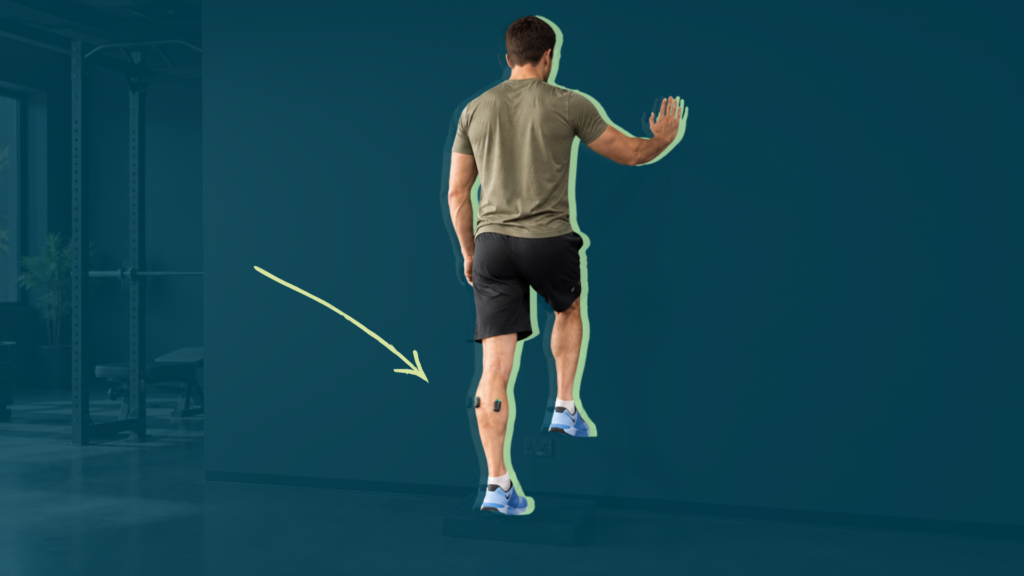
Cue the athlete to “try to hit your head on the ceiling” or “push the ground away from you hard and fast.” Other cues can target triple extension, which is a key monitoring point for practitioners.
If you are able to use velocity based training devices, aim for 0.75 – 1.0 m/s, increasing the weight progressively while maintaining the desired velocity. Or, use F-v imbalances to vary load and velocity.
| Concentric progression: 3-5 x 5 | |
| Exercise | Modality |
| Sit to stand with explosive intent (without leaving the ground) | Body weight or weighted |
| Increase concentric intent with strength exercises | Squat or leg press |
| Double leg jump on horizontal Total gym | Increase incline as needed |
| Single leg jump on horizontal Total gym | Increase incline as needed |
| Double leg CMJ | Body weight |
| Single leg CMJ | Body weight |
| Double leg squat jump (from seated) | Body weight |
| Single leg squat jump (from seated) | Body weight |
| Double leg squat jump (from seated) | Weighted |
| Single leg squat jump (from seated) | Weighted |
| Double leg squat jump | Trap bar |
| Single leg squat jump | Trap bar |
| Double leg CMJ | Weighted |
| Single leg CMJ | Weighted |
Considering the large deficits in the second phase of the concentric phase of the CMJ [7], it would be prudent to make sure you add sufficient calf and toe-off exercises. Therefore, a large focus will be on cueing / coaching the athlete to finish the vertical jump in triple extension. Add the following motor control progressions to assist with triple extension throughout the rehab.
| Progressions for acceleration stream (focus on triple extension) |
| Wall drill – holds |
| Wall drill – switches |
| Wall drill – switches with Swiss ball |
| SL RDL to box |
| Banded lunge to bench |
Reactive strength (improve drop jump deficits)
Reactive strength rehab will start early post-op and in conjunction with the explosiveness rehab above.
Athletes should start reactive strength when the knee is clinically pain free without swelling. The athlete needs to be able to lock the knee into extension and complete double leg calf raises. Once they can do this, we can start toe taps (band assisted, if needed at first).
Athletes should extend the knee as best as they can, keeping the heels off the ground when landing. The focus during early, low intensity plyos is on rhythm and flow. Increase intensity as plyos progress, with the cues shifting to “make a noise” – we should be able to hear contact on the floor – and keeping good form. Other useful cues are “hard and fast” to keep intensity up, and “floor like hot lava” to decrease ground contact time with good competence and intensity.
| Reactive strength progressions | |
| Exercise | Sets x Reps |
| Toe taps | 3×20 |
| Alternate leg pogos | 3×20 |
| Single leg pogos | 3×20 |
| Line hopping | 3×20 |
| Cone hopping | 3×10 |
| Cone hopping (2 forwards, 1 backwards) | 3×10 |
| Double leg tuck jump | 3×10 |
| Single leg tuck jump | 3×10 |
| Double leg drop jump | 3×10 |
| Single leg drop jump | 3×10 |
Tweet ThisThe end goals for double and single leg countermovement jump explosiveness at discharge are focused on restoring symmetry and strength, aligning with individual patient needs and specific athletic demands
@dustin179
Case study: Explosiveness and reactive strength in ACLR rehab
The sections below provide an overview of an ACLR patient’s rehabilitation focusing on explosiveness and reactive strength from week 1. Additional motor control exercises support the explosiveness and reactive strength progressions. They aid and maintain good alignment and control in the squat position of the hip, knee and foot. They also help prepare the athlete for the landing and jumping progressions, and address potential underlying deficits.
Weeks 1-2
Start with assisted toe taps, with a power band overhead. Once the athlete is able to move with a normal gait under full body weight you can shift to unassisted toe taps. But even if the patient is non-weight bearing, there’s still a regression that lets you build the foundation: supine toe taps against a wall.
For hip control, start with side lying straight leg hip abduction and bent knee hip external rotation, a.k.a., leg raises and clam shells. Introduce and progress load via a TheraBand as early as possible.
For foot control, focus on foot inversion / eversion and flexor hallucis longus. Addressing peroneal strength early will assist with foot alignment during functional movements; and including the flexor hallucis longus exercises (manual resistance or banded) will encourage the athlete to focus on getting the 1st MTP down with control during exercises.
Improve calf capacity and knee extension with double leg calf raises with the knee extending as much as possible. Continue motor control progressions of the foot, hip and knee to support controlled double leg and single leg squat and landing through weeks 8-12.
Weeks 2-4
Continue with unassisted toe taps, focussing more on increased speed and intensity.
Start concentric explosiveness work with double leg sit to stand from a box, watching for good control and progressively increasing concentric pace. If the patient is pain free with isometric leg press, start double leg leg press or Kieser machine with high reps and low load.
Motor control progressions will support controlled double and single leg squat. Start with assisted squat using suspension cables and horizontal Total Gym. Progress to free squat, box squats, goblet squats and leg press.
At discharge we want a good vertical jump, which requires triple extension of the foot, knee, and hip. Therefore, start wall drill holds early and cue early movement. Continue double leg calf raises and start banded single leg calf raises into extension, emphasizing the importance of locking the knee into extension. Encourage the athlete to finish the calf raise (and all foot push off exercises) on the 1st MTP.
Weeks 4-6
Encourage the athlete to increase the height of the pogos, and add in alternate leg pogos. Make sure the knee is properly extending, that the heel does not hit the floor, and that the athlete generally manages good form with the band before progressing to unassisted.
Increase press / push speed on the leg press or Keiser, and introduce single leg. Increase the speed of concentric double leg sit to stand, so the athlete is now exploding upwards without leaving the ground. Encourage fast explosiveness on other strength and motor control exercises, as well.
For eccentric explosiveness, once the patient can double leg squat to 90° with no pain, start eccentric absorption on closed chain exercises, i.e., double leg fast eccentric catch on leg press with 3 second holds. The patient should also begin assisted (power band) double leg drop catch.
Maintain motor control exercises as before, with relevant progressions.
Weeks 6-8
Continue alternate leg unassisted pogos until the athlete is fully competent with them, then commence assisted (banded) single leg pogos.
Progress load on leg press / Kieser. Transition the fast sit to stand from double leg to single leg, managing squat height from a comfortable range, i.e., 110° knee flexion. Start double leg jumps on a horizontal Total Gym, slowly increasing inclination as needed to progress.
Progress the unassisted double leg drop catch to assisted double leg to single leg drop catch. The ability to single leg squat to a certain range will let you know the limb’s ability to eccentrically absorb forces at those ranges. Therefore, perform the eccentric exercises to the athlete’s single leg squat range only).
Start single leg squat progressions using suspension cables, bands and Total Gym, progressing to free squats.
Weeks 8-10
Progress reactive strength work to unassisted single leg pogo.
Add load to the double leg fast sit to stand and increase the depth for the single leg version without any additional load. Increase the incline for double leg hops on the horizontal Total Gym and start small, low incline single leg hops on the horizontal Total Gym. If the patient is confident and comfortable, start low level countermovement jumps with minimal lift off from the floor.
Build the eccentric explosiveness with double leg drop catches, focussing on coaching the athlete’s speed, intensity and depth. Progress to unassisted single leg drop catch as tolerated and only in the single leg squat range depth. Start low level CMJ eccentric landings with minimal lift off, as in the concentric component.
Continue progressing the motor control support exercises as needed. Transition out of the side lying hip external rotation to a weight bearing position as soon as possible. Banded hip external rotation in a lunge position or banded hip external rotation in a isometric squat position are the most common options. These will assist hip control and strength to aid in landing progressions.
Weeks 10-12
Progress form, quality and contact time with single leg pogos and introduce line hopping.
Entry criteria for single leg landings are: 200% BW quad strength, no pain or swelling, single leg squat controlled to 90°. When the athlete meets those, start double leg jumping and landing with a body weight CMJ and squat jump from a seat.
Progress to single leg drop catch from single leg stance, with the focus on speed and intensity. Begin ladder drills focusing on double leg and single leg landings in the “home” position.
Continue motor control exercises and triple extension progressions. Coach the athlete into triple extension and up onto the 1st MTP.
Weeks 12-14
Once the athlete is competent in line hopping, introduce cone hopping. Make sure the athlete is clearing the cone with each repeated hop forwards and backwards without a pause. Coach them to look forward, keep the heel up off the ground, and maintain good knee alignment. Test the athlete with a few double leg drop jumps from a low height.
Add weight (dumbbells) to the double leg squat jump. Start single leg squat jumps and double leg landing. Maintain loaded explosive work on compound exercises.
Progress the single leg ladder landings. Add weight to the double leg drop catches and progress to weighted double leg to single leg drop catch.
Weeks 14-16
If the athlete is managing repeated cone hopping over a single cone, add more cones while maintaining form and speed of movement. Introduce forward and backward cone hopping with the same pattern of two hops forward, one hop backwards. Start double leg tuck jumps and increase step height for double leg drop jumps.
Progress concentric explosiveness work to a weighted single leg squat jump and single leg landing. Increase the load by adding double leg and single leg trap bar squat jump. Begin double leg and single leg CMJ performance training, emphasizing triple extension, height and landings.
Continue single leg landing progressions on the ladder in multiple planes with perturbations. Start overloaded drop catch landings with bands or Vertimax.
Weeks 16+
Continue double leg tuck jumps, focussing on increasing height and speed and improving form if there are any asymmetries. Progress to single leg tuck jumps once the athlete is competent with double leg. Start single leg drop jumps from low step and add weight to double leg drop jumps.
Add weight to the double leg CMJ and progress to weighted single leg CMJ. Continue refining double leg and single leg CMJ performance.
Progressively increase weight on the trap bar and coach intensity so the athlete moves into good depths with control. Start double leg drop to double leg landing and progress to single leg landing. Good eccentric absorption assists with the deceleration phase needed for change of direction.
More complete programs lead to a more complete athlete
“Assume nothing, test everything.” Once we measure, we can individualise an optimal rehab programme. By re-measuring every six weeks we can assess if our rehab is addressing the underlying deficits outlined in previous studies (2, 7), and confirm that the athlete is sufficiently progressing towards the discharge goals.
Acknowledgement to Brendan Butler, Enda King and Paul Read.
Tweet ThisEffective ACL rehabilitation requires more than just meeting discharge criteria. It involves comprehensive strength, flexibility, and neuromuscular control to ensure safe return to sport
@dustin179