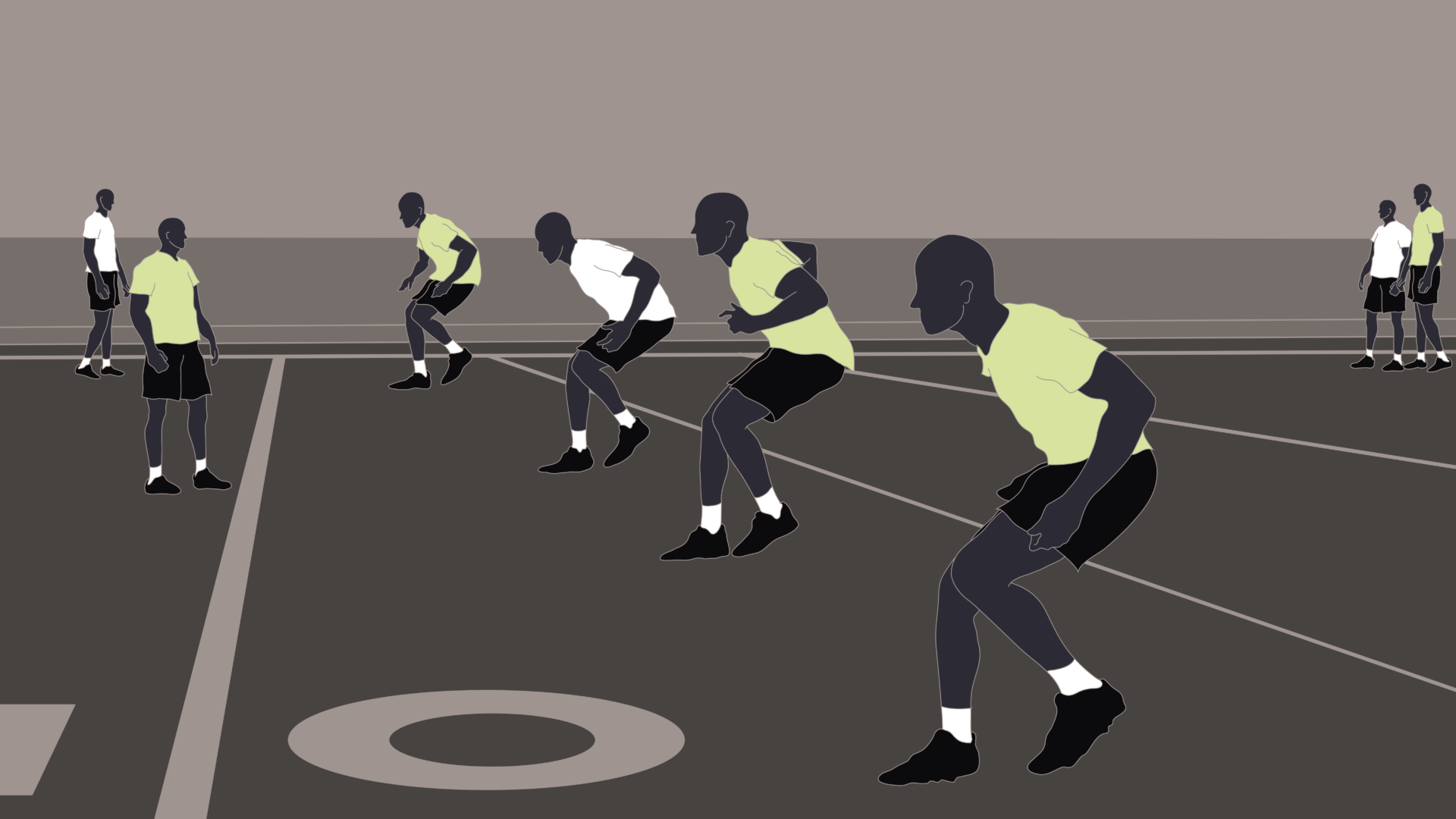

We asked practitioners from six NWSL clubs this question. This is what they said:

Jillian Zeller
Performance specialist, Angel City FC
Deceleration is a complicated skill that requires high internal forces at specific angles. To enhance deceleration ability, we manipulate multiple variables systematically and then simultaneously. The four components we prioritize are maximum deceleration, deceleration distance, time, and re-acceleration.
| Variable | Physical Quality Needed | Training Methods | Implementation |
| Maximum Deceleration | Eccentric Strength | Yielding Isometrics | Front Foot elevated Split Squats 2x30s |
| Eccentric Strength | 3-5second tempos & Reverse Sled Drags | ||
| Posterior Chain | Romanian Deadlift & Nordics | ||
| Single Leg Strength Work | Reverse Lunges & Single Leg Squats | ||
| Deceleration Distance | Movement competency at specific joint angles | Overcoming Isometrics | Split Squat ISO Hold 2x10s |
| Concentric & Eccentric Strength | Rear Foot Elevated Split Squats & Single Leg RDL | ||
| Plyometrics (landing mechanics- vertical- ncm) | Snap Downs & Depth Drops | ||
| Movement on pitch – Low- moderate magnitude decels | Slow Assisted Low Lunges and decels & Decelerations with zones | ||
| Deceleration Time | Elasticity & Responsiveness | Run Specific Isometrics | Ankle/Knee/Hip Iso Holds & Pushes |
| Strength Speed | Rear Foot Elevated Split Squats & KB Swings | ||
| Plyometrics (horizontal force- cm & dc) | Broad Jumps & Double Contact 45 degree bounds | ||
| Movement on pitch- moderate-high magnitude decels | Split Stance and Angled Decels & Assisted Decelerations | ||
| Pre planned to reactive drills (45-60 degree cuts) | |||
| Re-Acceleration | Rate of force development & Reactivity | Run Specific Isometrics | Ankle/Knee/Hip Iso Pushes & Switches |
| Speed Strength (vbt) | French Contrast training | ||
| Plyometrics (reactive & continuous) | Continuous single-leg hurdle hops & staggered stance continuous broad jumps | ||
| Movement on pitch- High magnitude decels w/ double action | Minimal deceleration zones & high entrance velocity | ||
| Multi-action & chaotic (90-180 degree cuts) | |||
| Assessments. 10-0-5 & ADA. |
Peak forces can reach up to six times body mass during maximal deceleration; therefore, our priority is eccentric strength. Eccentric strength determines how effectively we absorb force, break momentum, and control joint flexion under load. We develop eccentric strength through yielding isometrics, then build strength with single-leg and posterior-chain exercises. Simultaneously, we incorporate plyometrics that emphasize landing mechanics teaching our body to absorb force dynamically. Snap downs and reverse sled drags, for example, assist with lowering the center of mass. The primary focus of eccentric strength is to improve early-phase deceleration forces.
Deceleration distance is the length (meters) it takes an athlete to brake. Improved braking efficiency shortens this distance. We start with short entrance runways, lower velocities, and larger deceleration zones. For example, 5–15M runs at 60–70% speed and a 5M deceleration zone, progressing to a 3M zone and eventually a 1M brake. We then incorporate assisted decelerations with a 1080 device, reinforcing posture and positioning. This progression coincides with increasing the magnitude of plyometrics, from snap downs to depth drops. The goal is to maintain braking efficiency as deceleration demands increase.
Deceleration time is how long the athlete takes to brake from an entrance velocity. To move from low- to moderate-magnitude decelerations, we increase entrance distance and velocity. We revisit 5, 10, and 15M approaches with 0–3M deceleration zones at higher entrance velocities (75–85% of Max V). We introduce different deceleration positions, including split stance and angled, as well as reactive elements. In the weight room, we emphasize speed strength and horizontal force production through exercises such as broad jumps and 45-degree bounds.
Re-acceleration is the athlete’s exit velocity following maximal deceleration. We increase complexity by adding a second action, such as a change of direction or stop-and-go drill, and reactive elements. In the weight room, we emphasize rate of force development (RFD) through run-specific isometrics. High eccentric RFD allows the athlete to absorb and stop momentum at a higher rate, while high concentric RFD allows the muscles to transition from absorbing force to driving force into the ground, producing a faster exit step.
Deceleration is a skill that can be improved through proper coaching and targeted training stimuli. By systematically developing eccentric strength, braking distance, deceleration time, entrance velocity, and re-acceleration, we can improve an athlete’s ability to efficiently absorb and redirect force, maintain control at higher velocities, and transition into their next action. This enhances overall performance while potentially reducing injury risk during competition.
Tweet ThisPeak forces can reach up to six times body mass during maximal deceleration; therefore, our priority is eccentric strength.
Jillian Zeller

Jessica Mendez
Lead Strength Coach, Utah Royals
Dr. Damian Harper’s “Braking Performance Framework” is a go-to reference of mine when it comes to enhancing deceleration ability. It approaches deceleration training from a 360-degree point of view, making it simple to apply both on the pitch and in the weightroom, and provides some especially powerful tools for female soccer players not only from a performance lens but an overall health and robustness standpoint.
A method I heavily rely on when chasing improvements in deceleration ability, specifically slow eccentric strength, is Accentuated Eccentric Loading (AEL) on machines. Machines like a leg press or Keiser squat pro have been especially effective in this because not only do they keep the athlete safe and have a very low barrier to entry, the athletes are also able to fully focus and emphasize the eccentric portion of the movement, keeping the main thing, the main thing.
When we’re on the pitch, I love to use the 1080 sprint to also train slow eccentric strength but in a more functional sense. We purposefully overload the eccentric portion for something like a lateral step, penultimate step, or even as simple as a forward bent knee walk and tell the athlete to move with as much control as possible; really owning each position. They are not only getting a feel for these angles and forces but also training the tissue at these slow, higher forces.

I view the development of this slow eccentric strength as the foundation for deceleration ability. The next step for me is then training various forms of isometric strength and reflexive eccentrics. The isometric phase is critical in my eyes when it comes to deceleration because it acts as the bridge and force transfer between the eccentric and concentric phase. If the athlete cannot tolerate the forces coming at them isometrically, all that force will just dissipate and they will fall flat.
Some of my favourite methods to train this type of work are things like banded overspeed catches (squat, split squat, etc.) with an isometric pause, forcing the athlete to not only slam on the brakes but own the pause position. I also use this on pitch with the 1080 Sprint or bands with things like an overspeed deceleration from various angles with a pause at the transfer point of the cut.
For female soccer players, developing decelerative strength isn’t just about becoming more athletic, it is about giving them the physical tools to perform and stay safe during some of the most demanding moments of the game.
Tweet ThisThe isometric phase is critical in my eyes when it comes to deceleration because it acts as the bridge and force transfer between the eccentric and concentric phase. If the athlete cannot tolerate the forces coming at them isometrically, all that force will just dissipate and they will fall flat.
Jessica Mendez

Preston Secrest
Sport Scientist / Assistant Strength & Conditioning, Orlando Pride

Christi Edson
Head of Performance, Orlando Pride
Training deceleration is one of our favorite examples of connecting the weight room to the field. We do not think of it as a single drill; we think of it as a braking system continuum. In Formula 1, speed only matters if the drive can brake late, stay under control and exit the corner efficiently. Football (Soccer) is similar. Our athletes need to arrive fast, absorb force, organize their body, and leave the movement ready for the next action.
We use the control-chaos continuum from Taberner, Allen, and Cohen as a lens for this progression. We are with high control, usually in the gym, targeting isometrics that challenge the specific positions athletes need when they decelerate: deeper hip and knee flexion, trunk control, foot stability, and the ability to own both linear and lateral positions. We begin with yielding isometrics, asking the athlete to hold a position and resist collapsing, then progress towards overcoming isometrics where they push aggressively into an immovable constraint.
From there, we move into moderate control strength work: split squats, lateral lunges, step-downs, curtsey lunges, and loaded catch positions that blend concentric and eccentric qualities. Once the athlete can brake with shape and intent, we progress to plyometrics such as snap downs, pogo to stick variations, skater hops and different jump variations with and without load.
On field, the same idea of control to chaos continues. Planned changes or direction drills come first, with predetermined angles, distances and entry speeds. We then add a reaction piece (a coach’s cue, a teammate’s movement, a ball’s flight) to add more chaos. Can the athlete repeat the action efficiently by analyzing unplanned external factors? Lastly, we increase complexity by placing the athlete against an opponent, where deceleration becomes perceptual, tactical and no longer self-paced. With or without the ball, this adds the final piece of chaos: competition.
Once that theoretical framework is established, the practical progression looks less like a straight line and more like an off-set ladder. The inside run starts first with gym-based isometrics and controlled linear running on field; because those are the earliest opportunities to restore positions, confidence and tissue tolerance. However, as the athlete progresses, that inside run does not disappear; it runs parallel to the outside rung of rehab, where field-based deceleration, change of direction and reactive tasks become more complex. In that sense, we see the strength work as a concurrent thread throughout the process, not a box we check before moving from the gym to the field.
For us, the goal is simple: earn the positions, build the brakes, then add speed and chaos. Deceleration is not just stopping, it is a skill that lets an athlete control momentum, create the next action, and beat the player in front of them.
Tweet ThisFor us, the goal is simple: earn the positions, build the brakes, then add speed and chaos.
Preston Secrest and Christi Edson

Haley Downey
Performance Specialist, Portland Thorns
My approach to improving athletes’ deceleration ability is to use a combination of overcoming isometrics, flywheel training, and depth drops and jumps to develop rate of force development, eccentric braking, and tendon stiffness. Starting in preseason, athletes lift twice per week, one mixed upper body and overcoming isometrics session and one full lower body lift. All athletes see a variation of an isometric calf raise, single leg squat, split squat, and single leg hip thrust. Proper positioning during each exercise is essential, emphasizing this early in the season is beneficial as it builds correct loading through specific joint angles, like the deceleration position in soccer, while not adding unnecessary fatigue during a demanding point of the season. We will continue to program overcoming isometrics throughout the regular season in their lower body lifts. Athletes will either focus on quicker, shorter maximal efforts or a slower build into a longer maximal effort, both won’t exceed 6 seconds per rep. For much of the season, lower body lifts are on MD-3 with some athletes continuing to have additional overcoming isometrics on MD+2. This allows for adequate recovery before game day from a lower body focused session.
In addition to overcoming isometrics, each athlete will have different eccentric loading exercises based on injury history and level of proficiency all with an emphasis on being as explosive out of positions as possible. This is done through traditional lower body strength exercises and flywheel training. For example, a dumbbell or barbell loaded split squat, forward lunge, or lateral lunge. As players advance, I will introduce flywheel exercises to continue to challenge the eccentric loading phase, as this adds an eccentric overload not typically seen in traditional strength training. Across the season I will progress through various movements such as double leg squats, split squats, forward and lateral lunges on the flywheel. Whenever possible, athletes will do unilateral training to train ankle and knee stability and pelvic control needed for deceleration.
The final component to enhance an athletes’ deceleration ability is still targeting eccentric braking and stiffness but now through depth drops and depth jumps. Depending on the athlete, they will have single and double leg variations. Some athletes train these in isolation, while others are programmed as contrast movements with their overcoming isometrics and flywheel exercises. The cue given is to stick or freeze on depth drops and as quick and as high as possible for depth jumps.
Combining all of these components together builds athletes’ ability to absorb force, stop quickly, and then to reapply that force to change direction. Building this into throughout the season allows us to continually develop athletes’ deceleration abilities.
Tweet ThisThe cue given is to stick or freeze on depth drops and as quick and as high as possible for depth jumps.
Haley Downey

Ben Young
Performance Director, San Diego Wave FC
My first step when trying to enhance any physical capability in a team sport context is to create a working model, framework, and at the micro level an exercise index. This allows me to check and challenge what we are doing against a belief, a rationale and system to aid decision making and exercise prescription.
Damien Harpers’ work here helps me make sense of deceleration and I buy heavily into his framework of splitting our deceleration work into 3 distinct buckets; Braking Force, Braking Speed and Braking Impulse. The activities which can occur across these 3 buckets can be trained in two spaces; the gym, or on the pitch. I simplify this further by thinking of this as a continuum of activities ranging from exercises which don’t particularly look and feel like deceleration (heavy slow eccentrics & yielding isometrics) to high task specificity activities such as rapid eccentrics, resisted decelerations, reactive change of direction and everything in-between.
To bring it to life in our context; Prior to our intensive (small area) days on the pitch the team will complete a braking preparation warm up. Here we focus on the braking speed and braking impulse end of the continuum. We feel this not only compliments the work we are going into on the pitch, but also serves to developing these qualities overtime. Within this session you will see lots of bungees, aqua bags and light free weights. Activities such as rapid eccentrics, stomp variations, drop catches, resisted decelerations / resisted pressing & braking steps or reactive change of directions.
Post session we work the opposite end of the continuum, braking force. In the gym you will see lots of braking force activities such as heavy slow eccentric unilateral squat variations, flywheel work and yielding isometrics. Some players also head back out to the pitch to complete plyometrics with a final braking emphasis, loaded decelerations and cuts.
To refine the exercise prescription for each individual we use jump outcome metrics: Eccentric mean power, Eccentric RFD, Eccentric Impulse as well as the jump strategy metrics; Eccentric Speed & Eccentric Depth. These metrics helps us define two things 1. Do they have high or low braking strength qualities 2. How do they like to produce and absorb force. The answers to these questions bucket the players and gives us a system to assess & refine against.
Tweet ThisMy first step when trying to enhance any physical capability in a team sport context is to create a working model, framework, and at the micro level an exercise index.
@benyoung01

Julie Twaddle
Head of Performance, Denver Summit FC
While enhancing deceleration ability is complex and multifactorial, the methods I rely on most are those that prepare athletes to brake quickly and safely and then immediately re-accelerate. My general principle is to start from the head coach’s game model and what it asks of players. For example, counterpressing, where the nearest player(s) immediately pressure the ball carrier to win back possession after a turnover, is very important to how we play and is required throughout an entire match. This requires closing down an opponent at high speed, braking under control, and then preparing to either make a tackle or re-accelerate into the next action. Training the ability to execute this effectively and safely requires deliberate exercise selection.
Work from researchers such as Dr. Damian Harper has helped inform how to train deceleration ability. The Braking Performance Framework nicely outlines training deceleration by addressing braking force control and braking force attenuation. With this in mind, the drills and exercises aim to build eccentric strength and tissue capacity and then to develop the ability to produce high braking forces in less time. The exercises and drills I often use to train these abilities include building awareness and capacity through low split squat isometrics and band resisted reverse walks; developing strength through split squat and K-box variations; progressing RFD through snap downs, loaded drop squats, and depth drops; and bridging the gap from gym to pitch through dynamic movement patterns such as assisted decel lunges and angled decels using the 1080 Sprint.
If I had to isolate one “braking” exercise, I would choose a ‘Drop Catch’ Lunge. This movement allows for rapid, eccentric patterns similar to what is performed on the football pitch. The exercise itself can range from simple to complex, starting with bodyweight and progressing to an overhead barbell movement. My favourite variation is with dumbbells due to ease and comfortability of the movement for athletes and I would prescribe 2-4 sets of 5-6 reps each side.
However, deceleration ability is not developed through isolated exercises alone. In close collaboration with the coaching staff, we expose players to unanticipated, contextual decelerations through transition games where a turnover triggers an immediate press and through 1v1 pressing scenarios. We also manipulate pitch size to influence approach speeds and monitor total and high-intensity decelerations to prepare athletes for game demands.
Ultimately, however, no single exercise trains an ability as multifactorial as deceleration. Working backwards from how our players must decelerate within the game and our specific game model, then building the underlying qualities through both controlled and sport-specific methods, guides my approach with elite female soccer players.
Tweet ThisMy general principle is to start from the head coach’s game model and what it asks of players.
Julie Twaddle