
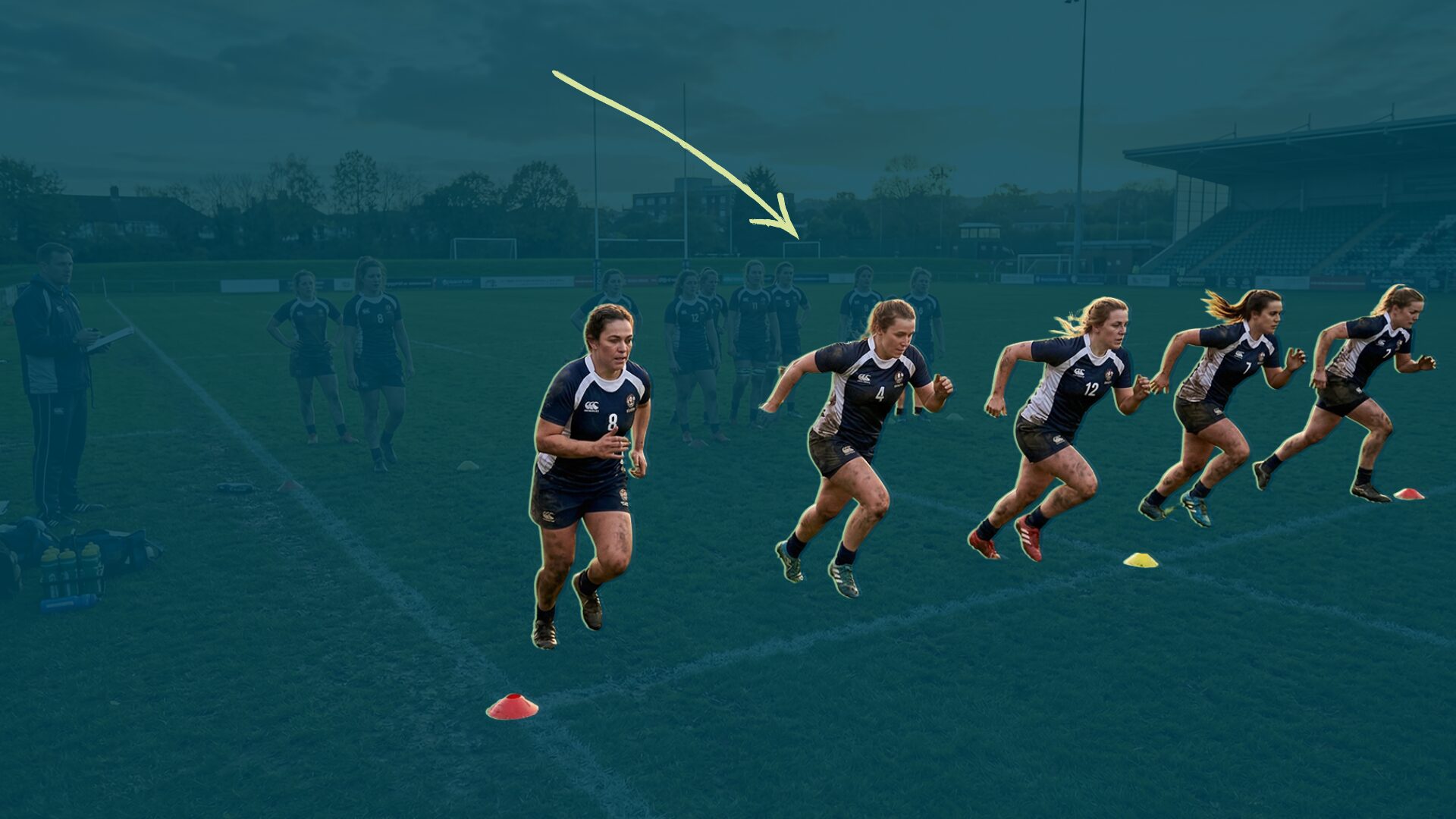
While repeated sprint training is a highly effective method for developing athletes’ physical qualities, it represents just one form of interval training. Short-bout high intensity interval training (short-HIIT) is another format, one that promotes a range of physical adaptations and prepares athletes for the intermittent demands of field and court sports.
Short-HIIT involves repeated efforts lasting less than 60 seconds with work-to-rest ratios in the range of 1:1 to 2:1. Each effort is at or above an athlete’s maximal aerobic speed (MAS).[1, 2]
Although short-HIIT can be implemented using various exercise modalities, this article focuses on running-based conditioning, since that is particularly relevant to field-based team sports such as football and rugby codes. The aim of this article is to provide insight into the acute and chronic effects of short-HIIT and offer practical guidance on how it can be integrated across different phases of the training year.
Metabolic and cardiovascular demands of short-HIIT
Short-HIIT allows athletes to accumulate a large volume of high speed running within a brief time frame (Table 1), delivering a potent aerobic, anaerobic, and neuromuscular stimulus.[3]
The anaerobic and neuromuscular challenges arise from high running speeds, repeated accelerations and decelerations, and—when shuttles are incorporated—changes of direction. These demands are not as extreme as they are during other HIIT formats, such as repeated sprint training and sprint interval training.[1] But short-HIIT still facilitates large motor unit recruitment (i.e., type II muscle fibres) and substantial glycolytic contribution. Blood lactate concentrations at the end of a set are typically 8.3 ± 1.0 mmol∙L-1 , but I’ve observed some athletes’ values as high as 19 mmol∙L-1.[2]
On the other hand, depending on the intended training outcome, practitioners can design short-HIIT sessions that produce lower glycolytic stress in order to place greater emphasis on aerobic metabolism.

The high intensities associated with short-HIIT facilitate near-maximal cardiac output. Estimates for average heart rate and peak heart rate during short-HIIT activities are 88 ± 2% and 94 ± 2% of their maximum, respectively.[2] Furthermore, athletes spend 34 ± 9% of total training time during short-HIIT above 90% of V̇O2max, equating to several minutes per set, a critical threshold for driving maximal physiological adaptations.[2,3–7] To enhance aerobic fitness, coaches should aim to maximize the athletes’ time above this threshold by manipulating programming variables.
Session ratings of perceived exertion (sRPE) during short-HIIT are typically classified as “very hard,” ranging from moderate to maximal, though it’s worth remembering that the athlete’s fitness level influences their perceived effort. Athletes with a V̇O2max of 50–55 ml∙kg-1∙min-1 rated short-HIIT as very hard (7.9 ± 1.0), while athletes with a V̇O2max of >55 ml∙kg-1∙min-1 perceived it as less demanding (6.2 ± 1.3).[2]
Together, these physiological and perceptual responses offer general insights for coaches. Actual training demands will ultimately depend on session design and contextual factors such as training status and individual physiological characteristics.
| Session format | Prescribed intensity (% ASR) | Total distance (m) | HSR distance (m) | VHSR distance (m) | Sprint distance (m) | sRPE | Session duration (min) |
| 2 x 6 x 15:15 | 25 | 1026 ± 36 | 701 ± 36 | 33 ± 37 | 0 ± 0 | 4.8 | 8 |
| 2 x 6 x 15:15 | 30 | 1091 ± 64 | 731 ± 58 | 13 ± 13 | 0 ± 0 | 5.1 | 8 |
| 2 x 8 x 15:15 | 25 | 1452 ± 76 | 954 ± 57 | 0 ± 0 | 0 ± 0 | 6.3 | 10 |
| 2 x 8 x 15:15 | 27.5 | 1456 ± 74 | 910 ± 88 | 3 ± 5 | 0 ± 0 | 6.0 | 10 |
| 3 x 6 x 15:15 | 27.5 | 1634 ± 99 | 1103 ± 90 | 21 ± 32 | 0 ± 0 | 5.6 | 13 |
| 3 x 6 x 15:15 | 30 | 1709 ± 103 | 1165 ± 126 | 7 ± 10 | 0 ± 0 | 7.3 | 13 |
Note: Adapted from [8]
Tweet ThisShort-HIIT still facilitates large motor unit recruitment (i.e., type II muscle fibres) and substantial glycolytic contribution. Blood lactate concentrations at the end of a set are typically 8.3 ± 1.0 mmol∙L-1.
@Fraserthurlow
Physical adaptations to short-HIIT
The primary aim of short-HIIT is to enhance cardiorespiratory fitness. A meta-analysis demonstrated moderate to large improvements across key fitness measures when short-HIIT was implemented alongside usual training practice (Figure 1).[9] MAS increased by 7.4%, V̇O2max(directly measured) increased by 5.4%, and performance in the Yo-Yo Intermittent Recovery Test level 1 jumped 21.3%.
Short-HIIT also benefits speed and explosive qualities.[9] Athletes showed a 6.7% increase in countermovement jump height, 3.7% improvement in repeated sprint ability, and 3-4% quicker short sprint and change of direction times.[9] These improvements are particularly meaningful given that the smallest worthwhile change in sprint performance is 1-2%.[10]
Knowing these expected improvements from short-HIIT can inform training prescription, helping coaches optimise adaptations and monitoring athlete progress.
Repeated high speed muscular contractions are likely the foundation of the neuromuscular stimulus of short-HIIT. They may also contribute to structural adaptations.
For instance, a six-week short-HIIT intervention in rugby league players, performed without any eccentric hamstring strength training, resulted in moderate increases in biceps femoris fascicle length and small increases in muscle thickness.[11] Longer fascicle lengths are associated with a reduced risk of hamstring strain injuries.[12]
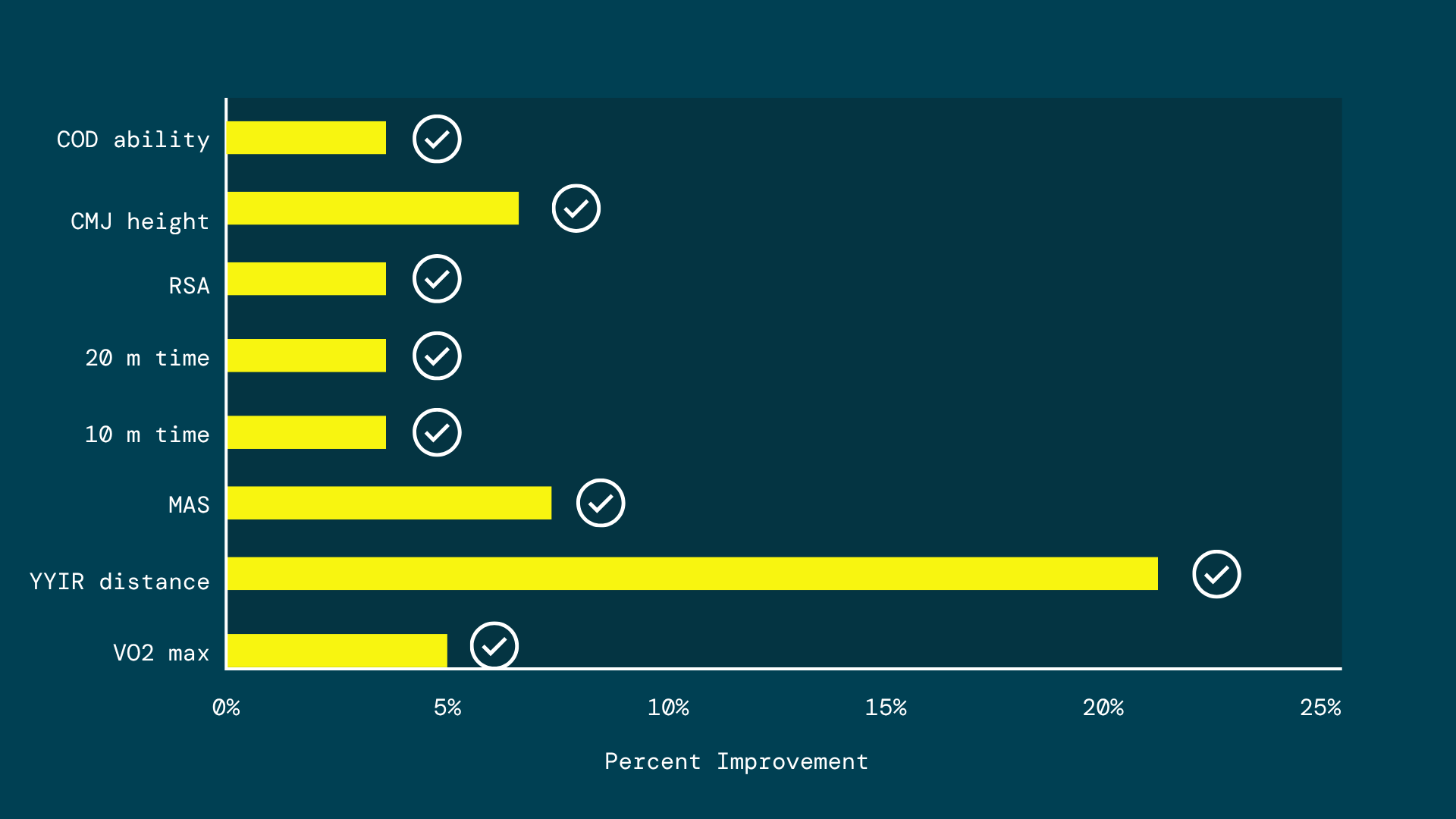
Note: Data extracted from 32 studies [9]. RSA = repeated sprint ability; YYIR1 = Yo-Yo Intermittent Recovery Test level 1
Tweet ThisShort-HIIT also benefits speed and explosive qualities.[9] Athletes showed a 6.7% increase in countermovement jump height, 3.7% improvement in repeated sprint ability, and 3-4% quicker short sprint and change of direction times.
@Fraserthurlow
Programming short-HIIT to meet your needs
Much of the recent focus on short-HIIT has been on methods of prescribing intensity, typically based on MAS or the anaerobic speed reserve (ASR).[13–17] This emphasis is well justified, given ASR’s ability to individualise training intensity and reduce inter-individual variation in both the acute psychophysiological responses and the physiological adaptations to short-HIIT.[13–17]
However, it’s also important to consider the prescription of programming variables in the design of short-HIIT, as these can also influence the acute and chronic stimulus.
The prescription of short-HIIT consists of 11 primary programming variables (Table 2).
Practitioners can program straight-line running for short-HIIT, reducing perceived exertion and maximising running speed. Alternatively, they can program shuttle runs to increase anaerobic contribution and prepare team sport athletes for braking, acceleration, and change of direction.[1, 2] A scheme of 4 sets of 6 repetitions will maintain running quality, while longer series (e.g., 2 sets of 12 repetitions) accumulate time at elevated oxygen uptake.
The repetition duration typically ranges from 10-45 s, with 15 s and 30 s intervals most common.[1, 2] Shorter intervals emphasise running speed, and longer intervals increase aerobic strain.[2]
The inter-repetition rest time (i.e., rest interval duration) and subsequent work-to-rest ratio can be manipulated to amplify the cardiorespiratory demand by reducing rest time (e.g., 30 s repetition with 15 s rest).[18–20] This could be appropriate during the general preparation stage of preseason. Later in the season, when the priority is speed exposure, longer rest periods allow for faster running speeds.
Recovery between repetitions and sets is usually passive, but active rest periods can provide a further physiological stimulus by maintaining elevated oxygen uptake. This may be desirable when aerobic loading is the primary objective.[1, 2] Endurance athletes (V̇O2max > 60 ml∙kg-1∙min-1), who recover quickly between efforts, particularly benefit from active rest periods or 2:1 work-to-rest ratios. This allows them to accumulate a greater amount of time in their “red zone.”
| Programming variables | Most common prescription |
| Running modality | Straight-line |
| Number of repetitions | 8 or 12 |
| Number of sets | 2 |
| Repetition duration | 15 s |
| Inter-repetition rest time | 15 s |
| Inter-set rest time | 4 min |
| Inter-repetition rest modality | Passive |
| Inter-set rest modality | Passive |
| Session intensity | 120% MAS |
| Session frequency | 2 per week |
| Program duration | 6 weeks |
Optimising the prescription of short-HIIT involves maximising the time that athletes spend above 90% of V̇O2max, with a target of at least several minutes per session.[4, 5, 21] Incorporating an active rest period or extending repetition duration are the best programming strategies to maximise time above 90% of V̇O2max (Figure 2).[2] Comparatively, prescribing two more reps per set has no meaningful effect.[2]
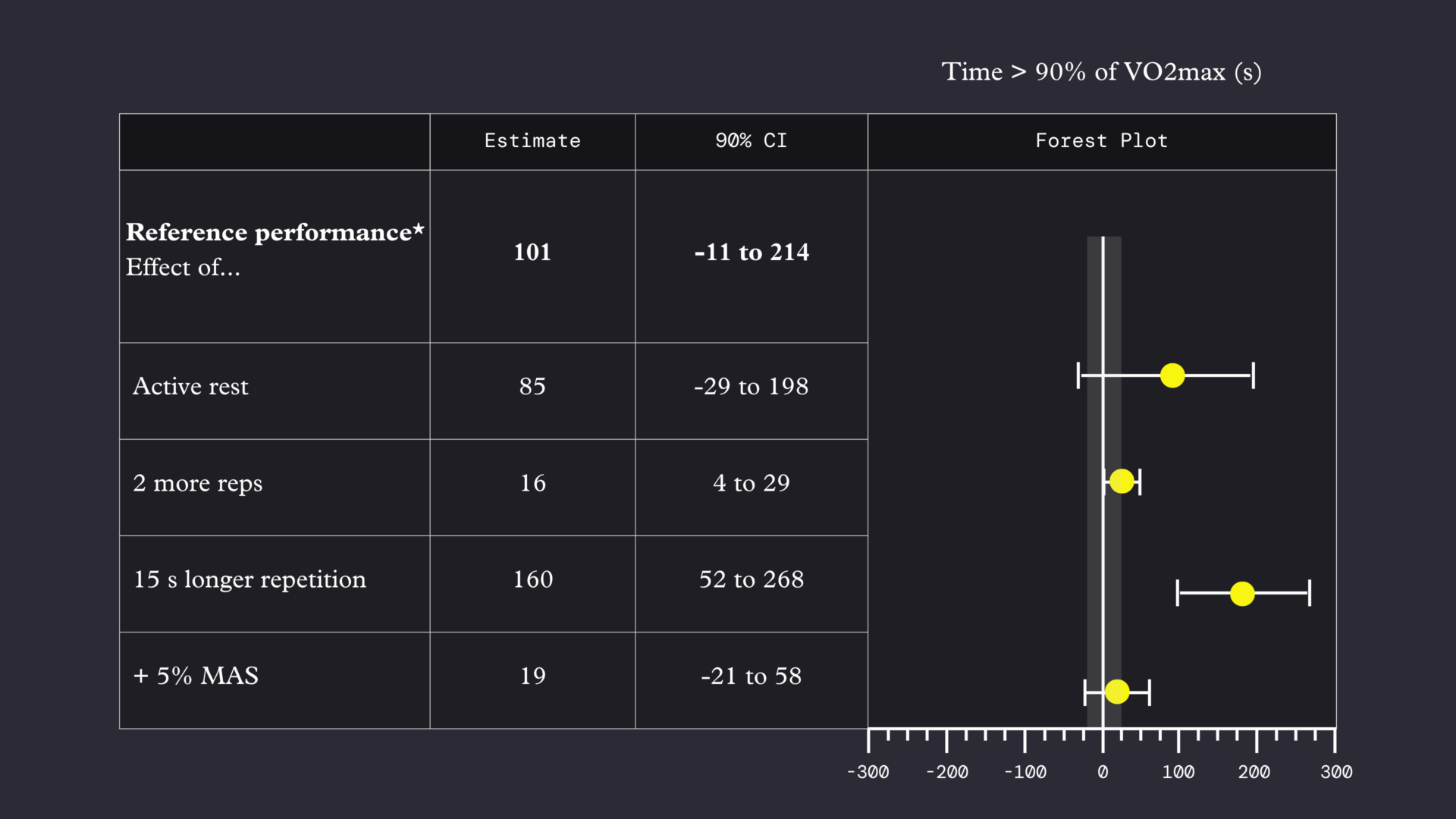
Note: Area outside the shaded zone represents the region of practical significance – extracted from [2]. Abbreviations: * = 1 set of 12 straight-line repetitions, performed at 120% MAS for a 15 s work duration with 15 s of passive rest
Coaches often have only 10–20 minutes per session to develop players’ fitness, making training efficiency critical.
Prescribing an active rest period, an increase in repetition intensity, and a higher work-to-rest ratio are the most effective options for improving the efficiency of a short-HIIT session—that is, the proportion of time the athletes are above 90% of V̇O2max.[1, 2, 18–20] Coaches do not need to apply these manipulations across the entire session to meaningfully enhance the physiological stimulus.
For example, a baseline session was two sets of 10 × 30 s intervals performed at 120% MAS on a motorised treadmill with 30 s passive recovery. Shifting to 15s of active recovery at 65% MAS, shortening the recovery to 15 s, or increasing running speed by 5% MAS during just the first 2-3 repetitions of each set produced a pronounced increase in physiological responses across the entire session. For one athlete, the standard session did not take him above 90% V̇O₂max. By introducing active recovery in the first 2-3 repetitions of each set, he increased his average session V̇O₂ by 10% and spent 7 minutes above 90% V̇O₂max (Figure 3).
These findings bolster the idea that deliberate “fast start” strategies at the beginning of each set may be a practical and effective way to maximise the overall training stimulus.
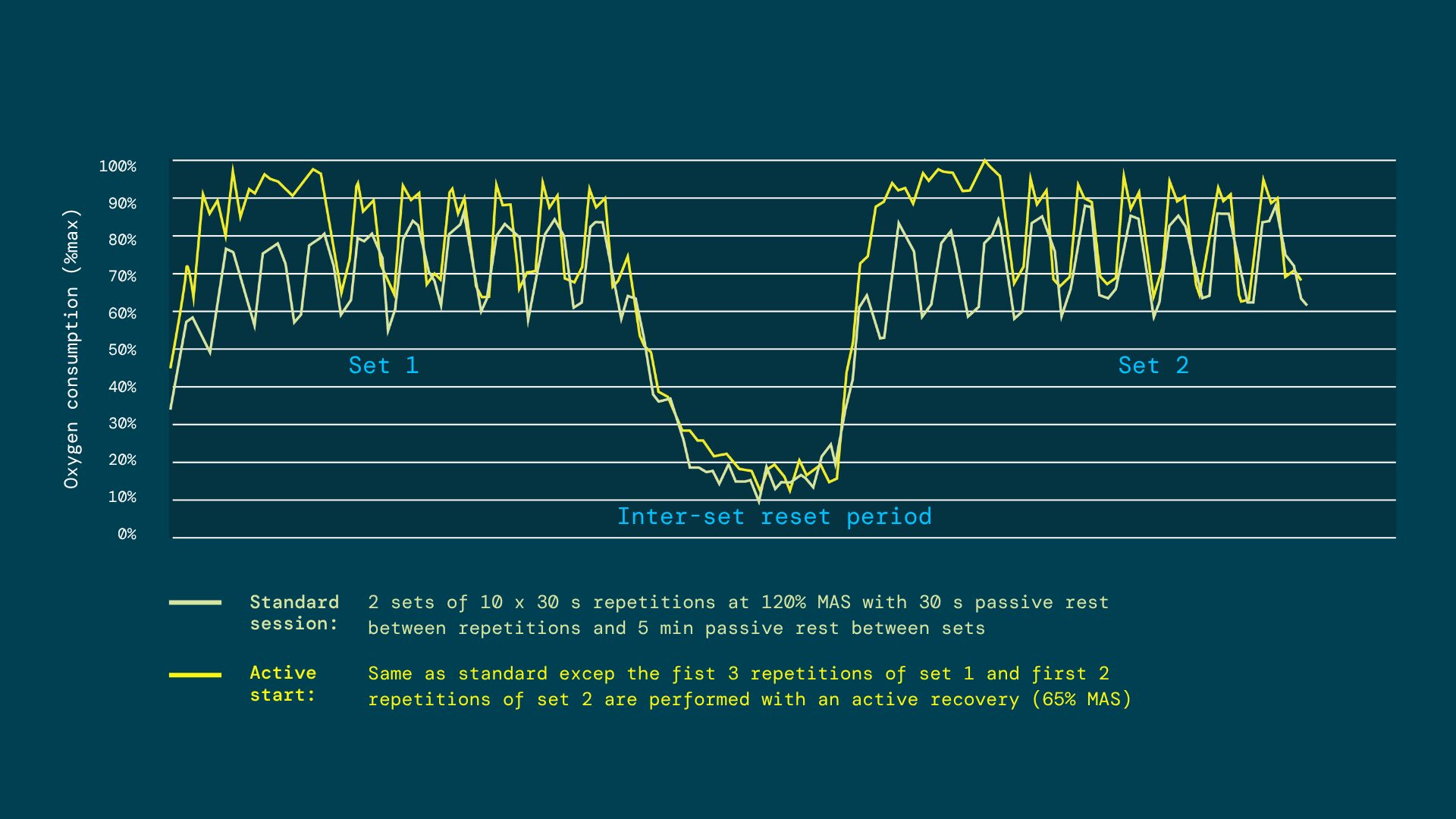
Note: Each spike represents one repetition
Tweet ThisOptimising the prescription of short-HIIT involves maximising the time that athletes spend above 90% of V̇O2max. Active rest periods or extending repetition duration are the best programming strategies to maximise time above 90% of V̇O2max.
@Fraserthurlow
Programming short-HIIT across the macrocycle
The annual training program provides several opportunities to implement short-HIIT. During the off-season it can preserve fitness with minimal logistical demands. In the pre-season, it can drive rapid physiological adaptation, while in-season it maintains fitness within congested schedules. It also factors in to return-to-play phases as a way of reintroducing controlled exposures to high speed running while rebuilding fitness.
This flexibility allows practitioners to tailor sessions to the evolving needs of athletes, whether the priority is adaptation, maintenance, or reconditioning.
Tweet ThisDuring the off-season it can preserve fitness with minimal logistical demands. In the pre-season it can drive rapid physiological adaptation, while in-season it maintains fitness within congested schedules.
@Fraserthurlow
Off-season
During the offseason, short-HIIT can maintain athletes’ exposure to high speed running while attenuating the loss of aerobic and anaerobic fitness. The primary adaptations targeted in this phase are maintaining V̇O2max and MAS, with secondary benefits to repeat sprint ability, speed, and power.
Since it requires minimal time and space, it’s a simple training tool. The challenge is determining which method of intensity prescription best suits the athlete.
Given that athletes often train without supervision during the off-season, most won’t measure the distance they’re required to run for each repetition based on their MAS or ASR. Furthermore, setting an exercise intensity using heart rate zones for supramaximal HIIT is limited by several issues, including availability of equipment and heart rate lag at the onset of exercise.[1] Therefore, basing the program on RPE is the most suitable option, allowing the athlete to self-regulate their exercise intensity based on how the session feels.[1] To help with adherence and consistent physiological stimulus, it’s also best to simplify the design of sessions, e.g., 1:1 work-to-rest ratios with a passive rest period.
Alternating each set between straight line efforts and shuttle efforts will ensure exposure to diverse neuromuscular demands.
| Week | Mode | Sets × reps | Rep duration (s) | Inter-rep rest (s) | Inter-set rest | Session intensity (RPE) | Session duration (min) | Acute demand |
| 1 | S1: STR S2: SHU | 2 × 10 | 15 | 15 (passive) | 3 min (passive) | Hard | 13 | High |
| 2 | S1: STR S2: SHU | 2 × 12 | 15 | 15 (passive) | 3 min (passive) | Hard | 15 | High |
| 3 | S1: STR S2: SHU | 2 × 10 | 20 | 20 (passive) | 3 min (passive) | Very hard | 17 | High |
| 4 | S1: STR S2: SHU | 2 × 12 | 20 | 20 (passive) | 3 min (passive) | Very hard | 19 | High |
Note: STR, straight line running; SHU, shuttle runs
Preseason
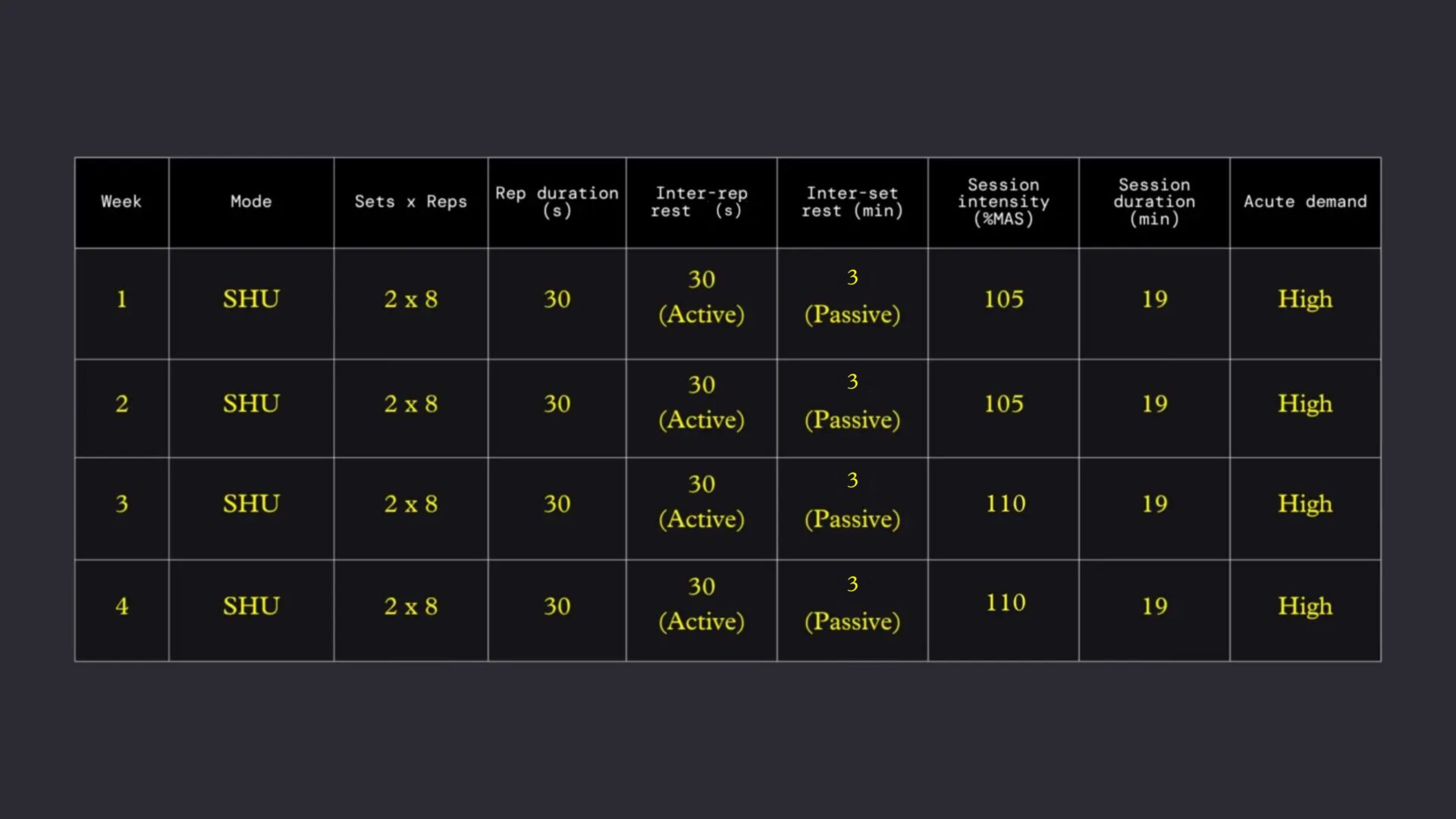
The primary goals of incorporating short-HIIT during preseason are to maximise aerobic capacity and MAS, primarily through increases in cardiac output (stroke volume), mitochondrial biogenesis, oxidative enzyme activity, and faster V̇O2 kinetics.[24–27]
Begin by building the aerobic energy system through longer intervals (e.g., 30–60 s), with reduced rest or active recovery. Then progressively increase athletes’ exposure to high speed running.
To maximise efficiency while getting as much time above 90% V̇O2max as possible, consider two sets of 12-15 × 30 s repetitions at 105% MAS with an active recovery at 50% MAS.[28–30] This protocol maximises physiological adaptations, as athletes accumulate around 8 minutes above 90% of V̇O₂max per set: more than 50% of total set duration.
While this prescription is suitable for endurance athletes, team sport athletes will get greater return from 6–10 repetitions per set in order to preserve quality and manage training stress. That is especially the case for those with speed or hybrid profiles.
Unless the athletes are performing this session around an oval, the 30 s efforts will need to be completed as a shuttle run, which will increase the anaerobic demand and mechanical load. Shorten the intervals as preseason progresses in order to increase the intensity. That would also be the time to incorporate non-running activities (e.g., grappling, sport-specific tasks) into the recovery periods to reinforce movement patterns that are transferable to game-specific actions under fatigue.
Tweet ThisThe primary goals of incorporating short-HIIT during preseason are to maximise aerobic capacity and MAS, primarily through increases in cardiac output (stroke volume), mitochondrial biogenesis, oxidative enzyme activity, and faster V̇O2 kinetics.
@Fraserthurlow
In-season
Frequent matches during the season lead to high acute and chronic training loads.[31] Recovering between matches is the priority, but coaches must ensure that their athletes maintain their fitness levels over the course of the season.
The time-efficient and relatively low volume nature of short-HIIT makes it particularly suitable during the season. However, the players may have sufficient exposure to high speed running and mechanical load from their matches and technical practice. In that scenario, the best choice may be limiting further exposure while maintaining the physiological stimulus during conditioning.
An effective strategy to achieve this via short-HIIT is a greater work-to-rest ratio (e.g., 2:1). Straight line efforts will also be beneficial to reduce the mechanical load, anaerobic demand, and perceived stress that is associated with shuttle runs.[2,32,33] However, changes of direction may be unavoidable based on training facilities.
For players who do not meet weekly load requirements (e.g., non-starters), practitioners can design sessions for them to accumulate high speed running volume similar to what they would have encountered in a full length game.
| Week | Mode | Sets × Reps | Rep duration (s) | Inter-rep rest (s) | Inter-set rest (min) | Session intensity (%MAS) | Session duration (min) | Acute demand |
| 1 | STR | 2 × 8 | 20 | 10 (passive) | 2 (passive) | 105 | 10 | Mod |
| 2 | STR | 2 × 8 | 20 | 10 (passive) | 2 (passive) | 110 | 10 | Mod |
| 3 | STR | 2 × 8 | 30 | 15 (passive) | 2 (passive) | 105 | 14 | Mod |
| 4 | STR | 2 × 8 | 30 | 15 (passive) | 2 (passive) | 110 | 14 | Mod |
Return to play
A crucial aspect of an athlete’s return to competition after an injury is successfully progressing through a training phase that involves sport-specific amounts of high speed running.[34–37] Short-HIIT can recondition the athlete through controlled volumes of running in specific speed thresholds, while simultaneously eliciting physiological adaptations for improvements in aerobic and anaerobic fitness qualities (e.g., V̇O2max, MAS, repeated-sprint ability, power).
Initially, this should be through shorter, straight line repetitions at lower intensities. This minimises musculoskeletal stress while still inducing improvements in V̇O₂ kinetics and oxidative enzyme activity within just a few weeks (3–6 sessions).[24,38,39]
As the training progresses, sessions can gradually increase in volume, intensity, and complexity through longer distances, changes of direction, and sport-specific actions, further enhancing anaerobic capacity and neuromuscular qualities.
| Week | Mode | Sets × Reps | Rep duration (s) | Inter-rep rest (s) | Inter-set rest (min) | Session intensity (%MAS) | Session duration (min) | Acute demand |
| 1 | STR | 2 × 8 | 15 | 15 (passive) | 2 (passive) | 105 | 10 | Low |
| 2 | STR | 2 × 8 | 20 | 20 (active) | 2 (passive) | 110 | 13 | Mod |
| 3 | STR | 2 × 8 | 20 | 20 (active) | 3 (active) | 110 | 13 | High |
| 4 | STR | 2 × 8 | 30 | 30 (active) | 3 (active) | 110 | 19 | High |
Getting the most out of short-HIIT
Short-HIIT is a potent, time-efficient conditioning strategy that simultaneously targets aerobic, anaerobic, and neuromuscular qualities. When appropriately prescribed, short-HIIT can elicit large improvements in cardiorespiratory fitness, while also contributing to the development or maintenance of neuromuscular characteristics. Short-HIIT offers considerable versatility across the annual training cycle. But it should be used as a complementary tool within a broader, periodised framework.
A key practical takeaway is that the interaction of programming variables determines the effectiveness of short-HIIT.
In particular, strategies that accelerate the attainment of high cardiorespiratory demands, such as active recoveries, longer repetition durations, greater work-to-rest ratios, or deliberate “fast start” approaches, appear critical for maximising time spent above 90% of V̇O₂max, especially when training time is limited.
Tweet ThisActive recoveries, longer repetition durations, greater work-to-rest ratios, or deliberate “fast start” approaches, appear critical for maximising time spent above 90% of V̇O₂max, especially when training time is limited.
@Fraserthurlow