

Strength & conditioning hasn’t been short of classic debates over the years. Bilateral vs. unilateral squats. To Olympic lift or not. Coaches would often place themselves in one camp or the other, and attach themselves to a certain method of training.
We largely seem to have moved on from this. We don’t often hear practitioners any more use blanket statements like “all our athletes have to back squat.” Instead, we focus on what adaptation we want to create, e.g., increase lower body force expression, and then select the most appropriate exercise based upon athlete profiles, preferences, logistics and equipment.
However, we can’t say the same thing for conditioning, a realm where a methods led approach still seems to be the norm. People still set up shop in the HIIT or tempo camp, the games based or conditioning run camp.
A good example recently has been the buzz around Zone 2 training. Some hail it as the savior and the answer to all training woes, others say it’s not appropriate for team sport athletes. Neither party view it for what it is: a tool in our toolbox, a simple approach to regulating training intensity that will bring about certain adaptations that are appropriate for some and not for others.
Perhaps it’s somewhat understandable, as the industry leans more heavily on the “S” side of S&C. This certainly was the case during my own educational experience, and while I’d imagine university programs have progressed to a more well rounded curriculum, a quick browse across social media still seems to highlight the strength side of things as the sexier option. When conditioning is the focus, it is, again, often centered around methodology; or it’s simply hype videos highlighting how hard athletes and squads are working, with little focus on the actual adaptations that underpin physiological development.
That’s the focus of this article: not to espouse one particular method of training as the best, but rather to highlight the adaptations that practitioners can target and the range of methods that can achieve these. An adaptation led approach allows your training week to become far more efficient, creating opportunities for additional conditioning work that you may have overlooked had you relied on one particular method.
Four conditioning methods will be at the heart of our discussion. Moderate intensity continuous training (MICT) is continuous training in lower heart rate zones. High intensity training (HIT) encompasses forms of interval training where the athlete performs multiple sets of <10 minutes, aiming to accrue high durations of time spent at high heart rates. Repeated sprint training (RST) consists of short (<60s) maximal efforts with short, incomplete rest periods, performed for multiple reps and sets; while sprint interval training (SIT) features similar durations of reps and sets but with longer and complete rest periods.
Tweet ThisZone 2 training is not a one-size-fits-all. It should be viewed as a tool in the toolbox, effective for some athletes, not for others, depending on their specific needs and training goals
Steve Pledger
Linking central adaptations to conditioning methods
Central adaptations generally relate to how much oxygenated blood is delivered to the working muscles, so they occur mostly in the cardiopulmonary system.
Cardiac output (stroke volume)
Increased cardiac output in trained individuals stems almost entirely from increases in stroke volume, as maximal heart rate is similar, or even slightly reduced, in trained populations. Increases in stroke volume can stem both from increases in blood volume and from alterations in left ventricular mass / function.
Following exercise, blood vessels remain vasodilated for a certain amount of time, leading to low blood pressure (post exercise hypotension, PEH). The body increases plasma volume in response, within 1-2 weeks [8]. The magnitude of PEH appears to be independent of the mass and location of musculature, with upper and lower body exercises showing similar effects. This highlights that PEH is more dependent on central factors than peripheral, and therefore any exercise mode can have this effect [1].
MICT, HIT and SIT are all effective at enhancing PEH, with HIT and SIT having greater effects [2–4]. However, MICT has positive effects on plasma volume (5) and appears to have longer lasting PEH [6], which could lead to an enhanced chronic effect. However, longer term studies are lacking.
RST is not as effective [7], due to either a lower total exercise time or decreasing intensity over the sets given the shorter rests. Therefore, as long as magnitude of work (intensity x duration) is sufficient, MICT, HIT, SIT are all effective options for increasing plasma volume.
Over longer time frames in well trained populations, cardiac output can also increase via increases in left ventricular mass, volume, wall thickness and compliance. These adaptations result from repeated mechanical stress in the heart chambers leading to an increase in protein synthesis.
MICT and HIT are the most effective training options for this route, as the athlete needs to accumulate substantial time under mechanical cardiac stress to trigger these adaptations. MICT and HIT enable this duration relative to heart rate intensity, while the high intensity of RST and SIT preclude sufficient durations [10–14].
Red blood cell volume
Intervention studies investigating the effects of training on red blood cell volume are scant, but endurance athletes can have up to 40% higher volume of red blood cells than recreational athletes. Low arterial oxygenation as a result of the increase in plasma volume triggers EPO production, leading to greater red blood cell count.
Two weeks of 3-4 weekly sessions of MICT resulted in a rapid increase in plasma volume and plasma EPO, which subsequently levelled off. Red blood cell volume increased by week 4 and doubled by week 8 [15].
Because the increase in plasma volume is a common factor, the same training methods that increase stroke volume also increase red blood cell count: MICT, HIIT and SIT, provided we regularly update the athlete’s intensity zones in order to provide a sufficient stimulus.
Linking peripheral adaptations to conditioning methods
Peripheral adaptations affect the extraction of the oxygen at the working muscle and sustaining muscular performance.
Mitochondrial density and function
While MICT promotes mitochondrial adaptations, HIT is substantially more effective [16–18] because it increases cellular / metabolic stress, ATP turnover, glycogen utilization, metabolic fluctuations due to the interval nature of the work, and recruitment of higher threshold motor units, allowing adaptations to a greater volume of muscle.
Training volume is the most important input for adaptations to mitochondrial density (when intensity remains constant), whereas training intensity is key for adaptations in mitochondrial function [19]. Increases in density occur fairly rapidly, while increases in function are either secondary and, therefore, subsequent, or only result from very high intensity work.
The most effective methods are, therefore, high volume HIT for mitochondrial density, and RST and SIT for mitochondrial function.
Mitochondria possess a large overcapacity relative to oxygen supply rate, that is, the mitochondria rarely have to work at full capacity. Oxygen and ADP supply are the limiting factors, both acutely given the intensity of the exercises or chronically because central delivery mechanisms are not up to scratch. Taken together, an effective approach could entail:
- blocks of HIT first to bring about mitochondrial density increases, followed by blocks of very high intensity RST/SIT to optimize mitochondrial function;
- focusing first on developing central adaptations to improve oxygen supply.
Capillary density (angiogenesis)
Elite endurance athletes can have a capillary:muscle fibre ratio more than double that of untrained populations [20], suggesting a very high capacity for progressive development in this regard.
The signaling pathway underlying angiogenesis appears to be intensity independent, and the stimulus required to elicit a response is more mechanical in nature than metabolic. Therefore, longer sessions create the most effective stimulus. Shear stress, the frictional force of blood against vessel walls, can increase within four weeks in response to both MICT and HIT. It plateaus soon after, even if training intensity increases.
MICT is the most effective training option, with a higher angiogenic response than HIT [21,22]. In fact, excessively high intensity – as in RST and SIT – can hamper angiogenesis [23, 24].
Ionic buffering capacity
This encompasses several different adaptations: the abundance and function of sodium-potassium pumps, proliferation of hydrogen transporters, and increased activity of receptors that enhance calcium sensitivity. However, research rarely focuses on one specific adaptation. Regardless, the same training methods span these adaptations that support the overall goal of improving ionic buffering.
RST is the most effective method for buffer capacity improvements, as the key factor in stimulating adaptation is metabolite accumulation. The high intensity, short rest protocols make it ideal for accumulating metabolites and limiting their clearance. The greater the amount of musculature involved, the greater the metabolite accumulation, so whole body methods are ideal.
SIT is less effective than RST because, although it entails higher maximal intensity, the longer rest periods allow for enhanced metabolite clearance and less time under metabolic stress [25–28].
Tweet ThisEffective conditioning in sports goes beyond methodologies. It’s about understanding the adaptations you’re targeting and using a range of methods to achieve these efficiently and effectively
Steve Pledger
Programming adaptation based conditioning
After we understand the adaptations that underpin conditioning methods, we can start layering on contextual factors to ultimately decide on what we’ll prescribe.
First, clearly state your objective. Does the athlete have the required physiological capacities to optimally execute the game model in their given position? If not, why not? What are their limiting factors?
Then, examine how the athlete’s physical / physiological profile aligns with the objective. This is where robust testing and monitoring procedures are particularly useful, both to provide objective data to underline what you and the technical coaches may already know subjectively, and to monitor the effectiveness of your interventions.
As practitioners in the field, we mostly rely on proxy measures to achieve and assess these adaptations. We can’t monitor these physiological attributes directly, at least not without taking our athletes off to a lab. A testing battery that provides an indication of an athlete’s aerobic ability and anaerobic speed reserve are ideal to pinpoint his limiting factors.
Next, consider the load the athlete been exposed to so far in the microcycle, and what they need to get to.
An individual who needs top ups still has to perform their team training. The loading from regular training should influence what conditioning method we use to keep the athlete within the sweet spot of providing enough load to bring about adaptation without overloading and risking injury.
With this in mind, now we can select the method.
Case study #1: Speed machine with a small tank
All players perform preseason maximum velocity (flying 20m sprints), maximum conditioning (30-15) and submaximal standardized conditioning (partial bleep test) assessments. These provide us with some objective data on each athlete’s physical profile to complement subjective feedback about players’ performances during training and match play. The full picture informs us about which players require ongoing conditioning top ups.
Throughout the season, then, we typically perform maximum velocity sprints every 1-2 weeks and a sub-maximum conditioning assessment every 4-6 weeks, using heart rate data to measure fitness levels.
If we deem players are fit enough, we rely wholly on our training to be a sufficiently intense stimulus to meet all the conditioning requirements throughout the season. If not, we can program ongoing conditioning top ups.
Athlete A plays in a position that requires frequent, repeated high speed efforts under the team’s game model. His maximum velocity, maximum acceleration and jump scores are all among the best in the squad. His fitness is well below par, however, with his outputs rapidly declining as the game goes on, and coaches noting that he is frequently out of position in key moments in games.
His high maximum velocity coupled with his poor performance on the 30-15 test gave us an initial indication that this athlete had poor aerobic capabilities. His heart rate values in the submaximal conditioning assessment, both in the final minute of the test and his heart rate recovery following test cessation, indicated poor central and peripheral aerobic qualities, respectively.
With this in mind, our objectives were to target central and peripheral aerobic adaptations in order to aid his ability to recover from intense efforts, and to raise his critical speed. This would allow more of the game to fall within his sustainable aerobic zone.
Therefore, we programmed MICT that required him to spend significant and progressive amounts of time at moderate heart rates, targeting PV / RBCV increases, left ventricular function and angiogenesis. Including HIT in his program put him in significant and progressive amounts of time at high heart rates, causing significant metabolic stress and high threshold motor unit recruitment. These targeted left ventricular mass and mitochondrial density. Given this player is a high output player, we sought opportunities for him to perform the conditioning work at the high speeds where he is comfortable, and to allow his focus to remain on good technique as fatigue sets in.
Conditioning top ups are usually only after training on MD-4 (small space, acceleration / deceleration / change of direction training) and MD-3 (endurance, open field, speed based). The methods depend on how much loading he reached during the training session in terms of high intensity actions, intensity and total distance on MD-3. These determine how much capacity he has left to perform additional work.
If the MD-4 training lacked both sufficient number of high intensity actions and the level of intensity required, he would perform 1-3 sets of 4-5 minutes shuttle intervals (10-15s on, 10-15s off). The aims there are accruing high intensity accelerations and decelerations, spending more time in heart rate Zone 5, stimulating high threshold motor unit and creating significant metabolic stress. We have a rough idea of the optimal interval length based off his 30-15 scores, but we’ll program a range of lengths based on how the athlete is feeling and his heart rate responses.
If, on the other hand, the MD-4 training hit the necessary high intensity action loading, but lacked the density or intensity required, he’ll top up with 3-5 sets of dribbling tracks lasting approximately 2-3 minutes with 2-3 minutes rest.
The intent there is spending more time in Zone 5 and creating significant metabolic stress. While only performed at a moderate intensity, the multidirectional and ball skill elements of these tracks make them very muscularly taxing. Heart rate responses can quickly reach high levels that he maintains for the duration of the drill.
| HI accels & decels | Intensity | Method chosen |
| Shuttle-based HIIT | ||
| Dribbling tracks |
Moving ahead to MD-3, if training achieved the necessary total distance but lacked the high speed running demands and intensity, we’ll prescribe 1-3 sets of 4-5 minutes straight line intervals (10-15s on, 10-15s off). This accrues high speed volume, time spent in Zone 5, stimulate high threshold motor units, and creates significant metabolic stress.
We have a rough idea of interval length based off 30-15 scores but, again, will always allow a bandwidth of lengths based on how the athlete is feeling and his heart rate responses.
If the player achieved the necessary total distance and intensity in training but came up short on high speed running, he’ll do 15-30 minutes of aerobic jogging interspersed with pick up tempo runs. This builds high speed volume with more time in Zones 2 and 3, allowing higher recruitment of Type II fibres with the tempo pick ups, and gives him the chance to practice maintaining form at high speed under fatigue.
If total volume was the missing piece on MD-3, he’ll move on to 15-50 minutes of aerobic jogging, often broken up into 8-12 minute intervals to prevent excessive form breakdown. That way he can build total volume and spend more time in Zones 2 and 3. If we program more than 30 minutes of jogging, he’ll do it in a separate afternoon session.
| Total distance | High speed running | Intensity | Method chosen |
| Straight line HIIT | |||
| Tempos + jog | |||
| Jog | |||
| Incline treadmill walk |
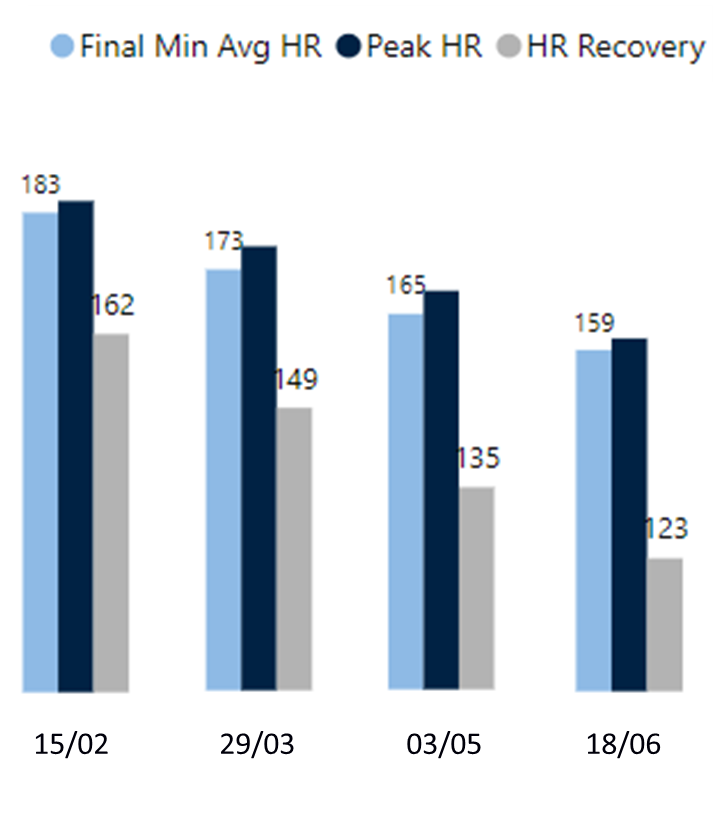
Figure 1 below shows the athlete’s heart rate results from a standardized submaximal conditioning assessment over a period from February – June. The results indicate an improved aerobic ability while exercising (lower peak HR and final minute average HR) plus an improved ability to recover post exercise (larger decrease in HR 1 minute post-test). Coupled with positive subjective feedback from coaches during match play, we can conclude these were successful interventions.
Case study 2: Aerobic beast needs another gear
Athlete B plays in the same position as Athlete A, so he has the same physical match play requirements. However, Athlete B is an entirely different athlete physically. An aerobic beast, his scores on maximal conditioning tests are excellent, and he also has a surprisingly good maximum velocity. He struggles, however, with acceleration / deceleration / change of direction, in terms of absolute speed and in maintaining the intensity of actions over longer efforts. While he is able to recover well between efforts and perform them for the duration of a game, he is vulnerable to losing any given scenario during the game.
Our objectives for this player were first to improve his strength and power output (alongside technical work) to aid his speed off the mark and COD ability. Then we would work to enhance his ability to maintain these higher outputs for longer durations.
Due to the athlete’s low training age, the first step saw fairly rapid development with simple and progressive resistance and speed work. Our attention then turned to providing conditioning top ups aimed at repeating high intensity efforts for moderate-long durations with incomplete rest to maximize metabolite accumulation and improve buffering capacity.
If his training on MD-4 or MD-3 had insufficient volume of high intensity actions and intensity levels, he would perform 1-3 sets of 4-6 reps of a multidirectional task at maximal intent (15-30s on, 45-90s off). This would allow for significant metabolite accumulation within a set. The task is designed to replicate the kind of high intensity actions he faces in his position, such as hard press, decelerate and reposition.
When training hit the high intensity action loading but lacked the required density or intensity, the top ups would be 1-3 sets of 4-6 reps of a multidirectional task with the ball at maximal intent (20-40s on, 60-120s off). This session has the same aim as the above, but adding the ball slightly limits the intensity at which he performs the actions. What we lose in the intensity of actions we make up by the additional muscular demand that the ball skill provides, so there’s a similar stimulus through both means.
| HI accels & decels | Intensity | Method chosen |
| Multidirectional RST | ||
| Dribbling tracks |
Maximum velocity and volume were not concerns with this athlete, so we used the same options on MD-3 and MD-4. Because we don’t use a repeated sprint assessment as part of our assessment battery, there was no objective data to monitor the effectiveness of this intervention outside of countermovement jump height and maximum acceleration values increasing, both suggesting improvements in absolute power output. But from a subjective stand point of positive feedback from the athletes and coaches, we were confident in the effectiveness of this intervention.
Considerations for RTP athletes
Returning to play is a scenario where you often encounter the kind of problem outlined at the start of this article. People will pull out their trusty conditioning handbook and prescribe random sessions on the watt bike to prevent injured athletes from getting fat and bored.
Not that there’s anything wrong with that. I definitely have my go to sessions to prescribe when I think a player or squad needs a change up. But a more thought out approach considering the adaptations can certainly have a greater effect, wherever the player is in the rehab or RTP process.
Until the athlete can perform any kind of load bearing conditioning (even the Alter-G) we can pretty much disregard the peripheral side of conditioning adaptations. While off-feet training will tap some similar muscle groups, in terms of patterns of activation and contraction modes, nothing will replicate running. The focus for the off-loaded phase of RTP should mainly be on central adaptation, accruing a progressively greater amount of time in Zones 2, 3 and 5.
Conditioning modes that involve as much musculature as possible, like assault bikes and Versaclimbers, have the dual benefit of needing less intensity to reach the necessary heart rates and minimizing localized fatigue (as opposed to the quads on the bike or triceps on the ski erg). The sessions needn’t be that complicated, as long as we progress the time spent in each zone and you provide enough variety to prevent the athlete from dying of boredom.
In tandem, also look to prescribe plenty of local muscular endurance work in the gym. While this won’t replicate the peripheral demands encountered while running, it has the benefit of a huge variety of exercises to choose from. That way you can target a more specific set of musculature relevant for running than if you were bound by a particular machine. Because effective work can be performed with little to no weight, it’s the perfect option for early-stage rehab when loading may still be compromised.
Once the athlete can bear load again, we can then embark on a logical progression targeting both central and peripheral demands in line with stages of rehab.
Tweet ThisAdapting conditioning in team sports requires an individualized approach. Key is understanding specific athlete needs and tailoring strategies for maximal impact in performance enhancement
Steve Pledger