Head coaches have their game models: how they want to build, press, transition and everything in between. Building the players who can physically execute and thrive within it is not a question of conditioning but of each player’s capacity to execute the game model.
Every drill and every session should develop each player for their role within the game model. GPS and heart rate monitoring provide the data to evaluate how well we satisfied the foundations of training design. First, the drill must deliver the mechanical and metabolic outcomes we planned. Second, we need to know if the blends of the session, the week, and the block were sufficient to drive the required physical adaptations. And we need to know whether we exceeded the demands of the game in training at the speed, intensity, and metabolic cost of the game for the right durations.
While external load tells us what players did relative to a game, internal load tells us what it costs them.
Internal load is driving our work within our game model and our current roster. With Firstbeat heart rate monitoring, we aim to uncover a piece of the physiological prescription required to execute the game model, and then check every day, week, and block to verify that we achieved what we prescribed.
Defining conditioning outcomes with a shared language
To integrate fully with the coaching team, we want “conditioning” to be part of the conversation and a consideration in everything we do, not an extra block of work bolted on to training. That starts in session planning, where we make sure each session and drill within the session has a clear physical objective.
That conversation requires a shared language, some guiding principles, and a simple framework that allows stakeholders to adequately understand what we are trying to achieve.
Our language is built on two simple themes: metabolic and mechanical loads. These extend across our whole periodization model, giving us a common understanding about what we are trying to achieve in the short- and long term.
Mechanical load is external load. What type of actions are happening in the practice, what movements are we trying to overload, how intense, how dense, what is the magnitude of the actions and how much volume should the players accumulate.
Metabolic load is internal load. What energy systems do we wish to tax across the aerobic vs. anaerobic continuum, how hard, how often, and how much time do we want the players to accumulate at high intensity. Metabolic load is the physiological cost and make-up of the session, independent of the external load.
Every drill and session is defined across all four corners of the game—technical, tactical, physical, and emotional—but the priority of each is a deliberate choice. These objectives dictate all of the constraints that make up the drill.
This shift means we are now not asking for a 10-minute slot at the end of training. The performance staff collaboratively plans each drill to ensure all departments are meeting objectives and aligning the overall blend of the session to the broader technical, tactical, and physical outcomes.
Tweet ThisTo integrate fully with the coaching team, we want “conditioning” to be part of the conversation and a consideration in everything we do, not an extra block of work bolted on to training.
@benyoung01
Data informed, not data led
The framework, conversations, and planning process take priority over the numbers. When every session has a defined target, three things tend to change.
First, the session is planned against clear objectives before training. Drills that do not serve the session objective from each area get questioned. Everyone leaves the meeting clear on what the session will or won’t deliver. That tells us what we need to address elsewhere in the week, or recognize that we need to tackle something of higher priority.
Second, the post-training review is now grounded and quickly able to go deeper. Instead of discussing whether training was hard or not, we’re checking whether what just happened is what we prescribed and expected. If there is a big gap, we can ask whether it was due to the drill design, the players, fatigue from the day before, or any other factor. The answers will, in turn, lead to further shared understanding.
Third, players begin to learn the intent for every session and drill. When they understand why, they buy-in more and train with greater intent. Over time, this improves the culture around the physical side of the game.
Using heart rate targets to design drills
The performance team’s job is to ensure that each drill and the overall blend of the session produces the physiological responses required to develop the players. To keep things simple, we use three metrics for this assessment.
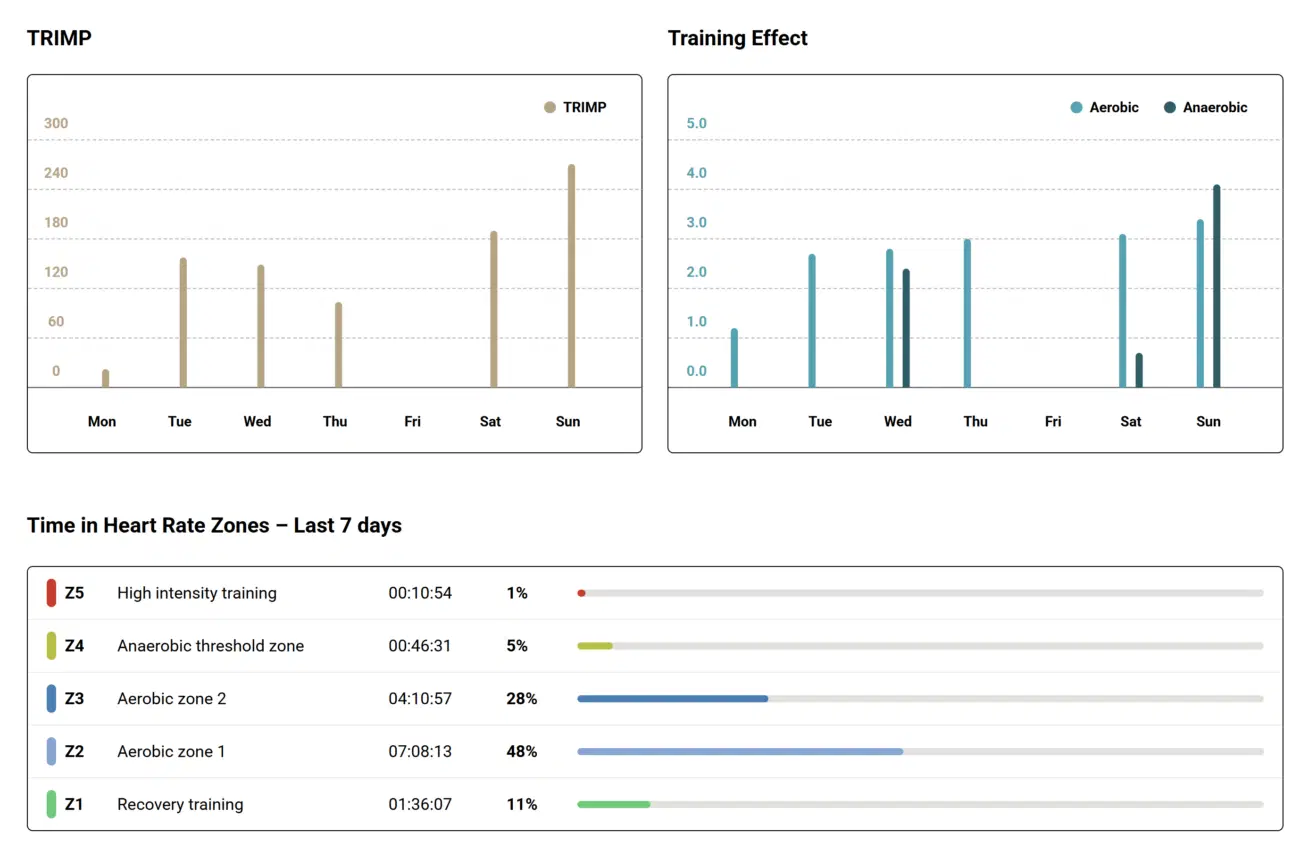
Training impulse (TRIMP) gives us a single session load score that accounts for both duration and intensity, with higher intensity work weighted exponentially heavier than lower intensity work.
Zone distribution tells us how a session’s time is split across the heart rate zones. It shows how athletes accumulated the load, not just how much. This is where we can start asking questions of the data, such as whether we are spending enough time at Zones 4 or 5 often enough and for long enough to build capacity.
| Session | Coaching intent | Target Z4+Z5 (%) | Target TRIMP (per min) |
| MD+1: Recovery | Active recovery, flush | <5% | 1.0 |
| MD-4: High intensity | Overload repeated high-intensity capacity | 20–30% | 2.0 – 2.5 |
| MD-3: Tactical | Moderate, game-specific patterns | 10–15% | 1.5 – 2.0 |
| MD-2: Speed / power | Short, sharp; full recoveries | <10% | 1.5 – 1.8 |
| MD-1: Activation | Primer, low accumulation | <5% | 1 – 1.4 |
| Match day | Match demands |
Six levers for heart rate drill design
Once the session has its physiological target, the next question is how we design the drills for it.
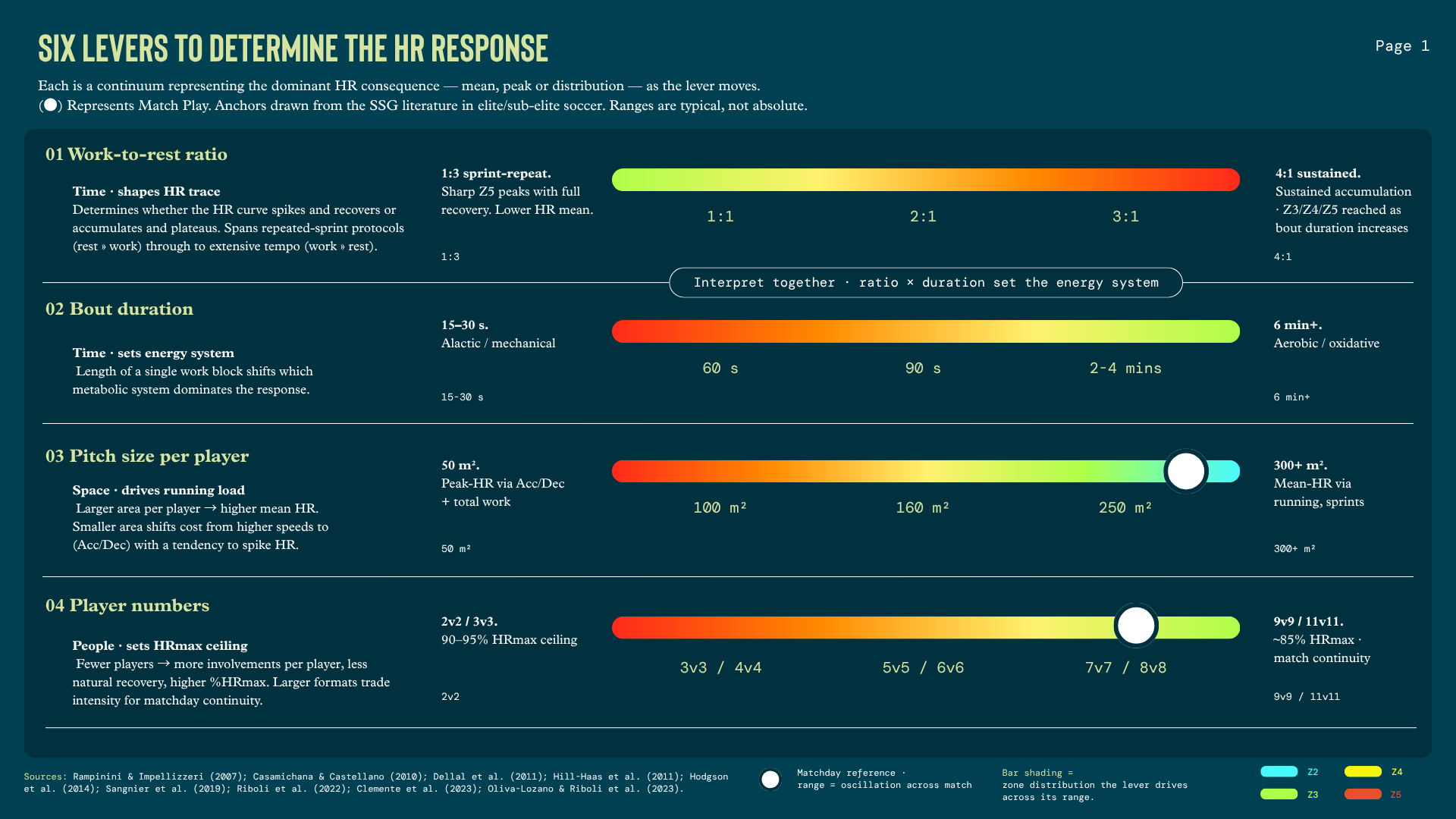
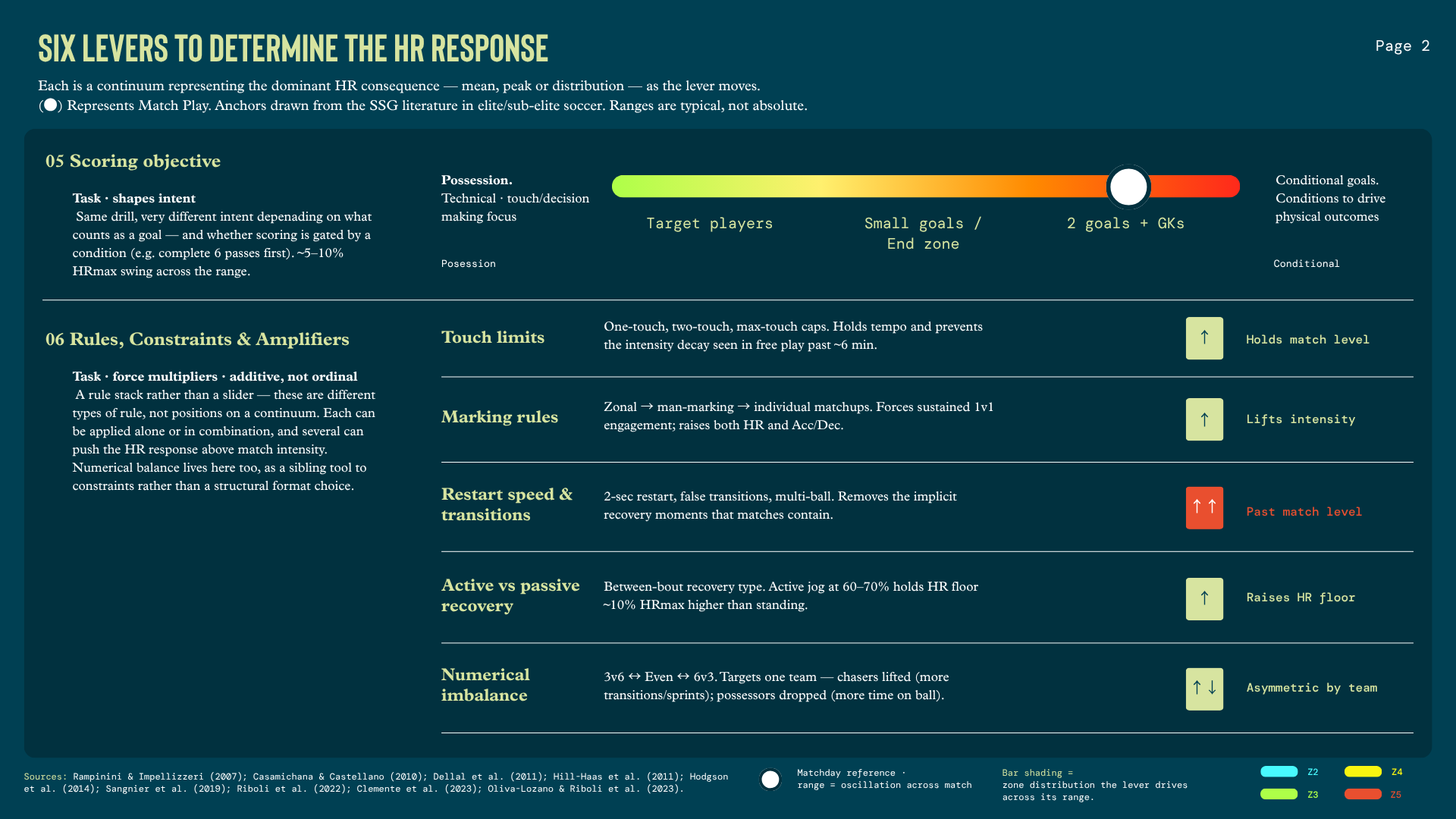
Six levers cover every adjustment we make at the margins of a drill to shift the HR and physiological response. With these levers, we can completely reshape the TRIMP effect or the zone distribution of any drill.[10] We use all of them as needed to limit or push a drill above or below match demand. They can all change and shift the mechanical and metabolic cost of a drill.
The process almost always involves moving two or three levers to maintain the tactical relevance while ensuring we target the correct physiological response. The conversation often takes match intensity as our starting point, and then we decide if we are looking to take players above, equal to it, or below it.
Work-to-rest ratio
Work-to-rest ratio determines the shape of the HR trace far more than the absolute work time. A 1:3 ratio at any duration gives you sharp peaks with full recovery between—HR climbs and drops. A 4:1 ratio flattens that shape into sustained accumulation, where HR rises and plateaus rather than spiking. Equal amounts of total work can look completely different at these two extremes.
Bout duration
Bout duration sets the energy system. Short bouts (15–30 s) stay alactic and mechanical. Peak HR can be high, but the athlete reaches it late in the bout, and the metabolic cost is more localized.
As duration extends past 60 seconds, the oxidative system takes over and HR plateaus higher and longer. By 4–6 minutes, the drill is continuous with aerobic dominance.
Bout duration and work-to-rest ratio are related, so practitioners cannot consider them each in isolation. 1:1 at 30 seconds and 1:1 at 4 minutes are entirely different drills. We always set duration first, based on the energy system we want to tax, then consider the ratio.[3]
Pitch size per player
Larger space per player means more running, higher mean HR, and the load looks more like extensive running. Smaller space per player means players spend less time at high speed but accumulate more accelerations, decelerations, and changes of direction. The mean HR can drop slightly but the spikes get sharper.[6,9,12]
Number of players
Fewer players means more involvements per player and less natural recovery: 2v2 and 3v3 can quickly sit at 90–95% HRmax.
As numbers grow, the workload distributes more naturally and the format starts looking like the continuity of an 11v11 match. We use small numbers (3v3, 4v4) when we want to drive the HR ceiling, and larger formats (8v8, 9v9) when we want to drive more continuous, longer aerobic adaptations.[5,8]
Scoring objective
The same drill can shift dramatically depending on what counts as a goal, and whether scoring is determined by a condition. Possession-only objectives tend to drive technical and tactical focus, with HR sitting below match level. Conditional objectives (complete six passes before scoring, score within 8 seconds of regaining possession) drive physical outcomes by changing what players must do to succeed.
HRmax can vary by 5-10% for the same drill by varying the objective, which is significant when we’re trying to hit a specific zone distribution. However, these constraints are typically determined by the technical or tactical objectives.
Rules, constraints and amplifiers
These sit separately because they don’t behave like the other levers. They are not a continuum—they stack. Each one can lift HR above match intensity when added on top of the format you’ve already chosen.
For example, touch limits hold tempo and can prevent the intensity drop off. In free play, the longer a drill runs the more players naturally find rest, slower turns, and extra touches; and they have less urgency in moments that are not end product. A 1- or 2-touch rule strips that recovery out and can lock the work rate in.[7]
Marking rules can be hard to manipulate based on the out of possession game model. However, zonal marking tends to let players share workload and find natural recovery moments. Man-marking removes that, keeping engagement and intent high throughout the drill.
Players use the natural stoppages in play to recover. A 2-second restart rule, multi-ball setups, or false transitions remove those windows, which can help keep HR high.
This can be one of the levers that is easiest to land tactically. The conversation with the head coach isn’t about “making it harder,” but about exposing the team to playing through transitions and not allowing the team to settle, or replicating the peak periods of a game.
Active recovery can completely manipulate the drill HR profile. A variety of runs between blocks will shift and manipulate the drill or session outcome. Slow aerobic runs designed to sustain HR make each subsequent rep start higher, and the players accumulate more time in the target zone. Maximal repeated speed efforts force players to spike into the red zone before the next block. The choice between active and passive recovery is a physical, tactical, and technical decision.
Numerical imbalance (3v6, 6v3) asymmetrically loads the two teams. The outnumbered team gets pushed mechanically and metabolically, while the team with extra players can drop down in workload.
Tweet ThisThe conversation with the head coach isn’t about “making it harder,” but about exposing the team to playing through transitions and not allowing the team to settle, or replicating the peak periods of a game.
@benyoung01
Erasing the lines between tactical, technical, and physical
Our coaches designed a drill that had two tactical outcomes: breaking down a low block and emergency defending against fast transitional attacks. It sat on a day where we wanted high metabolic outcomes while overloading the extensive areas of the game.
We came up with a multi-ball crossing and finishing exercise against a low block, which then transitioned quickly into a fast attack with an emergency defending scenario. Time above 90% was minimal and the extensive demands became extremely high. Physically, we’d missed our objectives.
The following week we made four significant adjustments.
We need the continuous portions of the drill to be much longer within the live play to attain the density of actions and subsequent HR response. Rather than crossing and finishing, we would add additional balls in an attack vs. defense component, and encourage playing through the defensive structure as well as around it. Combined with the wide play and finishing, the drill provided continuous activity levels and the realism of breaking down the low block in multiple ways, driving the metabolic outcome.
Second, following a fast transitional attack, the players completed an immediate recovery jog back into their starting positions.
Then we restarted quickly, and did not allow for full HR recovery between reps.
Finally, we changed the ratio of fast attack transitions, from every rep to once every three attacks vs. defense rounds.
The revised version of the drill produced the same session, same coaching intent and tactical outcome, and same total time on task, but a completely new HR profile. Average time above 85% HRmax jumped to 10 minutes. Zone distribution settled where we wanted it. We stretched the players technically, tactically, and physically while also stretching decision making under fatigue.
Success came from three important collaborative areas. As a group, we are open to trying new drills and are OK if things fail as long as we learn. We stay open minded and collaborative to ensure the drill facilitates all the outcomes we intended. And we objectively and subjectively review and refine after each session to make sure we are always getting closer to the outcome needed.
Internal load is the real driver of adaptation
Drill design is straightforward enough when there is good dialogue and trust between performance and technical staff. However, a single well-prescribed session does not prepare players for the game if the weekly, block, and seasonal pictures are not all aligned.
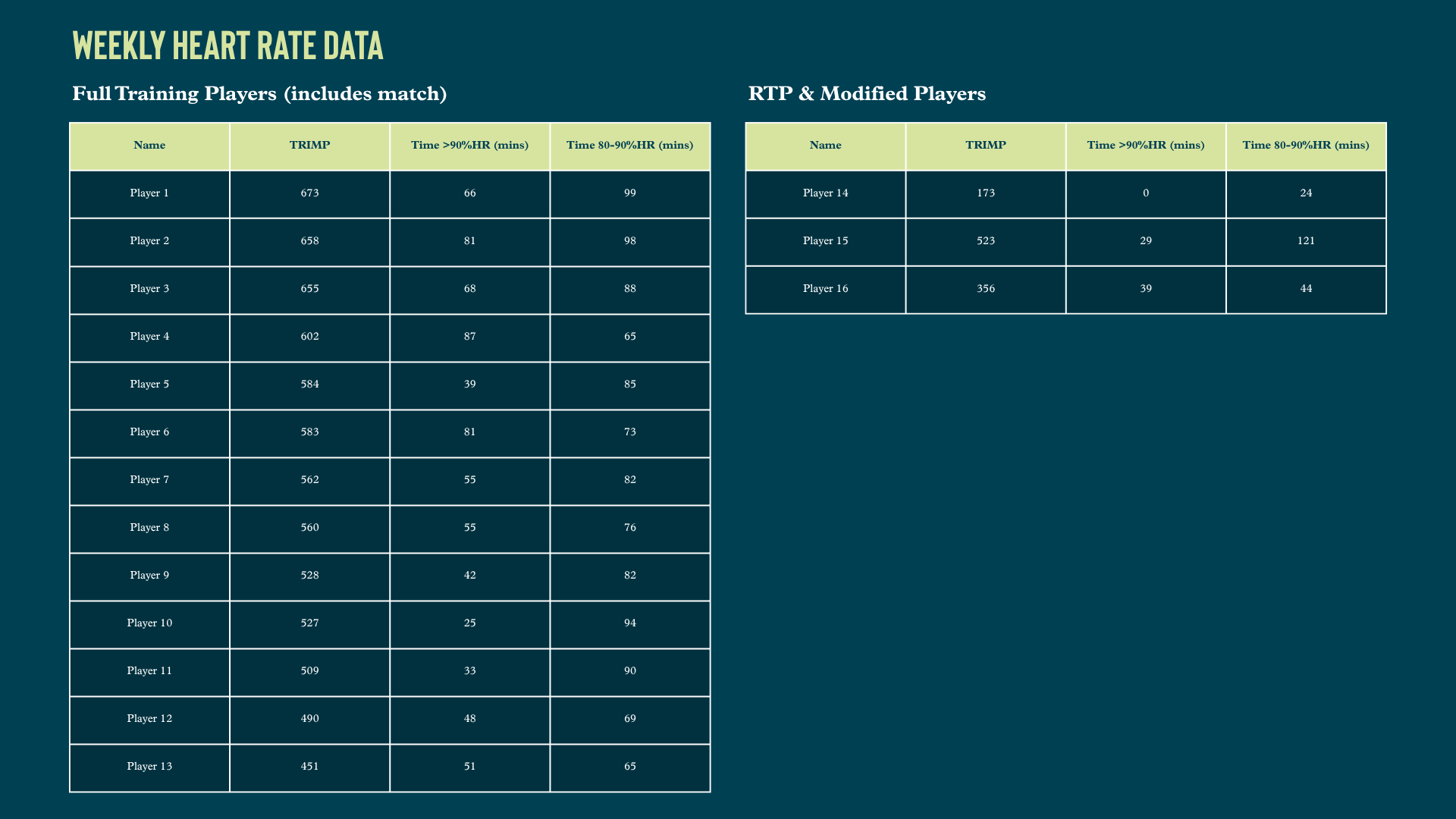
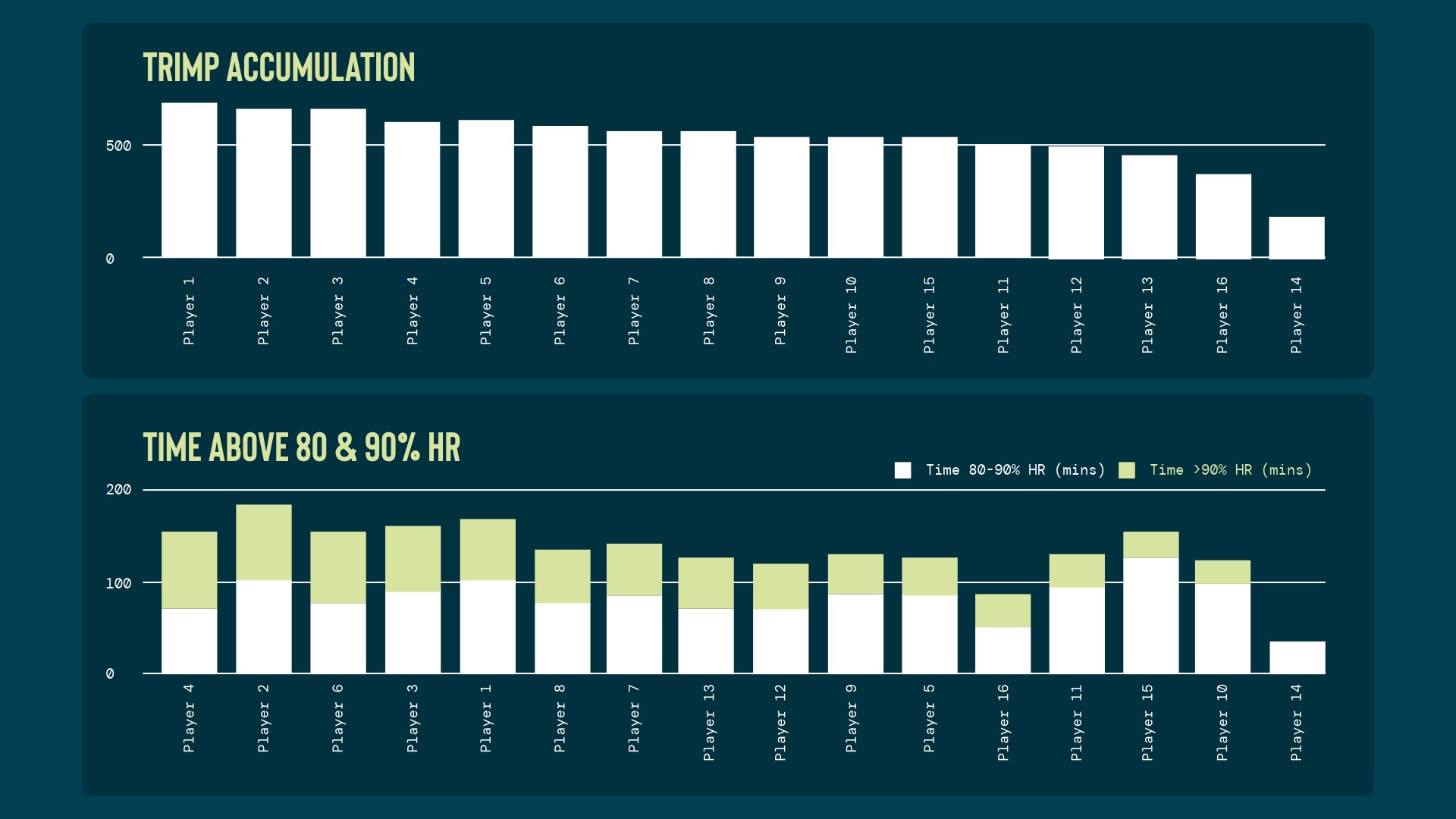
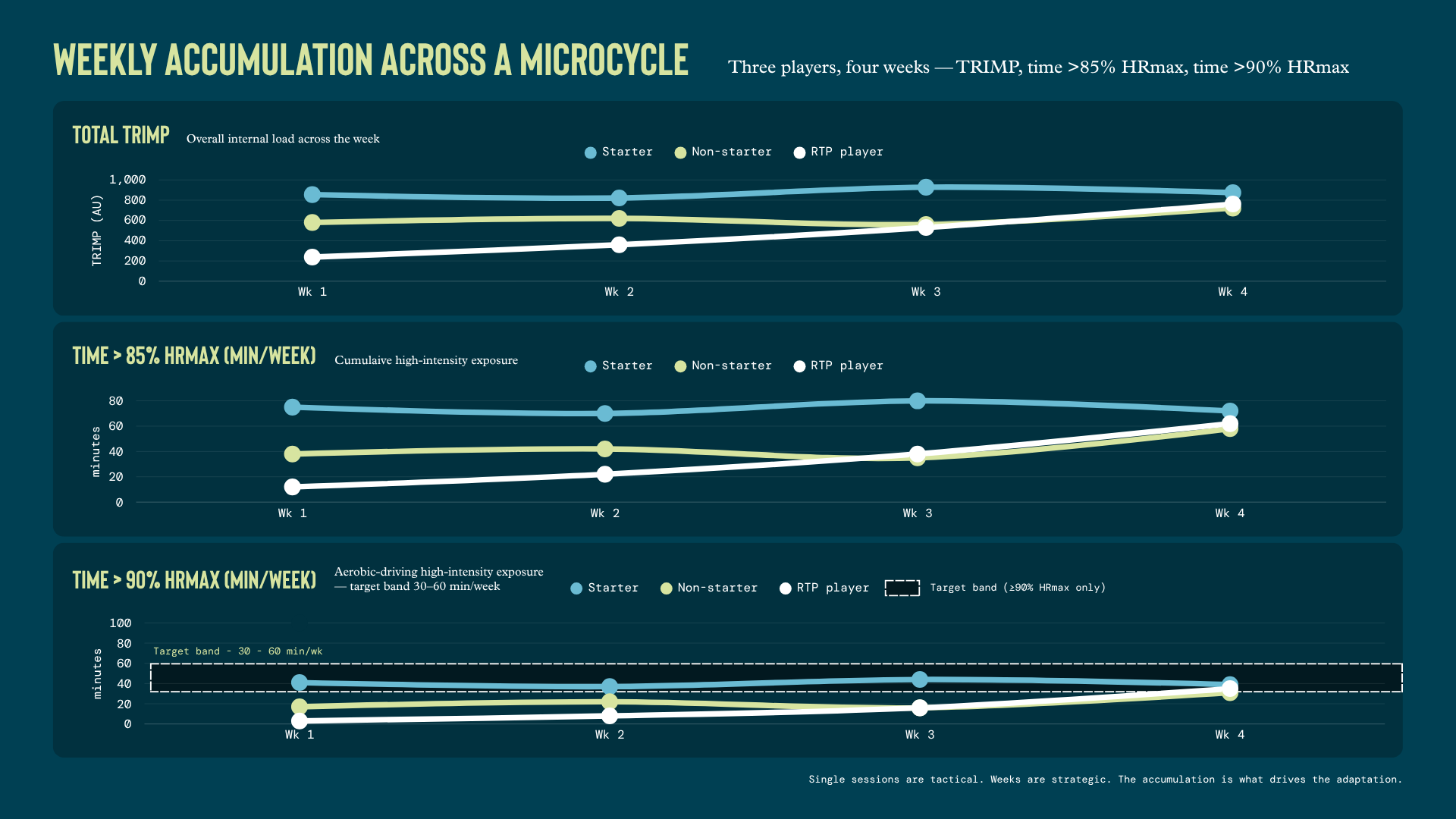
We align those cycles through how much total TRIMP each player accumulates across the microcycle, and how much time above 85% and 90% HRmax each player accrues in the same window.
The first tells us about overall internal load. The second tells us whether we are hitting the high intensity threshold often enough and for long enough to maintain or build aerobic capacity.
We have created a simple one-page dashboard to help us quickly answer these questions for the time period of interest.
Set the lower boundaries at the minimum effective dose
Buchheit et al[1] pulled dose response data across 12 studies in elite team sports, and concluded that about 30 minutes per week above 90% HRmax is the minimal effective dose to maintain or improve cardio-metabolic fitness.[1,4] A follow-up tested whether professional football consistently delivers this dose, analyzing 948 microcycles from 20 professional teams across nine leagues.[14] Only 49% of starter weeks and just 21% of non-starter weeks hit the 30-minute threshold above 90% HRmax.[2,14]
Their analysis also produced a dose-response relationship, with every additional 10 minutes above the threshold yielding a 1–2% improvement in key aerobic markers: VO2max, lactate thresholds, Yo-Yo IR1, 30-15 IFT.[1,4]
Based on those papers, 30 minutes is our floor, not a target. Maintenance lives in the 30–60 minute range across a normal week. Below that, we assume we are not maintaining the aerobic capacity. Exceeding that range produces marginal aerobic gains at an increasingly heavy recovery and freshness cost.
The gain could be significant over time, but the mechanical cost could be aggressive. To achieve a 1–2% gain in aerobic conditioning via an additional 10 minutes above 90% HRmax can be a significant amount of mechanical work. Working from 30 to 50 minutes above 90% HR over the course of the week, for example, raises the questions whether the physiological benefit outweighs the cost and whether the player can absorb the extra load over the short or long term.
Each individual has a sweet spot. Understanding your players and finding that sweet spot is the real work of the performance department to strike the balance of fitness and fatigue. When we look at our weekly numbers, we’re not aiming for a single squad-wide target. We look at each player individually, and ask whether their total weekly exposure above 90% HRmax (training + game) is landing in a place that is going to build or maintain aerobic capacity relative to their individual context.
Closing the gap between starters and non-starters
Starting players get the bulk of their high intensity exposure on matchday, which can make up a big chunk of their weekly Z4+Z5 minutes in 90 minutes of football. Non-starters accumulated a median of just 8 minutes per week above 90% HRmax, compared to 25 minutes for starters.[14] At the population level, only one in five non-starter weeks reaches the maintenance dose. The match is driving the bulk of the conditioning response, and players who are not on the pitch are not getting that stimulus.
Buchheit et al showed a clear pattern: non-starter “top up” sessions across the 20 teams delivered adequate volumes of >80% HRmax, but consistently failed to push players into the >90% HRmax band to drive aerobic adaptations.[14] We are therefore very intentional in how we structure and deliver our top up sessions around both metabolic and mechanical targets.
To help mitigate the gap between starters and non-starters, we zoom out every week and check the total accumulation across the squad. If a non-starter is sitting well below the 30-minute floor for time above 90% HRmax, we proactively plan a series of micro top up sessions within the week. These could be small-sided games with conditioning runs between, an off-feet equivalent, or a conditioning focused block immediately post-game.
Tweet ThisThe match is driving the bulk of the conditioning response, and players who are not on the pitch are not getting that stimulus.
@benyoung01
Catching the squad-level drift
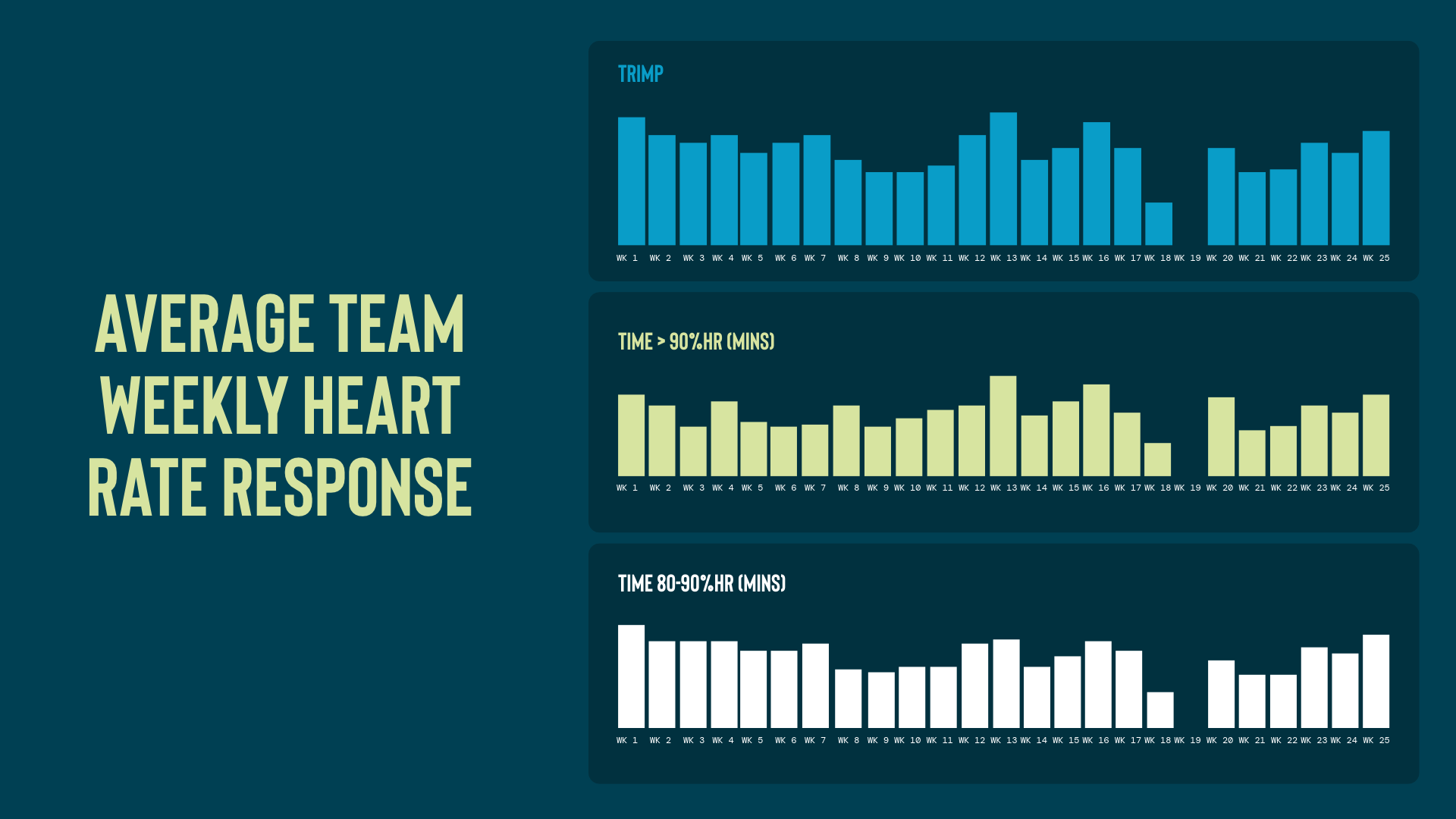
Across a long season, weekly accumulation also tells you when the squad is drifting. If the team’s weekly time above 90% has trended down for three weeks in a row, even if individual session targets look fine, it is worth a discussion. Perhaps the fixture density or schedule has changed, or practices have skewed more tactical. Whatever the reason, the weekly view catches it cleaner than the session-by-session view.
Building exposure for players returning to play
For RTP players, the weekly accumulation lens is essential. We’re tracking the build of high intensity HR exposure and TRIMP from week to week as we progress them back through the phases. Looking beyond the targets for individual sessions, our major interest is their weekly accumulation of time above 85% and 90% throughout their RTP. Aligned to all other relevant RTP metrics, we want to see that curve building until weekly exposures match those of a full-team starter to give us more confidence the player is ready.
Fitting this framework for your game model
This framework works for us at San Diego, in the National Women’s Soccer League, with our squad, our game model, our staff, our calendar. Yours should and will be different. What could transfer is the approach.
Start with the game model and your specific performance problem. The game model, its needs, and the individual player requirements come first; the physical prescription comes second.
Define a physiological outcome for every session and how it blends with the technical and tactical objectives. If you can’t say what the session is supposed to produce, you can’t check whether it did.
Build a shared language with your coaches. Pick a couple of numbers that make sense to you and your colleagues. We use TRIMP for the dose, zone distribution for the shape of that dose. Use them consistently, and make them the language of session review.
Design drills around the target. Using the six levers to adjust drill constraints: work-to-rest ratio, bout duration, pitch size per player, player numbers, scoring objective, rules. Every constraint can manipulate and shape the heart rate response.
Zoom out to the week and block. Single sessions are tactical. Weeks and blocks are strategic. Track weekly accumulation of TRIMP and time above 85% and 90% HRmax for every player. ~30 (±20) min/week is the floor, not a target.
Close the gap between starters and non-starters deliberately. Non-starters do not get the high intensity exposure that matches deliver. Without proactive top-up work designed around HR exposure and not just GPS targets, the gap widens fast.
Tweet ThisIf you can’t say what the session is supposed to produce, you can’t check whether it did.
@benyoung01
Finally, look at trends, not snapshots. Patience and repeatable application of a framework move the needle. Single sessions deceive. A wider view and trends tell you what is happening to the squad and what they are adapting to.