
Every now and again, a training methodology dominates the industry, with its proponents preaching about the almost mystical results. French contrast training is one such method for its apparently positive effects on power, rate of force development and speed.
French contrast training is a protocol of four movements in a fixed sequence:
- Maximum force exercise
- Plyometric exercise
- Ballistic or speed-strength exercise
- Overspeed or assisted exercise
French contrast training shares similarities with other training protocols, including contrast training and complex training[1]. Recently, Cormier et al.,[1] published a paper discussing inconsistencies in training terminology within the scientific literature, and attempted to create consistent nomenclature for complex- and contrast type training.[1] Fundamentally, French contrast training is a method that varies load and sequences exercises in an effort to improve force and velocity performance.[1,2]
Basic principles and considerations for French contrast training
The French contrast method seeks to exploit post-activation potentiation to improve short term training responses, leading to longer term changes in performance.[2]
The primary acute aim is to recruit high threshold fibers using an exercise sequence that, if executed as intended, can expose the athlete to greater peak forces and peak rates of force development than traditional protocols. The limited French contrast research is promising, and shows improved performance in maximum strength, jump height and biomechanical variables through short to medium term French contrast programs.[3,4]
Prior to using French contrast training, I was curious if the method actually improves the underpinning physical characteristics, or if the performance enhancements are the result of improved coordination in the selected movements, that is, the same movements used as the marker of performance. To express this another way: does performing a sequence of back squats, hurdle jumps, jump squats and assisted countermovement jumps challenge the squat and jump movement patterns, leading to improvement in performance; or do they change the physical capacities that transfer to sports performance?
Regardless of the relatively small body of evidence supporting French contrast training, there is significant research showing the short and long term benefits of complex and contrast type training.[2] That’s a reasonable basis to conclude that French contrast training is a viable method for enhancing neuromuscular performance that will transfer to wider sports performance.
Many French contrast training advocates suggest using it in 2-3 week blocks due to it being an advanced and highly stressful training protocol.[5] I have used it for much longer durations and have not attributed any athlete injuries to the method.
French contrast training is adaptable. Coaches can progress it in a sequential “blocked” method; or, perhaps, use it weekly during a competitive season. The density of work during French contrast training is high, and athletes must have adequate levels of physical and psychological work capacity for higher density efforts.
Ultimately, the same considerations as any other programming or periodization methodology apply.
Tweet ThisThe French contrast method seeks to exploit post-activation potentiation to improve short term training responses, leading to longer term changes in performance
@Mramacdonald
Case studies from rugby and judo
Maintaining fitness and readiness through uncertain schedules
French contrast training can help athletes maintain performance levels of many qualities through periods of the year when the competition calendar is unclear. In many sports, tournament dates continually shift, creating significant physical and psychological challenges. In one scenario, I was aware the athletes had not had significant downtime for many months, and as a coaching team we wanted to reduce the overall time the athletes were training.
A benefit of French contrast training in this scenario was how we could reduce session duration because of the high density of work compared to traditional training designs. Athletes could complete a high quality session in under 45 minutes. The method also allowed us to target many key physical qualities and progress back to full training volumes and intensity more quickly when the competition calendar came into focus.

Unfortunately, we did not have access to force plate data during the November window when we relied on French contrast training. I was surprised, however, that lower body strength continued to trend upwards despite a reduction in lower body volume-load. Given the reduction in repetitions, and thus skill repetition, I expected strength might decrease slightly.
Force improvements likely helped drive continued increases in strength in the primary lower body lifts. Observing this effect of French contrast training shifted me towards believing French contrast training develops the underpinning physical characteristics that transfer to sport, and does not merely improve exercise-specific results through skill improvements.
Tweet ThisObserving the effect of French contrast training shifted me towards believing it develops the underpinning physical characteristics that transfer to sport, not merely improve exercise-specific results through skill improvements
@Mramacdonald
French contrast training overcame social distancing limitations
A challenge of the COVID-19 pandemic was the physical distancing rules. Those rules meant athletes could not practice scrums together, which is problematic for all involved.
For several forward players, I created a hybrid French contrast training program, combining general and position-specific exercises to optimise training time. At the same time, two key aims of the rugby coaches were improving the players’ ability to break the gainline in offence and improve tackle dominance in defence. Both skills favour increased force-velocity characteristics.
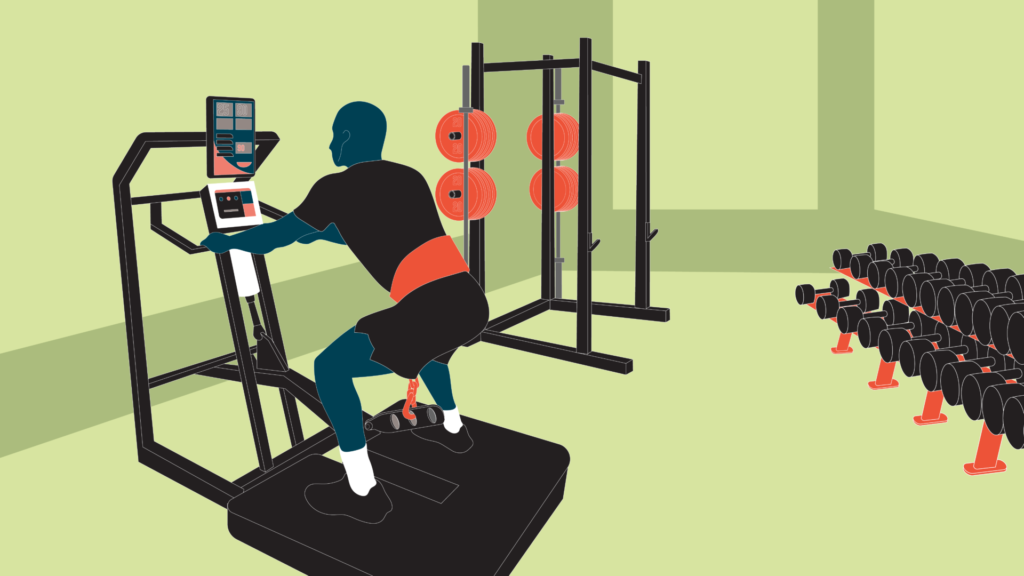
I used the ScrumTruk, a weight room scrum machine, as an overcoming isometric for exercise 1, as well as using a moderately heavy load on the ScrumTruk for exercise 3, as in these two sequences:
Rugby Forward Specific Sequence 1:
- Deadlift x 3 with 85% of 1RM
- Band resisted broad jump x 5
- Explosive ScrumTruk x 5
- Band assisted broad jump x 5
Rugby Forward Specific Sequence 2:
- Isometric ScrumTruk x 3 seconds x 3
- Repeated broad jump x 5
- Clean pull x 3 with 120% of body mass
- Acceleration x 10m

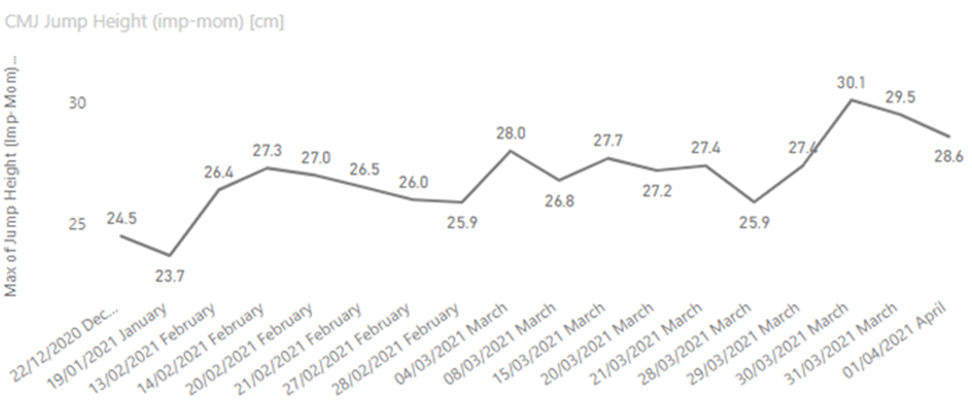
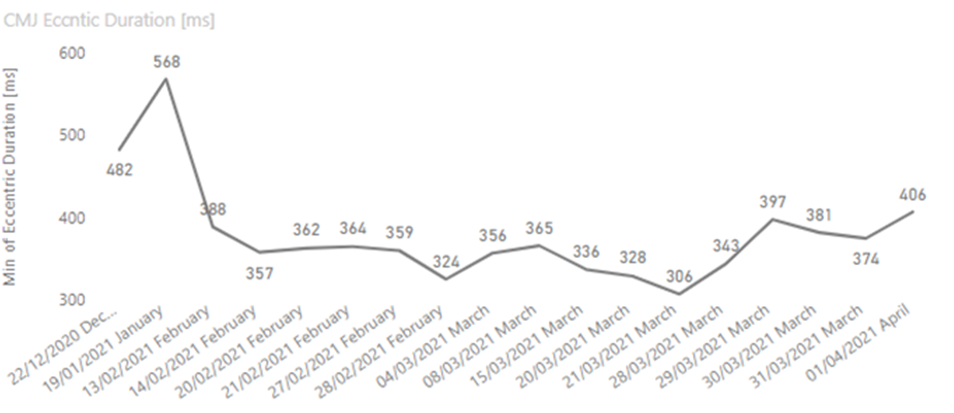
During this eight week training phase between January and March, I was able to monitor athletes’ countermovement jump using force plates. The training increased CMJ height 17%, increased concentric mean force 10%, maintained eccentric mean force, increased concentric peak velocity 6%, and decreased eccentric duration 16%.
The training did not include any countermovement jumps apart from five repetitions during the session warm up, yet it yielded impressive improvements in CMJ performance and jump variables. This suggests the French contrast training protocol facilitated changes in key physical characteristics and not simply skill improvements in the CMJ. The athletes also maintained their deadlift at levels of performance they achieved in the previous training phase, despite lower volume-load of deadlifts. Again, this suggests French contrast training is helping drive physical changes and not skill improvements.
Given the complexity of performance, I find it challenging to attribute improvements in rugby performance to changes in physical metrics, but they likely contribute. Improvements in concentric mean force and concentric peak velocity, at least mechanistically, transferred to the areas of the forwards’ game we were targeting. The forwards improved their distance per carry, in part due to improved change of direction characteristics. Players also improved their tackle dominance, and increases in concentric mean force and concentric peak velocity would have contributed to these performance enhancements.



Supporting on-field tactical goals
I used French contrast training with a relatively novice female rugby athlete due to its time efficiency benefits. The athlete had a full time job and did not have much time to devote to the weight room. Despite little history of structured S&C training, when the athlete started training with the squad, she was fairly competent in the basic movements and possessed good all around athletic ability. French contrast training would allow her to target a range of physical characteristics in a short session duration, while allowing for technical progression.
I programmed the same French contrast training sequence for 12 weeks leading into the Six Nations Championships. During the first weeks, the athlete focused on the technical competency in the plyometric movements, and intensity naturally increased as she became more fluid and rhythmic in her efforts.
Rugby Back Day 1:
- Front squat x 3
- Tuck jump over hurdles x 5
- Countermovement jump squat x 5 with 50% body mass
- Band-assisted CMJ x 5
Rugby Back Day 2:
- Trap bar deadlift x 3
- Repeated broad jumps x 5
- Countermovement jump shrug x 5 with 50% body mass
- Acceleration x 10m
Despite the efforts initially being submaximal, the athlete’s CMJ responded positively during the first four weeks, improving 9%. This trend continued into an 18% improvement in CMJ height performance after 12 weeks.
Similarly, concentric mean force increased during the initial four weeks, and increased 22% by week 12. Eccentric mean force mostly ranged within a 40 N bandwidth for the entire 12 weeks, so the training was not effective at improving this characteristic. Concentric peak velocity fluctuated during the 12 weeks, but overall there was a 7% increase over the course of the training. Eccentric duration decreased rapidly in the initial training period and continued in a consistent range thereafter.
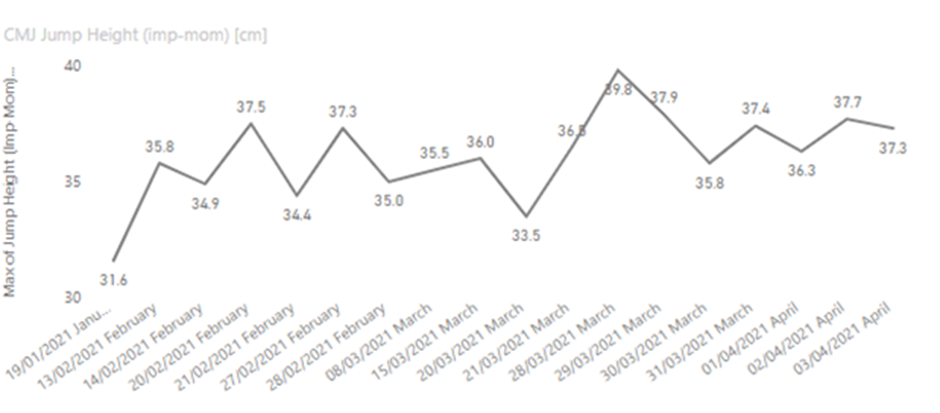
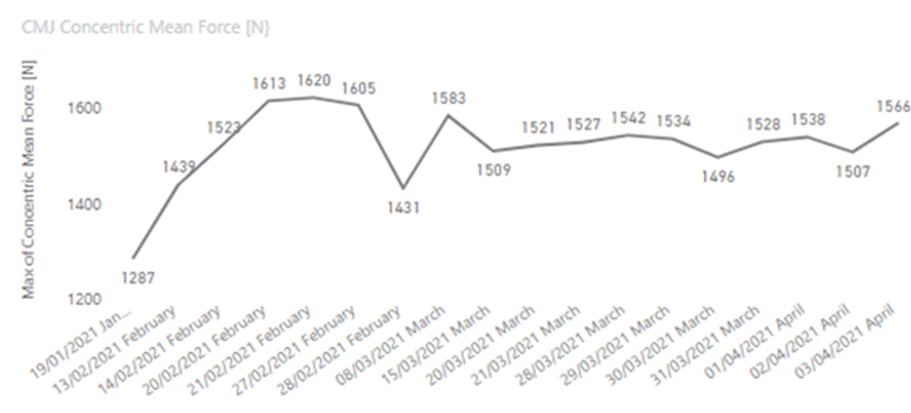
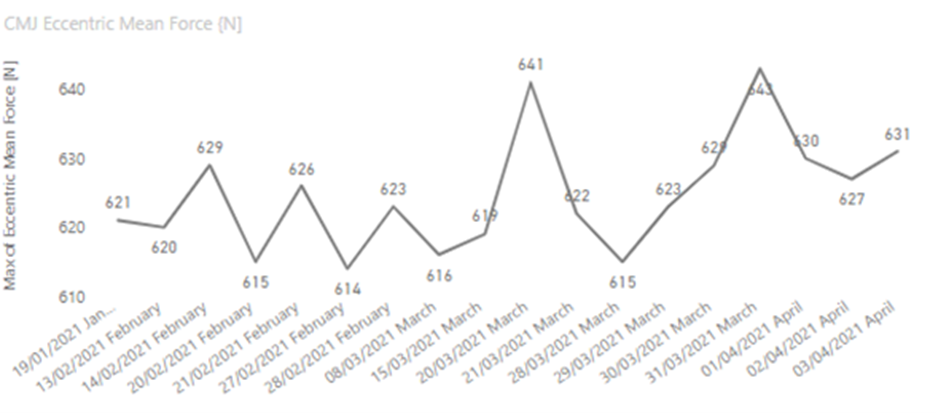


Given the improvements in CMJ performance were likely driven by changes in concentric mean force and concentric peak velocity, French contrast training positively impacted these key physical characteristics during the initial four week period. Therefore, French contrast training can improve transferrable physical characteristics for sports performance in short timeframes with novice athletes.
This surprised me, as I expected little, if any, improvements in concentric force, eccentric force or concentric velocity during the initial training weeks due to the low skill level of the athlete. I expected any changes in jump performance to be confined to improvements in skill. Yet even with a relatively novice athlete, the training method improved physical characteristics.
A key rugby strategy at this time was using kicking for territory. For a kick chase to be successful, the athletes must run at high maximum velocities to shut down the opposition player who will be catching the ball. This puts pressure on the catcher and reduces their time from catching the ball to making a decision. We were targeting the opposition catcher, therefore our chasing players required high peak velocities, excellent deceleration abilities to optimally position themselves for tackling, and concentric power to compete at the breakdown.
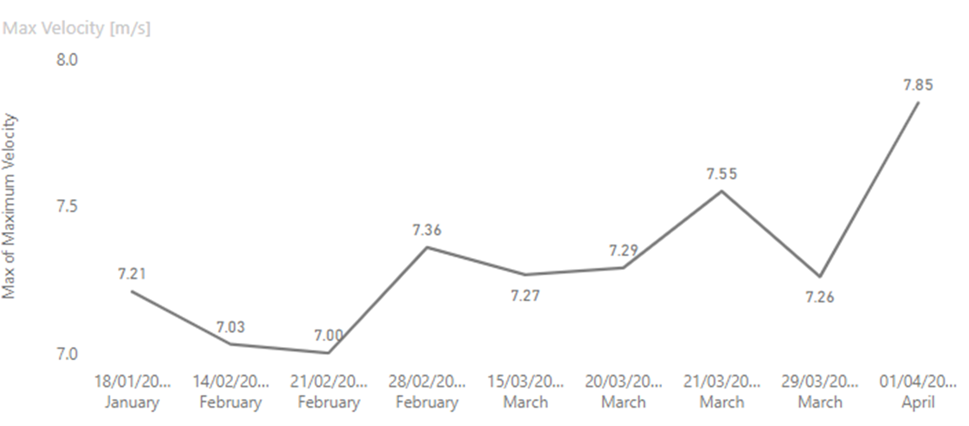
Over this training period the athlete’s maximum velocity increased 9%. Given the athlete also improved their concentric CMJ velocity and maintained eccentric mean force, their potential to decelerate effectively correspondingly improved.
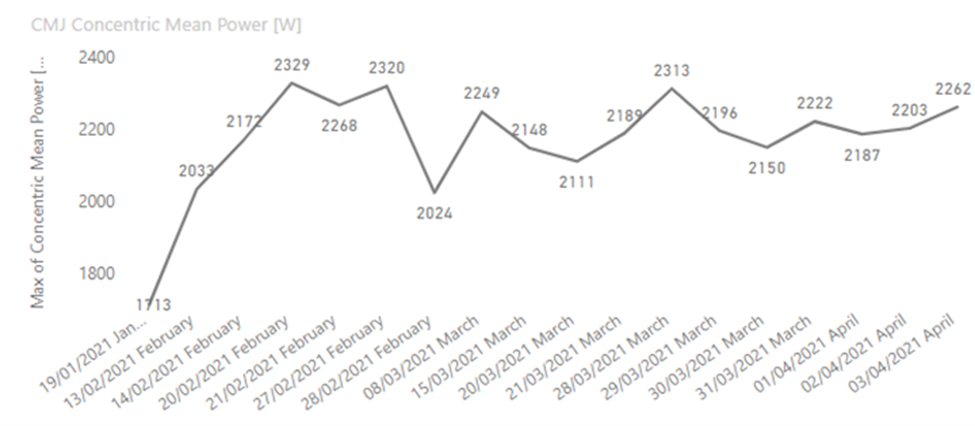
Concentric mean power also increased 30% during the training period, enhancing the athlete’s potential to compete at the breakdown.
Disappointingly, as this athlete was a novice athlete, they did not get any opportunity to demonstrate whether this increased potential translated into effective kick-chase results.
Tweet ThisFrench contrast training can improve transferrable physical characteristics for sports performance in short timeframes with novice athletes
@Mramacdonald
Optimizing training time in judo
While working in judo, I used French contrast training during periods of limited training time, such as busy competition periods. The exercise sequence promotes the concurrent training of several physical characteristics, and intelligent exercise selection can increase maximum force and velocity characteristics very safely when reducing body mass. Selecting isometric exercises, such as an overcoming isometric squat, can recruit high threshold fibers and is a suitable alternative to heavy dynamic exercises while dieting.
I typically integrated position-specific strength training for athletes who demonstrated a high level of general strength in the weight room yet didn’t seem to be able to translate those qualities to the mat. Despite no accurate monitoring of force or velocity variables, including this type of training was beneficial for several reasons.
First, it is rare in judo for an athlete to complete maximum effort throwing with full recoveries. Second, athletes will typically practice throwing with a training partner of similar body mass, and it is challenging for the partner to produce high levels of resistance.
Third, during an ideal judo throw there will be a descending force curve, that is, once the opponent’s balance has been broken, the force to complete the throw will likely decrease as effort shifts to repositioning to land in a scoring position. Seldom do ideal situations occur, therefore French contrast training combined with heavy band resistance can create an ascending force curve, increasing sticking points in positions where force would otherwise be low.
High performing judo athletes completed the following circuit during competition phases. The athletes worked in groups of three to provide additional resistance during the overcoming isometric throw, and to alternate who was being thrown to limit fatigue. Athlete A would complete the sequence, followed by one minute to switch over before athlete B would complete the circuit, and finally athlete C. They would complete three total rounds at the beginning of the technical sessions twice per week.
French Contrast Throwing Sequence:
- Isometric throw x 3 seconds x 3 repetitions
- Repeated broad jump x 5 repetitions
- Band resisted throwing x 3 repetitions
- Overspeed throwing x 3 repetitions
I’ve also used the following sequence to specifically focus on the upper body pulling rate of force development, which is key in breaking an opponent’s balance during the initial stages of a throw:
- Heavy bench pull x 3 repetitions
- Repeated band resisted judo high pull x 5 repetitions
- Band resisted throw entry x 3 repetitions
- Overspeed throwing x 3 repetitions
Monitoring in this environment was challenging for many reasons, but we collected broad jump data monthly.
Contrast and complex training was the default training I used in judo at all stages of the year, so French contrast training was not a huge shift for the athletes. I relied on French contrast training the most in 2017 due to competition frequency, and this surprisingly corresponds to the peak values for broad jump. However, jump improvements had consistently been increasing each year, so this was probably just a continuation of the trend and perhaps had less to do with the training method. Similarly, the athletes’ average body mass was lower during this year. Therefore, it is inconclusive whether French contrast training added any performance improvements compared to other methods.

Evaluating the effectiveness of this type of training on throwing performance is difficult for several reasons. One reason is that the quality of opponent is a major determining factor in throw success; and, as athletes increase in the world ranking, they will receive bye rounds in tournaments, meaning the only fights they have are against higher quality opposition. During some years, athletes may only fight opposition in the top 20 of the world and, therefore, throw very little.
Another reason is that tournaments at different stages of an Olympic cycle have varying levels of difficulty, as the intention is to increase world ranking.
Ultimately, this makes it highly challenging to assess the effectiveness of French contrast training in such a small sample size, in such a complex sport.
That said, 2017 was the year I most frequently programmed the hybrid French contrast training, and it was also the year with the highest number of throws per contest.
Considering that broad jump improved during this period, it is reasonable that French contrast training improved force and velocity characteristics and throwing position-specific characteristics, and this synergy resulted in improved throwing performance.


Results from French contrast training speak for themselves
I’d like to think I’m quite a cautious practitioner when it comes to programming weight room training, yet I am open to alternative methods, especially if they provide advantages in certain scenarios. French contrast training provides an alternative and effective training stimulus, especially in scenarios where training time is limited.
Athletes who have used the French contrast training protocol have demonstrated improvements in transferrable physical characteristics. Countermovement jump performance, concentric mean force and concentric peak velocity have all increased in athletes who have employed French contrast training. This satisfies the earlier reservations I had regarding the connection between improvements in physical characteristics and transference to sports performance.
Importantly, this method is suitable for a range of environments, both in individual sports and team settings. Hybrid sessions using sport specific exercises as a maximal strength stimulus, such as the ScrumTruk or isometric judo throw, allow us to improve transferrable physical characteristics while providing sport skill benefits.
Finally, and perhaps most importantly, every athlete who has completed the training method with me has bought into it and enjoyed it. They’ve reported feeling more “explosive,” and this has helped drive intent in their sporting actions – ultimately creating a more powerful athlete, in their sport, where it matters most.
Tweet ThisCountermovement jump performance, concentric mean force and concentric peak velocity have all increased in athletes who have employed French contrast training
@Mramacdonald