
Invasion sports are team games in which the purpose is to invade the opponents’ territory while trying to score points and minimise the opposition’s scoring. These include all codes of football, field and ice hockey, lacrosse, hurling, and court sports such as basketball, netball, and handball. These multidirectional sports require a range of technical and tactical skills, as well as the development of various physical qualities for successful performance. Agility is one feature of invasion sports that can be described as a physical quality or a skill. When an attacking player is able to evade defenders and create scoring opportunities, this can be one of the most exciting aspects of invasion sports.
Understanding the demands of the sport
Before a coach can develop a training program, it is important to understand the demands of the sport. So what exactly is agility in invasion sports? Before answering this, a popular definition of agility in the strength and conditioning (S&C) literature is “a rapid whole-body movement with change of velocity or direction in response to a stimulus’’ [1]. This definition acknowledges agility can include a whole-body change of direction at any angle, and/or a deceleration to stop suddenly in response to a stimulus. The athlete must perceive a stimulus, react, and then perform a movement in response.
In the context of a game, there are many scenarios where agility occurs. For example, when a team loses possession and must transition from attack to defence, players may have to quickly change their running direction. Another example is an inaccurate pass from a team mate, requiring the intended target player to suddenly react and change running direction to receive the ball. While these are quite common scenarios, more critical moments in invasion sports occur in direct contests.
A contest is a situation where possession is disputed or opposed. For example, an attacker in possession is moving forward and gets into close proximity to at least one defender. The attacker has to assess the situation and make a decision whether to pass the ball or take on a defender and attempt to evade in order to progress down the field or court. If the attacker decides to evade, they might use a deceptive action such as a fake pass or step to improve their chance of success.
Analysing agility
An analysis of agility in professional Australian Rules (AR) football showed that deceptive actions such as a fake disposal were used in a third of all attacking agility scenarios [2]. The attacker must scan the movements of the defender before a final agility manoeuvre is performed. In the same contest, the defender also needs to scan the attacker’s movements and be prepared to quickly react and move to block the attacker’s progress, or be close enough to perform a tackle within the rules of the game (Figure 1).
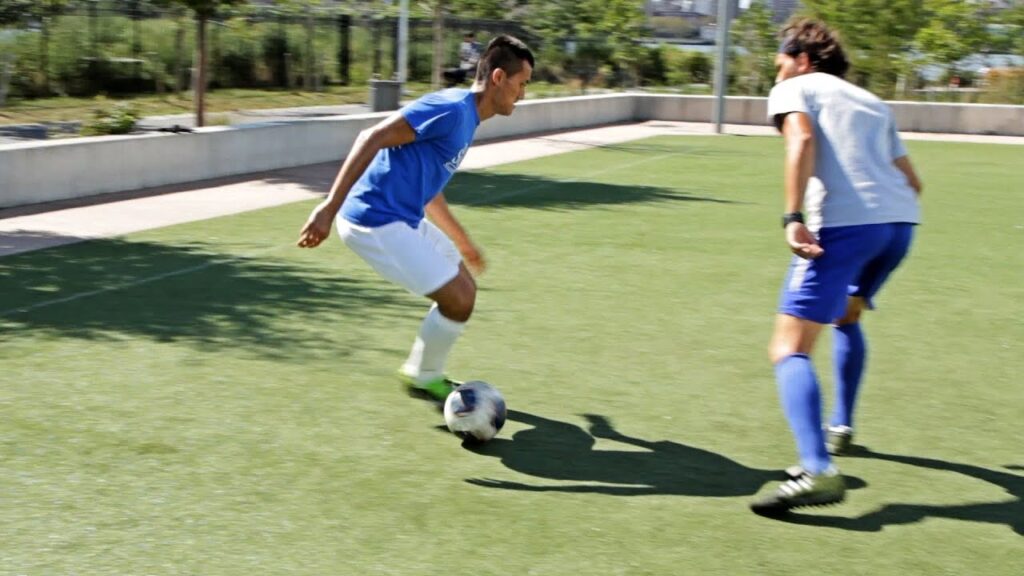
Figure 1. Both attacker and defender scanning each other to quickly respond with an agility manoeuvre during a contest in a soccer match.
The ultimate goal of attacking agility is to create space and time to maintain possession and progress down the field or court, while defending agility aims to reduce space and time, thereby applying pressure to the opponent to achieve a turnover. Interestingly, research has shown that being good at attacking agility doesn’t guarantee being good at defensive agility, and vice-versa [3,4]. Differences between attacking and defending agility can be seen in relation to the techniques used, approach speeds, and the angles of directional changes (Table 1). This means coaches should evaluate their athletes’ performance in both, and train them accordingly.
Tweet ThisResearch has shown that being good at attacking agility doesn’t guarantee being good at defensive agility, and vice-versa
@woozleyoung
While evasion and attacking agility can be extremely exciting to watch, defensive agility appears less spectacular but is equally as important to a team. Look at player number 16 in the Australian football video, who demonstrates effective defensive agility, resulting in a turnover.
Agility manoeuvres can vary hugely with respect to the speed at which opposing players are moving, as well as the entry and exit angles at which they travel. The footwork patterns can also vary considerably and there may or may not be a deceptive action involved. Therefore, it is apparent that agility is a complex skill, especially for “360-degree sports” such as soccer, Australian and Gaelic football, where the ball and player movement can be in any direction [2].
| Attacking (%of all agility events) | Defending (% of all agility events) | |
| Technique used | ||
| Side step | 74 | 39 |
| Corss-over cut | 10 | 84 |
| Deceleration only | 8 | 23 |
| Curved run | 0 | 24 |
| Approach speed | ||
| Sprint | 9 | 19 |
| Stride | 47 | 63 |
| Walk/jog | 33 | 15 |
| Angle of direction change | ||
| <90 degrees | 47 | 42 |
| >90 degrees | 41 | 28 |
Table 1. Examples of differences between attacking and defending agility in professional Australian Rules football (from Rayner, [2]). Note: Percentages don’t add up to 100% because only selected variables are shown to highlight differences.
The role of the S&C coach for training agility
The variability and complexity of agility raises the question of which coach in a team is responsible for developing agility in invasion sports. Is it the sport-specific skills coach or the S&C coach? My view is that both coaches should collaborate to combine their perspectives to help their athletes. For S&C coaches, having the capability to develop agility can be a valuable addition to their coaching skill set, which could potentially improve their employability.
Unfortunately, the variability and complexity of agility means that there is no simple recipe or standard training drills that will prepare all athletes for the demands of competition. So how should the S&C coach approach agility training? One solution that could help is identifying the many factors that contribute to agility performance. In my opinion, there are three key trainable areas; physical qualities, technique, and cognitive factors such as the speed and accuracy of reacting to opponents’ movements [5]. These three components are, in turn, influenced by many other factors. Ideally, a holistic program should incorporate all three components.
Tweet ThisThe variability and complexity of agility means that there is no simple recipe or standard training drills that will prepare all athletes for the demands of competition
@woozleyoung
Many S&C coaches have been formally trained in sport science. An established scientific method is to use a reductionist approach, where a skill such as agility is broken down into smaller, simpler components that are thought to underpin agility. For example, a common approach is to train technique with pre-planned change-of-direction (COD) movements using lines or obstacles (e.g. poles, cones, ladders) to direct the athlete’s movement. “Speed, Agility, Quickness” (SAQ) is one such program that uses this approach [6].
The attraction to this training method is probably that it’s relatively easy to design drills, measure performance, and monitor training load. There are many tests that are used to assess this COD ability, such as the Illinois agility test, Pro agility, or the 505 test. By training these isolated COD movements, it is hoped that the athlete will be able to perform the appropriate technique in the heat of the moment on the sporting field. In other words, it is expected training will transfer to agility performance in competition.
Does COD training transfer to agility performance on the field or court?
Although it might seem logical to assume that a COD drill will transfer to agility, the answer to this question is really unknown. There has been very little research examining the transfer on any training methods to agility performance because of the apparent reluctance of researchers to assess sport-specific outcome measures that are known to reflect performance. However, there are a few studies that question the benefit of COD training to enhance agility performance.
The first study [7] required elite junior Australian Rules football players to perform either COD drills or small-sided games (SSG) that were designed to challenge agility, with 11 sessions over a 7-week period. The SSG group demonstrated a significant (P<0.05) moderate gain of 4% in a defensive agility test, whereas the COD training group experienced no improvement (trivial change, P>0.05). The test used to assess agility was a defensive agility test which had previously been validated in junior elite football players [8]. A similar finding was reported for junior soccer players, where adding COD drills to normal soccer training provided no additional benefit to agility performance, as tested by reacting to an opponent while dribbling a ball [9]. Another study of elite junior soccer players [10] showed that COD training provided some benefit to attacking agility performance, although this disappeared when the task involved dribbling a ball.
Wheeler and Sayers [11] examined the side-stepping technique of national and international rugby players while evading a defender and compared this to the technique of pre-planned side-steps without an opponent (COD task). They found several significant differences in technique which led them to conclude that by only training pre-planned COD drills, incorrect movement patterns may be learned.
Therefore, the little evidence that exists in this area suggests that COD tasks and agility are different and seems to question the notion that training with pre-planned COD movements will transfer to agility performance. Another issue with COD drill training is that practising stereotyped movements is inefficient for developing the movement variability that athletes require, especially in 360-degree sports like soccer. To cover all the speeds, angles and techniques that are required in match play would require a vast amount of training time. Another issue is that the speed, angle, and technique used are all inter-dependent. For example, very sharp changes of direction can only be made at sub-maximum speeds [12].
Tweet ThisThe little evidence that exists in this area suggests that COD tasks and agility are different and seems to question the notion that training with pre-planned COD movements will transfer to agility performance
@woozleyoung
What can we learn from skill acquisition principles?
Since agility involves movement in response to a stimulus, it requires a “perception-action coupling”; that is, the movement and perception (stimulus) influence each other, and to maintain the integrity of the skill, should not be separated or isolated. Therefore, rather than decoupling or decomposing a complex skill into parts, it is preferable to simplify the skill to promote learning [13]. In relation to agility, this may be achieved by reducing the speed of movement or the number of opponents in a contest.
Training pre-planned COD movements in isolation from agility, is considered as “part”’ practice. Since this movement is out of context from the sporting field, it has different sensorimotor information to an agility task requiring reaction to a stimulus, and therefore this part practice has lower transferability to the whole agility skill [14]. The concept of training agility with the perception and movement intact (like in competition) also conforms to the well-accepted principle of specificity of training.
Agility training examples
1v1 activities
To train agility in the context of the sporting environment, two methods are recommended. The first is 1 v 1 activities, where one athlete has the role of the attacker in possession of the ball, and the other athlete assumes the role of defender (Figure 2).

Figure 2. Starting positions for the attacker (x) and defender (0) in a 1 v 1 activity.
The attacker is instructed to attempt to evade the defender to cross the end line, while the defender is asked to pursue the attacker and get close enough to apply pressure. Depending on the sport and objective of the activity, the defender may be encouraged to attempt to tag or tackle the opponent. The athletes are placed in different locations within the grid in each trial, to create variation in the space between the athletes. For example in Figure 2, there are 10 different starting positions for the attacker and 10 for the defender to commence the activity. This ensures that the speeds and angles at which the players come together will vary across trials, requiring both athletes to seek varying strategies and movement solutions to achieve the task. Observation of this activity confirms that athletes will self-organise their agility approach to match the situation. A variation of this activity is to have both players jogging in a random direction in their half of the grid until either the attacker of defender initiates the contest [15].
The coach can also experiment with the size of the grid to impose a constraint that can influence the demands of the activity. For example, we have found that if the grid area is too large, the attacker may simply sprint in a straight line to reach the end zone. Although this may reflect the acceleration game demands, the grid area should be decreased if the objective is to target agility development. A key advantage of this activity is that athletes can train for both attacking and defending agility according to their needs, which is not possible with COD drills.
Although the specificity to a 1 v 1 contest in games is apparent, there are also limitations of this activity. Since there is only one opponent for each athlete, the attention is focussed on the single opponent and ignores the more complex game-like scenarios found in competition. Decision-making in matches takes into consideration other team-mates and opposition players. Further, with only one opponent, the attacker doesn’t have an option of performing a fake pass, and therefore both players are not exposed to dealing with that scenario. However, these issues could be overcome in part by introducing a second attacker and defender to the activity e.g., 2 v 2.
Small-sided games
Another recommended agility training method is small-sided games (SSG). These are an extension of the 1 v 1 activity but with multiple attackers and defenders, e.g., 3 v 3 or 4 v 4, and is played as a continuous game with prescribed rules. There is an abundant amount of literature describing how SSG can be used to develop technical, tactical and fitness elements for various invasion sports. However, much less is known about the role of SSG for agility development. The smaller number of players in this activity compared to a full ground game means that each player can have numerous involvements in contests, which should provide a more powerful agility training stimulus [16].
To achieve exposure to attacking and defending agility, the coach must find the right combination of pitch size, player numbers, and rules to promote evasive activities. If the field is too open (low density), players will likely run further and faster but may not experience much agility activity. Conversely, if the pitch is too dense, there will be more evasion required but it will occur at relatively slow speeds. Therefore, like all training, coaches need to experiment with the constraints of the activity to achieve the desired training stimulus.
One rule I have found effective for Australian Rules football is to only allow a maximum of 3 passes before the attacking team must try to evade. Without this rule, we found that players tended to pass rather than take on an opponent. Games such as this have been researched in the field and been found to be effective for agility development [7]. The following video shows a professional Australian Rules football team training with a SSG designed to encourage agility. In this brief bout, there were five contests resulting in agility manoeuvres for both attackers and defenders.
Summary and conclusions
Agility in invasion sports should be understood in terms of the objectives and tasks the attacker and defender are attempting to perform. The attacker uses evasive techniques to create time and space to maintain possession, whereas the defender attempts to move closer to the attacker to create pressure and force a turnover. Attacking and defending agility can be thought of as different skills and should be trained accordingly. The variability and complexity of agility in invasion sports (especially 360 degree sports) means that it lends itself to training in a somewhat holistic way with perception of opponents actions and the subsequent agility movement retained together, rather than by training mainly with isolated COD drills.
Examples of training with 1 v 1 contests and with SSG were described. SSG are the most specific method as they involve similar player dynamics, decision making, and variable evasive movements to competition. In this article I have argued that training COD movements in isolation is not sport-specific and therefore has limited transfer to on-field agility performance. However, I believe there is a place for isolated technique training for some athletes and at certain times in a periodised program. Future articles will expand on technique training and will also explore resistance training as well as developing the cognitive component of agility.