Coaches want to be confident that the drills their athletes perform transfer to improved performance. Ecological dynamics is a lens coaches should apply to movement problems and subsequent solutions to make sure that transfer is assured, not assumed. Examples are widespread in contemporary coaching practice, and some of the world’s best coaches are deploying these strategies at the very highest echelons of sports performance to great effect.
Creating training environments that encourage exploration and “repetition without repetition” is at the very core of this theory.
Tweet ThisEcological dynamics is a lens coaches should apply to movement problems and subsequent solutions to make sure that transfer is assured, not assumed
@SpencerGoggin
Recently, Eddie Jones described this process as he shone some light on the England Rugby camp:
“Whether that be in the schedule structure, training content or the way we present information to the players. In training, we create situations where we don’t tell the players the purpose of the game as we want them to work it out for themselves and very quickly adapt.”
Rugby union, in ecological dynamics terms, is a complex adaptive system (CAS) where multiple individuals interact with the environment [4]. Central to ecological dynamics theory is the concept that athletes can dial themselves in to specific environments through continual interactions between the individual, the task and the environment. These interactions produce information that the athlete will continually adjust and attune to, enabling more positive perception and action opportunities [5,6].
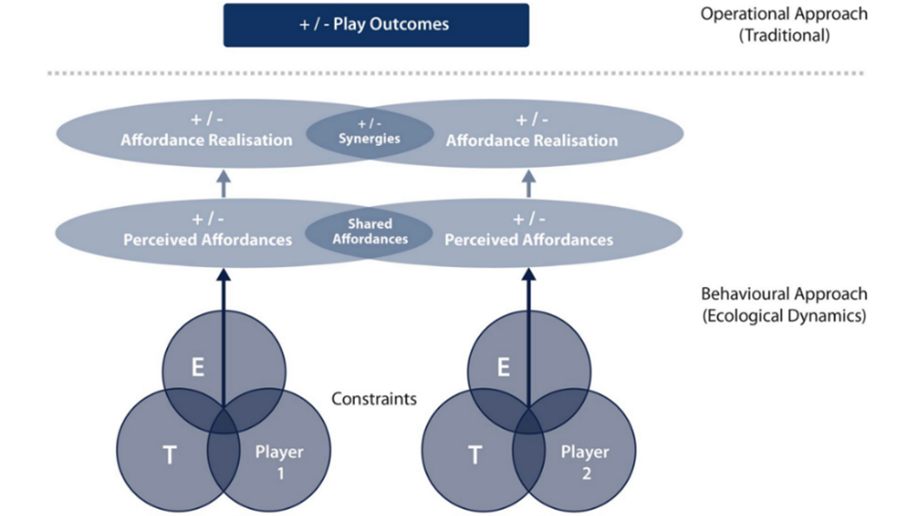
The overlapping constraints of task, environment and organism (athlete) combine to form a dynamic cycle of adjustments (Figure 1). The information an athlete receives is an ever-changing result of the constant interactions of perception and action. These opportunities for action are called affordances [1].

During game play, each player’s actions and intent generate information that other players readily perceive and act on continuously. How well players on the same team attune to these opportunities creates space for team behaviours to emerge.
If cohesive team performance is a direct result of an athlete’s ability to attune to information related to their teammates [10], could coaches accelerate the rate at which individuals pick up on the shared affordances by designing environments and tasks that better align with ecological dynamics?
Sports as complex adaptive systems
When practitioners look at sport as a complex adaptive system, they identify much more than just a set of descriptive statistics from which to formulate technical, tactical and physical interventions. This perspective highlights the absolute necessity of considering the human part of the performance problem, and why it is essential to look more closely at lower order performance indicators that directly affect higher order outcomes.
Performance frameworks should represent the desired outcomes
Winning is the currency of coaching and performance. Every team aspires to a net positive amount of higher order performance outcomes: more points, more wins, better league position. The cumulative result of lower order events – individual skill execution, players’ physical conditioning, decision making – determines the outcome of higher order events. It all makes sense: to win the competition, you must win more games. To win more games, you must score more points. To score more points, you need net positive results in the critical lower order performance outcomes that are the basis of sport in question.
Currently, Rugby Union preparation and development frameworks are designed largely on information from descriptive analyses: injury epidemiology, in-game demands, positional profiling of physical, technical and tactical skills. Performance practitioners draw up iterations of the training process based on these descriptive analyses to correlate with performance variables associated with higher order outcomes.
Coaches create long- and short-term programs they feel will best address their athletes’ or team’s physical, technical and tactical strengths and weaknesses based on supporting data and anecdotal experience [11].

Sports practitioners have traditionally conceived of this process as linear, with changes in the physical, technical or tactical characteristics of an athlete resulting in improved individual outcomes. That resulted in more lower order team outcomes, which contributed to more successful higher order actions, ultimately producing more wins. For example, Colomer et al [12] found 29 lower order variables associated with Rugby Union performance: possession kicked, lineout success on opposition ball, tries scored, points scored from conversions, tackles completed, turn-overs won, among others.
Coaches working within this linear, reductionist process would perform a lit review and gather data that supports a particular training intervention, then develop the identified variables in a discrete fashion. There would be no appreciation of the interaction between them. Strength & conditioning coaches would solely focus on getting athletes capable of executing physical skills identified in the determination model, removed from context or interaction with the environment, other athletes or the task.
Tweet ThisViewing sports as a complex adaptive system makes it much easier to see just how important the human element of performance really is
@SpencerGoggin
A traditional example is the review by Cunningham et al [13]. This review examined physical parameters alongside their association with on-field performance and effort-based KPI’s for international Rugby Union players. Intermittent running performance (yo-yo IRTL1) for forwards correlated with number of tackles made, first three players at the ruck (attack and defence), number of effective rucks, total possessions and completed passes (r= 0.522 – 0.717). Relative peak power and jump height (counter-movement jump), single leg peak power (SL CMJ) and reactive strength index (drop jump from 20 cm) showed a positive correlation with clean breaks in the forwards (r = 0.558–0.594). For the backs, there was no significant correlation between intermittent running performance and effort-based performance KPI’s (tackles made, number of effective rucks, total possessions). RSI in the 40 cm drop jump and 20 cm single leg drop jump were the only two correlations (r = 0.619 – 0.621) with clean breaks.
The authors conclude that, for most of the relationships, the magnitude and direction of change for the predictor variables with respect to the dependent variable was beyond that which athletes can achieve through training (i.e., >20%). They also acknowledge the need to connect improving physical performance with improved KPIs during match play. This statement concedes that transfer is assumed, not assured, when training is delivered void of context. The human element is lost.
Less well understood are the interactions of players that lead up to some of the most critical moments during Rugby Union games, such as clean breaks and kicks [14,15].
This is a limitation of traditional descriptive performance analysis methods that underlie most, if not all, of our coaching interventions. As performance analysis models evolve, so must coaching practice. The future of performance analysis will include a more dynamic systems-based approach.
Practical application of ecological dynamics in sport
Co-designing learning environments
Gibson’s seminal work states “we must perceive in order to move, but we must also move in order to perceive [1].” This captures the cyclic nature of perception-action coupling and its critical importance when designing a learning environment. Learning design should be a dynamic process, even at elite and advanced stages of learning.
Constraints are the demands of the conditions placed on emergent actions [31]. Constraints can be separated into task, environment and individual.
Developing appropriate constraints requires a coach to derive the essential components of a sporting movement or performance environment and scale them for that athlete. That requires prior knowledge (from the athlete or the coach) of the relevant performance factors to guide coaches toward the most relevant constraints that will impact performance.
Athlete-coach collaborations are necessary to develop innovative and creative means to manipulate interacting constraints to continuously enhance performance [30]. The better the learning landscape allows for and even encourages athletes to interact with constraints, the more effectively the athletes can perceive relevant information. In turn, coaches and athletes will go out and design better landscapes in the future.
Each athlete’s prior knowledge and experience plays an important role in environment design. Elite players will be able to provide detailed insight into the most task relevant information that may be present in an environment, allowing for deeper levels of task individualisation. Younger, less experienced players will not have that knowledge and experience. Therefore, they may require more task simplification or constraints to highlight the most relevant information present during a task or scenario.
Representative task design: Examples from jumping
Representative task design follows from the idea that the constraints placed on a task should represent a performance concept. When environments are designed correctly, the manipulation of task constraints poses questions to the learner, which they answer with action.
Manipulating task constraints takes learners through three phases [31]:
- Search: the constraints of an activity are explored to achieve a task goal;
- Discovery: when a variety of solutions begin to stabilise into strategies;
- Exploitation: how can that athlete enhance an outcome using the information they perceive.
Take jumping, for example. Constraint manipulation during the fundamental development stages might take the form of storytelling: crossing a river or molten lava. Athletes are encouraged to jump from island to island in order to cross safely. A coach should start out by offering different routes to encourage individuals to search for a variety of different movement solutions, gradually increasing or changing the distances required for each jump so no two routes end up the same [30].
Fast forward to elite long jumping. Athletes now must learn how to exploit a situation.
Tweet ThisIn training, we create situations where we don’t tell the players the purpose of the game as we want them to work it out for themselves and very quickly adapt
@SpencerGoggin
Scenario-based coaching is a particularly effective coaching strategy at this level. However, in order to create a landscape that closely mirrors competition, the coach must have a deeper knowledge of performance. A coach might know that foul Jumps make up roughly 30% of all jumps for men and women [31]. The lowest percentage of fouls and lowest mean distance per jump occur in Round 1 of competition. Do these findings suggest that athletes are registering a safe score early, given that only the top eight progress after Round 3 [32]? Is this a deliberate adaptation of an athlete’s strategy given the competition demands at that moment?
With this knowledge, what would change in the design of a training environment?
Coaches can collaborate to recreate scenarios for athletes:
- two failed jumps and this one must hit a certain distance to continue;
- setting an “error limit,” e.g., five foul jumps for the whole session, all jumps must be above a minimum jump distance;
- adding tailwind / headwind so the athlete encounters environmental constraints.
Representative task design and Rugby Union
A common field-based strategy to achieve greater ecological validity is using small, sided games (SSG) [21]. The objective of the SSG is to foster specific technical or tactical skills alongside physical qualities [22].
Games can be manipulated to have varying degrees of competition-specific validity and task representation. One idea may be to periodise game constraints across a preseason block in order to point players towards the most task relevant information. This would require the close integration of all coaching staff and key players in order to design landscapes that delineate the process and milestones.
Early in preseason, manipulating the size of the pitch and the number of players on it is the simplest way coaches can design a landscape to encourage a particular lower order action. The increase in space during a 4v4 game compared to an 8v8 game on the same size pitch led to an increase in the running demands on the players [23]. Reducing the number of players also increased technical demands, as players got more catch and pass opportunities [20]. A discussion among the technical coaches about how and when 4v4-type events might happen in game would be worthwhile to create more task-relevant information for the players. Manipulating game rules to match the scenario to players’ experience on the field will again increase the ecological validity of this drill, and address an under-researched area: how manipulating constraints impacts tactical execution during SSG’s [24].
As teams move closer to the start of the season, games that more closely replicate the task demands of competition become the priority. Unstructured conditioned games in training are an effective training intervention up through the elite level [34]. Creative coaches will manipulate the individual make up of one team versus another as an opportunity to potentiate action solutions, particularly in unstructured play when mismatches may promote certain opportunities for action to emerge.
Mismatched 1v1’s and 2v2’s present an opportunity for S&C coaches to make a significant impact with their speed and agility coaching. If the task goal is to score, how can coaches manipulate the constraints to allow individuals opportunities for new behaviours to emerge? Potential constraints may include:
- changing the starting position of the defenders;
- the shape and dimensions of the area players can operate in;
- standing start vs. rolling start;
- mismatches: big vs. small, slow vs. fast;
- tactical scenarios, like keeping possession vs. needing to score.
These create opportunities for the players to gather knowledge of and for each other, potentially leading to increases in shared affordances.
Setting constraints on the individual athletes
Rate limiters affect an athlete’s ability to express a skill, and therefore are a factor in designing constraints. Rate limiters can be specific to the individual, the task and the environment, each temporarily hampering the emergence or stabilisation of a solution [35].
Identifying rate limiters and mitigating against their influence on performance is pivotal in an appropriate learning design. Given an athlete’s strength, speed and power and how these qualities may influence performance, the coach can manipulate the task to remove strength as a limiting factor by using smaller balls or matching tackle partners by physical size.
Environmental constraints
Environmental constraints involve the physical (playing surface, weather conditions) and social characteristics (presence of an audience, audience involvement, atmosphere) of the performance environment. In anticipation of a wet weather game in Perth, for example, the New South Wales Blues tried to replicate these environmental conditions by using soap-covered rugby balls.
Coaching strategies within an ecological dynamics framework
Wayfinding
Gibson described wayfinding as the process of designing environments for learners to explore, defining it as:
“The process of learning to search for, and detect, information in an environment that individuals learn to exploit for solving (i.e., ‘navigating’) performance-related problems, situated as fields (regions) within an evolving landscape.”
Wayfinding views skilful actions as dynamic, body-environment interactions [16], through which individuals self-regulate to achieve their intended task goals [17], rather than repetitious movements of the body removed from context. Concepts such as skilled behaviour, learning, expertise and talent are all viewed as emergent properties of a functionally adaptable, evolving relationship between a performer and the constraints of his or her environment [18]. The learner is ultimately responsible for solving the emergent problems the practitioner built into the landscape.
The greatest impact this approach can have for an athlete lies in not telling learners which decisions to make and how to play the game or perform an action [33]. Traditional practice assumes a need for long-winded, detailed explanations about how to perform an action or what decision to make. Coaches should be aware that instruction itself is a constraint that interacts with the task and the individual to shape behaviour during each phase.
An often-misconstrued criticism of this methodology is that the coaching style is “set and forget,” as you place a learner into an environment in which they “find their own way.” The reality is the practitioner works with the learner to guide their attention towards critical features of the environment to inform perceptual exploration and action [19]. This process takes practice. Experienced athletes will have a more in-depth understanding of the environment and what information is critical to performance, and subsequently can take a much larger role in environment co-creation. Less experienced athletes will need more guidance towards the critical components.
The coach’s role is to recognise when an athlete has developed greater levels of expertise and understanding, then move through these newly oriented performance frameworks.
Progressively and thoughtfully evolving the environment is necessary to continue those improvements, whether they come through the specifics of load, complexity, velocity, ground reaction force or any other input.
Matching content, format and goals when giving feedback
Feedback can reinforce an athlete’s exploration into current movement solutions, or highlight, demonstrate or initiate the search for other opportunities. It’s another critical part of the puzzle.
Traditionally that would take the form of a coach talking to an athlete about movement errors so the athlete can move closer towards a movement template. A nonlinear approach would instead direct a learner’s attention to a specific task goal. An external attentional focus better directs a learner towards self-organising tendencies [37]. Whether feedback is delivered with an internal or external reference is up to what that practitioner decides is ideal for that athlete, in that moment.
Coaches should always remind themselves that feedback should guide the athlete toward specific information about the environment. Then let them explore to find an effective performance solution.
Demonstrations for attention as well as task
Demonstrations traditionally provide learners a visual model that assists with the development of a movement solution [37]. Demonstrations and other forms of feedback can restrict or expand an athlete’s search activities, depending on their needs.
A non-linear approach suggests that demonstrations should promote more acute attention to information available in the landscape. Practitioners manipulate task constraints based on what an athlete can already do, and subsequently manipulate them in order to challenge the learner to add something to their current actions in order to achieve a new performance goal. Demonstrations are still a critical component of the coaching process, but can be combined with movement constraints that safely challenge the athlete safely into learning a new skill.
Extending ecological dynamics throughout the training environment
Non-linear learning principles extend into the gym as task constraint manipulation allows athletes to progress based on competence rather than time. The process outlined here describes how S&C coaches could potentially move an athlete through a performance framework through the creative use of constraint manipulation and exploration. Environments and tasks can allow these fundamental adaptable skills to emerge as a result of interactions with information.
A practical use of designing sessions to encourage movement would be including “live” environments: warm-ups for older athletes or perhaps the primary strength stimulus for younger athletes. Stafford et al [28] proposed parkour as a possible method to enhance movement abundance by building “live” environments that enhance the athlete’s ability to make decisions, assess risks, take chances and transition between movements and obstacles.
S&C coaches are working to create movement experts, but as an athlete ages degrees of freedom can become frozen, which in turn leads to less adaptable movement skills [27]. Designing a landscape with the athletes may encourage problem solving and collaboration as they move equipment through obstacles. Or, the S&C coach can integrate with the medical team during late stage rehab as an athlete must navigate through a “live” environment as they approach the chaotic nature of sports performance.
Ecological dynamics returns the human element to sports performance
Viewing sports as a complex adaptive system makes it much easier to see just how important the human element of performance really is. Improving performers’ knowledge of and for each other accelerates the cumulative effect of shared experiences, the impact of which is known to directly influence successful outcomes, both higher and lower order. Through the creative use of constraint manipulation and representative task design, coaches can better design training environments to replicate the competitive landscapes athlete’s encounter and, in doing so, accelerate this process.
Coaches in the future will, at a minimum, become familiar with ecological dynamics theory and know how to co-design a landscape in order to empower the learner to take greater ownership. Perhaps the most important and uncomfortable change for coaches will be taking that step back and stop using explicit feedback, in favor of letting behaviours emerge as a result of athletes’ interactions with the landscape.