

Content of fundamentals article
- Article summary
- What is isometric training?
- What are the different methods of isometric training
- How to assess isometric strength?
- What the research says about isometric training
- Benefits of isometric training on sports performance
- Learnings from isometric training studies
- Conclusion
Article summary
- Isometric training involves muscle contraction without any external movement
- Adaptations from isometric training depend on 1) intensity of contraction; 2) duration of contraction; 3) rate of contraction; and 4) joint position where muscle contraction occurs
- Isometric training can enhance sports performance by increasing maximum strength, rate of force development and tendon stiffness
- Isometric training is superior in increasing tendon stiffness compared to other modes of strength training, and improves the performance of multiple sports related skills and movements.
What is isometric training?
Isometric training involves muscle contraction without any external movement. Compared to traditional strength training that involves concentric and eccentric action, isometric training is safer and has lower metabolic requirements [21]. Furthermore, when the joint is at an optimum angle, the muscle is able to produce higher force during isometric than concentric and eccentric contractions [34].
What are the different methods of isometric training?
Isometric training employs two forms of isometric contraction: the “push” method (PIMA), where isometric contraction occurs while exerting force against a fixed object, and the “hold” method (HIMA), which entails exerting equal force against a specific load [5,10,30]. Understanding of the differences between the two methods is poor, despite wide acknowledgment that these differences exist. Few training studies compare the adaptations between isometric training using these two methods of contraction. The literature mainly covers the push method.
EMG activity is higher for the push method when the muscles are near exhaustion during an isometric contraction task [10,30]. The muscle recruitment threshold reduces at a higher rate during the hold method [5]. This may explain why individuals can sustain isometric force for less time with the hold method than the push method [10,30], as an earlier recruitment of more motor units may also lead to earlier fatiguing of the recruited muscle fibres.
How to assess isometric strength
Multi-joint isometric tests have been gaining popularity in recent years, in part because they are relatively simple to administer, pose minimal injury risk, have high test-retest reliability, are able to detect subtle changes in strength, are considered to be less fatiguing than 1 repetition maximum (1RM) test, and outcomes correlate with various sports performance metrics [26]. Additionally, practitioners now have more access to force plates and strain gauges.
Among the isometric tests, the isometric mid-thigh pull (IMTP) has been most extensively studied. Muscles around the ankle and knee contribute a relatively high amount of force during the IMTP [1].The IMTP is best performed with 125–145o of knee flexion angle and 140–150o of hip flexion, with elbows fully extended and hands strapped to the bar with lifting straps (Figure 1).

An isometric test that specifically assesses hip extension strength (Figure 2) was recently validated [12]. Measures from this test correlate significantly with sprint performance [12].

What the research says about isometric training
The rate of force development and time under tension influence the explosive and maximal force development adaptations stemming from isometric training [4,32]. This is similar to how we adapt to dynamic strength training. For example, heavy weight training with higher time under tension is more effective for developing maximal strength, while plyometric training with higher muscle contraction velocity is more effective for improving explosive strength.
Apart from reporting that isometric training could also result in muscle hypertrophy, researchers led by Keitaro Kubo noted the effectiveness of isometric training in improving tendon and aponeurosis stiffness [16-18]. One study showed that isometric training resulted in greater improvement in tendon stiffness but less improvement in active muscle stiffness than plyometric training [17]. This indicates that isometric training would be a better option to increase tendon stiffness, which is an important factor in improving rate of force development and storage of elastic energy during the stretch-shortening cycle (SSC).
Studies have also compared the neuromuscular adaptations between isometric and other modes of strength training. These studies have yielded differing results. For example, isometric training resulted in greater increases in isometric strength than isokinetic training, while isokinetic strength increased similarly after the two different modes of training. However, in a different study, while isometric training resulted in a greater increase in isometric strength, it was inferior to isotonic and isokinetic training in improving dynamic strength. These findings support the theory of training specificity. Coaches should ensure their athletes continue performing a particular skill when performing strength training to allow for strength gain from this mode of training to transfer to improvement of the targeted skill [21].
We recently published a study that compared the adaptations to isometric bench press at a single position (90o elbow angle) vs. multiple positions (60o, 90o and 120o elbow angles) [28]. Both protocols led to similar improvement in 1RM bench press, but the multiple position group had a greater improvement in ballistic push up peak power. We explained that the largest input to 1RM performance is the ability to produce sufficient force to overcome the sticking region, which is around 90o elbow angle. Both groups performed isometric bench press at that position, resulting in similar increases in force production capability at that position. However, the ballistic push up requires participants to accelerate the body throughout the full range of movement, and starts at a position similar to the bottom position of a bench press without a countermovement. The group that trained at multiple positions would most likely increase force generation capability throughout the full range of movement to a greater extent then the single position group. Hence, they had an increased ability to perform the ballistic push up. Therefore, athletes should perform isometric training at multiple positions if the objective is improving the performance of ballistic movement.
Benefits of isometric training on sports performance
Results from multiple studies highlight the benefits of isometric training on cycling [14,42], kayaking [23], endurance running [2,22], jumping [8,24-27] and sprinting [24,27].
Cycling
Healthy male adults improved multiple parameters during a cycling incremental test after performing only isometric knee extension for seven weeks. This study did not include a control group, and simply performing isometric knee extension alone might not be relevant to high performing athletes. Fortunately, a more recent study by Kordi et al. [14] overcome these limitations. Participants were elite track cyclists, with a control group performing only traditional dynamic strength training exercises (squat, deadlift, etc). In addition to three sets of dynamic back squat, the experimental group performed cycling-specific isometric training on a modified bicycle that allowed the crank arm to be fixed at three different angles. The results showed greater improvement in 4 s maximal sprint power output in the experimental group than the control group (Figure 2). Furthermore, isometric knee extension performance also improved more in experimental group.
This training method may have been so effective because the training stimulus was task-specific, as it was performed on a bicycle; and because it allowed the athletes to repeatedly produce and sustain maximal force in cycling-specific positions. That would not be attainable during track cycling, whereas this set up provided an overload stimulus.
Any small amount of improvement in elite athletes’ performance typically requirea a great deal of effort and time. The 3-4% improvement in peak power output in the experimental group indicates that the use of cycling specific isometric training is a feasible option.

Kayaking
While strength training is an integral component in sprint kayakers’ training regimes, the number of strength training intervention studies for this sport is quite limited, let alone studies on isometric training. To my knowledge, our study that investigated the effects of isometric training on sprint kayaking performance is the only one in the literature [23].
We randomly assigned national and collegiate sprint kayakers into either a group that performed traditional strength training or one that replaced half the volume of squat, bench press and prone bench pull with the isometric mode of the exercises.
The group that had isometric training experienced a greater improvement in both strength and 200m ergometer kayaking performance (Figure 4). We suggested two reasons for these findings. First, the athletes performed the isometric squat, bench press and prone bench pull at joint positions that were close to those during the initiation of the kayaking pull stroke. This would have led to greater increases in force generation capability at sport-specific joint positions, which enabled the kayakers to overcome inertia more easily, resulting in greater mean power over the 200m time trial.
Second, all the kayakers participating in the study had more than two years of experience in performing traditional strength training, which would have resulted in diminishing returns as they continued performing the same type of training. Isometric training introduced a training variation that could have disrupted any plateau in neuromuscular adaptations.
These findings support the idea of performing isometric training either at the joint position where athletes initiate the concentric phase for a specific movement, or at the most biomechanically disadvantaged position of the movement, i.e., sticking region. In addition, coaches may include isometric training into their athletes’ programs after they have been performing traditional strength training for a long period of time to preclude diminishing returns.

Endurance Running
The effects of resistance training on endurance running have been extensively studied. Researchers have implemented different types of resistance training such as heavy and light weights, plyometric and also isometric training in their studies [2,20,22]. The increase in musculotendinous stiffness is one of the main reasons for improved running economy and overall running performance after a period of resistance training [2,33]. Increased musculotendinous stiffness allows for greater return in elastic energy and more efficient transmission of force, reducing the metabolic costb [15]. This already suggests that isometric training will benefit endurance running performance via its enhanced effects on tendon stiffness compared to other modes of resistance training. Two studies thus far have supported this idea.
Oxygen consumption at various speeds decreases in recreational endurance runners after performing isometric plantar flexion exercise in a seated position for 14 weeks (Figure 5). This improvement was accompanied by increases in tendon force and stiffness of tendon aponeurosis.
Similarly, running performance and running economy improved after only six weeks of isometric training. This included a group that performed plyometric training and one that performed calisthenic exercises. Our results showed that both isometric and plyometric training improved maximal aerobic speed and 2.4-km run time, while only isometric training resulted in improved running economy at two running speeds (Figure 6) [22]. We do not know why plyometric training did not result in improved running economy, as it did in other studies. One reason could be because some of the participants were already accustomed to this mode of training as they had resistance training experience. Thus, there was a diminishing return effect. Isometric training, on the other hand, not only provided a new stimulus, as none of the participants had performed this mode of training before, it very likely also produced a greater increase in tendon stiffness. That conferred greater return in elastic energy when running, reducing the energy cost.
The magnitude of improvement in running economy after isometric training in our study was similar to that reported by Albracht & Arampatzis [2] despite a much shorter intervention period (12 vs. 56 sessions). This was likely because we included a multi-joint isometric exercise in addition to the isometric plantar flexion, which could have resulted in greater a increase in overall muscular strength and tendon stiffness of the lower limb. Furthermore, all of our isometric exercises were performed in an upright standing position, which is more similar to running posture.
Since running involves rapid SSC like plyometric training, runners likely have high active muscle stiffness but lack tendon stiffness if they do not perform heavy resistance training. This imbalance may have reduced their potential to maximise the use of elastic energy from the stretched tendon. It may also increase the risk of tendon injury [6]. Therefore, runners should perform isometric training both to optimise performance and reduce the risk of injury.


Running economy 1 – Energy expenditure when running at 10 km.h-1(female) and 12 km.h-1 (male).
Running economy 2 – Energy expenditure when running at 12 km.h-1(female) and 14 km.h-1 (male).
Jumping
Jumping activities such as the countermovement jump (CMJ) involves a rapid stretch-shortening cycle similar to running. The eccentric phase during the SSC provides the muscle more time to develop force and also allows non-contractile connective tissue to store elastic energy [39]. This enables the muscle to generate a higher amount of force during the concentric phase. We could logically assume, then, that isometric training would be beneficial to CMJ performance, as a stiffer tendon would enable the storage of greater amounts of elastic energy when stretched [1,15]. This idea was supported by three recent studies [24-,27].
Both sustained and non-sustained contraction protocols resulted in improved CMJ height (Figure 7) [24]. CMJ height also improved after isometric training more than after plyometric training among endurance runners (Figure 8) [25].
Isometric training also increases propulsion time and countermovement depth. However, the eccentric phase did not change despite the increase in countermovement depth. This means that participants in the isometric training group likely improved their eccentric rate of force development, and the improvement in muscular strength enabled them to change their jump strategy by adopting a position with a lower centre of mass. This change in strategy allowed them to generate more propulsive force over time, which led to an increase in jump height. The greater countermovement depth also led to greater tendon stretch, which would have resulted in greater storage of elastic energy to be used during the propulsion phase.
Finally, including the isometric squat continuously for 24 weeks vs. periodic inclusion (6 weeks on, 6 weeks off) or only performing the dynamic squat resulted in a greater improvement in jump height (Figure 9) [27]. However, contrary to the previous study, isometric training in this study did not increase propulsion time and countermovement depth significantly. Instead, there was a significant improvement in modified reactive strength index. This indicates that long term and periodic inclusion of isometric training over a longer training period may also lead to more optimal force generation using the SSC.
Apart from the improvement in tendon stiffness, the other possible contribution to the increased CMJ height in both studies could be improved force generation capability at the joint position where concentric starts, as athletes performed the isometric squat at 90o knee angle in both studies.
These findings conflict with some earlier studies. Some of the possible reasons could be because these studies 1) utilised a single joint isometric exercise, which has less transfer to dynamic multi-joint activities; 2) did not use a rapid contraction protocol, which is important in improving rate of force development; 3) did not involve dynamic activities such as running, jumping and sprinting, reducing the ability of the participants to transfer strength gain to improve dynamic performance.


Sprinting
Similar to jumping, sprinting also involves rapid stretch-shortening cycles. However, the rate of contraction is faster during sprinting than jumping, as the ground contact time is typically ≤200 ms during the acceleration phase and ≤100 ms during the maximum speed phase. Therefore, the ability to develop force rapidly is highly important to sprint performance.
Performing heavy resistance and plyometric training improves sprint performance, with high intensity training showing more benefits [32].
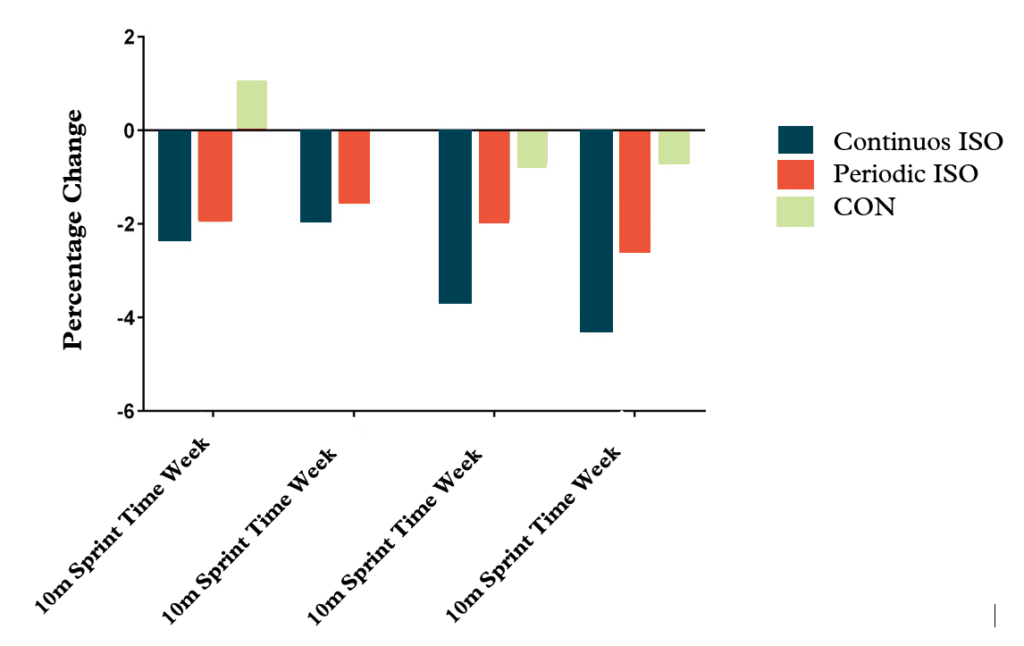
While the benefits of dynamic resistance training on sprint performance are well documented, currently only two studies investigated the effects of isometric training on sprint performance [24,27]. In the study where we compared the two isometric training loading strategies, only the protocol where participants sustained the isometric contraction for 3 s resulted in significant improvement in 30m sprint time (Figure 8) [24]. The 1.4% improvement in 30m sprint time was comparable to what elite team sport athletes gained with dynamic strength training [29,35]. Both continuous and periodic isometric training improved 5, 10 and 20m sprint performance more than dynamic strength training alone (Figure 11A-C) [27], with continuous training being more effective than periodic training.
Similar to the findings on jumping performance, isometric training produced greater change in sprint times along with maximum force development on the isometric mid-thigh pull. While these studies did not measure the change in tendon stiffness, the improvement in sprint performances in these studies may stem from the increase in tendon stiffness, as this is one of the distinct adaptations to isometric training and musculotendon stiffness is a determinant of sprint performance[37].



Learnings from isometric training studies
The isometric training literature provides some key takeaway for practitioners:
- Isometric training can result in strength gains at both trained and untrained joint angles [13,40].
- Training at single (sticking point) and multiple joint positions may result in similar improvement in 1RM of a specific exercise. Training at multiple joint positions is more effective in improving ballistic movement performance [28].
- Long duration contraction repetition had a larger effect on hypertrophy than multiple repetitions with short duration contraction (e.g., 4 x 20 s vs 4 x 10 x 3 s) [31].
- Short duration contractions at high intensity resulted in greater strength gains than long duration contraction at low intensity (e.g., 1 s at 100% maximal voluntary contraction vs. 1 min at 30% maximal voluntary contraction) [41].
- Performing isometric training with rapid contraction is more effective for improving rate of force development than ramping up the force gradually [4,32].
- The principle of training specificity applies. Isometric training alone can result in greater increase in isometric strength compared to concentric and eccentric training [11], but is less effective in improving dynamic strength [17,19,36].
- Replacing half the volume of dynamic exercise with isometric training can result in greater strength improvement than just performing the dynamic exercise [23]. For example, two sets of dynamic squat plus two sets of isometric squat can result in greater strength gain than four sets of dynamic squat.
- Isometric training can enhance sports performance by increasing maximum strength, rate of force development and tendon stiffness.
Conclusion
Adaptations from isometric training depend on 1) intensity of contraction; 2) duration of contraction; 3) rate of contraction; and 4) joint position where muscle contraction occurs. Isometric training is superior in increasing tendon stiffness compared to other modes of strength training, and improves the performance of multiple sports related skills and movements.