
You recently published a paper, “Gluteal muscle forces during hip-focused injury prevention and rehabilitation exercises,” which got a lot of attention on social media. Can you clarify what the purpose of this paper was, as I think people may be using the findings to feather their own nest.
Mechanical tension / muscle force is the primary stimulus for training induced muscle adaptations, such as increases in size and strength. However, beyond the amount of weight lifted, how much force do muscles and tendons in the body actually experience during training? And how does this force change with exercise choices? Nobody really knows.
Strengthening the gluteal muscles (gluteus maximus, medius and minimus) is crucial for controlling body posture and opposing the forces at the hip and knee that contribute to lower limb injuries. Yet, it is unclear how well current injury prevention and rehabilitation programs target the gluteal muscles. In fact, most exercise selection choices are primarily based on expert opinion, clinical reasoning or, worse yet, electromyography (EMG)! More on that soon…
Although there are many factors involved in exercise selection (athlete / patient considerations, injury history, equipment requirements, training status) as well as muscle adaptation (protein availability and metabolic activity), we aimed to provide objective information about muscle force during a wide range of gluteal strengthening exercises to guide exercise selection.
You mentioned that there may be a misinterpretation of what muscle forces are, how you used EMG and what the implications are. Can you expand on this?
Based on the response to our study on social media, results displaying muscle forces seemed to be commonly mistaken for muscle activity, or are assumed to have the same meaning. Interpreting EMG as muscle force output is a longstanding problem in research and clinical practice. For a comprehensive yet easy to understand discussion on this topic, I recommend the article by Vigotsky et al. [1].
EMG is a measure of muscle excitation – the electrical signal of the muscle – which, when filtered and normalised to a maximal effort contraction, provides a rough estimate of muscle activation, that is, the percent of fibres active. Therefore, muscle activation is a unitless measure of muscle state, not force output.
EMG signals alone are very prone to inaccuracies due to poor signal quality, muscle crosstalk, movement artefact, or normalisation that does not reflect a true 100% signal. These inaccuracies are evident in systematic reviews of muscle activity during exercises, such as single leg squats, where gluteus medius activity can be anywhere from 20-100+% of maximum muscle activity [2]. Other than indicating that the muscle is “switching on,” EMG studies tell us very little about how much force a muscle is producing.
Importantly, there is no evidence that exercise selection based on EMG has any association with training-induced adaptations [3].
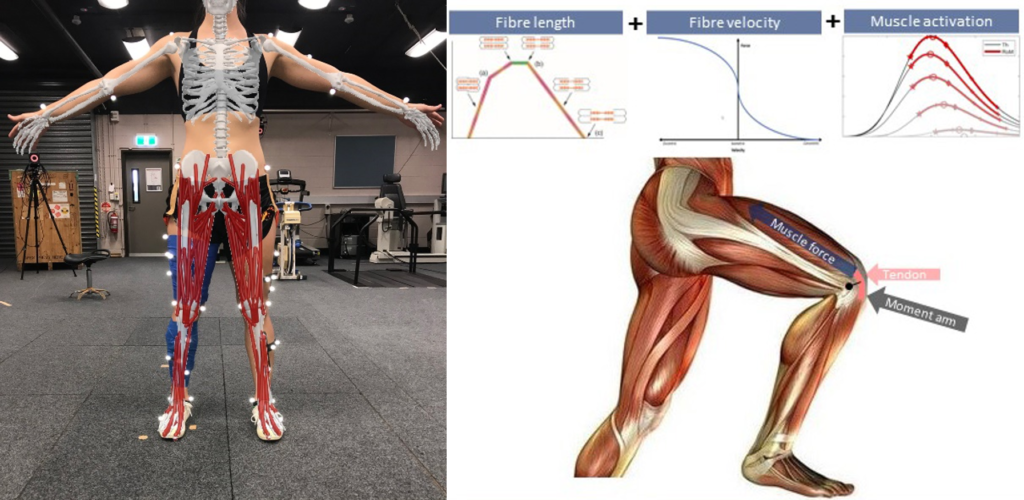
Muscle force production is dependent on three relationships: force-length, force-velocity and force-activation.
We can use a physics based model of the musculotendon unit (e.g., Hill-type muscle model [4]) to estimate muscle forces. In our study, we recorded 3-dimensional motion capture data, ground reaction forces, and EMG from 14 lower limb muscles during a range of hip focussed exercises [5].
Biomechanical data let us create a full lower body musculoskeletal model and determine all individual muscle forces required to produce the observed forces and movements. EMG only helps determine how force should be spread across similar action muscles, such as the hip abductors. In the context of muscle adaptation, muscle forces provide an indication of mechanical tension, which may be a useful proxy of the stimulus for muscle development.
Tweet ThisThere is no evidence that exercise selection based on EMG has any association with training-induced adaptations
@TylerCollings3
According to the study, the single leg hip thrust at 12RM saw the highest peak forces for the gluteus maximus, followed by the single leg squat at 12RM and single leg hip thrust at body weight. If a coach was looking at this to guide programming, what would be your interpretation and advice?
We think these results can be applied in many different ways, depending on the training context:
- If the training goal is to improve gluteus maximus strength, where peak mechanical tension is an important stimulus, then loaded split squats, single leg RDL, and single leg hip thrust may be good exercise choices.
- If the training goal requires high volume, then based on the muscle force-time profile, loaded single leg hip thrusts may be the optimal exercise choice.
- If training is constrained by time, then selecting an exercise which targets all gluteal muscles may be more efficient, such as the single leg RDL.
- If rehabilitating a gluteus maximus tendinopathy, then selecting an exercise with low peak muscle-tendon forces may be required, such as body weight hip hike, or side lying leg raise. Coaches can then progress in a controlled manner towards high force exercises.

There is clearly an ongoing debate based on the use of banded warm ups and using bands as “activation” exercises. Can we use your data to inform our decision making on such exercises?
Our study does not directly examine whether banded exercises may or may not be useful as a warm up exercise. However, if the justification for performing a banded exercise is to generate high muscle activity, our study suggests that many exercises produce the same or even higher muscle activity. For example, side lying leg raise, single leg squats and single leg Romanian deadlifts all produce relatively similar gluteal muscle activity to banded side steps.
High muscle activity is generated in response to the need to produce high forces and, as mentioned previously, depends on muscle fibre lengths and velocities. Therefore, as our study shows, other loaded exercises (12RM) produced more muscle activity than banded side steps. Greater loads are likely to increase muscle activation even further.
Don’t have any equipment available? Long lever side planks produce some of the highest external hip moments that require large hip abductor muscle forces to counteract. In this position, gluteus medius and minimus operate at near optimal fibre lengths (i.e., on the plateau of the force-length relationship) with isometric fibre velocities. As such, they produce the highest muscle activation observed in our study (80%).
Or how about explosive movements? Although not included in our study, movements that require high rate of force development and have fast concentric fibre contraction velocities are likely to produce greater muscle activity than any low load (such as bands) and slow contraction exercises (such as side steps / crab walks). For example, maximal effort sprinting, jumping, hopping or changing direction.
Tweet ThisIf the training goal is to improve gluteus maximus strength, where peak mechanical tension is an important stimulus, then loaded split squats, single leg RDL, and single leg hip thrust may be good exercise choices
@TylerCollings3
What other data do you believe clinicians and coaches should be taking into account when decided upon exercise selection?
Peak muscle force captures the maximal amount of tension, while potentially the accumulation of force over a rep has important implications for volume. Current methods involve quantifying volume as weight * reps, which doesn’t account for the fact that muscle tension changes over the rep and exercises have different force-time profiles.
The methods we present in our study may have the potential to improve the way coaches monitor resistance training loads in the future.
Coaches should consider the overall muscle loading of the entire training program, not just individual exercises. Although many coaches likely do this already, how often do we consider the loading placed on secondary or stabilising muscle groups?
For example, a lower body program may prescribe exercises with the goal of promoting adaptations in the quadriceps, hamstrings and gluteal muscles. But how much loading do the individual adductors, deep hip muscles or calf muscles experience during these exercises, particularly if using single leg exercises. Could there be overloading of the smaller muscles that contribute to the common muscle strains and pains seen in sport?
Monitoring muscle forces in every muscle during exercise may provide some insight into these questions.
In addition to muscle loading, the same methods used in our study can provide joint, tendon and ligament loading. Avoiding or enhancing load on these structures may be an important reason for selecting one exercise over another in certain clinical populations or in those with injuries.
What are the biggest mistakes you see young practitioners/clinicians make and what advice would you give them to help?
There is usually no one “best exercise.” At the end of the day, training requires a regular and progressive stimulus to promote adaptations. There are usually a range of suitable exercises and any one of these can be an effective tool. Interestingly, due to individual differences in biomechanics and coordination, the optimal exercises for loading the gluteal muscles in our study varied between individuals.
Exercise complexity is often not better than simplicity. Exercises performed in creative positions or with elaborate equipment may not elicit any superior adaptations to a more “conventional” set of exercises. For example, if muscle force is the driver of adaptation, exercises that compromise ability to generate force (such as unstable surfaces) will be inferior to standard exercises.
The best exercises are the ones that get used. Although insight into the biomechanics of exercises is beneficial, if the “scientifically optimal” exercise isn’t easy to perform or integrate into programs, then it may add little value. Finding exercises that work for the individual and their training environment is crucial.
Tweet ThisThere is usually no one “best exercise.” There are usually a range of suitable exercises and any one of these can be an effective tool
@TylerCollings3