

When you look at daily monitoring data, what signals genuinely influence your programming decisions for individual athletes?
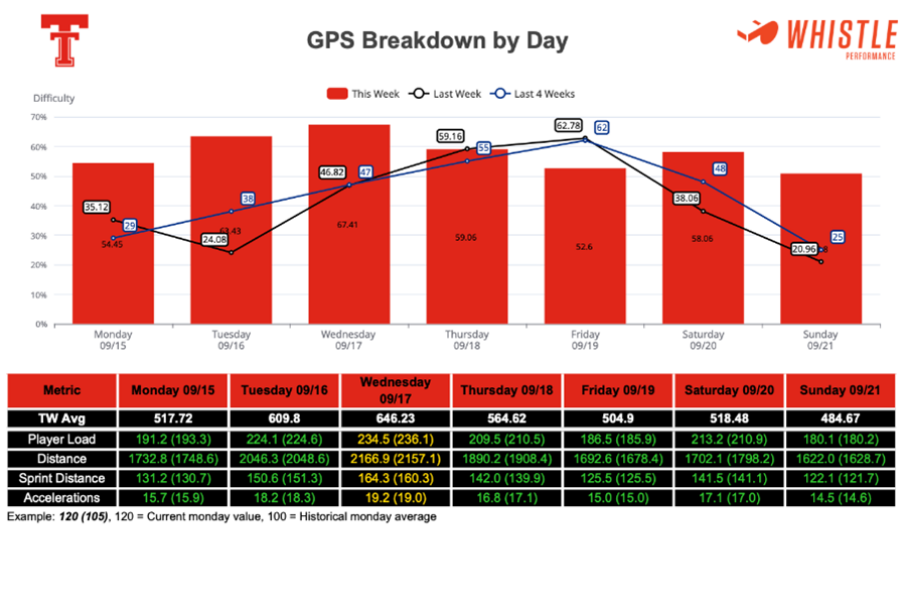
The two most important KPIs we monitor daily are load and distance. In 2013, we came up with a practice format that would align with our GPS numbers. The goal was to be fresh on game day. We planned to have a high load and distance at the beginning of the week, then skew the practices the rest of the week to bring the players back up from a fatigue and CNS standpoint.
This took a lot of coordination and buy-in with the head coach and position coaches. The plan was to script all long plays—1st and 10 or 3rd and long—at the front end of the week, along with spreading out some of the special teams on these days. Special teams are hidden yardage, and can affect your load or fatigue numbers if placed on the wrong days of the weekly practice script.
Once we established the practice format, we overlaid the team load and distance numbers on the high and low days of practice. We had markers for each day for team load and distance. From there, we broke it down to position groups and then to individuals.
The receiver group and the secondary group are very high among offense and defense, respectively. Therefore, it is key to establish markers for these two groups.
Every day I am monitoring these athletes very closely. We need them to be fresh for game day. If there are any discrepancies with their numbers, we come up with a plan for the rest of the week for practice and weight room to handle fatigue. This could mean limiting reps in individual and team periods; or it could be the exact opposite, where the athlete needs more reps to eliminate the possibility of being too fresh for game day. In the weight room, it could be reducing sets or reps for lower body exercises, or changing the training modality along with the VBT zone for a particular lift.
Tweet ThisThe goal was to be fresh on game day. We planned to have a high load and distance at the beginning of the week, then skew the practices the rest of the week to bring the players back up from a fatigue and CNS standpoint.
Aaron Uzzell
Are there any daily monitoring metrics that you feel have become noise and you have removed from your data collection processes?
We have tracked a lot of metrics over the years. There are three that I don’t track regularly anymore.
I used to track explosive efforts and sprint average total. These numbers were almost equal every time. I eventually went in and changed the parameters on the explosive efforts to show separation. After a while, I didn’t see the need for it or to report to the coaches. It wasn’t going to change our model nor affect what we were doing.
Acceleration / deceleration has become a hard metric to monitor during practice. Years ago, I went into the week thinking we had to have so many on certain days of the week for practice. I based that target on how many plays the coaching staff had scripted for each period.
The problem I started running into was the coach repeating a play or extending the practice for the team, a group, or an individual because he didn’t like what he was seeing. The result was the players exceeding the target volume.
As a result, I started taking the average for the day or the week, and using that as the basis for off season training.
The average is more conducive for off season training. For change of direction days or maximum effort days during the off season, we can imitate what we see in practice or game by looking at the average accelerations / decelerations. We can’t mimic the exact number, of course, but we can make sure we are preparing the body for the demands of practice and the game.
Another metric I disposed of was monotony. We wanted to see if there was any predictability with monotony, which we calculated by dividing the total weekly load by the standard deviation of the weekly load. It really didn’t help us much, but showed us what we already knew: high strain would produce high monotony.
Tweet ThisAverages are more conducive for off season training. For change of direction days or maximum effort days during the off season, we can imitate what we see in practice or game by looking at the average accelerations / decelerations.
Aaron Uzzell
Can you share a recent example where data meaningfully changed the content, intensity, or structure of a lift or field session on the same day?
Data drives everything I do with the athletes. There is not one instance, but several over the course of a season. If you are monitoring the data correctly, you will need to undulate your training modalities for each athlete.
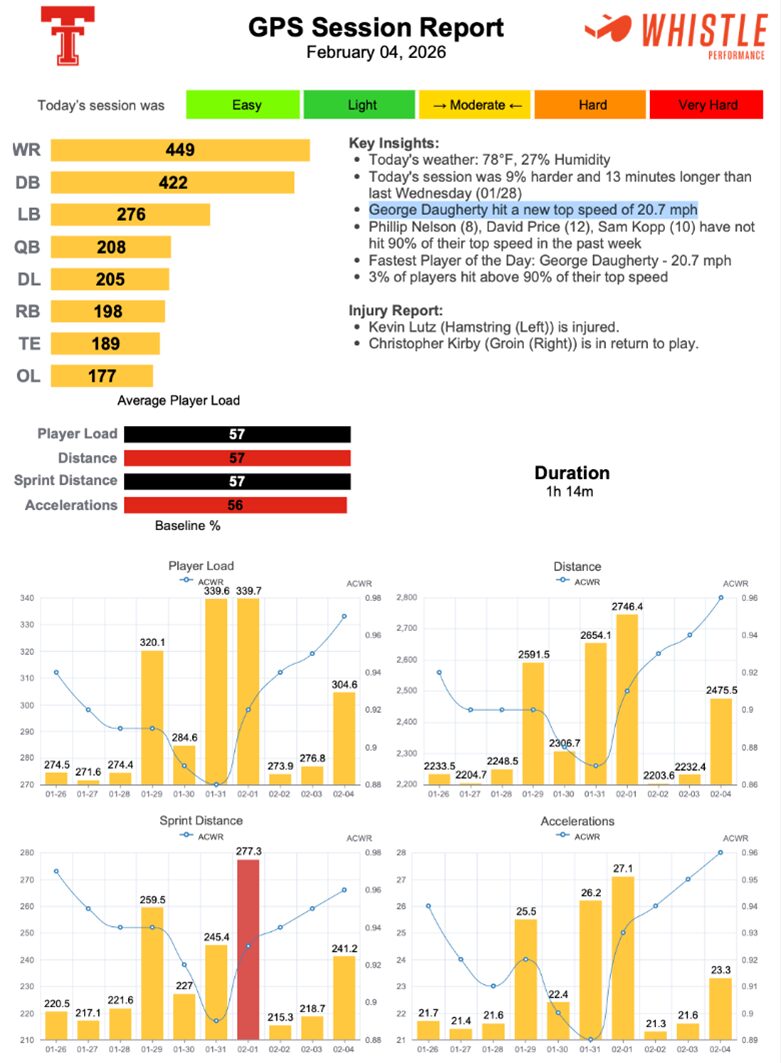
My biggest change usually comes after a game. Normally, we have athletes who hit a new top speed.
This is important to flag. High speed running is CNS driven. If the athlete sets a personal best, his CNS has fired faster than it ever has before in practice or competition. Therefore, I put the athlete in a recovery phase the next day. It may be anything from complete rest to some type of low active recovery modality: foam roll, stretch, or some hurdle mobility. He’ll then have a slow build up over the next couple of days.
The goal is to be ready for the next game, so the reps in practice and weight room are low at the start of the week and gradually build up to game day. All the while, we are monitoring his load and high speed running in practice. Too much stress on the athlete after this situation can lead to injury, such as improper coordination with the hamstring or hip flexor.
The overall goal for the season is to be fresh for every game. If we don’t attend to high CNS outputs, then the cumulative fatigue of the CNS will catch up. The athlete may end up with a lower body injury and miss games or part of the season.
Tweet ThisHigh speed running is CNS driven. If the athlete sets a personal best, his CNS has fired faster than it ever has before in practice or competition. Therefore, I put the athlete in a recovery phase the next day.
Aaron Uzzell
How do you design systems so that the time between collecting data and making a coaching intervention is short, clean, and repeatable across the staff?
Before signing on with Whistle Performance (formerly GPS DataViz), I relied heavily on Excel to track KPIs and monitor athletes. This was extremely time-consuming and required a significant understanding of Excel to build, manage, and update. It took quite a while to build the layout for the coaches by creating formulas, organizing datasheets, and manually compiling reports.
The process of uploading the GPS wearable, exporting to Excel, then inputting data into my Excel layout limited the immediate impact the data could have on daily decision-making and athlete management.
Delivering timely and actionable feedback to the coaching staff was challenging, and insights were sometimes shared well after practice had already concluded.
The goal was to generate a report that would be usable by the coaches. I wanted to be able to give the coaches something after practice to share with each other and the players.
GPS DataViz has completely transformed how we analyze, visualize, and communicate performance data. I can upload the GPS data and have a report within 90 seconds.
The platform allows me to quickly see the big picture while still maintaining access to detailed information, making it much easier to identify trends, manage workloads, and highlight key points that matter most to coaches.
Most importantly, it has significantly improved how we present data. Complex metrics come across in clear, visually engaging reports that are easy for the coaching staff to understand and apply. I can now deliver a comprehensive practice report to an individual coach or the entire staff immediately after practice for team and position meetings.
This has strengthened my relationship with coaches because it starts a conversation about the data. I can show that what we are doing is viable and beneficial for the team and individual athletes. The more consistently I can show coaches what is happening during practice and educate them on how to interpret and use the data, the more aligned everyone becomes in their approach to training, recovery, and performance.
Tweet ThisMost importantly, it has improved how we present data. Complex metrics come across in clear, visually engaging reports that are easy for the coaching staff to understand. I can now deliver a comprehensive practice report immediately after practice
Aaron Uzzell
How do you balance objective data with your coaching instincts when deciding whether an athlete needs more load, more speed, or more recovery on a given day?
Through 30 years of observing and evaluating daily practices, I have been able to balance objective data with firsthand experience to better understand how athletes respond to training. Understanding the loads and demands of sport helps a lot with this process, too.
This long term perspective allows me to recognize the differences in what an athlete with a higher training age can handle compared to a younger athlete or a new player entering the program.
Training age plays a critical role in how we should interpret and apply performance data. The same workload or stressor can have very different effects depending on an athlete’s background and level of physical preparedness.
Older, more experienced athletes generally have a greater capacity to tolerate higher intensities and volumes of training because they have adapted to years of progressive stress. Younger athletes, on the other hand, require a more gradual and intentional approach to development. They need a gradual build of load and intensity. I cannot impose the same level of physical or physiological stress on them as I would an older athlete without increasing the risk of injury.
For younger athletes, the focus is on building a strong foundation over time, allowing their bodies to adapt progressively as their training age increases.
The data from our EliteForm, Catapult, and VALD help guide this process. But data must fit into the coach’s understanding of the athlete’s experience, history, and individual needs.
By combining data with observational insight, coaches can make more informed decisions that support long term development rather than short term gains. This ensures that each athlete is trained appropriately, adapts safely to increasing demands, and continues to progress as their training age increases.
Tweet ThisBy combining data with observational insight, coaches can make more informed decisions that support long term development rather than short term gains. This ensures that each athlete is trained appropriately, adapting safely to increasing demands.
Aaron Uzzell
How are you integrating the use of AI into your daily monitoring systems at Texas Tech Uiversity?
Work ethic is and always has been key here at Texas Tech. But as we look toward the future of Texas Tech Athletics, we’re adding a layer of high-tech precision to that engine.
In the past, we were “data-rich but insight-poor.” We had GPS units, force plates, and heart rate monitors spitting out millions of numbers, but the manual analysis took hours. By the time we had an answer, it was too late. This is where AI is becoming integral to data insights. In using Whistle AI Chat, we are now able to formulate insights which bring us, as practitioners, to the answers.
Cutting out signal noise has been one way in which Whistle AI has streamlined gaining insights from our data. By isolating the key 10% of the signal that actually moves the needle, our coaches are able to make availability decisions, based upon objective data. This affords our best players to remain on the field because we managed their load with precision.
For my teams, this is a force multiplier. While we still rely on our “gut feelings” we are embracing objective, automated, and predictive insights. It allows us to spend less time behind a spreadsheet and more time where we belong—on the floor with the athletes, coaching the movement and building the person.
At the end of the day, it’s all about the student-athlete and by integrating Whistle AI to give them an advantage, we help them operate at their best while avoiding risk of injury. We’re using this tech to keep them healthy, keep them fast, and ensure they’re peaking on game days.
With the emergence of AI we can efficiently monitor data on a day-to-day basis, aiding decision making around when to push an athlete on and when to pump the breaks.
Tweet ThisWhistle AI has streamlined gaining insights from our data by isolating the key 10% of the signal that actually moves the needle, our coaches are able to make availability decisions, based upon objective data.
Aaron Uzzell