Coding in sport has become quite a polarizing subject. For some practitioners it is a source of creativity. For some, absolute confusion; and others, it’s almost complete hatred. There are S&C coaches who will verbally abuse anyone that speaks “coding” in their presence. At the other extreme, some sport scientists are so far down the analytics rabbit holethat nobody is even sure they are speaking their first, second or third language anymore. And, for the most part, these debates and silent feuds leave the physios and physical therapists on the outside looking in (which they may be happy or relieved about).
Having taken up coding at 50 years old, with years of “traditional” sport performance work behind me, I like to think I can bring down the temperature a bit.
As always, let’s start with resolving some confusion about what’s what. Coding is neither the answer to everything, as its fiercest advocates will tell you, nor is it the devil that its critics fear letting in the door. Like most analytic or productive tools at our disposal, it’s a method to answer complex questions; to perform tasks, particularly repetitive ones, quite quickly; a way for us to share our work; a way for us to understand our own work, and the work of others.
And it is not a job requirement for every practitioner in sport, but it is very important.
Any new technology is by definition disruptive. While coding is not new, it’s new enough in sport to still seem like a threat to how practitioners work and what they know. That can often translate into a perceived threat to practitioners’ jobs. Let’s take a look at how coding, and the data analysis it powers, can be an advantage to individual practitioners as well as sports organizations.
Tweet ThisCoding is neither the answer to everything, as its fiercest advocates will tell you, nor is it the devil that its critics fear letting in the door
@JasonAWeber
Can this technology help me do my job better?
That’s the basic question, isn’t it? It’s one that we’ve probably all answered many times in our careers, when we come across a new product or some vendor walks through our door.
Think of GPS or bar speed technology (e.g., Gym Aware). When these hit the sports market in the mid-2000s, there were no legacy technologies to compare them against, nor supporting research nor even blog articles to tell practitioners what to do with them. But early adopters did what early adopters do, and over time both became standard issue in sports. While you’ll still encounter coaches and other practitioners who choose not to use GPS, bar speed or some other now-common tech, they’re the exceptions to the rule.
The early adopters of coding in sport performance have already pushed the technology and the practice up the adoption curve. Two simple indicators of how far along we’ve moved are the number of Sportsmith articles on different “how to” aspects of coding, and the number of practitioners who have built brands or businesses around it (myself included).
We often hear people say that “the most important ability is availability” when talking about players. When it comes to practitioners, one of the most important abilities is adaptability. It’s certainly a key to longevity in a profession known for high turnover and short careers.
Tweet ThisAny new technology is by definition disruptive. While coding is not new, it’s new enough in sport to still seem like a threat to how practitioners work and what they know
@JasonAWeber
Coding across the training ground: Benefits for each role
Here are some guidelines for a range of sports performance practitioners to adapt coding into your professional career paths.
Strength & conditioning coaches
The strength & conditioning field relies heavily on coaches sharing knowledge amongst themselves. While I value and support the development of underlying academic knowledge, let’s be realistic: 99% of what good coaches know, they’ve learned from other coaches.
That said, our environment has become more complex, and technologies like GPS and bar speed systems can help us do our job better.
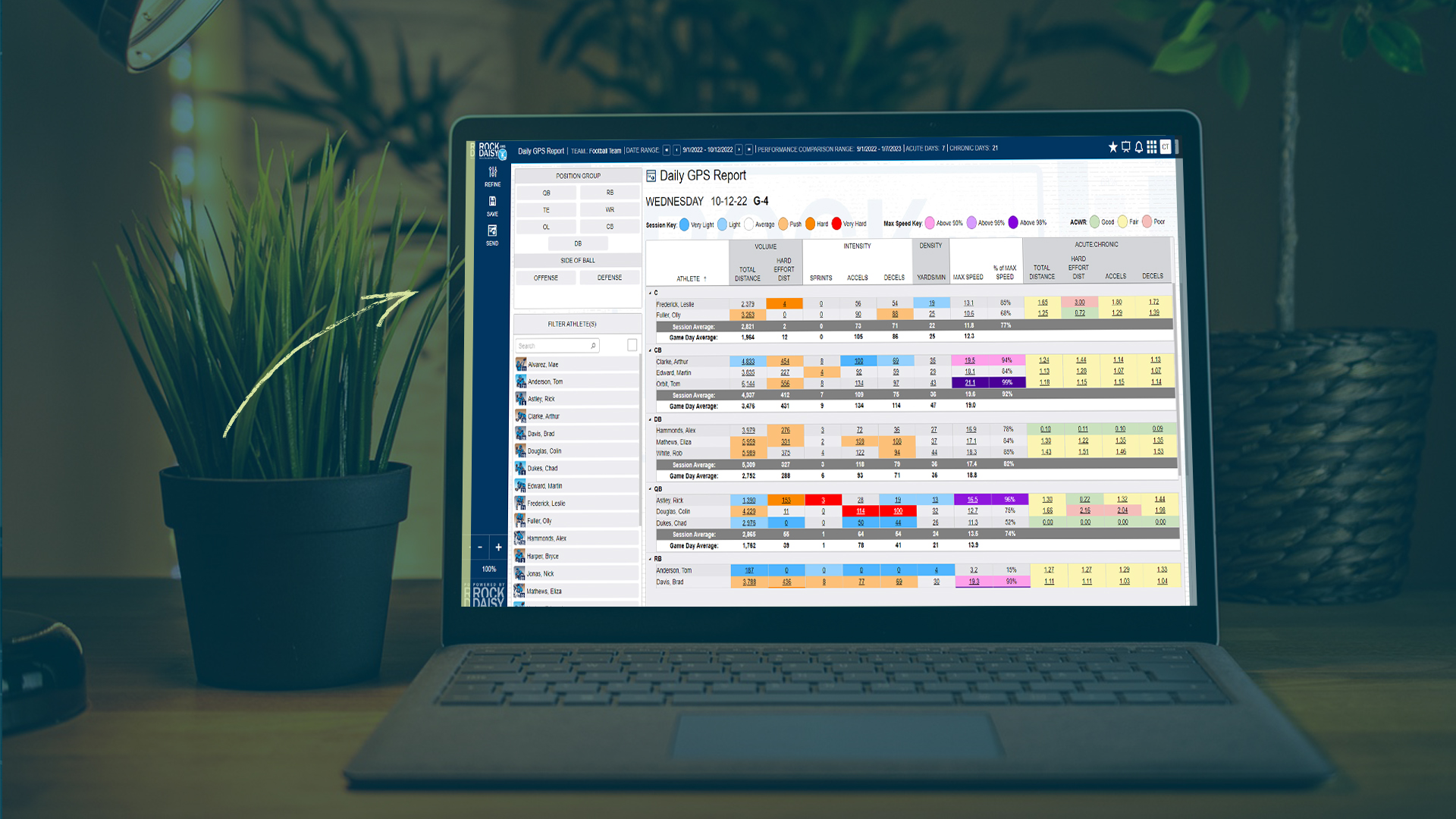
But managing the data streams from these devices has become a challenge in and of itself. Trying to get your head around how they all relate and or work together to contribute to performance, injury prevention or rehabilitation can mask the utility of these devices and the value that justifies their price tags.
This is where coding comes in. Knowing how to clean, structure and manipulate the data, at scale and in short amounts of time, enables us to apply validated or cutting edge data science techniques to understand how lifting volumes, seasonal structures or running programs contribute to overall performance.
For example, an S&C coach is planning a preseason lower body power phase aimed at sprint accelerations in training and games. The endpoint dependent variable is the number of high threshold accelerations each player performs per session or game. For now, we’ll leave off all the other things a non-hypothetical S&C coach would care about, like running volume.
The first step is determining optimal load for peak power in jump squats; 1RM squat; force-velocity profiles in sprinting; and 10m and 20m sprint times.
The coach could take care of most of this with Excel, with the amount of time it would take depending on the size of your squad, e.g., tasks like athlete-by-athlete calculations of force-velocity, and copy-pasting data from one sheet to another.
But the overall question regarding the impact of the program on the volume of high threshold accelerations would be very tough to answer with Excel alone.
Doing the same work with R or Python – though not as immediately familiar and comfortable as Excel – could answer the question relatively easily. One of several machine learning packages, like Tidymodels in R, will identify how increases in performance in the input variables – jump squat, 1RM, speed – influence the volume of accelerations. These models are not static. You can easily evolve your workflow over time as you validate and refine the model’s output based on what you are seeing in training. This increases the model’s value to you and the players, improving them athletically while improving your methods as a coach.
The big payoff – the eye opener – is if your data analysis reveals that the training intervention you thought was mission critical may, in fact, have quite a low effect on the target performance variable.
Now you can make a real impact on player performance, one that would have been out of reach in Excel.
S&C coaches working in a multidisciplinary team have the option to bring the sport scientist on board with this plan so they can do the coding in your stead. If you go that route, don’t just hand it off. Be part of the process. Understand the question you are trying to answer and the mechanisms by which it might answered.
The better option is to learn to code and do it yourself. That’s the only option if you are one of the many solo performance teams out there. For those coaches, coding skills are critical. Not only can it increase output and efficiency, especially by automatizing repetitive tasks like daily training reports, but it’s a set of skills that can be scaled up when opportunities in an MDT environment become available.
Being able to code also allows the solo operators to avoid the costs – and the temptation to pay the costs – of athlete monitoring systems.
Practitioners comfortable in R or Python can build and maintain their own systems for monitoring their athletes, which is invaluable when it’s all your time and money.
It remains a powerful use case even when your team or institution has the luxury of a big data aggregator system. Those platforms are limited to what is built in. If you want something different, you have to talk to your account rep or system admin, they’ll pull together a timeline and a budget… in that amount of time, you could have already sorted out your own ideas around fatigue and fitness decay rates, data fusion models (bringing multiple streams of data into a single workflow) and individual loading models. Compare the amount you would learn about your athletes and your data from undertaking this process to what you would get from having a ready-made application handed to you.
You don’t need to code to be a good S&C coach, but you need to understand the massive assist it can offer you. As Jace Delaney wrote, “the idea that I don’t need spreadsheets to coach, or the coach’s eye is always superior, is outdated and naive.”
Tweet Thishe early adopters of coding in sport performance have already pushed the technology and the practice up the adoption curve
@JasonAWeber
Physios and the sports med team
This group of practitioners are in much the same situation as S&C coaches. They don’t need to rush off and learn to code, but they should know enough to be able to work with sport science staff and answer critical questions relevant to their role in athlete performance.
Staying with the example of the program to increase the number of high threshold accelerations, it makes sense to consider that this project will have some significant implications for injury prevention. The S&C coach should present this plan to the multidisciplinary team, so the physio can ask questions like:
- Does a previous hamstring injury change an athlete’s starting performance level?
- Does a previous hamstring injury impact an athlete’s capacity to adapt to the program?
- Does the magnitude of change in performance have any protective effect on the group?
These questions don’t require any additional data from the training sessions. They only require another classification variable for the athletes, e.g., 0 or 1 for “no prior hamstring injury” or “prior hamstring injury” for the first two questions; and 0 or 1 as outcome variables for an injury during the season. These two columns could spur the physio to analyze whether there are clusters of players for whom the MDT can expect differential outcomes. That’s a related but distinct analytical project from what the S&C coach is doing with the same data.
Realistically, if an S&C coach and a physio are working this closely together, there will be a sport scientist in the organization managing the full scope of the coding project. But if not, the physio should have the ability to do this, if for no other reason than the career advancement / professional development aspect I talked about for the S&C coach.
Department head
Management positions in an MDT are an extension of the positions within the MDT. Department heads or, in my least preferred term, heads of performance don’t need to rush off to coding school. But it’s imperative for leaders to understand what their staff is capable of, what they require and what they are doing. Department heads do not need to know how to code, but they need to understand the principles of science and statistics so they can guide mission critical evaluations within the department – all things they would know if they learned to code at some point in their careers.
The department head needs to be able to assess the goals, risks, benefits and KPIs of our project to increase acceleration volume. Their biggest contribution could be ensuring that the data doesn’t remain in any one or two silos.
Department heads need the global perspective to intervene as necessary, especially if the individual practitioners get too head-down in their own rabbit holes. The department head can make more connections across a department, bringing in perspectives and expertise that the S&C coach, physio and sport scientist may not have thought about or known of. And they can identify gaps in technology, knowledge or personnel, helping you smooth the process of getting them to sign off on continuing education, attending conferences, making new purchases and even hiring additional staff.
Tweet ThisWhen it comes to practitioners, one of the most important abilities is adaptability. It’s certainly a key to longevity in a profession known for high turnover and short careers
@JasonAWeber
Sport scientists
For everyone else, coding skills are a good idea and a nice-to-have. For sport scientists, yes, unequivocally, they need to know how to code. Specifically, they need to understand coding and statistics to a sufficient level that they can do the heavy scientific lifting associated with questions from S&C coaches, physios or department heads.
Our acceleration volume project could be a fun challenge for the S&C coach and physio, but it is simply bread and butter for a sports scientist.
More than just the R or Python skills, a good sport scientist should be able to listen to the S&C coach, understand what she/he is trying to achieve, and help them design a data acquisition methodology that fits the training model and feeds an analytic process to describe the critical features they have questions about.
Beyond data cleaning, processing, and running statistics, sport scientists should also be well versed in visualisations. The days of just plotting a bar graph are gone. In today’s environment, we often encounter high dimension data that need to be reduced to limit collinearity and then presented in a way that displays 4-5 key features through aesthetics such as colour, size, shape and axis. An interactive plot from a package like Plotly goes one step further by allowing the audience to interact with the output, which can greatly increase buy in.
Machine learning models may be of high value to answering questions from the MDT, but sport scientists cannot let machine learning become the new black box algorithms. Sport scientists need to be able to explain the model, not just build it, run it and send out the results. R and Python both have great tools for explaining machine learning models, such as ModelStudio.
Whatever tool you use, the ability of the sports scientist to explain the analysis in simple terms is central to success.
Tweet ThisSport scientists unequivocally need to know how to code. They should understand coding and statistics to a level that enables them to do the heavy scientific lifting associated with performance questions
@JasonAWeber
Coaching means coding
Looking ahead, as time goes on we will see the sport scientist more as a “business intelligence” analyst. They’ll sit a bit apart from the day to day operations and provide a live, objective view of what the team is and is not achieving.
Coding and advanced statistical skills are just about a must have for sports performance practitioners. If only a few members of a multidisciplinary team have some coding skills, they will be the ones pulling the threads.