Fast bowlers account for 41% of time-loss injuries in cricket, despite comprising less than a quarter of most squads [1]. The impact is significant—missed games, delayed development, and stalled careers.
Most follow predictable patterns: too much too soon, too little preparation, or too little progression in workload. The good news is that these risks can be mitigated. But doing so requires systems that build strong, anti-fragile fast bowlers, and manages workload with clarity. What this means on Monday: give every fast bowler a weekly ball budget, progress it steadily, and coach the one or two attractors that keep the spine safe under load.
Whether you’re working with juniors, emerging professionals, or elite players, these strategies work because they’re built around the specific pathogenesis and aetiology of fast bowling injury.
Tweet ThisFast bowlers account for 41% of time-loss injuries in cricket, despite comprising less than a quarter of most squads. The impact is significant—missed games, delayed development, and stalled careers.
@nathankiely_
What breaks fast bowlers?
Fast bowlers experience 18.2 injuries per 1,000 fast bowling player days, with match availability dropping as low as 55-60% in some seasons [1]. Among adolescent fast bowlers, 65% show at least one stress-related lumbar spine abnormality on MRI [2]. These overuse injuries, particularly to the lumbar spine, carry significant time-loss burdens. Clinical recovery timelines frequently extend up to six months depending on injury severity and return to play protocols.
Soft tissue injuries—hamstring, groin, and side strains, and tendinopathies—are also frequent. These disrupt preparation and performance, particularly when recurring or mismanaged. That shifts our bias toward steadily progressing exposure to chronic bowling load, and developing the physical qualities that enhance trunk control under fatigue.
Kinetics, kinematics, and cumulative load of fast bowling
Elite bowlers often deliver 200-400 balls per week; junior and academy bowlers regularly range between 120 and 140. Each delivery combines high speed running, abrupt ground reaction forces (GRFs), high velocity trunk rotation, and rapid arm circumduction. All of these place extreme demands on the body.
Injury risk isn’t incidental; it’s embedded in the nature of the task.
At front foot contact (FFC), fast bowlers experience vertical GRFs up to 9.5 times bodyweight within 0.05s [3, 4]. Musculoskeletal modelling suggests approximately 5x bodyweight compressive load at the lumbar spine, a critical biomechanical collision point of force transfer.
Even small spikes in load matter. As mechanics degrade, tissue stress rises sharply. This is the bridge between biomechanics and loading prescriptions. Crucially, these changes don’t always show up as lost speed or accuracy in the short term. Bowlers often compensate to maintain performance, but the hidden cost is elevated stress on vulnerable tissues.
The braced front leg technique—keeping the knee extended at FFC and ball release—is a common trait in faster bowlers, as it allows momentum from the run-up to be redirected through the kinetic chain into the ball [6]. But this comes at a mechanical cost. Braced bowlers show higher lumbo-pelvic shear forces, further amplifying stress [7].
At ball release, the trunk simultaneously undergoes flexion, rotation, and lateral flexion under compression—an inherently risky combination. Fast bowlers with a history of lumbar stress injury exhibited excessive lateral trunk flexion in their bowling action.
Pillars of physical preparation
Monitoring load is only meaningful if the athlete has the physical capacity to tolerate it. A well-structured strength & conditioning program is the first line of defence as well as a performance enhancer.
Fast bowlers should aim to build a well-rounded foundation of athleticism across a range of physical qualities.
Strength and power development
The fast bowling action imposes extreme demands on the legs, trunk, and shoulder. Bowlers need eccentric strength and isometric control. Quad, glute, hamstring, abdominal, pectoral, and latissimus strength enables trunk control and safe deceleration.
| Exercise | Prescription | Notes |
| GHD side hold with plate punch | 2-3 x 6-8 each side | Punch hold |
| Dumbbell lateral trunk flexion | 2-3 x 6-8 each side | Hand on head, stretch and crunch |
| GHD side hold with overhead reach | 2-3 x 6-8 each side | Long reach |
| Side lying side bends | 2-3 x 8-12 each side | Touch hip on ground |
Hip and thoracic mobility
Excessive trunk flexion often compensates for poor hip or thoracic mobility. Reduced thoracic rotation increases lateral trunk flexion velocity. Mobility interventions targeting the hips and thoracic spine can reduce compensatory spinal load.
| Exercise | Prescription | Notes |
| Wall T-spine trace the sun | 2 x 6 each side | Hip-shoulder disassociation |
| Cable sling press | 2-3 x 6-8 each side | Same arm, same leg: lock down hips |
| Hip 90/90 | 2-3 x 6-8 each side | Progress from hand support to no support to hands OH |
| Wall hurdle spindle | 2-3 x 8-12 each side | Reach high on stance side |
Running capabilities and capacity
Ninety percent of fast bowling is running. Every delivery is preceded by a run-up that can exceed 6.5 m/s, and bowlers may cover more than 22 km in a single day [4, 10]. Yet running technique is often overlooked.
Poor sprint running mechanics—primarily a function of lumbo-pelvic control—increase injury risk [11–13]. Improving technique reduces cumulative loading and enhances efficiency. Sprint exposure also matters, as regular bouts of ≥95% maximum velocity sprinting offer a “vaccine” against soft tissue injury for field sport athletes.
Finally, conditioning should address both anaerobic capacity and aerobic power. These qualities reduce fatigue related technique breakdown and support recovery between spells.
| Benchmarks | 1600m (mm:ss) |
| Elite | <5:40 |
| Competent | 5:40-6:20 |
| Limited | >6:20 |
| Benchmarks | 20m (s) | 40m (s) | Max velocity (m/s) |
| Elite | <2.95 | <5.15 | >9.40 |
| Competent | 2.95-3.10 | 5.15-5.40 | 9.00-9.40 |
| Limited | >3.10 | >5.40 | <9.00 |
| Benchmarks | Back squat 1RM (xBW) | Bench press 1RM (xBW) | Chin up 1RM (xBW) |
| Elite | >2.00 | >1.50 | >0.5 |
| Competent | 1.50-2.00 | 1.20-1.50 | 0.20-0.50 |
| Limited | <1.50 | <1.20 | <0.20 |
Tweet ThisImproving sprint technique reduces cumulative loading and enhances efficiency. Sprint exposure also matters, as regular bouts of ≥95% maximum velocity sprinting offers a “vaccine” against soft tissue injury for field sport athletes.
@nathankiely_
Technical solutions to load-related problems
Biomechanical researchers have long sought to identify technical risk factors for injury, and coaches often tried to “fix” technique as a first line of defence.
One of the earliest and most influential targets was the “mixed action”, where misalignment of the shoulders and hips created excessive spinal rotation and torsional stress. Seminal studies showed that mixed actions carried higher rates of lumbar spine abnormalities and injuries compared to side-on or front-on actions [15, 16]. MRI work confirmed a greater prevalence of pars interarticularis abnormalities—the precursor to stress fractures—in these bowlers [15]. This evidence heavily shaped coaching for the next two decades, with a strong push to “clean up” mixed actions in youth bowlers.
More recent work has shifted away from action labels toward kinematic faults that increase spine loading, regardless of style. Chief among these is excessive lateral trunk flexion at release, which pushes the spine into the elastic zone of motion under compression [8].
Bowlers unable to organise a stable hip-lock attractor—presenting with anterior pelvic tilt, lumbopelvic extension, and ipsilateral pelvic drop at front foot contact—were significantly more likely to sustain lumbar bone stress injury [17]. These hazardous patterns often appear under fatigue, as lower limb power declines and athletes compensate to preserve performance, reinforcing the connection between physical preparation and technical control [7, 18].
This paradox—stable output masking deteriorating mechanics—explains why injury risk escalates even when performance appears unaffected.
Despite clear biomechanical links, technique change is rarely straightforward. Altering an action creates new loading patterns for tissues long adapted to the old demands, and even technically “better” movements can be riskier if the body hasn’t had time to adapt.
Adult bowlers improved shoulder alignment and counter-rotation, but not enough to leave the high risk category (>30°) [19, 20]. Trunk lateral flexion remained resistant to change even after two years of targeted coaching in England’s elite fast bowling group. In contrast, U17 bowlers could make significant positive kinematic changes with structured coaching, removing them from high risk categories altogether [21].
This aligns with motor learning theory: skills are far more malleable before coordination stabilises [22].
The takeaway is simple: don’t try to cue and constrain your way out of poor physical preparation. Technical change is possible, but it’s slow, difficult, often incomplete, and can backfire if physical deficits remain unresolved.
Workload management: Less is not more
Fast bowling workload management has a complicated and controversial history. Fans, ex-players, media and coaches are all provoked by the mere idea of fast bowlers being “rested.”
Contemporary workload management is not about pulling bowlers out of big matches. It’s about helping them stay in the game. Most importantly, the art and science itself has evolved significantly. The field has matured and today we’re more athlete-centred, data-informed, and collaborative than ever before. Now, we err toward letting players play—and assist this by adjusting training to balance total loading. Sports science serves to support the program, not run it.
To understand the progress, we need a baseline.
In the 1986-87 Sheffield Shield season, 38% of fast bowlers sustained a time-loss injury [16]. At the time, injury surveillance was rudimentary, S&C minimal, and workloads unmonitored. In contrast, during my tenure at Cricket New South Wales, our highest risk cohort (academy fast bowlers) had an injury prevalence of 11.8-16.9%, demonstrating a significant improvement in player availability.
Modern workload management doesn’t just reduce injury. It enables long term skill acquisition, providing a more consistent environment to develop the art of fast bowling. In previous generations, players with repeated injuries often dropped out of elite programs or retired altogether.
Today, athletes like Pat Cummins—who missed six years of test cricket due to injury—have returned from their injury troubles to perform consistently at the highest level, supported by smarter programming, advancements in sports medicine, data-led return to play decisions, and load monitoring that prioritise robustness over short-term performance.
Injuries still happen, and we’ll never prevent them entirely. But we’ve become much better at managing them: mitigating risk, and reducing severity, recurrence, and long term impact.
Monitoring workload
Forget GPS and IMUs for a moment. In most settings—even elite ones—the best indicator of bowling load is still ball count. Alternative measures like session RPE (sRPE) and GPS-derived ball counts are valuable in broader athlete monitoring, but can be far more cumbersome or expensive to collect. In fact, McNamara [23] even showed that bowling volume has a more direct association with injury than other GPS workload variables.
You don’t need an athlete management system—Excel and WhatsApp are enough. The key is ownership: athletes log data, coaches review weekly, and staff intervene in response to spikes or lows.
Teams with more resources may consider web-based dashboards that automate visualisations of weekly rolling loads. But the core principle is the same: measure what matters and review it often.
ACWR is simple but effective
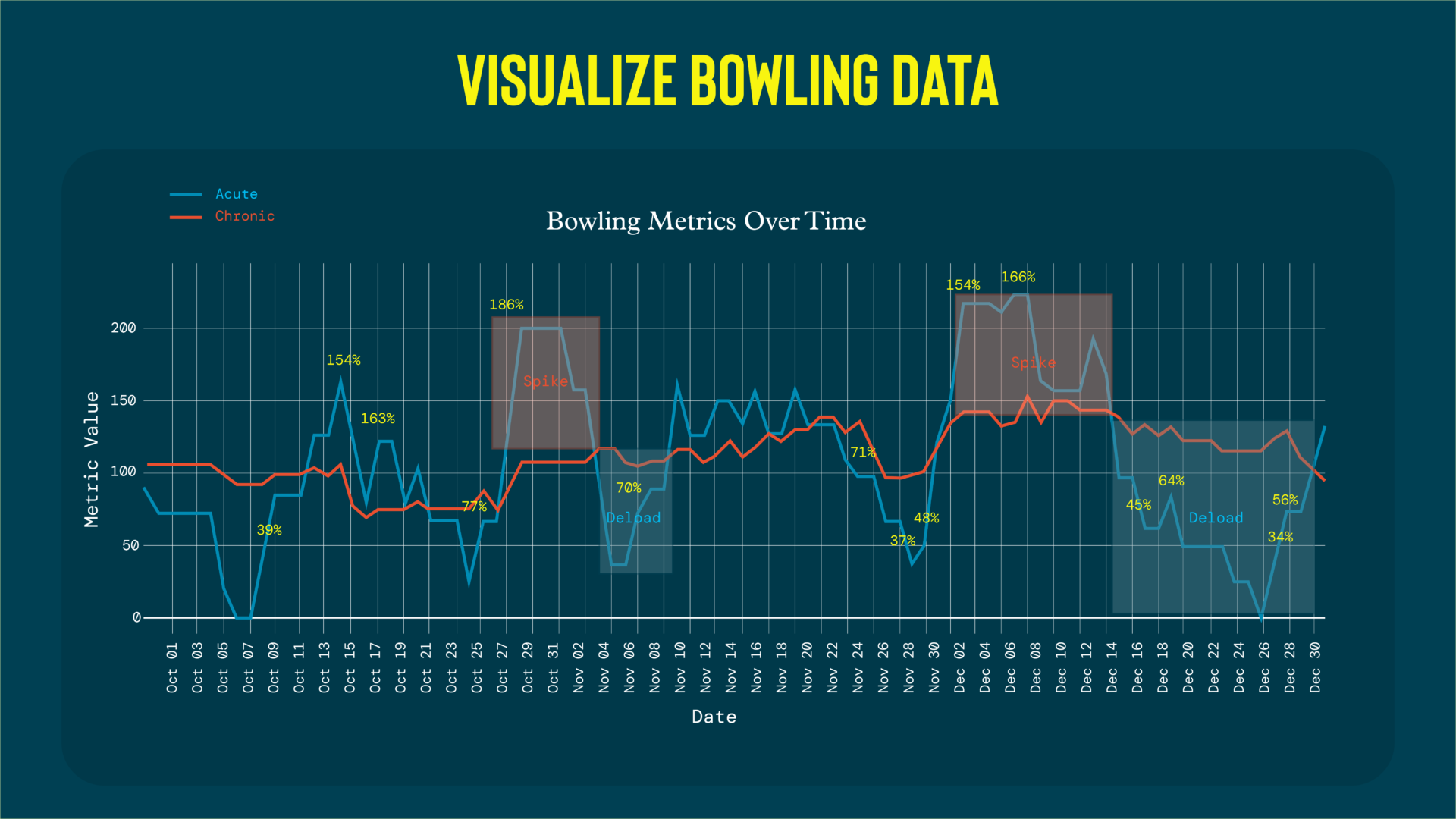
The pragmatic principles of load monitoring are acute and chronic workloads: how many balls bowled over the last seven days (acute) and the average number per week over the last 28 days (chronic). The Acute: Chronic Workload Ratio (ACWR), then, is acute workload divided by chronic workload.
ACWR gives context to how sharp a recent increase or decrease in workload is, relative to what the athlete has been conditioned for. Despite continuing debate, it is one of the most practical tools available to staff.
The “sweet spot” tends to be between 0.8 and 1.3, where athletes are loaded enough to maintain adaptation, but not so much that fatigue outweighs fitness or detraining occurs [24].
Outside this range, compensation strategies may keep bowling performance steady in the short term, but they accelerate mechanical breakdown and drive injury risk upwards. That’s exactly why simple load tools—ball counts, 7- and 28-day rolling loads, and ACWR—earn their keep: outputs can look stable while compensations quietly raise tissue stress, and these tools surface that hidden risk before it shows up as pain or missed games.
Fast bowlers with an ACWR >2.00 were 4.5 times more likely to sustain a time-loss injury than bowlers within the moderate range (0.50–0.99). Athletes with high chronic loads have lower likelihood of exposure to spikes due to a larger workload capacity buffer. In contrast, bowlers with low chronic workloads are vulnerable to even relatively small weekly increases. And while high chronic loads build resilience, consistently exceeding 188 balls/week for more than three months also increases injury risk, demonstrating that there may be physiological limitations to fast bowling exposure [26].
Some of the criticisms of ACWR include physiological oversimplification, mathematical issues, and contextual misuse.
These hold that the ACWR assumes a linear relationship between load and injury, and misrepresents concepts like fatigue and readiness. ACWR values can be unstable with low or irregular data; they lack predictive validity; and rely on arbitrary thresholds. Finally, ACWR is often used post hoc, and overemphasized without considering multifactorial injury risk.
These critiques are important and highlight the need to interpret ACWR in context, not in isolation. But for many cricket environments, ACWR remains a pragmatic tool. It allows us to track changes, guide return to play progression, and communicate objective thresholds.
All models are wrong, but some are useful. When it comes to making training load decisions in a chaotic environment, ACWR remains easy to interpret and offers actionable insights in real time.
Tweet ThisThe pragmatic principles of load monitoring are acute and chronic workloads: how many balls bowled over the last seven days (acute) and the average number per week over the last 28 days (chronic). The ACWR can then be calculated.
@nathankiely_
Bones, biology and bowling loads
Younger bowlers are still growing, but more importantly, their bones are still hardening. Cortical bone—the dense outer shell responsible for structural strength—continues to mineralise into the mid- to late 20s [28]. That makes the skeletal system particularly vulnerable during adolescence.
This risk compounds when power increases suddenly during puberty. Talented bowlers are fast tracked into multiple squads—school, club, academy, state—and often overloaded. The system rarely means to break them, but without coordinated oversight, it often does. MRI studies show radiological changes in the pars interarticularis in up to 65% of junior bowlers [2]. Structural damage frequently precedes the onset of symptoms, meaning we can’t rely on how the players feel [29].
This reinforces a hard truth: young bowlers often need to be protected from themselves. Workload targets must reflect biological maturity, not just competition level.
| Age / level | Weekly ball target (chronic load) |
| U17s | 100–120 balls |
| U19s | 120–140 balls |
| Senior premier | 140–160 balls |
| Elite professionals | 160–200 balls |
Match balls matter most—the game is the best teacher. Start with match demands, then work backwards to determine what volume of training deliveries a bowler can safely handle that week.
The 1-3-5 and 2-4-6 heuristics
To manage risk in bowlers, Cricket Australia adopted two evidence-backed workload frameworks. Bowling on consecutive days increased injury risk 2.4x, and frequent bowling by under-prepared athletes raised their risk [25, 26]. Spells longer than 5-6 overs increased technical breakdown, especially in lumbopelvic control [18].
First is the 1-3-5 for U17s and below. No more than one day of bowling in a row, no more than three bowling days in a week, and no more than five overs in a spell.
For U19s and above, it’s the 2-4-6. No more than two days of bowling in a row, no more than four bowling days per week, and maximum six overs in a spell.
These heuristics scale load based on training age and bone maturity. Adult bowlers tolerate higher frequency and volume, but only with appropriate chronic loading and recovery.
These guidelines are specifically for the prescription of training. Occasional exceptions to these rules are expected. I recommend counting balls bowled above 80% of subjective intensity for the purposes of load monitoring.
The goal isn’t less bowling—it’s the right bowling.
Resilience, not reduction
Too often, workload management is misunderstood as a strategy for reducing bowling. The goal is bowling-specific anti-fragility: delivering enough volume for adaptation without exceeding what the body can handle.
Consistent bowling is protective. Infrequent, high volume spikes are dangerous. Building chronic load is a buffer against injury.
You don’t need GPS—just a system. A minimum viable monitoring system includes:
- WhatsApp group where bowlers log their daily ball counts
- shared spreadsheet that auto-calculates acute and chronic loads and ACWR
- 2-minute pre-session toolbox meeting with athletes and staff
- dashboard or printout in the fast bowler’s WhatsApp group or change room with each bowler’s current loading parameters
Not every spike breaks a bowler, but every spike warrants a considered response. Injury risk can lag by 3-4 weeks post-spike, so early intervention is key [30].
When a spike occurs, start by assessing the context. Was it expected or planned? How has the player pulled up? Do we need to change the upcoming schedule, or can we stay the course?
Prioritise recovery with pool, mobility, massage, or off-feet flush work. Adjust their training focus, e.g., keep it short and get a quality strength session in. Then reassess fixture importance and consider capping load, if appropriate.
Most importantly, plan forward. Build chronic load gradually to avoid spikes in the first place.
When a spike becomes a stop (injury), the rebuild begins. Return to play is a separate discipline, but key principles apply.
For every week off, expect 2-3 weeks to rebuild previous load. Intensity matters more than volume; early-stage bowling at 60% effort can allow higher volumes without overload. Cricket Australia recommends 6-8 weeks of progressive bowling before a season, especially for youth athletes, and these guidelines are a useful template for RTP. Maintaining partial exposure—such as run-throughs or off-feet conditioning—can preserve key adaptations.
Overuse injuries require careful progression, with return guided by symptoms and functional readiness. The goal remains the same: stay as close to bowling as safely possible and rebuild with care.
Tweet ThisFor every week off, expect 2-3 weeks to rebuild the previous load. Intensity matters more than volume; early-stage bowling at 60% effort can allow higher volumes without overload.
@nathankiely_
Case study 1: Rookie with bone stress history
A 23-year-old rookie fast bowler with a 120 ball / week chronic load and prior bone stress injury presents with an ACWR of 180%. Scheduled to bowl 60 balls in a 50-over match next week, we’re left with 60 balls for training. But given the elevated spike risk, we’ll deload, reducing the training load to 36 balls. This may be consolidated into a single session, preserving other days for S&C and recovery.
This not only manages total load but reinforces the match as the performance anchor.
Case study 2: Resilient senior pro
A 30-year-old elite fast bowler, historically resilient to high chronic loads, is returning from a broken finger. With current chronic load at 90 balls / week and ACWR at 240%, he’ll play the full test series, but we will minimise training loads and prioritise recovery outside of matches.
With mature bone structure and a long term loading history, this player has a far higher risk tolerance—performance is our priority.
High chronic workloads reduce injury risk
High chronic loads, if achieved in a progressive manner, are protective, rather than risky, for preventing injury [24]. Bowlers who have developed consistent loading have built resilience through tissue adaptation to repeated stress.
This is why workload management isn’t about “resting” bowlers or reducing exposure. It’s about ensuring they bowl regularly within the bounds of what they are trained for.
This is why I suggest bowling year-round, taking one deload week (ACWR < 0.8) in every four weeks, and one week off bowling every 10-12 weeks.
Most issues arise when trying to build fast bowlers back up from a base of zero, so never stray too far away from being match ready.
Tweet ThisHigh chronic loads, if achieved in a progressive manner, are protective, rather than risky, for preventing injury. Bowlers who have developed consistent loading have built resilience through tissue adaptation to repeated stress.
@nathankiely_
Taking ownership of load management
A monitoring system is only useful if it’s used—and respected. That requires education.
Successful environments let athletes track their own volume and trends; share research on ACWR, injury risk, and performance; use terms like “acute load” and “spike” daily; and integrate reviews into weekly planning and conversation. This prepares players for the real demands of the game.

After all that, we have to keep in mind that the art of coaching still matters. The best coaches know when to trust the data and when to trust the athletes.
If we plan for 36 balls in a session, but the bowler feels good and wants to bowl an extra over or two to fine tune their rhythm, let them. Strict compliance isn’t the goal. In elite environments, somedays we break our own rules. Sometimes we bowl three days in a row. Sometimes we bend the model to serve the athlete, the coach, and the team—not the other way around.
Tweet ThisSuccessful environments let athletes track their own volume and trends; share research on ACWR, injury risk, and performance; use terms like “acute load” and “spike” daily; and integrate reviews into weekly planning and conversation.
@nathankiely_