Velocity based training (VBT) is a well established part of S&C. While it may seem like we may know all there is to know, there are still many areas yet to be explored and implemented.
VBT’s most common use is developing athletes’ ability to express force rapidly. But this is just the start, and as VBT equipment becomes more available and affordable in weight rooms, we will see coaches maximize its effectiveness. This article is about one “non-traditional” use of VBT: athlete preparation on the day before and day of games.
Tweet ThisVBT’s most common use is developing athletes’ ability to express force rapidly. But this is just the start.
Tim Crowley
Matching VBT technology to your needs and uses
There are three basic types of VBT units on the market. First are accelerometers, a small unit attached to the bar that determines bar speed. The Bar Sensei is a good example of this type of unit. Next are transducers. These are placed on the ground with a string or cord connected to the bar to determine velocity. Tendo and OVR are two popular devices that use this technology. Finally, 3-D cameras are up and out of the way on the rack. The camera detects bar speed or head movement for jumping type activities, which is converted into velocity and displayed on an iPad. Examples are Perch and Elite Form.
My experience with VBT began several years ago with a few Bar Sensei units. We rolled out our VBT system slowly, adding elements each week so that the coaches and athletes could adapt without it interfering with the training process. This allowed the strength staff to seamlessly build their skill levels while developing confidence and buy-in from athletes and team coaches.
The accelerometers provided good data, but we found it difficult to implement and scale across teams efficiently.
Some teams train twice a week for as little as 30 minutes, so our ability to be consistent and efficient is critical. The athletes in our program range in training age from those who have never trained in a weight room to high level collegiate and pro prospects.
After a year of research, we knew we needed a device that would not interfere with our coaching and could produce immediate feedback and provide a lot of data for analysis and insights. We switched from accelerometers to a camera-based system from Perch, with units on all our racks. This has been a game changer for our program and athletes as it allows us to become better coaches and collect relevant data.
Regardless of the athletic level and training age of our student athletes, or the technology involved, VBT requires maximal intent on the concentric phase of each movement. Intent improves the accuracy of the data, and the clarity of each athlete’s progression. When every rep of every set of every workout is done with maximal intent, we see dramatic improvements.We’ve built a weight room velocity around this: intent matters.
This is hardly a new concept, but visual and audible feedback on every rep drives home this concept and makes it “real” for the athletes.
The goals of our strength & conditioning program are simple:
- Keep athletes healthy in practice and available for competition.
- Teach them skills they’re going to need to be successful in the weight room at the collegiate and professional levels.
- Improve performance, more specifically, strength, speed, and power
Given the number of teams that we train in the course of a week, adjusting the training schedules based upon game schedules is often not possible. At the high school or developmental levels, training consistency might be the most important factor for long term athletic development.
As such, our goal is to have our teams in the weight room 2-3 times per week for the entire school year. This means continually aiming to improve strength and power throughout the season without impacting performance. The rate of improvement in-season may not be the same as during the off season, but for developing athletes who desire to play collegiately or beyond, continuous improvement through their high school years is important.
Another goal is to bring our athletes to peak strength and power when it counts the most: the post-season.
We aim to go no more than five days between workouts in season, as longer spans can lead to soreness 24-48 hours post-workout. If athletes are going into games feeling sore and slow, they will lose confidence in the training program. But when they are feeling fast and explosive, they are all in. This is both a physical and psychological advantage.
Tweet ThisOur goal is to have our teams in the weight room 2-3 times per week for the entire school year. This means continually aiming to improve strength and power throughout the season without impacting performance.
Tim Crowley
VBT for GD-1 readiness checks and prep
On the day before a game, we emphasize compound movements and exercises that the athletes are familiar with, the staples that they have seen since preseason.
The velocities that we target are fairly fast and, as always, performed with maximal intent:
- Accelerative zone .5 – .75 m/s
- Strength speed zone .75 – 1.0 m/s
- Speed strength zone 1.0 – 1.3 m/s
For ballistic exercises such as squat jumps and jerks, we look for peak velocity between 2.0-3.0 m/s.
Reps are a secondary consideration when programming GD-1. The priority is maintaining the velocity and intent during each repetition. Therefore, the set is over when the velocity drops outside the specified zone. This enables us to do the maximum number of reps within a specific zone, with a cap on maximum number of reps per set.
Previously, the target range was 3-4 sets of five reps each. Now, though, five sets of three reps is the norm because it improves the quality and consistency of hitting the target zone with each rep.
Each rep is displayed on the iPad as either yellow (velocity higher than the zone specified), blue (within the zone specified), or red (slower than the zone specified). Athletes are instructed to stop the set when they see red. This ensures that each athlete is getting the necessary stimulus without overtaxing their bodies.
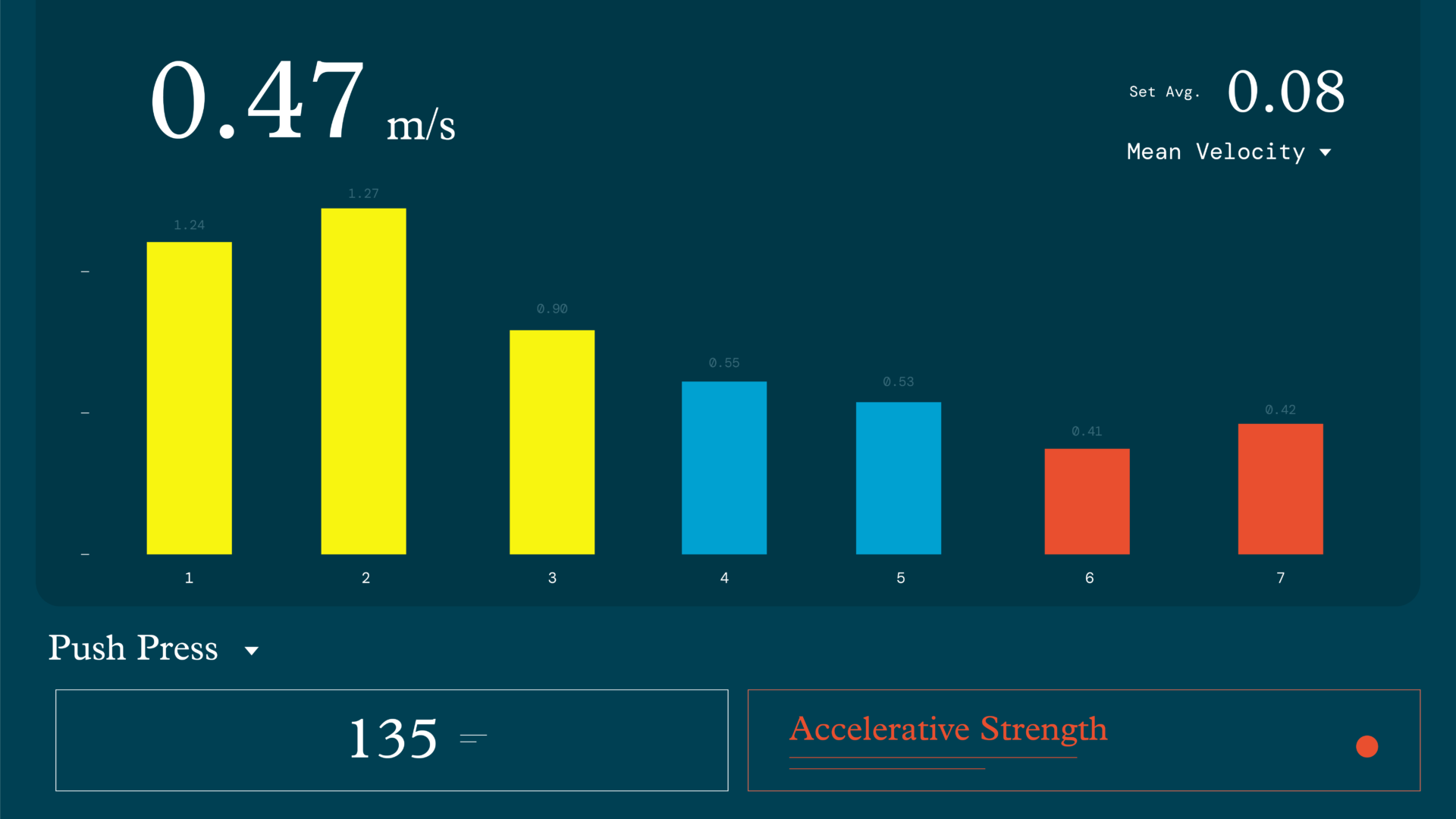
Tweet ThisThe velocities that we target are fairly fast and, as always, performed with maximal intent. Accelerative zone = .5 – .75 m/s, strength speed zone = .75 – 1.0 m/s, speed strength zone = 1.0 – 1.3 m/s.
Tim Crowley

Countermovement jump for readiness
When athletes walk into the weight room, we want to get a quick read on their fatigue levels so we can implement the workout appropriately.
Subjectively, we watch body language and energy level as they come in the room. Objectively, we use a two jump measurement.
After a brief warm up and mobility work, the athletes perform two countermovement jumps (CMJ) with hands on hips in front of the VBT camera. Since we do this at the start of every workout, we have data for the entire year and use the previous 30 days as our guide.
We can instantly see the jump data for each athlete, and then get a readout for the full team, letting us adjust at the individual and group levels. Next to each athlete on the team dashboard is a status column:
- Blank: within normal range for past 30 days average
- Green: one standard deviation above past 30 days average
- Orange: one standard deviation below for past 30 days average
- Red: two or more standard deviations below the past 30 days average

One of the reasons we have been using the CMJ as a measure of readiness is that it is the one evaluation tool available in our analysis software. The CMJ has been extensively studied and validated, but it may be worth investigating additional methods and exercises to assess readiness that may be more sport specific. Upper body explosive movements may apply better to sports such as swimming and tennis, as could lateral movements to multi-directional sports such as soccer or basketball.
As we begin to experiment with VBT and collect more data in the weight room daily, better methods may begin to appear.
Tweet ThisAfter a brief warm up and mobility work, the athletes perform two countermovement jumps (CMJ) with hands on hips in front of the VBT camera. We can instantly see the jump data for each athlete, and then get a readout for the full team.
Tim Crowley
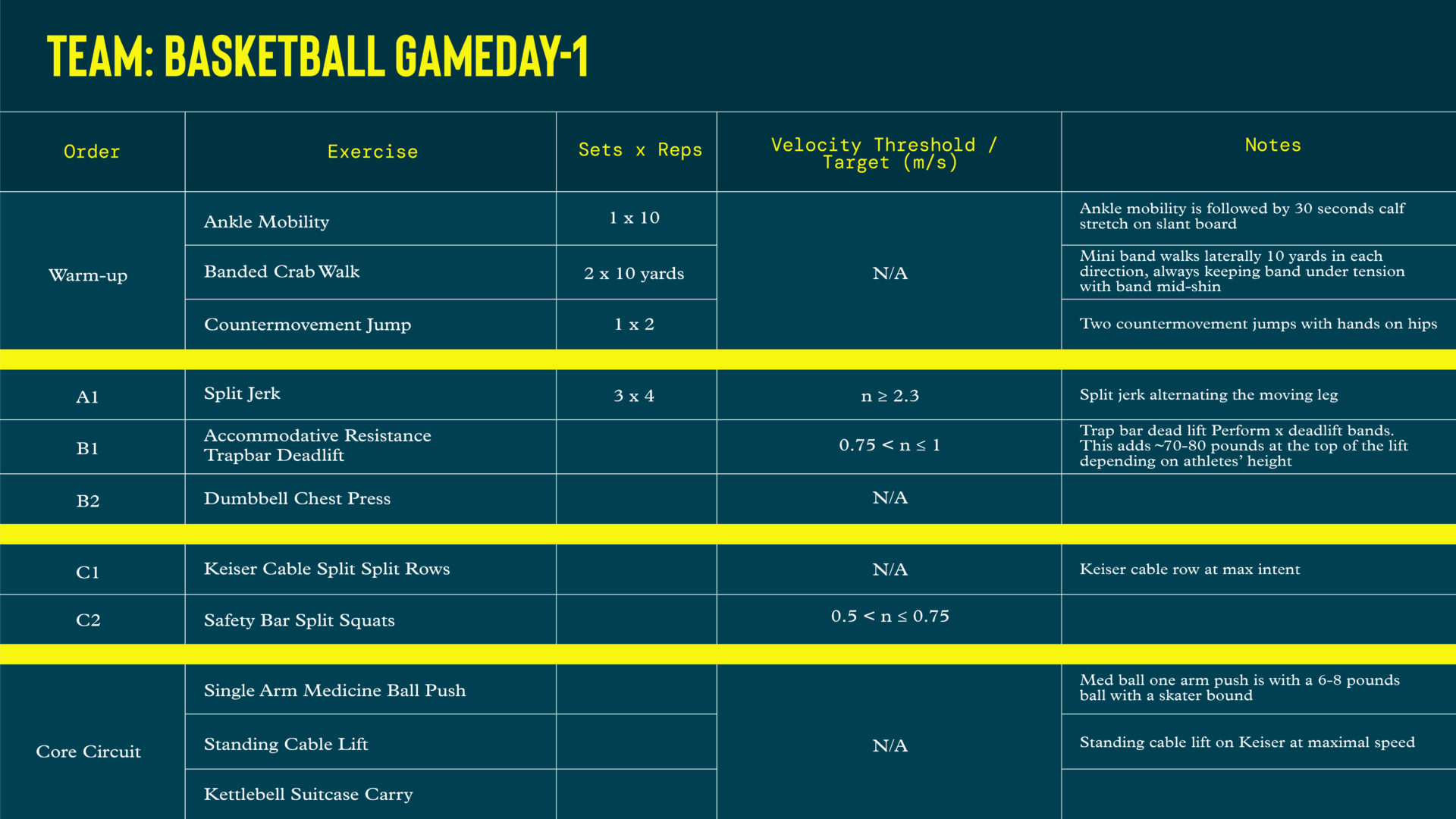
Sample workout for basketball GD-1
The players perform this workout immediately after practice, so they come into the weight room fully warmed up.
Click here to view more exercise examples
Tweet ThisWe switched from accelerometers to a camera-based system from Perch, with units on all our racks. This has been a game changer for our program and athletes as it allows us to become better coaches and collect relevant data.
Tim Crowley

Game day program
We do not always program game day workouts. It varies with the time of year, and depends on working closely with the coach. We have seen good success using this with teams such as basketball, baseball, softball, and volleyball.
The session below is a common one for volleyball, with the lift at 12 noon, before lunch, ahead of a match at 4pm or 6pm.

Click here to view more exercise examples
Extending VBT beyond force production
Every day, our staff ask themselves the following three questions:
- How can we do things better?
- How can we do things more efficiently?
- What if the way we’ve always done it was wrong?
It is our responsibility to continue to push the boundaries in safe and effective ways. The addition of the Perch VBT system has opened new ways to train and to evaluate the effectiveness of our program. We are already seeing the benefits as our athletes build resilience, stay injury free, and maximize athletic potential.
VBT allows us to evaluate the effectiveness of our training programs and to balance stress and recovery to keep our athletes safe and perform at optimal levels. As more coaches begin to explore all the possibilities VBT holds, and share their insights, we will enter an exciting time in strength & conditioning.
Tweet ThisThe addition of the Perch VBT system has opened new ways to train and to evaluate the effectiveness of our program. We are already seeing the benefits as our athletes build resilience, stay injury free, and maximize athletic potential.
Tim Crowley