

With the stakes around professional, collegiate, and even youth sports higher than ever, investment in athletes is growing significantly. One common area is athlete monitoring to enhance injury prevention and performance. Practitioners use a multitude of tools such as readiness questionnaires, force plate metrics, omega wave analysis, and GPS tracking to make informed decisions on how to adjust athletes’ workloads. The strengths of these methods lie in analyzing trends across populations and drawing conclusions about what is likely best for their athletes in the session ahead, while still leaving the ultimate decision in the coaches’ hands.
Autoregulation (AREG) is an alternative that uses an individual’s objective performance to drive the prescribed workload on a given day. This lets coaches and athletes capitalize on an athlete’s actual, specific readiness, rather than going by predetermined loads.
Tweet ThisAutoregulation (AREG) uses an athlete’s performance to dictate their workload, ensuring training is based on actual readiness. This approach tailors volume to the individual, optimizing performance and reducing the risk of overtraining
Jake Ferry
Cal Dietz described how he used a Tendo unit to monitor athletes’ lifting efforts as part of triphasic training. Athletes would continue their sets until they were no longer able to execute a squat at or above a prescribed percent “drop off.” For example, if the target bar speed was 1.00 m/s and the prescribed drop off was 5%, an athlete would continue until they could no longer maintain 0.95 m/s bar speed.
I used the AREG method for the last three years to monitor athletes’ relative fatigue levels and dictate set counts in the weight room. We use bar speed to verify directly that they can execute the lift with the intended quality. I’ve also substituted measurements like jump height or a 10 yard dash to indirectly evaluate an athletes’ CNS freshness before subsequent sets of lifts. Both methods have proven valuable in individualizing athletes’ workloads in group settings.
AREG also has a place in sprint training, using time to measure efforts and set prescribed drop offs. AREG fit perfectly in our recent NFL Pro Day training, where our main focus was on preparing athletes to run a competitive 40 yard dash. We had to strike the correct balance of increasing quality sprint volume without burning out the athletes, risking injury, or, more immediately, jeopardizing the next crucial workout.
Tweet ThisUsing AREG for sprint training can lead to significant improvements. Athletes may perform up to 300% more sprints, setting new personal records even late into sessions. It’s about finding the right stimulus for each athlete
Jake Ferry
Sprint volume with and without AREG
At the beginning of the training block, our two athletes ran composite best 40 yard dash times of 4.78s and 4.83s. As skill position players, anything slower than a 4.49s 40 yard dash is considered sub-par. They performed more conventional workload prescriptions during the first four weeks. I had decided beforehand how much sprint volume I would allow each athlete, erring on the side of caution to keep them fresh from day to day. Looking back, this likely underloaded them at times.
Over that early period we saw subtle improvements in speed, but not enough to put these athletes in contention. They needed greater exposure to high quality stimuli to drive adaptation. After a planned deload week with low volumes during week 5, we shifted to AREG. Rather than deciding their sprint volume ahead of time with a neat chart or reading too much into force plate data, their sprint performance would dictate their individual volumes.
This led to sprint volumes far greater than expected: as much as 300% more, at times, with rep ranges that fly in the face of conventional wisdom.
The athletes even set new PRs as late as 12 sprints into their session, after accumulating over 300 yards of sprinting on the day. More importantly, their subsequent performances reflected significant improvements in speed, suggesting they were ready for a more potent stimulus than before.
This is certainly not to say more is always better, especially in speed training. Athletes best develop speed – and they may only develop speed – when they can perform near maximal intensity.
However, if athletes’ responses to training are entirely individual, how can coaches accurately assume how much an individual can tolerate?
Tweet ThisAREG ensures athletes only perform high-quality reps, avoiding junk volume and promoting recovery. By adjusting volume based on daily readiness, athletes can push their limits safely and effectively
Jake Ferry
The core purpose of training is to deliver a sufficient stimulus to drive adaptation. The beauty of AREG is its ability to answer the question “What quantifies as enough?” AREG does not always lead to more volume, just the correct volume. On a good day, athletes perform greater volumes, on bad days they perform less. With AREG we avoid subjecting athletes to junk volume, create a safeguard for athlete recovery, and push athlete limits when appropriate.
Implementing AREG during combine prep
The primary goal of our training was simple: get faster with the aim of running a successful 40 yard dash at their respective Pro Days. The training week consisted of four training sessions, with two having a specific focus on linear speed. The first session of the week was dedicated to shorter sprints, using heavy resisted sprints (between 40-50% VDEC) and unresisted sprints of no more than 20 yards. The third session of the week had longer sprints, moderately resisted sprints (between 10-20% VDEC) and unresisted sprints of 30 – 40 yards.
Total sprint volume was the sum of both resisted and unresisted sprints. My rule of thumb is if there is maximal intensity, it counts as a sprint. The goal of the resisted sprints was to potentiate and reinforce certain technical qualities, so we always adhered to the preplanned volume for the resisted sprints. AREG came into play for the unresisted sprints.
Short sprint days
Both athletes started with 6 x 20 yd of resisted sprints at 40-50% VDEC. Next, we moved to the timed, unresisted sprints using AREG to dictate volume.
First, we determined each athlete’s previous best over the given distance: Athlete A: 2.72s, Athlete B: 2.75s. Then we calculated a 3% drop off from their previous best to determine their cut offs: Athlete A: 2.80s, Athlete B: 2.83s.
Athletes then repeated timed 20 yard sprints until falling below their cut off time. Athlete A performed 18 reps, equalling 360 total yards; and Athlete B performed 17 sprints, totalling 340 yards.
This far surpassed previous volumes for both athletes. Better yet, both achieved multiple PRs within the session, with new bests of 2.66s and 2.65s for Athlete A and B, respectively. We recalculated the drop off each time an athlete set a new best. For instance, after Athlete A ran a 2.66s sprint, we set his new cut off time to 2.73s for the remainder of the session.
Long sprint days
Similar to the short sprint days, we started with 5 x 30 yd of resisted sprints at 10-20% VDEC. We then used their respective best over that distance as the baseline, and set a drop off of 5%. Athlete A’s previous best was 3.72s, so his cut off time was 3.90s. Athlete B’s previous best was 3.78s, so a cut off time of 3.96s.
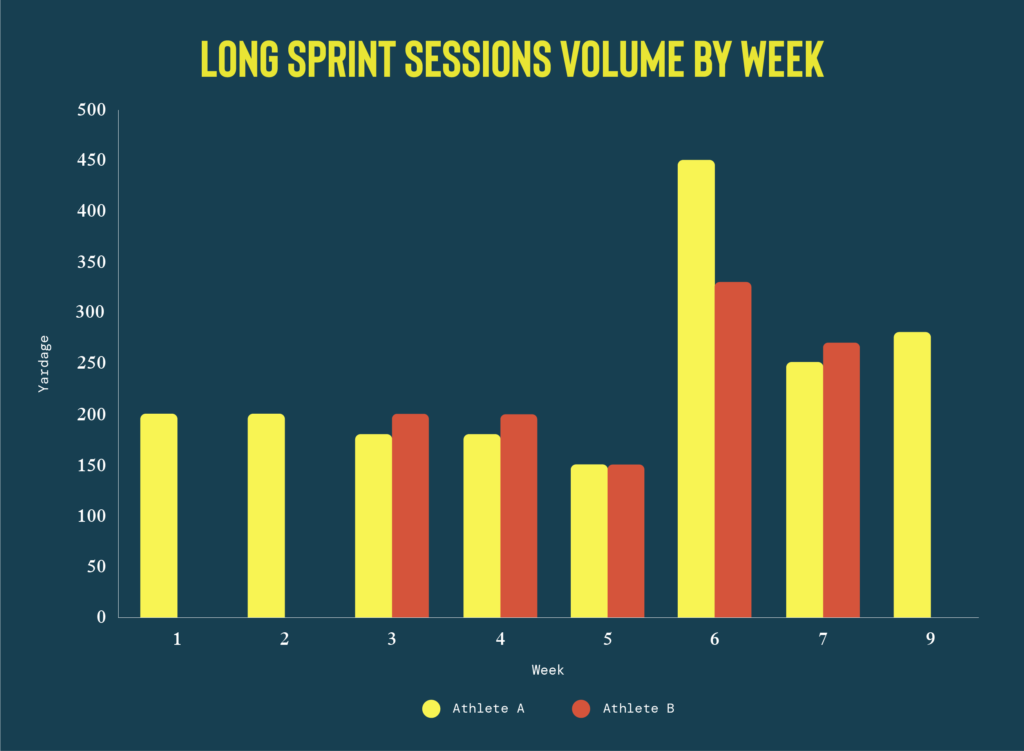
Athlete A performed 10 reps for 300 total yards. Athlete B performed 6 reps, accumulating 180 total yards.
Again, both athletes reached total sprint volumes on the day (450 and 330 yards) far greater than before. Both achieved new bests during the session of 3.66s and 3.72s for Athletes A and B, respectively. As with short sprints, we recalculated their drop off time each time they reached a new best.

Choosing the percent drop off
In most things related to sprinting, I have found success using Charlie Francis’ 95% rule: any rep 95% or greater of an athlete’s best was a high quality rep, significant enough to challenge the CNS and drive speed adaptations. With that in mind, I knew drop offs must be no more than 5%. Anything larger than that would be fruitless and result in unnecessary volume.
A 3% drop off for the short sprint days protected the primary purpose of being able to recover in time for the second linear speed day of the week, 72 hours later. A 3% drop off left enough of a window to achieve high volumes, while a smaller cut off would potentially rule the athlete out very early in the workout. A larger drop off would potentially lead to a poor second linear speed day that week. This approach was purely anecdotal and experimental. If the results contradicted our expectations, I was prepared to make an adjustment.
By contrast, I chose a 5% drop off for the long sprint days because it was the last linear speed day of the week, giving the athletes 96 hours recovery before the next speed session. The greater drop off was more forgiving, allowing athletes to achieve greater volumes, while still falling within Francis’ high quality range.
Being responsive to the athlete
While the drop offs were meant to be the cut off point for a session, on more than one occasion athletes ruled themselves out of additional reps, citing muscle fatigue or discomfort. This never resulted in missing or modifying successive sessions, suggesting these particular athletes had great awareness, knowing when to stop before it became too much.
Another instance where we adjusted drop offs was in the deloading phase before their Pro Days. In both cases, we reduced the athletes’ long sprint days from 5% to 3% drop off due to the proximity of their Pro Days.
Tweet ThisAREG can be applied in team settings too. Educate athletes on the process, set clear metrics for cut-offs, and design training spaces for easy monitoring. This individualizes training within a group context
Jake Ferry
AREG for team training
Implementing AREG in a larger group or team setting is entirely possible, and affords coaches the opportunity to individualize training with relative ease. The keys are educating your athletes on the AREG process; setting up an easy to self monitor, valid metric for the cut-off; and designing the physical space you use for your session to allow oversight of athletes before, during and after the AREG block.
For instance, a coach could simply set up timing gates with the results projected for all to see. Athletes can independently perform the sprint, evaluate their results, and choose an appropriate course of action. If your space allows, it’s possible for a single coach to monitor a large group of athletes, moving them on from one block to the next at their own pace. If the location of the speed work is separate from the remainder of the workout, or either part requires intensive coaching, a second or third staff member could divide responsibilities while still allowing athletes’ to work at their AREG dictated volumes.
Indirect benefits of AREG-based training
Timing sprints enhances athletes’ efforts. Doing so within an AREG set up creates multiple layers of competition that possibly combine to explain such notable performances.
Not only are the athletes competing against themselves and the clock, but now with the specific purpose of not “losing” to the cut off. Even a rep below their current PR still becomes a win if it’s above the cut off. Additionally, with multiple athletes training together, neither wants to be the first to be cut off. If training independently, I’m not sure either would have been able to achieve 17 reps. But watching the other continue on drove their competitiveness and self belief, and facilitated greater volumes.
Coaches using AREG within a session must be prepared to adjust on the fly. Hour long training sessions can quickly become two hours if an athlete doesn’t drop off as anticipated.
For instance, during the one remarkable session described above, our athletes performed 17-18 reps of a 20 yard dash at or above their previous PR before dropping 3% off their best time. While the efforts were only 2.6 seconds in duration, we insisted upon full recovery of 2-3 minutes between reps. What I anticipated to be a 20 minute portion of our training turned into a full hour.
This realization led to a redistribution of their overall workload, dropping sets and reps in the weight room to counter the unanticipated volume achieved during their sprints. With this in mind, coaches should be prepared to fully commit to the AREG application. In doing so, be confident in your priorities. Getting a faster 40 yard dash was priority number one for us. While we used the weight room to enhance certain qualities, we prioritized sprint work, becoming very comfortable with the notion that the weight room was purely complimentary.
The primary benefits of utilizing AREG with sprint volumes lies in the ability to maximize a given training stimulus for each individual on a given day. Think maximal effective dose.
Designing appropriate guidelines across daily, weekly, and entire training cycles is important to ensure the stimulus remains high quality. Letting go of preconceived notions of what is “enough” allows athletes’ performances to dictate how much they can tolerate. This can lead to far greater volume than a traditional model would allow. Conversely, you may be saving an athlete from poor training should their times not match up to calculated times on a given day. For instance, Athlete B didn’t manage nearly the same volume on his short sprint session in Week 7 as he did Week 6. This doesn’t mean it was a bad day – it was a reflection of his readiness on that day. By cutting that workout shorter, he likely performed better in his future sessions and, most importantly, during his Pro Day 10 days later.
Having only applied AREG during the later stages of training, it’s impossible to know how much influence those particular sessions had on their speed development. But our story has two happy endings. Athlete A ran a 4.47s 40 yard dash on his Pro Day, a 0.28s improvement over his time with us. Athlete B ran an unofficial 4.37s 40 yard dash during a private tryout, before recording an official 4.48s time during his Pro Day, a .35s improvement from his training block.