
Also contributing to this Sportsmith Six was Jean-Benoît Morin, Jurdan Mendiguchia and Kenny Guex.
Many practitioners will aim for a number of “sprint exposures” per week as a protective factor against hamstring injury. What recommendations would you have for the number of exposures?
First of all, let’s note that sprinting is not the only solution to reduce hamstring injury risk. Our approach is based on the analysis of hamstring injury mechanisms, and since sprinting represents a frequent injury mechanism, we think that it is relevant to include in the injury risk reduction approach. But, of course, this approach should be multifactorial to match the multifactorial nature of hamstring injuries.
Given that, one important concept is the management of the strains on the hamstring muscles. Sprinting exposure is appropriate only if the athlete can manage the strains on the hamstring muscles (more regarding sprinting kinematics and structures below).
To our knowledge, there is no study showing the efficacy of sprinting exposure to reduce the risk of hamstring injuries. Therefore, it is difficult to recommend, based on scientific evidence, sprinting exposure to reduce the hamstring injury risk – let alone a discrete prescription of, say, weekly exposures. Doing so is at most a suggestion based on the pathophysiological and biomechanical elements influencing hamstring strain, and on hypotheses from several indirect lines of evidence.
The key consideration is that exposure to sprinting might depend on several individual, environmental and contextual parameters: the sport, the position, the time in the season, the objective in the season, an athlete’s capability, playing and injury history… There is also important inter-individual variability in sprinting performance and capabilities that practitioners should also take into account.
It’s tricky or even counterproductive to offer a generic sprinting exposure to athletes. What is clear is that extreme over-exposure and under-exposure (e.g., sprinting only during competitive matches) are likely more risky.
The preferred approach starts with individualizing each athlete’s sprinting exposure according to their history, capabilities, goal, context and environment. This would also include their capacities of the day: do we have indicators that show that the athlete can perform a maximum velocity session today? Or, on the contrary, are we seeing signs that he is not in an optimal state?
The key words are individualization, progressivity and consistency.
What qualifies as a “sprint exposure?” Some practitioners will say 92% while other will say 95%. What percentage of V max will get the benefits of the “sprint vaccine”?
First, there is a tiny difference between 92 and 95% of Vmax; and, as for the latter point, there is currently no scientific evidence. Again, the response is a suggestion, and future studies should help to confirm / strength this.
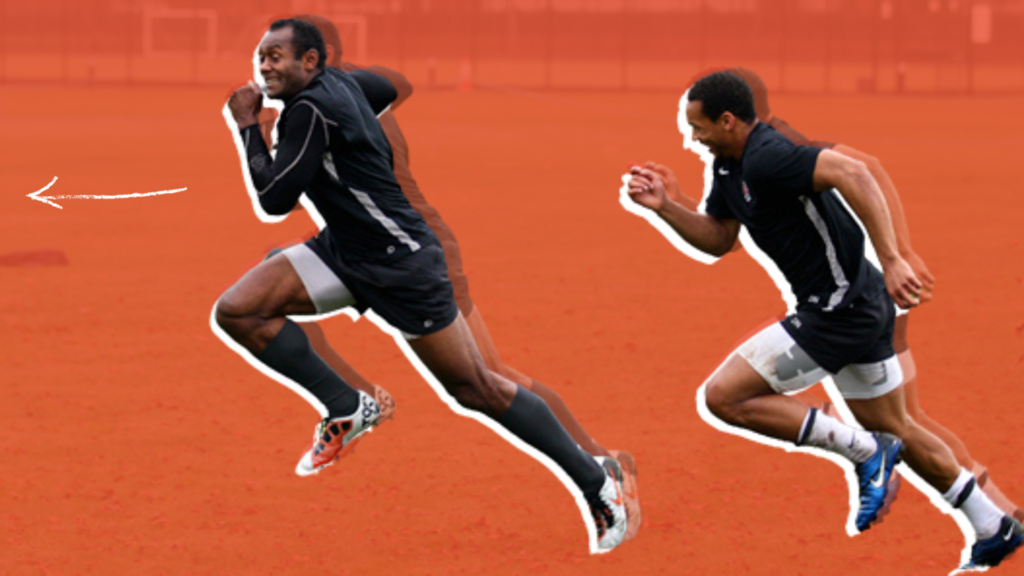
We need to be clear about what we are talking about. Terms like “sprinting” and “high speed running” are often and widely used, but without always meaning the same thing. This can clearly lead to confusion. Our group defines “sprinting” as maximal acceleration or velocity [3]. By “maximal” we mean 100% of the athlete’s capacity: an acceleration with 100% of intensity, force, velocity; or running with 100% velocity.
If the idea is to program sprinting with the aim of reducing hamstring injury risk, we suggest preparing the body for the function which it is to serve.
If the athlete is going to sprint at 100%, then it is important to prepare the body to such an action and intensity. If the athlete trains at 92% or 95%, when they eventually have to run at 100%, their system will be in terra incognita. If they are not prepared for such intensity and velocity, the body may not be able to manage the capacity or strain balance.
At high velocity (>7m/s or >26km/h), a 30% increase in running velocity leads to a 100% increase in hamstring muscle requirements [1]. The increase in hamstring muscles’ constraints is not linear or proportional to the running velocity increase. Thus, raising running velocity should be progressive to manage the almost exponential induced increase in hamstring muscle constraints.
Therefore, we suggest training the athlete to the intensity and velocity needed for the sport, limiting the extent of this terra incognita.
Tweet ThisTo reduce hamstring injury risk, sprinting exposure is appropriate only if the athlete can manage the strains on the hamstring muscles
@PascalEdouard42
As well as just sprinting, you recommend kinematic evaluations to understand where we may need to individualise sprinting interventions. Can you recommend any evaluations that may give good bang for the buck?
Our approach is based on the analysis of hamstring injury mechanisms. Sprinting is a frequent injury mechanism, so it seems relevant to include sprinting in the hamstring injury risk reduction approach.
However, we should not neglect other hamstring injury mechanisms. Their motion and kinematics should also be evaluated to improve the athlete’s movements and techniques, and decrease the musculo-skeletal constraints during such movements. The overall goal is to improve the evaluation of hamstring injury mechanisms, in order to improve hamstring injury risk reduction strategies. This necessarily will include, but not be limited to, sprinting.
In order to plan the sprinting training / preparation, we suggest a global evaluation of the athletes, from the structure (i.e., their body) to the function. In this case, clearly, sprinting.
If the sprint mechanical pattern is associated with high incidence or risk of hamstring strains, then recommending more sprinting might be counterproductive! In other words, if the athlete’s structure is not able to sprint because of high hamstring strains due to poor sprinting technique and biomechanics, it will be fundamental to first work on that before recommending sprinting and increasing sprinting exposure.
The evaluation depends on the tools and time available. Regarding the kinematic evaluations, the more relevant way would be to use the methods from scientific studies reporting an association between sprinting kinematics and hamstring injuries or injury risk factors [6-8].
However, since these are laboratory evaluations using complex approaches such as 3D motion analysis, for instance, they are probably not accessible nor time efficient.
There is a need to validate simpler field approaches to evaluate sprinting kinematics, for example, using 2D slow motion video, kinogram or markerless approaches. In the meantime, 2D videos and the help of sprint mechanics and training experts could be a relevant approach.
Still thinking about the evaluation process, how would you assess sprinting “structures”?
The sprinting structures mean all the elements of the musculoskeletal system that allow the function of sprinting. This includes muscles, tendons and joints, as well as leg interactions. Evaluations include measurements of the range of motion, flexibility and strength. Practitioners evaluating these factors should always have in mind the injury mechanism, so they can analyse the structure in relation to the potential injury mechanism.
Sprinting represents the most frequent hamstring injury mechanism for sports with sprints and accelerations. But it is not the only one, nor is it the most frequent cause in other sports, so it is important to have this broad view when evaluating the structures.
The measurement approach will depend on the available tools. We made some proposals in different articles [6,7], Lahti et al. [1,2] using simple field tools to analytically evaluate the “sprinting” structure (e.g., goniometer, inertial unit sensor, hand held dynamometer).
Tweet ThisAt high velocity (>7m/s or >26km/h), a 30% increase in running velocity leads to a 100% increase in hamstring muscle requirements
@PascalEdouard42
When it comes to increasing hamstring structure function through strengthening, what exercises would you recommend to compliment sprinting?
We think that hamstring muscle strengthening exercises should not be restricted to a single exercise. Hamstring muscles are bi-articular muscles, with hip extensor and knee flexor functions along with knee rotation. In addition, the pelvis plays an important role in the main strain modulator.
In sports, hamstring muscles have to act at different ranges of motion, velocities and contraction modes. To make hamstring muscles capable of managing the various constraints induced by sports, and not tear as soon as a new constraint is applied, practitioners need to prepare the hamstring muscles to face the largest possible range of constraints over the largest range of regions, lengths and velocities. This approach needs to include the pelvis and pelvic control.
Coaches should therefore expand their exercise toolbox so hamstring muscles can be prepared for this large range of mechanical demands during sports. Sprinting itself represents such an exercise.
What are the biggest mistakes you see young practitioners/clinicians make and what advice would you give them to help?
First, the term “mistake” must be interpreted with caution, given that, to date, there is still a lack of strong scientific evidence to clearly and precisely recommend sprinting to reduce hamstring injuries. The “mistakes” below are better thought of as experiences that do not seem consistent with the proposals we made.
A frequently encountered “mistake,” especially in athletics, is the lack of progressivity in the sprint intensity increase. Indeed, often athletes are performing a long period of strengthening or increasing running volume – submaximal running (<90% Vmax) on long distance (from 200 to 500m) and with lot of repetitions – and then brutally switching to maximal sprinting (Vmax over 30 to 100m) without any progressive increase in the velocity.
In our opinion and clinical experience, such an approach is associated with a very high risk of injuries, especially hamstring injuries [2].
We think it is better to expose the body regularly to the maximal sprinting constraints throughout the season, with no major “pauses” and inconsistencies. Practitioners should take into account the athletes’ capabilities and the environmental conditions. And, when an increase in the exposure (volume or intensity) is needed, approach it progressively.
Another frequently encountered “mistake,” again especially in athletics, is the imbalanced targeting of quadriceps and knee extensors during strength training, compared to exercises and workload volume on the hamstring and hip extensors muscles. This behaviour can create or exacerbate an imbalance between knee flexors and extensors.
Third, an important mistake is applying recipes, generic approaches for all athletes without taking into account the inter-individual variabilities and the different contexts.
Finally, and maybe the most difficult, is appropriately managing signs of pain and fatigue. The challenge is to distinguish normal pain induced by the training from pain being the first sign of tissue damage that requires appropriate intervention so as not to lead to a injury or longer term negative effect (https://blogs.bmj.com/bjsm/2018/02/13/choosing-not-injured-using-warning-signal-pain-overuse-injury-prevention-strategy/). One requirement here is clear and open communication between the athlete and the coach.
Tweet ThisCoaches should expand their exercise toolbox so hamstring muscles can be prepared for a large range of mechanical demands during sports. Sprinting itself represents such an exercise
@PascalEdouard42