
Within non-professional sport settings, low levels of return to performance and high levels of reinjury rates are common issues surrounding anterior cruciate ligament reconstruction (ACLR) rehabilitation. While 84% of athletes expect to return to sport within 12 months, only 24% achieve this goal [10]. ACL reinjury rates also remain high, with graft failure rates reaching 14% for adults and 28% for young athletes [8].
As rehabilitation professionals, we need to ask: are athletes failing rehabilitation or is rehabilitation failing athletes?
Many factors predispose an athlete to increased primary and secondary risk of ACL injury. But the performance and rehabilitation community can never seem to come to definitive conclusions about what may or may not be responsible for injury. We’ve gone through the merry-go-round of hop test batteries, strength measurement and qualitative movement analysis. For all that, the only conclusion we can decipher is that “injury is multi-factorial, and nothing can be pinpointed for the onset of non-contact ACL injury.”
The development of trunk strength and capacity, and how they translate to efficient movement on the field, are among the factors thrown into the debate.
The trunk is a unique subsystem that is responsible for the production and control of force throughout multiple planes of motion. It also mediates load throughout the lower and upper limbs. The trunk’s importance in the onset of ACL injury remains unclear even as it is continually overlooked during the rehabilitation journey in favour of local tissue capacities.
Weakness and atrophy to the localised tissue around the knee and the donor site are the most obvious and pressing issues for the rehabilitation professional in the acute stages post-ACLR surgery [1]. This pyramid of rehabilitation principles guides my decision-making for rehab programming.

The two foundational ideas are ensuring that you aren’t inflicting “anti-rehab” on your athlete and keeping the tissue directly surrounding the injury your primary focus.
For an ACL injury, this is the direct restoration of the quadriceps, hamstrings and calf musculature, with extra consideration towards the graft donor site (if applicable). However, in current sub-elite rehabilitation practices, this is where we typically stop and forget about the rest of the pyramid. We tend to forget that the rest of the body suffers a large deconditioning effect and that the neurological insult of ACL injury functionally affects how the rest of the body moves.
Tweet ThisWe tend to forget that the rest of the body suffers a large deconditioning effect and that the neurological insult of ACL injury functionally affects how the rest of the body moves.
@jrehab_
The aims of this article are to outline the importance of trunk biomechanics in the context of ACL injury, and to highlight practical methods of reconditioning athletic trunk strength during post-ACL reconstruction rehabilitation. The methods are based on a combination of best available evidence and my own personal journey in implementing these strategies in clinical practice.
Functional anatomy of the trunk: Actions and anti-actions
The fundamental point for clinicians to keep in mind when approaching the trunk in a rehabilitation setting is the difference between a muscle’s action and its antagonist resistance action. The best example is the abdominal wall. While it dominates flexion through isotonic contractions such as during a sit-up, its isometric bracing provides an anti-extension resistance during movements like a plank or dead bug.
The two functions interweave during sports that require frequent and high load changes of direction. Athletes in these sports have to shift their trunks into specific positions to brace for contact and then resist external force from their opponent to maintain their optimal body position.
We can break down the trunk into two subsections:
Anterolateral trunk
The anterolateral wall of the trunk consists of the internal and external obliques along with the transversus and rectus abdominus. The primary functional roles of the anterolateral wall are in lateral flexion, rotation, and flexion of the thorax.
Posterior trunk
The posterior wall of the trunk consists of the quadratus complex, iliopsoas, diaphragm and the large network of lumbar extensors. Its primary role is to provide extensor support around the spinal column and to produce lateral flexion.

Within each plane the musculature of the trunk can either produce or resist force. In field-based sports the trunk mainly acts to resist and dissipate force throughout the body, rather than producing it. However, specific tasks such as kicking, passing and swinging a racquet or bat may require powerful force production.
How the ACL’s anatomy shapes injury mechanisms and risk
The anterior cruciate ligament is comprised of two ligamentous bundles that attach from the posterior surface of the femoral condyle wall to the anterior aspect of the tibial spine. The anteromedial bundle largely resists movement while the knee is in flexion, and the posterolateral bundle is taut when the knee is in extension.

The primary anatomical role of the ACL is to resist anterior tibial translation of the tibia on the femur, with secondary roles of controlling tibial internal and external rotation. ACL injury occurs when the anterior tibial shearing force – that is, the force that pulls the tibia anteriorly – in conjunction with increased rotational load exceeds the capacity of native ligament control.
Multidirectional sport athletes are at higher risk of these injuries. Common patterns of injury mechanism include:
- Landing with an extended knee. This increases quadricep muscle force, shifting higher levels of relative load on the ACL while limiting protective co-contraction of the hamstrings.
- Landing with a heel strike. Increases ground reaction force up towards the knee, and reduces plantar flexor activity in dissipating force.
- Landing with a wide foot placement. Increases knee abduction moments, places rotational load onto the knee and reduces the protective effect of hip and trunk muscle activity.
The ACL usually ruptures within the first 40 milliseconds of ground contact. This eliminates the body’s capacity to reorganise its strategy after committing to a landing or change of direction task.

Neuromuscular considerations post-ACL reconstruction
The restoration of quadriceps and donor site muscle strength and mass is a common goal of post-ACLR rehabilitation programmes. However, a less common consideration is the proprioceptive impact that the insertion of a graft has on the tibiofemoral joint.
From a histological perspective, ACL graft tissue, regardless of autograft or allograft origins, fails to have the same mechanoreceptor capacities as native ACL tissue [3]. ACL tissue’s mechanoreceptors provide proprioceptive functions for the knee by inducing an afferent response signalling postural changes. Deformation within the tissue influences muscle activity surrounding the knee, a phenomenon known as “the ACL reflex” [5]. ACL reconstruction disturbs this process. The rehabilitation professional should understand how promoting optimal movement efficiency and load transfer from proximal – distal segments will offset the detrimental impact of reduced local muscle tissue activity during highly chaotic tasks.


Relating the trunk’s movement strategies to ACL rehab
The athletic trunk plays a vast array of roles in facilitating sporting performance, extending well beyond injury risk mitigation. These ultimately break down to force resistance and force production. For collision sport athletes, in particular, being able to effectively absorb and translate force in an integrated manner through the trunk and extremities provides an effective bracing platform to tolerate repeat contact.
Tweet ThisThe athletic trunk plays a vast array of roles in facilitating sporting performance, extending well beyond injury risk mitigation
@jrehab_
Rehabilitation professionals must understand that one of the most effective defences against injury is the ability to dissipate force throughout the lower limb. Teaching movement strategies that develop and enhance this skill, along with training the strength to execute it, are some of the mechanisms we should address with the athlete post-injury.
Proximal motion at the trunk has a substantial role in influencing biomechanics and moderating load experienced in the knee. Increased lateral flexion and rotation away from the intended direction of cut are associated with higher knee abduction moments and ground reaction moments. Both increase strain on the ACL.
An athlete’s eccentric quadriceps and hamstrings strength is recognised as the athlete’s most important tool for deceleration control and capacity. Recent injury prediction models have scrutinised specific biomechanical strategies during unplanned change of direction and their roles in ACL injury. Key variables included centre of mass relative to knee position in the frontal plane, pelvic drop and trunk side flexion angles. These factors combine for a 67.7% accuracy for predicting ACL reinjury [4].
While our ability to influence an athlete’s movement on the field during the chaotic demands of sport is questionable, we can influence these variables through planned and unplanned tasks during rehabilitation. These movements can serve as a screening tool for whether the athlete will be able to control and dictate their movement strategies on the pitch or court.

Trunk training for post-ACLR rehab and return to play
Sports rehabilitation professionals should have a system that can facilitate trunk training from the day the athlete leaves the operative theatre. This will provide a platform for transitioning towards integrated tasks later in the rehabilitation journey.
Tweet ThisSports rehabilitation professionals should have a system that can facilitate trunk training from the day the athlete leaves the operative theatre
@jrehab_
We should always attempt to implement load as early and as safely as possible in an athlete’s journey. Warren Buffet once said “The best way to make money is to not lose money,” and we should adapt this mantra for athletic rehabilitation.
The streams below are a non-exhaustive list. They are a progression-regression model based on my experiences of athlete movement competency and what we can implement when the athlete is limited in the early stages post op. When making decisions about where an athlete belongs in each stage of the model, I usually undershoot. My aim is to place athletes in positions that won’t place their compromised knee at risk, while still facilitating a training effect.
Transitioning from one stage of rehabilitation to the next does not automatically qualify an athlete to progress further down the progression model. We should also be mindful not to selecting highly complex variations in athletes with a low training age or technical proficiency.
Trunk training – anti-flexion / extension streams

Trunk training – prone anti-flexion / extension
Elevated plank
Kneeling SB rollout
Plank hold
Dynamic plank
Rollouts
GHD holds
GHD perturbations
Trunk training – supine anti-flexion / extension
Deadbug – SB / plate
Deadbug – PB
Deadbug – dynamic
Hollow hold
Leg raises
V snaps
Dragon fly
Trunk training – anti-rotation stream

Pallof hold
Pallof press
Pallof press – chaos
Woodchop – PB
Woodchop – cable
Landmine rotation
Landmine half moon
Trunk training – anti-lateral flexion stream
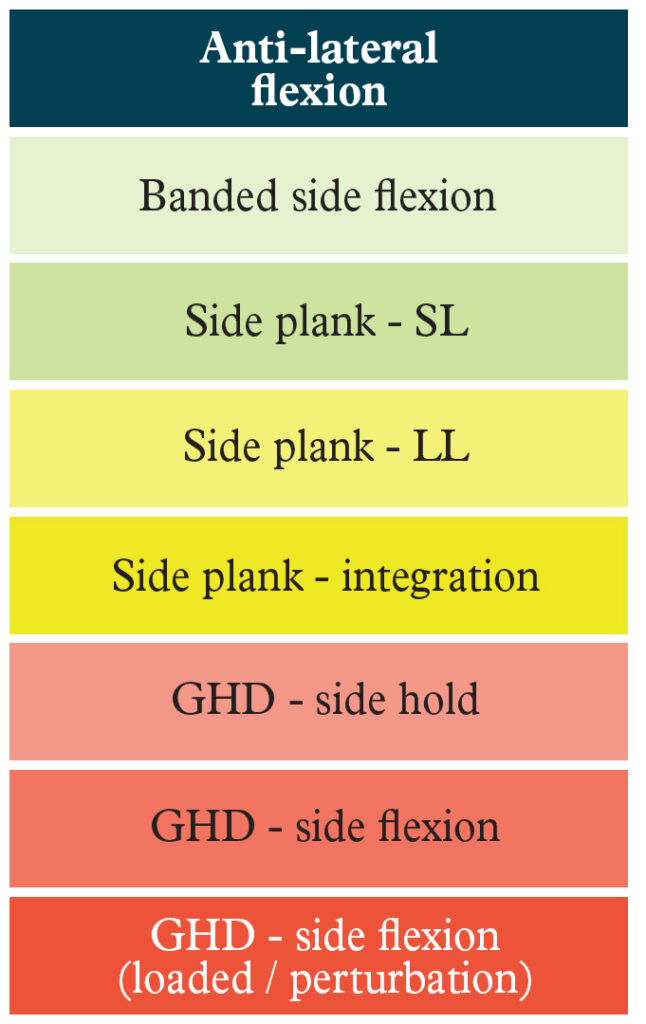
Banded side flexion
Side plank – SL
Side plank – LL
Side plank – integration
GHD – side hold
GHD – side flexion
GHD – side flexion (loaded / perturbation)
Key rehab framework: lateralisation through integration
Young professionals commonly make the mistake of progressing their athletes towards more demanding motor patterns too early. While reducing training monotony is an important consideration in program design, there are better alternatives to squeeze more juice out of the lemon.
Progression doesn’t always need to be through increasing complexity of the task. “Lateralization through integration” is an approach that integrates concurrent secondary physical or cognitive demands, progressing the exercise without simply advancing to a more difficult exercise selection choice. An example would be adding a mini-band hip flexion component to a traditional side plank, rather than jumping ahead to something like a GHD hold. We increase the difficulty and demand of the movement while keeping the athlete in a position where they are technically proficient.
Programming trunk training in a rehabilitation session
Each block of a rehabilitation session has a specific purpose designed to facilitate changes to an athlete’s movement.
Preparation
Acute preconditioning designed to facilitate optimal loading and reduced pain throughout the session. Examples include isometric loading for pain relief and / or neural drive.
Gait block
Drills centred around restoring an athlete’s capacity in acceleration, max velocity and frontal plane positions. This is largely performed during the phases of rehabilitation that precede the athlete returning to running.
Velocity block
Interventions to increase an athlete’s plyometric capacity, contingent on what stage of the plyometric continuum is most suitable.
Strength block
Key component of the session designed with the primary interventions for athletic strength and power reconditioning.
Resilience block
Extra training for the donor site or a specific deficit.
Within these blocks, direct trunk training would take place in an athlete’s strength block. I typically categorise an exercise into one of the following:
- Primary movement: Foundation movement pattern, usually presents high neural demand and is a focus point of a sequence.
- Supplementary movement: Aids in the development of the primary training goals.
- Accessory movement: movement pattern that aids in overall athletic development and injury resilience.
Most trunk-based work that I develop for athletes falls in the accessory movement column. I usually try to address two streams of trunk development per session. As an example:

This scaffold shows an example of the many different options you may select in a session. These are not mandatory or minimum protocols. As a clinician, you should prioritise and develop your programs based on your athlete’s specific needs, training age and contextual factors.
Conclusion
The neurological insult of injury, reconstruction and prolonged deconditioning all compromise coordination of trunk control post-ACLR. Altered movement strategies upon return to highly chaotic change of direction-based tasks place the athlete at risk of secondary ipsilateral or contralateral ACL injury.
The trunk plays an important role in mediating and distributing the forces placed upon the knee during landing and change of direction-based tasks.
Early integration of isolated and integrated trunk development streams places the athlete at an advantage when their rehabilitation moves into more complex intersegmental tasks. Rehabilitation professionals should consider the importance of trunk development streams when rehabilitating athletes post-ACL injury. Developing a system of effectively periodising programs to tackle each pillar of trunk performance will assist practitioners in effectively progressing an athlete back to performance.