

Have you ever been asked hard-to-answer questions like “What type of music do you like?” or “Who is your favorite singer or band?”
These questions are so difficult to answer because it’s hard to narrow our whole experience with music down to one genre or one artist. While many artists are great, people enjoy different types of music and appreciate it for a variety of reasons: rhythm, range, tone, timing, tempo, and so on.
I believe movement is like music. People move with different rhythms, ranges, and tones because of many different reasons: anthropometrics, genetics, experience… the list goes on. My goal for this article is helping people learn to appreciate different ways athletes produce power, like how we appreciate different types of music.
Having coached elite athletes for 27 years, I have often been asked another hard-to-answer question: “Who is the best athlete you have ever coached?”
In the past, I had a concrete answer, simply because I would determine power based on vertical jump height using a Vertec. For a long time, this was the best way a sports performance coach could practically measure power and athleticism. But after almost a decade of working with force plate technology in the weight room, this same question is now very difficult to answer because I have learned that there are many ways to appreciate and value how an athlete creates power.
Power training can be very complex, especially if we are trying to create a higher-performing athlete while also making them a healthier one. Just like a musician who is always fine tuning an instrument, I think it is important for coaches to appreciate how we can fine tune power development for athletes. Training to create power is not a one-size-fits-all solution.
This article is proudly supported by Exsurgo
Power production: Key performance indicators and movement strategies
With the help of force plates, I have been fortunate enough to dig a little deeper into what I consider the art of power development. Yes, we use objective data. Yes, we follow trends. But power development is a personal expression. It deserves to be called an art. Anyone can perform a vertical jump, throw a ball or sprint: young, old, athlete, non-athlete.
The art is not only how someone produces power, but also how a coach can help harness that power through programming and training.
Tweet ThisPower development is a personal expression. It deserves to be called an art
@A_Hudy
The sequencing in a vertical jump test, that is, the order of muscle recruitment from the ground up through the body, speaks volumes about an athlete. This emphasis on a vertical jump test focuses more on the process (sequencing) of force production rather than the output, jump height.
The leading KPIs used to determine the sequence and magnitude of power in a vertical jump are:
- Load: eccentric rate of force development (RFD)
- Explode: average concentric force
- Drive: impulse or time on the ground during concentric output
These terms are used for each variable to increase the efficacy of communication among individuals in an organization, from administration to athletes, who may not understand eccentric rate of force development, concentric strength or concepts of impulse and momentum.
Each variable is dependent upon the other, as they all occur under the force-time curve in the performance of a vertical jump. Changing one variable necessarily changes the others. For example, if I want to increase an athlete’s load (RFD) by performing heavy bilateral exercises for low reps, explode (average concentric force) and drive (time on ground during concentric output) change as a function of the intervention on load.
Though a vertical jump test using a vaned instrument like the Vertec is very specific for athletes that have significant vertical movements, it can provide beneficial data for all athletes. Force plate software, on the other hand, uses machine learning to sift through the data and create a movement signature profile for each athlete. The movement signature is then used to write exercise prescriptions for performance and health throughout the year.
The athlete’s movement signature reflects the movement strategies they employ to produce force in their vertical jump. The three broad strategies are:
- using a high rate of force development through absolute strength (load or average eccentric rate of force development);
- using an efficient stretch-shortening cycle with high concentric output, as we would see with an “elastic” athlete (explode or average concentric output); and
- using timing and momentum, often seen in highly experienced and/or skilled athletes (impulse or concentric force x time)
Profiling power production by body type and sporting movements
Coaches who do not have access to force plate technology can use body-typing as a substitute source of movement strategy when developing their programming.
- If an athlete is a mesomorph (muscular), I generally assume they use absolute muscular strength as a leading input for power production. I would group them as a “high load” athlete, one who can produce large amounts of force quickly. This type of athlete appears strong and aggressive when moving, and is usually someone who can absorb bodily contacts and can slow down moving objects, like during blocking.
- If an athlete is an ectomorph (long, lean, lower body fat), I typically attribute to them a reliance on relative muscular strength (elasticity) for power production. You can consider them a “high explode” athlete. Load is relatively low, but concentric outputs are high. These athletes make movement look easy, efficient and fluid.
- If an athlete is an endomorph (higher percentage of body fat with less muscle mass), I consider them a “high drive” athlete that creates power by using momentum. This type of athlete tends to use experience and/or skill to their advantage.
An offensive lineman in American football, an ice hockey player and a catcher in baseball can become very proficient at decelerating and creating lateral or rotational power. The same athlete, though, may not be proficient in vertical or horizontal power because of high body mass, increased thoracic mobility or lower values of posterior chain strength and mobility relative to the other variables.
Have you ever seen this type of athlete getting highlighted on social media because they excel at vertical jumping or sprinting? Probably not.
A basketball player or a defensive back should be able to create efficient vertical power, but may struggle to create rotational and horizontal power. This is because they have lower mobility capabilities throughout the feet, legs, torso and groin. They utilize less posterior chain strength in relation to the other variables, or lack timing and momentum (the movements are not fluid) when playing their sport. Steps or movements, while explosive or ballistic, can appear short and choppy.
Finally, a golfer or an outside hitter in volleyball may be able to produce great horizontal and rotational power, but have lower capabilities of lateral power because they have lower torso stiffness and groin strength (i.e., posturing capabilities). They may also have a lower rate of force production relative to their ability to use timing and momentum. That is, they can prolong the force they produce over time better than the other athlete types.
Profiling power production by vertical jump analysis
There are many examples I could give to illustrate different types of power production. Therefore, it is important to understand why power development in a vertical jump is complex, position-specific and individualized:
- A strong offensive lineman in American football may express a healthy symmetrical jump while landing quickly in the exact same place. A catcher in baseball would perform a similar type of jump.
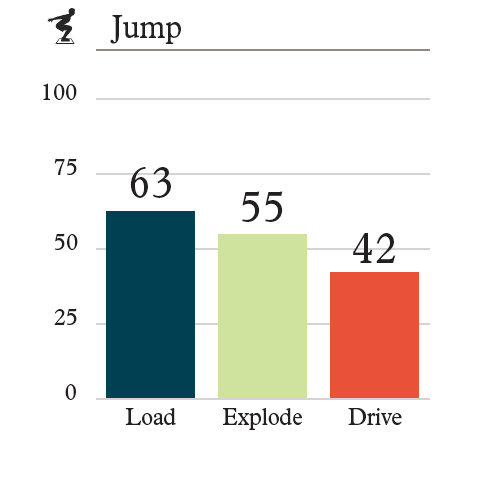
- A basketball player may load through their forefoot with little hip hinge and explode primarily through their ankles and knees, but still produce a high vertical jump. Rugby players or baseball infielders may do likewise.
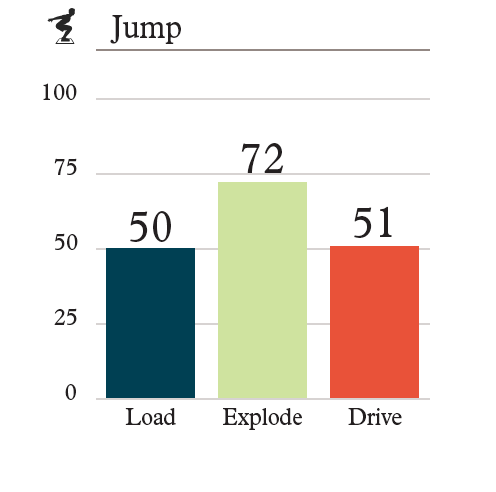
- An outsider hitter in volleyball may load through their entire foot and explode through greater hip range of motion and, while in the air, rotate 180 degrees to land facing the opposite direction, similar to a goalkeeper in soccer.

- A baseball pitcher may load into the ground while collapsing his torso, which creates a leak in maintaining vertical ground forces. This then exposes why he may not express his power well in jumping and sprinting. The vertical jump inefficiency allows him to express rotational power when throwing. Golfers have a similar profile.
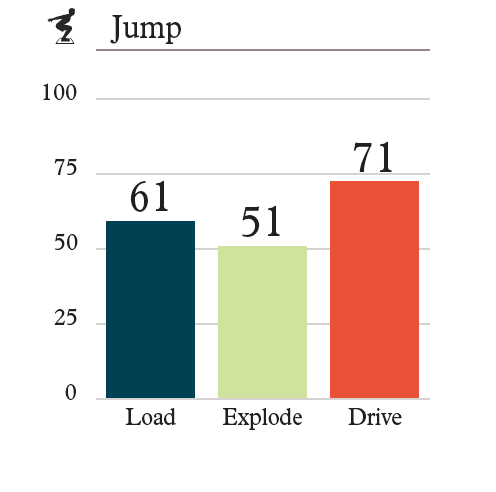
As great as movement strategies are, a vertical jump can expose previous injuries that need to be corrected. An improperly rehabilitated injury can drastically affect force production.
Tweet ThisAs great as movement strategies are, a vertical jump can expose previous injuries that need to be corrected. An improperly rehabilitated injury can drastically affect force production.
@A_Hudy
So many times, when I watch an athlete perform a bilateral vertical jump, I notice small deviations in an athlete’s symmetry as they are on the force plate preparing to jump.
These small asymmetries speak volumes: an athlete constantly leaning on one leg, a foot is externally rotated prior to take off, one foot placed in front of the other, a heel that doesn’t touch the ground prior to take off, feet shifting prior to take off, hips shifting to one side, a knee with valgus, twisting in the air and landing on one leg. If you can look for these slight deviations from a normal, healthy vertical jump, you can help an athlete increase power development by helping address a previous injury.
Exercises to enhance power production via movement strategies
Even though KPI’s do not operate in isolation, one can focus on a particular variable with the understanding that the others will change. If a coach wanted to primarily enhance the load or explode variable (they respond similarly), one must use the following:
- Anything that involves systemic flexion and extension
- Heavy loads (squats, rows, carries)
- Bilateral movements (front and back squats, deadlifts)
- Short-response plyometrics (specifically, depth jumps to limit time on ground)
- Eccentrics
- Posturing capabilities (anything to build robustness throughout the torso)
- Bracing to anti-movement holds (wall sits, anti-rotation holds, all planks)
- Heavy carries (farmer, suitcase, trap bar)
To primarily enhance the drive variable, one must focus on the following:
- Systemic mobility
- Hinging patterns
- Unilateral movements
- Posterior chain strength
- Long-response plyometrics
- Concentric-only exercises
- Time under tension
- Full ranges of motion
- Exercises that require stability (overhead squat, overhead split squat)
Video 1. Athlete showing clear asymmetry during countermovement jump
Video 2. Athlete showing clear asymmetry during countermovement jump
In-season program design: Ratcheting system to harness power output
Because the load, explode and drive variables do not operate in isolation, coaches must constantly evaluate and respond to the effects of the training and competition schedule to ensure athlete health. I refer to this response as a ratcheting system of in-season program design. I like this system because increasing performance is not linear.
Depending on the individual and the practice/competition schedule, we can ratchet between performance reps and healthy reps in the weight room and on the court. For example:
- Weekly or monthly monitoring of movement signature with the constant goal of regaining symmetries
- Daily monitoring of velocity / power / work using a velocity-based training system in the weight room to ensure progress towards movement goals
- Daily monitoring of practice and competition volumes using an athlete monitoring system or an “in-house” load tracker for proper periodization and management.
An in-season basketball player with the appropriate movement signature (medium / high load and explode with low drive), is constantly performing two hours of high-level, short-response ballistic movements on the court for multiple days in a row. He or she should limit ballistic repetitions off the court. Additional ballistic movements would most likely produce greater asymmetries among the variables (e.g., higher load and explode with lower drive), which could lead to injury.
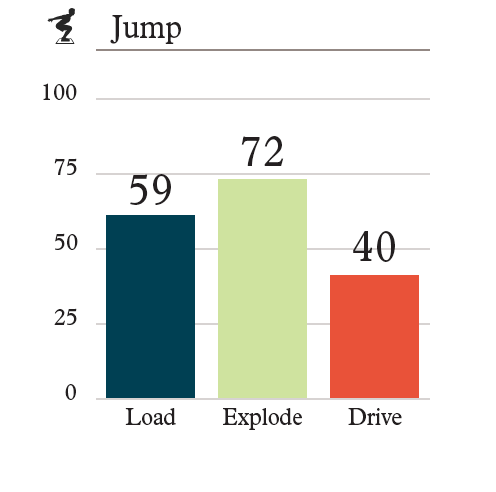
To undo the effects of practice and focus on harnessing power and health, I would prescribe repetitions to help prevent them from becoming so stiff that general movement performance declines. A heavy travel schedule could add to the athlete’s overall stiffness, as well. The program would focus on time under tension (to increase drive) with the goal of developing elasticity and fluidity while performing the sport.
In-season program to offset practice and competition reps
The goal of this resistance training program should be to enhance an athlete’s power expression by increasing the drive variable. Build programs around these key movement types:
- Systemic mobility
- Hinging patterns
- Unilateral movements
- Posterior chain strength
- Long-response plyometrics
- Concentric-only exercises
- Time under tension
- Full ranges of motion
- Exercises that require stability (OH squat, OH split squat)
If one or two of the KPIs becomes too high or too low, the chance of injury increases. The goal is to correct the asymmetries. Ultimately, this may be the most general sports performance program for basketball, but it can be the most specific program for athlete health.
In-season program to enhance practice and competition reps
On the other hand, if the basketball player lacks the appropriate movement signature and has lower reactive strength capabilities, I would prescribe increased performance reps – short, ballistic, loaded – in the weightroom. I would also focus on torso / core strength.
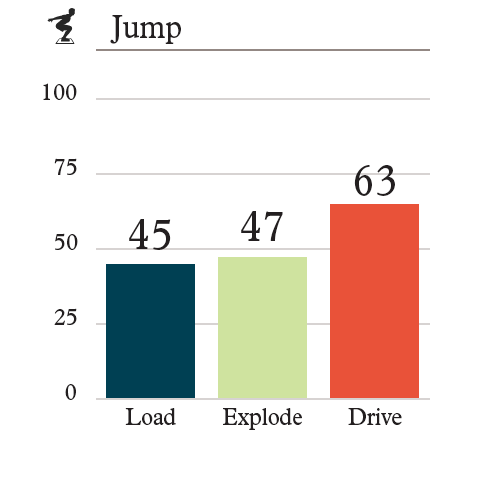
These athletes will benefit from exercises that build a robust torso to diminish leaks in the system. The intent is to create a more powerful athlete. Although many times this type of athlete may easily express their movements through full ranges of motion, they may lack sufficient strength for higher vertical ground reaction forces. For this type of athlete, focus on increasing the load or explode variables (they respond similarly):
- Anything that involves systemic flexion and extension
- Heavy loads (squats, rows, carries)
- Bilateral movements (front and back squats, deadlifts)
- Short-response plyometrics (depth jumps to limit time on ground)
- Eccentrics
- Anything to build robustness throughout the torso.
- Bracing to anti-movement holds (wall sits, anti-rotation holds, all planks)
- Heavy carries (farmer, suitcase, trap bar)
Ratchet between an off-setting program and performance-enhancing program once the desired force production changes appear. For example, if I have an athlete that has high load and explode, I will design a workout to increase drive. Once drive increases, I will switch back to a workout to increase load and explode again. If I have a high drive basketball player, I will design the workouts to increase load and explode. Once load and explode go up, I will switch the program to increase drive.
One does not have to rely on force plate technology. A coach or athlete can evaluate if the desired effects of the training program are manifesting when movement becomes more efficient in the sport; through video comparison of a countermovement jump’s sequencing is changing; by determining trends in game statistics; or by simply asking the athlete if they are performing better.
Vertical jump analysis: Study the jump, not the height
At this point in my career, I do not care what an athlete’s vertical jump height is. What I find most important is the sequencing and interactions of variables, and the asymmetries that exist in power development. Creating training programs throughout the year to optimize and harness power output can be complex, given the many variables to consider.
Hopefully after reading this article coaches will learn to appreciate different ways athletes produce power and understand that, just as with music, there are many different ways to appreciate it.