

Firstly, if you haven’t read the first part of this 2-part article series, check out part 1, “Using velocity based training for player and team assessments“.
Perhaps the most appropriate name for what a lot of people perceive to be velocity based training (VBT) is actually intent based training.
But that just doesn’t sound quite as catchy, only captures a fraction of what VBT methods can accomplish, and, ultimately, all other training could be intent based without the use of velocity. Nevertheless, a primary purpose of optimizing velocity as an output is to drive the athlete towards maximal intent across a range of loaded conditions in order to produce the maximal amount of force over the shortest amount of time. Velocity is an important feedback mechanism to drive this process.
Simply including visual and verbal feedback of velocity can improve athlete output during training sessions, which in turn improves physical adaptations across a training block compared to those who receive no feedback [1–4].A simple feedback loop built around a VBT tool displaying velocity may enhance your training process. There are a number of ways to do this when integrating VBT into training sessions.

Athletes intend to win: Creating competition through VBT
A practical element of the feedback process is creating competition among athletes [2],. This requires little to no formal education or understanding of the underlying VBT processes, and can essentially be a plug and play system for the athlete. Intra-individual and inter-individual competition both have their place within a session.
Most coaches group individuals with similar strength levels as training partners to maximize usable time during their training session. That means there are ready made match ups on the weight room floor, e.g., lift faster than your partner at the same absolute or relative load.
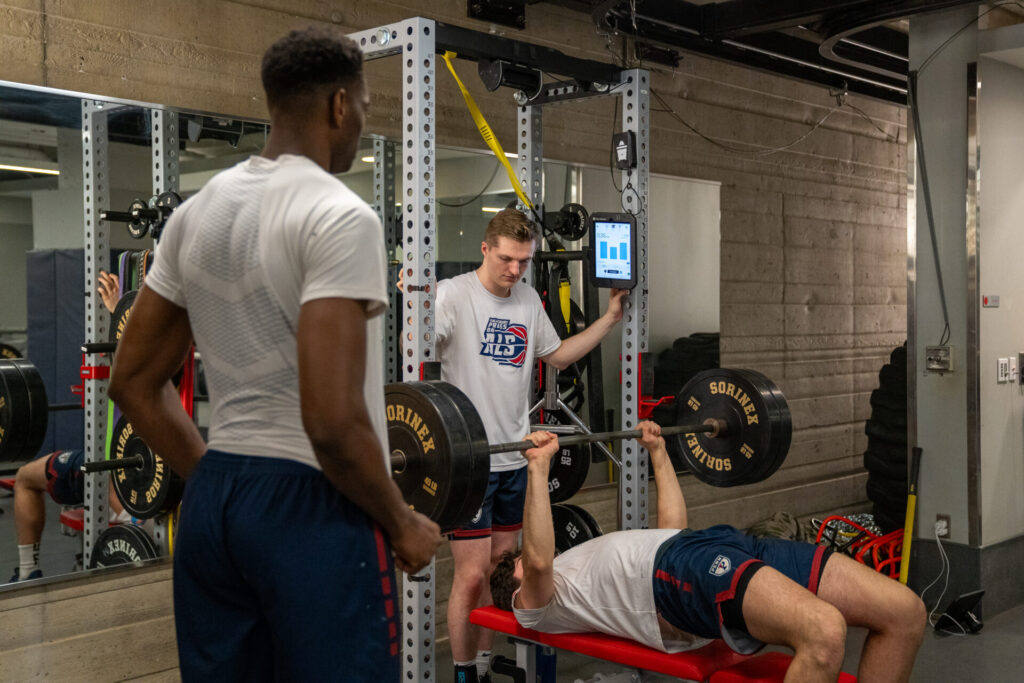
A number of VBT tools offer the option of live leaderboards and instantaneous feedback during the session. We put live leaderboards on the TVs around the weight room using the Perch platform to provide within session feedback to all athletes in the group. This simple addition creates some organic discussion, excitement and competition.

I usually put up two leaderboards during the session, separated by load ranges (warm up sets / lighter loads or the heavier working sets), displaying the primary variable of interest, such as mean velocity for bench press. This is particularly effective in increasing the athletes’ intent during “warm up” sets. Because they now apply maximal intent to every rep, we don’t call it a “warm up” anymore – it’s now session preparation.
Even if this option is not available to you in real time, just having an athlete see their peers hit a higher velocity can instantly create competition within the training group without much work on the coach’s part. This is particularly effective for athletes who are extrinsically motivated. Pairing more mature athletes with younger athletes can create extra motivation for the younger athlete to work towards their goals, while the senior athlete acts as a secondary coach in this arrangement.
At the individual level, beating your previous rep or set average is a simple way to establish intent without using any specific goals or thresholds. The athlete can then work across the rep range with the intent to maximize every repetition, with the instantaneous feedback making it like an interactive video game. This is most effective for intrinsically motivated athletes.
As an example of using this for cluster set formations, if the athlete has two or more consecutive lower velocity reps, we pause the set for a designated rest period, usually 10-30 seconds, before completing the desired rep range for the set. If the athlete fails to return to the desired velocity range, they should probably have more rest or the coach should terminate the set.

This is a different twist on the use of velocity loss, sidestepping the need for a general cut off percentage or threshold. In this case, the athlete is approaching each repetition with the intent to maximize their output. When they fail to reach the output, they can rest in order to maximize the intent of the next set or rep. This is the easiest and most practical form of autoregulation in this category, and a sure way to get your athletes to engage in the practice of intent.
Tweet ThisCreating competition in training with VBT not only motivates but also elevates athlete performance through direct feedback mechanisms
@CTsportsci
Setting guidelines for the competition
While both of these methods create competition, there are some potential drawbacks. First, with competitive intent, the primary focus on velocity may change the optimal degrees of freedom within the lifting technique. While competition is a good thing, it should not compromise correct movement technique and execution of the given exercise. Good athletes generally find ways to be faster by changing their movement strategy, which may not always be optimal in terms of risk.
For example, athletes can perform dead lifts with a more bouncy technique between reps, potentially causing them to lose torso control in an attempt to rapidly generate more force to improve their velocity output. This may be permissible in some settings, but for our purposes it strays too far from the optimal technique.
Another example is more complex lifting movements, such as Olympic lifts, that require a technical component. Focusing on generating more speed may compromise technical execution and the athlete’s potential to first learn correct positions. Therefore, it’s important for coaches to pay attention during training sessions and ensure the athletes stay within the realms of appropriate execution. Don’t sacrifice your coaching principles chasing higher velocities.
Given intent is the primary goal through competition, there may also be times in the year that competition isn’t the main focus or is not achievable within your session. For example, a starter with a high volume of playing time may have a different training focus in season and, therefore, may not be as high on the leaderboard as an athlete who does not play and who is looking for an outlet or opportunity to rise within the team.
With this in mind, it may be more favorable to use other methods to drive intent within your session, including velocity loss thresholds or specific velocity zone targets that can be more specific to the individual.
Tweet ThisIntegrating VBT in sessions promotes a culture of competition and progress, with live leaderboards sparking motivation among athletes
@CTsportsci
Velocity loss thresholds guide coaches and athletes
Velocity loss thresholds are a graded percentage of velocity. If an athlete’s velocity of movement within a set drops below a threshold, coaches can cut off the set based on the decrement in velocity.
The use of general velocity loss thresholds in VBT could enhance different training adaptations. For example, physiological adaptations vary based on the specific velocity loss percentage employed [5, 6]. Raising the cut off threshold to 30-50% increased the volume of the session, i.e., the number of repetitions performed at a given intensity. This potentiates adaptations related to muscle hypertrophy. Conversely, a lower threshold (<20%) may display more favorable adaptations to dynamic strength and sprint based activities.
Velocity loss thresholds provide an alternative means of driving athlete intent. Velocity first sets a target zone to stay within, and then is the basis of whether and when to terminate the set.
Implementing velocity loss cut offs may depend not only on your desired training adaptation, but also where you are in your annual training cycle.
| Pre-season | In-season | Early off-season | Late off-season | |
| Starters (high minute players) | No specific velocity loss thresholds. Competition focus (leaderboards). Open sets with guiding velocity zones. | 10% threshold cut off | Individual training focus: 10% (repeated high intensity efforts >85% 1RM) <40% (open/extended sets; hypertrophy/strength endurance) | No specific velocity loss thresholds Maximal strength training focus At home training (no access to VBT tools) |
| Bench rotation (lower minute players) | 10-20% threshold cut off (cluster set format with rest; terminate set when unable to reestablish threshold) | |||
| Bottom of the bench (no playing minutes) | <30-40% threshold cut off (straight sets/all reps to be completed in cluster set format if below threshold) |
Establishing velocity based targets
Working with collegiate athletes – typically 18-22 years old with varying training ages and experience – a question I frequently receive is “What weight should I use for this exercise?”
This can be a challenge because I’m essentially guessing based on my experience and judgment of what should be good for a player of that age, ability and size based on historical normative information. It is particularly difficult with incoming freshmen whom I have never seen nor trained before.
VBT feedback lets me simply tell them to select a load they feel comfortable lifting and perform a number of reps as a warm up set. I then use the information to describe the relationship between velocity and intensity, and plan the progression from there. Contrary to the idea that VBT is an advanced methodology, in this case VBT is a guide to get us closer to the target and is a means to easily assess the athlete’s capability in that exercise.
VBT allows for a conversation about how they can continue to progress towards their training goal. Coaches can provide a specific target velocity that matches the desired intensity for the training goal, e.g., “Your minimal velocity threshold for this exercise is .3 m/s, so you should work between 0.5-0.6 m/s and not be close to maxing out.”
This becomes particularly useful for athletes who have less experience with heavier lifting intensities. Other methods like RPE and reps in reserve may affect the athlete’s intent or motivation because they perceive they can’t go higher. Meanwhile, they are lifting at higher velocities than what we’ve determined are the limits of the exercise. Athletes now have a reinforcement tool where the coach can encourage them to push themselves, as there is more velocity left in the tank. This works even with the least experienced athletes.
We can also use an individual’s observed load velocity profile to establish these targets and loading progressions. Once we have at least one session’s worth of data, we can begin using the profile to drive intent.
Predicting velocity from load
For a given load, we can predict the range of velocities that the individual should achieve based on a load-velocity profile (LVP) from their previous performances of that exercise. If we don’t have a profile for an individual, we can start with the group profile. A linear regression equation establishes this prediction and we can then program the desired loads we want the athlete to target for the session.

These targets kick off a feedback loop, which drives intent as the athlete has a specific target velocity. We provide a target velocity and a target range. Our model has an error of ~.05 m/s, so the target velocity ranges will overlap a bit for varying loads. This accounts for some of the rep to rep variability we see in the output data. We can also be less conservative with these ranges and use a lower confidence interval if, for example, an athlete never exceeds their prescribed ranges, indicating the thresholds may be too large.
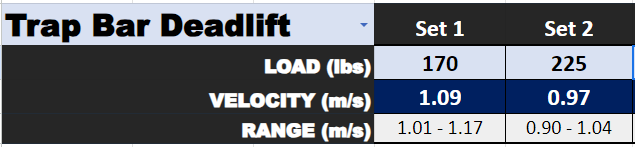
Our goal is to establish the heaviest load for a given velocity. This is our guide for deciding whether to change load: add load if they are on the faster end of the range for a load, regress / reduce load if they are not hitting the typical velocities.
Predict load from velocity
We can also work this equation in reverse, predicting what load range an athlete could use for a given target velocity.
Using a specific velocity target drives intent in a different way, as now the athlete is trying to find the maximal load they can lift for the given velocity. Incrementally increase intensity across reps or sets until they reach the target velocity. This creates flexibility within the program, as an athlete can use different loads to achieve the desired training stimuli for the day.

With the predicted load from velocity method, I like to program a “cluster” warm up set, which allows the athlete to get to the desired working intensity. This combines the methods of target velocities with a more specific load-velocity zone derived from the individual’s profile. I can set the suggested warm up ranges for a series of incremental loads across multiple sets with lower rep ranges (3-4 reps) and small inter-set rests (15-30 seconds) to adjust load until they reach their target velocity. This saves time in getting to the desired load for the working sets and provides a wide spectrum of preparation.
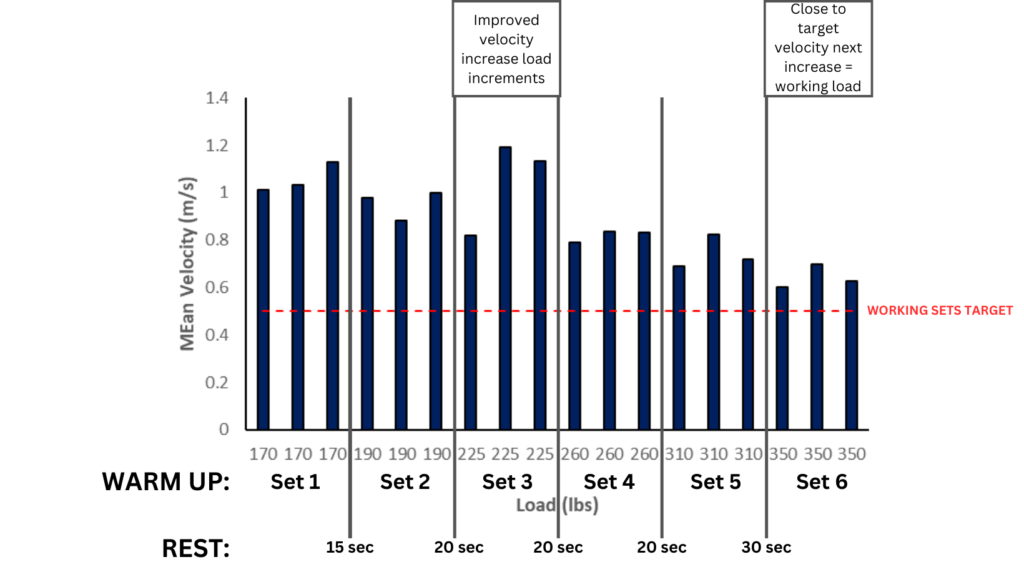
The cluster approach also provides a means to maximize the intent during lighter warm up sets, ensuring the athletes don’t just go through the motions. They now progress from lighter to heavier intensities before the main working sets. We can then begin to monitor progress longitudinally, using some of the same absolute warm up loads every session.
A progressive velocity based warm up is also a quick and efficient way to reach the desired load, which makes it relatively simple to determine the highest effective load for the given target velocity for the session. That additional information allows us to approach the target for that day’s training; and avoids methods which may waste time, e.g. increments that are too small, based on an abundance of caution or uncertainty, or increments that are too big in an attempt to save time.
Tweet ThisThe key to VBT lies in its ability to make training interactive, akin to a video game, pushing athletes to surpass their previous bests
@CTsportsci
Combining load, velocity and thresholds into programming
Coaches can use each of the approaches above either in isolation or integrate them with their current training process. My previous article introduced “Gain – Maintain – Restore” to guide which program an athlete should complete for the day. We can build on that here.
| Restore | Maintain | Gain | |
| Volume | <3 sets x <4 reps | 3-4 sets x <6 reps | 4+ sets x open rep ranges |
| Intensity | Light – moderate (>0.8 m/s) | Moderate – high (~0.4-0.6 m/s) | High (<0.5 m/s at <90% MVT for exercise) |
| Preparation (warm up) | 3 rep warm up with >5 secs between each rep | Cluster warm up (2-4 reps per cluster) goal: <0.6 m/s | Cluster warm up (4-6 reps per cluster) goal: <0.5 m/s |
| Competition | 1 rep lower than previous: between rep rest 20-45 secs | 2 consecutive reps lower than the one before: between rep rest 20-30 seconds | 3 consecutive reps lower than one before: between rep rest 10-15 seconds |
| Velocity threshold | 10% velocity loss: Terminate set | 10% velocity loss: 30 secs rest before one attempt to continue | 10-20% velocity loss: 10-15 secs rest |
| Overall objectives | Maintain intent through lighter loading scheme; maximize single repetitions | Complete all assigned reps within one cluster | Complete all assigned reps using infinite cluster format |
This may seem like a lot for the athlete to remember. We do not always need to use all of these approaches at once in our programming.
Prior to the session, add each program (Gain / Maintain / Restore) into the individual’s profile in your athlete management system, with the suggested set and rep schemes, loads, and notes on target velocities. With a VBT system like Perch, set the velocity loss percent threshold on the individual’s profile so it will notify the athlete when they fall below the threshold (this is adjusted to reflect which training group they are in at the start of the session).
Place each athlete’s suggested load progression, target velocity and load ranges at the rack. Direct the athletes to assist their training partners by starting and stopping the VBT device, and adjusting the exercise in their rest periods. This is particularly useful in a low rest activity like the cluster warm up section, where the training partners act like a pit crew.

This creates useful interactions between the athletes and their data. Just showing three different training options instills more belief in the athletes about the program. They apply the necessary intent despite not always being able to push their intensities linearly every week.
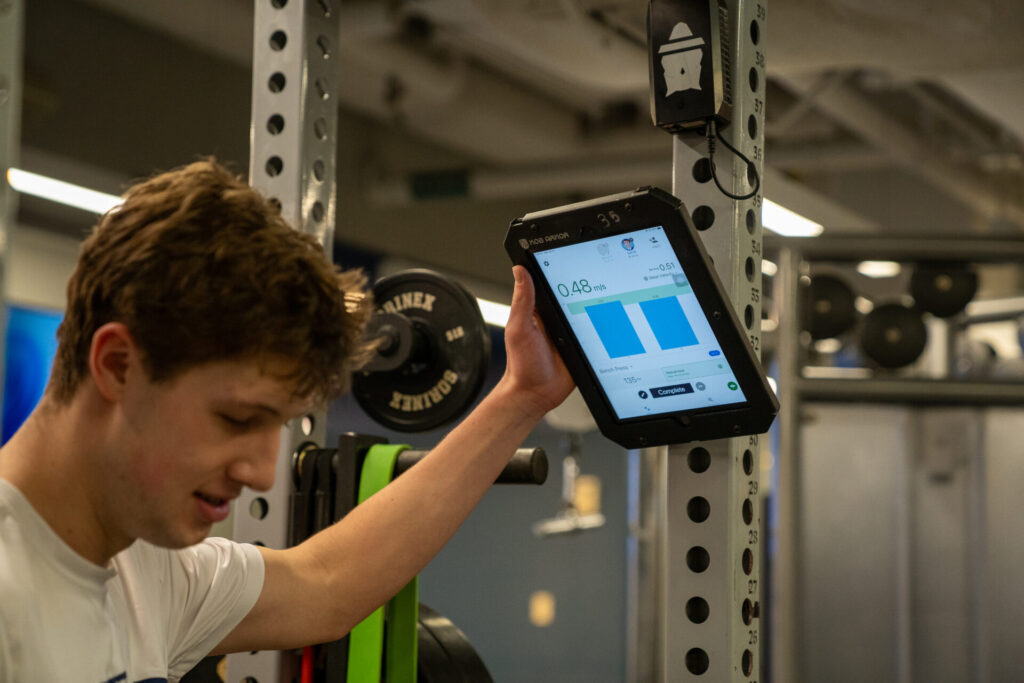
When we talk about velocity, we talk about intent
A variety of VBT methods can help drive intent within your training. Some are more easily implemented than others.
Simply aiming to be faster than your previous rep with a defined “rule” of resting if there are X consecutive reps lower than the previous is a plug and play method that doesn’t require much thought for the athlete. Similarly, creating a competitive environment through a leaderboard can also enhance the intent approach to training, not allowing athletes to hide.
Most VBT feedback tools incorporate this functionality, along with zones and ranges that can also signal to the athlete when they are faster or slower than what is desired for the day. This, again, drives intent for every rep and helps the athlete stay within a specific threshold.
Additionally, predicted ranges offer a more individualized target for the athlete and can help determine the intent to push (or pull) during the session. This also maximizes the session as the athlete applies intent to lighter loads, letting them hit a range of velocities across the load velocity spectrum.
Start simple and then add layers as your athlete becomes more comfortable with the nature of the data. Reserve some approaches like velocity loss thresholds for specific times within the training calendar that may require a greater level of detail to the training process.
Tweet ThisVBT offers a nuanced approach to training, allowing athletes to adapt their intensity and focus on precise improvements in speed and power
@CTsportsci