For team sport and sprinting coaches, what we see and how we communicate it are of the utmost importance. Our coaching eye combines with the dialogue we have with the athlete in front of us drive performance outcomes.
The term “coaching eye” is quite common in coaching circles, but is hard to define. It is the holy grail of sports performance coaches’ attributes, separating the good from the great, the legends from the novices. Being able to watch someone run past you at 22 mph and spot the most minute details that will push their abilities and skills higher takes years of practice and repetition.
Dan Pfaff is one of the greatest sprint coaches to do it. He attributes this ability to five KPI’s:
- Recognize familiar patterns of movement quickly and accurately.
- Identify and classify unfamiliar movements.
- Accurately recognize shapes and patterns of movement from different angles.
- Identify patterns when they are a part of a more contextually rich environment.
- Recognize atypical patterns.

We are all striving to improve our coaching eye and recognize its importance. It’s an art built atop an intuition that is specific to each coach. If it takes multiple years (if not decades) and hundreds of athletes to develop this fully, how do we expedite the process or at least ensure that we are giving the proper insight and actionable interventions that will drive positive change for the athletes we are working with right now?

Video bridges the gap between raw visuals and a trained coaching eye
Coaches need to have the same desire for metrics on the field as we do in the weight room, where we track load, volume and the others. Video analysis closes the distance between our coaching eye as it is today and where we want it to be.

Debriefs with athletes, support staff, coaches or other stakeholders require us to have objective measurements that paint a picture of what happened in training. Coaches want to be able to show improvement, track key performance metrics and measure rehabilitation goals all while disseminating this information to multiple areas. Therefore, we need consistent and clean data and video to be the backbone of our presentations to show real progress and quantify performance and rehabilitation.
If the field of play is where athletes break down, and the way we load our tissues matters, then measuring movement strategies on the field becomes top priority. It is no longer good enough to make athletes fit and fast – they must be efficient, resilient, healthy and confident athletes. We have distilled some key priorities from our processes over the years:
- The more efficient our athletes are and the better they are technically, the healthier they will be.
- Rehab is performance and performance is rehab.
- The better they can apply force in the right direction at the right time, the better performers they will become.
- The more they can put themselves in orthopedically sound positions to maximize the use of elasticity and free energy, the more robust they will become.
- Add speed, load and intensity on top of optimal function, not on top of dysfunctional movement strategies.
We would never eyeball jump height, RSI or Nordbord peak force. We wouldn’t leave it up to a feeling or a subjective measure. We surely can’t do the same when it comes to sprinting.
The key questions for this article are: What metrics should we be looking for? What metrics should we use to analyze and challenge our bias, to learn and grow as coaches? What metrics help us determine healthy and efficient performers?
Tweet ThisIt is no longer good enough to make athletes fit and fast – they must be efficient, resilient, healthy and confident athletes
@coachrgrubbs & @EatSleepTrain_
Projection: How the athlete moves on the ground and through the air
For years we have talked around the concepts of projection, switching, and reactivity. More simply, what are the athletes doing in the air vs. on the ground? A sprinting athlete is either pushing on the ground to propel forward in space, or is preparing in the air for the next contact to continue the cycle over again.
Observing the basics of projection
Projection, which is essentially displacement, is one of the most fundamental aspects of acceleration, going from point A to point B and pushing your hips horizontally. We like to use the words “powerful” and “forceful” to describe athletes who have high levels of relative strength in ankle, knee and hip extensors, and who can essentially turn themselves into a projectile.
Distance and range are extremely important when talking projection. Can an athlete cover a large distance and make big shapes? Big shapes and expansive ranges allow athletes to create large forces and wind up to attack again and again. As a result, these visuals are the ideal target for the coaching eye training to observe projection.
When looking to the kinematics and merging your coaching eye with the video, did the athlete go forwards, and how far? Do their hips, shoulders and body all launch forward aggressively, or is something inhibiting this from happening? The best sprinters are able to go forward far and can continue going forward as they rise gradually. Stu McMillan calls it “Rhythm and Rise.”
Many variables describe and influence projection: distance travelled, what is happening on the ground and what actions are happening behind the body.
Hip displacement vs. step length
Hip Displacement. Horizontal distance the hip moves with each step.
Step Length: Distance between take off and touchdown on each step.
Hip displacement and step length are two similar measures in terms of what they attempt to portray. These are outcome-based measures, and are the most representative of overall projection. They capture the “what” of projection, not the why.
Coaches should track both of these metrics, but use hip displacement as the prevailing marker when attempting to quantify projection. Step length does not account for where the hips are going. The ratio of these two metrics, though, quantifies how they interact. The smaller the gap between step length and hip displacement, the more efficient the step length is to driving the hips forward in space. We do not want to see a big step length with a small hip displacement. We tend to see smooth step length data when this ratio is small, and zig-zagging or otherwise non-smooth data when the gap is wider.
The question then becomes whether the athlete is creating a big step length by reaching in front or attacking back to project the hips forward? This derives from the relative strength of the ankle, knee and hip extensors and trunk stability.
Tweet ThisThe smaller the gap between step length and hip displacement, the more efficient the step length is to driving the hips forward in space
@coachrgrubbs & @EatSleepTrain_


Contact hip extension angular velocity / Hip extension at takeoff vs. Late extension thigh angular velocity / Thigh extension at takeoff
Contact hip extension angular velocity: the angular velocity the hip travels through during ground contact in relation to trunk angle.
Late extension thigh angular velocity: the velocity the thigh moves through in isolation during ground contact.
Thigh angular velocity has gotten a lot of attention lately due to the work of Dr. Ken Clark and his research team. This is for good reason given how efficient the thighs are. What they do during ground contact will have a direct effect on hip displacement.
The thighs will tell a story, and the more efficient they are, the more efficient and effective the athlete’s projection becomes.
We want to isolate the thighs when thinking about projection without the influence of a tilted or vertical trunk. Doing so makes this component of sprinting more relevant for team sport athletes who may have relatively upright trunks yet still need high thigh velocities. For example, if a player has lots of back extension in a vertical manner, he or she can boost the hip extension angular velocity without affecting projection outright. By isolating the thighs we can observe true hip extension ranges, where the goal is a large range of back side movement by pushing the ground away, not extending the spine.

Jonas Dodoo uses the phrase “bum before back” to cue the athlete to use his hips – not the erectors – as the driver. We develop a proximal-to-distal strategy with the glutes as the main mover, and let the lumbar and back provide support via a secondary role.
When looking at thigh extension, particularly late extension thigh angular velocity, we are not just looking for big ranges. Big range with a long wind up comes at the expense of acceleration abilities. Instead, we are looking for athletes who can move through big ranges on the ground quickly, with the ground slowing their thigh as little as possible. We often cue our athletes to spike their ground forces and intentionally not let the ground slow their thigh sweep behind the body. By having a fast late extension thigh angular velocity, they create significant fast eccentric forces through the anterior hip, kickstarting the punch of that same stance leg once it departs the ground.
From a physical perspective, the relative strength and RFD of the hip extensors is imperative. What you do in the gym can have a direct transfer to this skill?
How many times do you see athletes in the gym use their backs and arch hard to lift their chests instead of using their glutes to extend the hips through? By reinforcing good patterns in the gym, you can transfer these patterns to the field. Using the erectors to extend the spine and letting the knees roll forward to push only adds strength on top of a faulty movement strategy. Transferable patterns – a stable knee and back, with the glutes and hamstrings extending the hip – are the foundations of strength and speed.
Tweet ThisTransferable patterns – a stable knee and back, with the glutes and hamstrings extending the hip – are the foundations of strength and speed.
@coachrgrubbs & @EatSleepTrain_
Contact hip extension angular velocity example
This video shows an athlete with a low late extension thigh angular velocity that leads to poor hip displacement. Knowing the equation for thigh angular velocity – actual range of motion / duration of movement – opens two routes of attack: increase range on the ground in the same time period or go through the same range faster. Either route will increase this low late extension thigh angular velocity and lead to higher hip displacements.
If we choose the first option, we can intervene to create more thigh extension on the ground. This will satisfy the range component and lead to larger hip displacements through a bigger thigh sweep behind the body.
Cueing is effective, sometimes more so than a particular exercise, and the right words will elicit a certain feeling or response from each individual athlete. “Push longer” will attach the athlete to using the ground to their advantage to push themselves forward instead of ripping the leg away too soon. The athlete must increase range of motion between the thighs by “pushing back” against the ground more aggressively. This will enable greater force production.
The alternate option, which can be used in conjunction with the first, is to move through the range of motion faster. This will satisfy the time component and establish an urgency that may seem counterintuitive to “push longer.” But by cueing the athlete to have a more rapid early extension thigh angular velocity (the velocity derived from the apex of the thigh to ground contact) and “whacking the ground from above,” we create the speed and pretension necessary to set up the ground phase. The aim is to create pretension through the foot and ankle, land closer to the midline, and minimize braking all while creating an environment to increase RFD.
From a physical perspective, we want to add external resistance to provide a constraint to the system in which we must create large ranges of motion (particularly in thigh extension) to push the hip forward in space. We are concerned with system stiffness for transmission of forces, but our thoughts are notably drawn to the hip and its ability to create large forces quickly. Below are a few physical interventions placed upon the athlete, from least specific to most:
Toe off orientation vs. Touchdown orientation
Toe off orientation: Trunk and shin angles when departing the ground.
Touchdown orientation: Trunk and shin angles when contacting the ground.
These two measures occur at different time points in the stride cycle, and are extremely valuable in tandem with one another. By looking at both measures and how they relate, we are seeing change in angles during ground contact and how the athlete is handling the ground with each stride.
The trunk and shin are the sprinter’s compass, directing forces and showing the angle of force application. J-B Morin’s research and frameworks around ratio of force (RF) have become foundational for quantifying the orientation of forces.
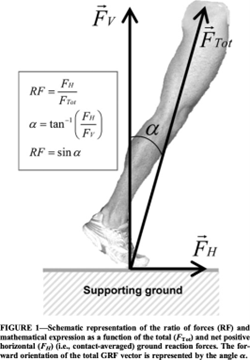
We want to compare the two measures and quantify their relation to each other as a signal of the stiffness on the ground. We talk a lot about shin and trunk discipline, notably during the first four contacts. A soft contact, or a contact well in front of the center of mass, will lead to a large compression and rolling of the body, followed by elongated time on the ground. The end result are compromised hip displacements due to energy leaks around the ankle, knee and hip.
A small difference between toe off and touchdown angles in early acceleration indicate good shin and trunk discipline.
Physically, having the pillar strength to keep a quiet spine and being able to “pin the shin” will lead to small changes in toe off and touchdown orientations. The trunk stabilizes and rotates while coiling and releasing energy to prevent a collapse of the torso. Can the knee extensors and plantar flexors tolerate the high eccentric moment on touchdown in deep knee and ankle angles? Training these physical qualities will allow for a stable platform to handle ground reaction forces.
Orientation example
The athlete in this video struggles with toe off and touchdown orientations, which lead to poor hip displacements. The forces are too vertical and too early, limiting his ability to go forward in space.
Projection is about balancing the considerations around air time. Air time has a bounded bandwidth. Too little time in the air and you sacrifice hip displacement because you don’t have enough space. Too much airtime and you run the risk of taking too much space and not going forward. Ideally, athletes want to go as far forward as possible with the minimal amount of air time necessary to reposition the limbs and get back to the ground to continue going forward. This athlete is wasting too much time in the air.
We want to cue this athlete to “push back aggressively” to rob some time in the air, orient more force horizontally, and create a larger hip displacement. Very gifted and elastic athletes who have a little less hip extension power and those who aren’t as forceful can get away with this because their elasticity covers the deficiency in force production. Couple this with the fact that having no fear and going horizontal is also a gift, and we want to slowly nudge most athletes to produce forces forward rather than up in early acceleration.
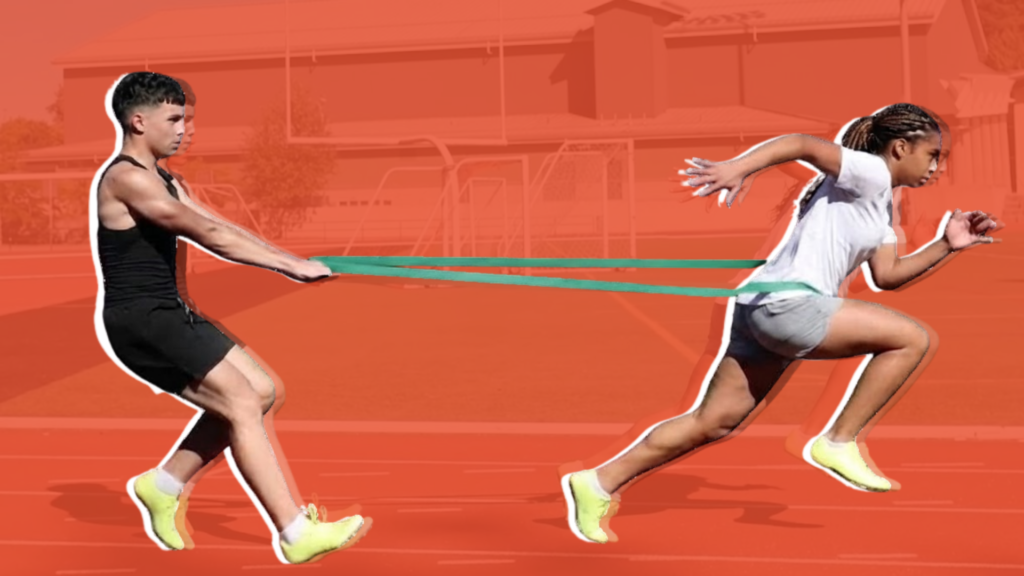
Resisted work with the harness attached around the shoulders may seem counterintuitive: if loaded heavily, the harness will actually pull the athlete vertically, reinforcing the problem and precluding forward movement. We also want to potentiate technical abilities. The athlete must counter the line of pull running through the shoulders and torso by orienting the shin and torso horizontally. When the harness is taken off to rehearse the strategy in unresisted runs, the feeling of horizontal forces will carry over.
A second exercise intervention involves the 1080 Sprint. The 1080 Sprint’s variable resistance increases the load across the run as velocity increases. This creates a demand to not pop up vertically too quickly because the athlete has to continue propelling horizontally as the load gets heavier and heavier. Ultimately, we can instill in the athlete a mentality of accelerating deeper into the run by orienting forces horizontally.
We round this out with a healthy amount of general preparation around the hips, knees and ankles. Ensuring that our athletes can not only handle but produce large forces is imperative if we are to get them to use the ground to their advantage.
Tweet ThisToo little time in the air and you sacrifice hip displacement because you don’t have enough space. Too much airtime and you run the risk of taking too much space and not going forward
@coachrgrubbs & @EatSleepTrain_
Peak ankle deceleration vs. Resultant peak ankle acceleration
Peak ankle deceleration: Deceleration of ankle flexion during ground contact.
Resultant peak ankle acceleration: Ankle extension during ground contact.
Similar to toe off and touchdown orientation, these measures compare what is happening in preparation for and at ground contact vs. what the ankles do when they come off the ground. Ankle deceleration looks at stiffness and force absorption at the ankle. Can the athlete handle the ground? Ankle acceleration is looking at propulsion and force expression at the ankle. Can the athlete get off the ground?
The ankle and foot need to be able to handle the large forces the hip generates and minimize energy leaks. Some compression is valuable and warranted, but an athlete who compresses too much will bleed energy and force on the ground and fail to utilize the stored elastic energy in extension.
As Marcus Pandy (2021) wrote:
“The ankle plantar flexors played a major role in achieving maximal effort accelerated sprinting. The soleus acted primarily as a supporter by generating a large fraction of the upward impulse at each step, whereas the gastrocnemius contributed appreciably to the propulsive and upward impulses and functioned as both accelerator and supporter.”
In this study, up to 65% of the vertical impulse contribution came from the soleus and gastrocnemius.
In early acceleration, attacking the foot back towards the hips facilitates the pretension in the ankle and foot. The pretension the athlete creates by driving the foot back sets up a beneficial ankle deceleration ability. By preparing and stabilizing early, the athlete will reap the rewards of utilizing all that elastic energy in ankle acceleration.
A solid base underpins the confidence to attack the ground. Neurologically, the brain will not allow you to attack the ground with high forces if it knows the ankle cannot handle the blow. Traditional strength & conditioning has made it easy to ignore the foot by debating things like Olympic lifts vs. jumps, or squats vs. no squats. Strong athletes with a weak foot-ankle complex are better off landing further in front, compressing a bit and then using concentric action to push off the ground. This is what you see often in athletes who bounce up and down and seemingly get stuck on the ground with a low hip height.
A more efficient strategy is using a rapid stretch and contraction of the Achilles to load and slingshot the heel forward. The ankle complex goes through a triphasic action from deceleration to acceleration. It eccentrically absorbs force on contact, isometrically stabilizes to support the hip travelling over the foot, and finally concentrically contracts to plantarflexion.
The more trained the three phases of this triphasic action, the cleaner the ground strike.
Tweet ThisStrong athletes with a weak foot-ankle complex are better off landing further in front, compressing a bit and then using concentric action to push off the ground
@coachrgrubbs & @EatSleepTrain_
Ankle deceleration example
The athlete in this video has poor ankle deceleration, which causes him to bleed forces on the ground and severely limits hip displacements. This could be a two pronged issue:
- Technical issue stemming from too large of a touchdown distance;
- Physical issue stemming from a physical limitation in RFD and eccentric strength around the ankle or foot.
Technically, we are certainly looking to clean things up through “pushing faster” on the ground and “whacking back faster” from above the ground. By attacking the free leg faster and more aggressively back, the athlete lands closer to the midline to reduce braking with stiffer ankles. By pushing faster on the ground, he increases RFD with a faster attack to create more pretension in the foot and ankle. This will create a more stable base to minimize heel drop.
Of course, there needs to be some amortization and dampening on impact to load the foot and Achilles properly, but it once again it comes back to bandwidth. Too much or too little, and you are leaving valuable performance on the table.
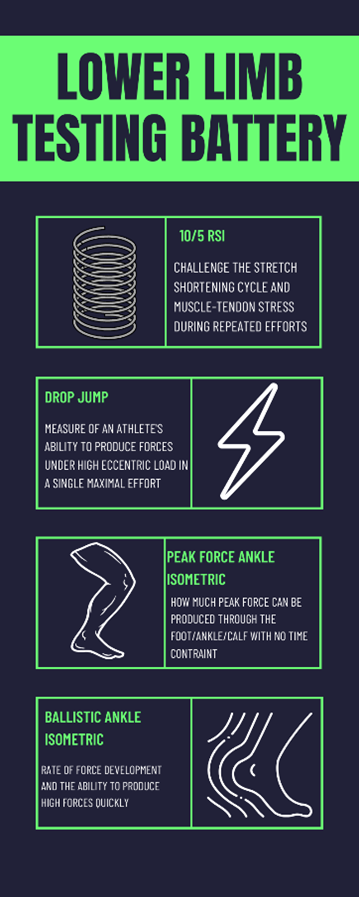
By evaluating system stiffness and lower leg capabilities through a battery of testing, we can tease out whether the athlete has the general capabilities to handle the ground in an environment that minimizes technical influence as much as possible. The four tests below have been a great complement to evaluating lower leg capabilities.
Technical changes to enhance sprint speed
Creating technical changes can be difficult. They can take time and patience, but are among the most fruitful endeavors that you can undertake to improve an athlete’s performance and health.
Coaches will need to couple technical interventions with physical interventions to truly give the athlete the ability to realize and express these concepts in movement. Cueing can be powerful and can drive the actions we are looking to achieve, but you cannot cue an athlete into a position that they don’t have the physical tools to achieve. Upgrade the software and the hardware.
Projection is only one piece of the linear sprinting piece puzzle. Projection, switching and reactivity encompass the framework of sprinting efficiency. It is one thing to run from A to B quickly. It is another to do so with efficient mechanical movement that optimizes the stress and load placed on tissues.
Team sport sprinting requires more than just straight line running speed. The ability to decelerate, stop and turn in multiple vectors, all while responding to very specific stimuli, is the heart of “game speed” ability. Even so, game speed still falls back to linear running speed. It is the ability that has a knock-on effect to every other sporting action.
Being fast in a straight line doesn’t guarantee an athlete will be agile in tight spaces, nor does it guarantee that she will be able to make decisions in response to an opponent. But linear speed in the context of a vertically integrated model raises the ceiling of those qualities. All else being equal, the faster athlete has the ultimate advantage.