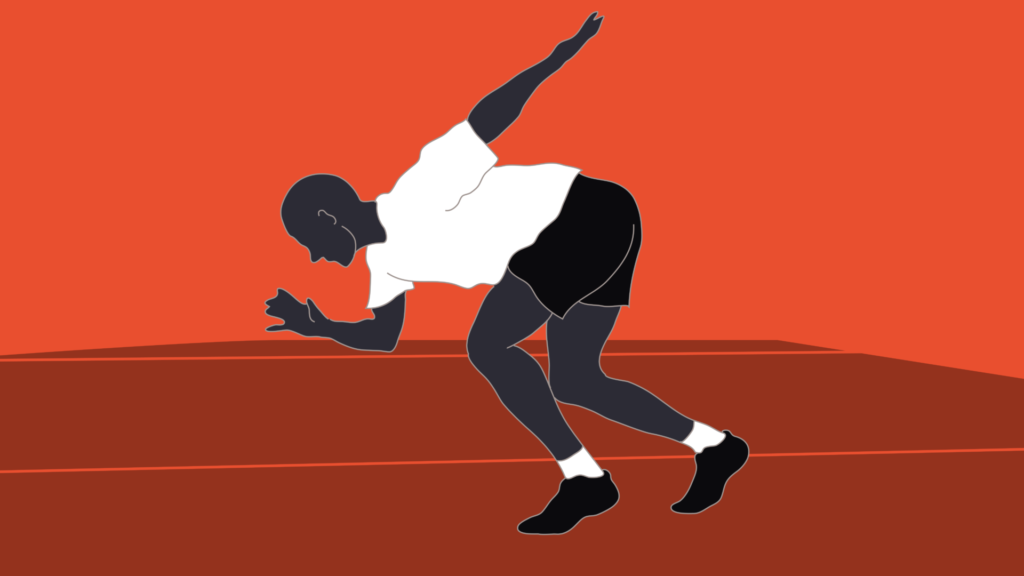
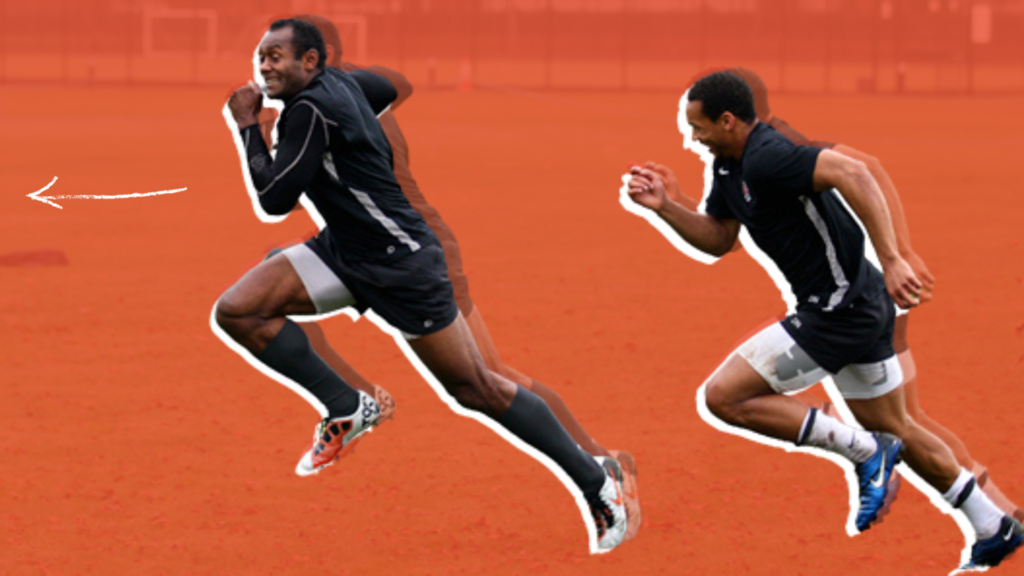
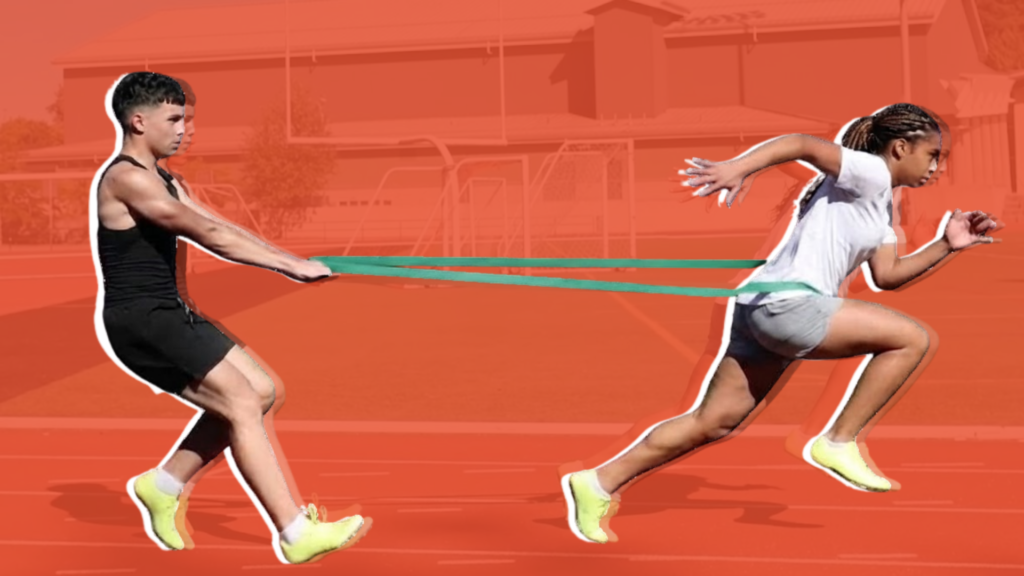
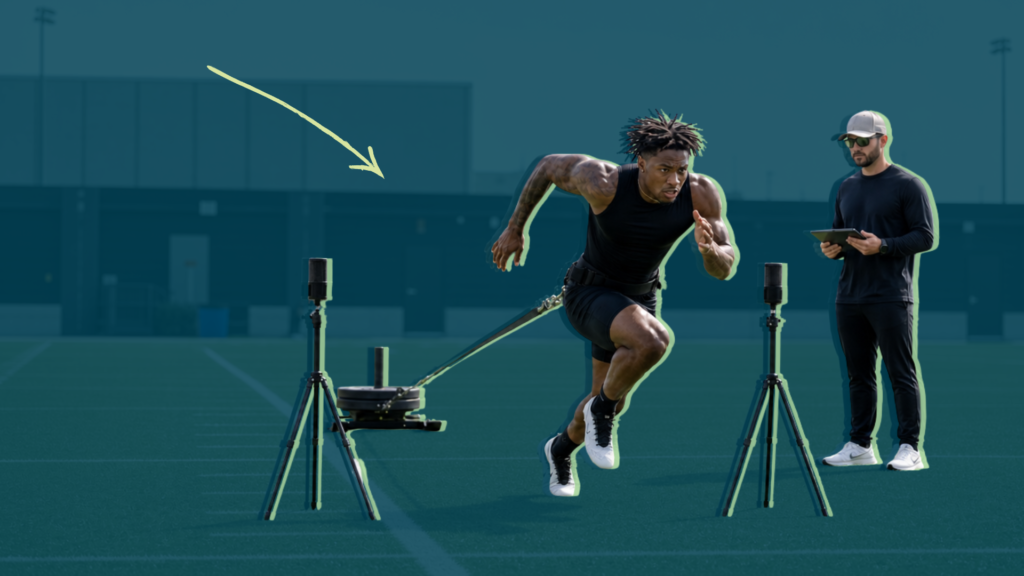
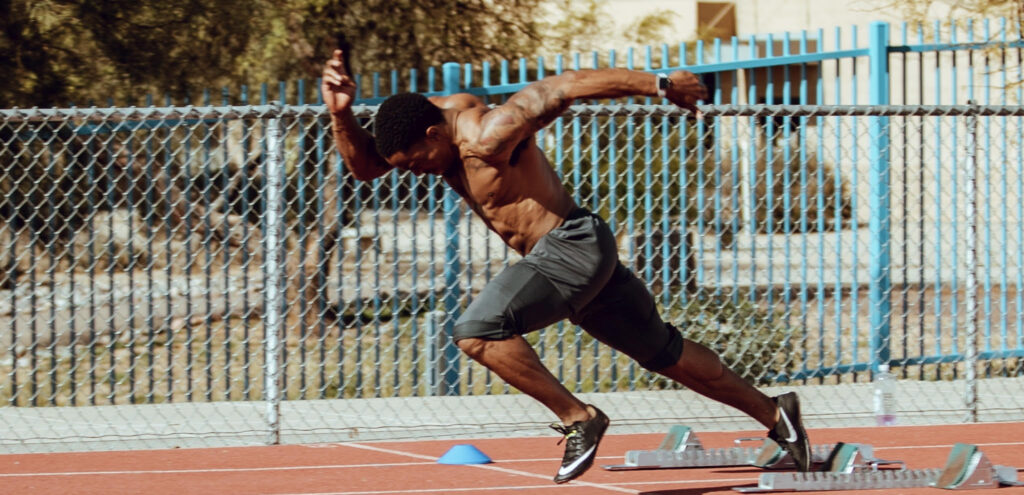
About a decade ago, I began to loosely categorize sprinters into either “push dominant” or “pull dominant,” sometimes called “pushers” or “pullers”.
Over the past few years, there have been a number of misconceptions and distortions of what this categorization means. The three primary areas of confusion tend to be:
- Thinking “push” and “pull” are binary choices, that an athlete is either 100% one or the other;
- Using “push” and “pull” to describe the actual kinematic outcome of an athlete’s sprinting, i.e., the “puller” “attacks the ground,” while the “pusher” waits for the ground, and then “pushes it away.”
- Taking these terms too literally. “Pulling” does not mean the athlete “pulls” the track back, like the old “clawing” cues. Rather, they relate more to the feeling of being “pulled” down the track, rather than pushing themselves down the track.
This article provides a brief overview and slight update of my push-pull categorization.
While many of the concepts discussed later in the piece are specific to track & field, coaches of team sport athletes will still benefit from understanding the specifics. And even though it is not a formal scientific study of the topic, the ideas adhere to sound scientific principles. That said, sometimes coaches take a leap of faith, with the belief that sometimes “efficient practice precedes the theory of it; methodologies presuppose the application of methods (Ryle, 1949).”
Like with a lot of what we do as coaches, some of the ideas are still somewhat speculator. They are not the final objective word, but an effective and practical way for coaches to better understand how athletes move and perform, and how they can use this information to help with their coaching instruction.
Categorizing creates frameworks for understanding and communication
Catagorization helps us to recognize, differentiate, and understand our surroundings. It reduces all the complex information into more manageable chunks, so we can make better sense of the world around us.
In sport, we use categories all the time. For example, in strength & conditioning, coaches may categorize exercises into upper and lower body, and single-limb or double-limb.
They often further divide them into the following categories, among others:
- Pushing
- Pulling
- Squatting
- Hinging
- Carrying
- Rotating
Such a system helps coaches to organize their training programs, and – importantly – aids in developing a common language to which they can refer when communicating with athletes and other coaches.
In sprint coaching, coaches often organize the type of work they do through dividing their training program into the following common categories:
- Acceleration
- Maximum speed
- Speed endurance
- Special endurance
- Intensive tempo
- Extensive tempo
But it is not only the type of work we prescribe that we categorize to make sense of what we do.
We do it with the biomechanical strategies sprinters employ, using descriptions such as “stride frequency-biased’ and ‘stride length-biased’,” and this may help coaches better individualize an athlete’s technical model.
It is with these ideas around categorization, that I began to think about the “pushing” and “pulling” categories.
Categorizing sprinting mechanics
Categorization systems already exist at the intersection of the sprinting and sport science communities.
A recent comprehensive review of commonly measured running parameters by Van Oeveren et al [1], showed that “the full spectrum of running styles can be described by only two parameters, namely the step frequency and the duty factor (the ratio of stance time and stride time) as assessed at a given speed.”
James Wild et.al [2], (in press) set out to establish whether different acceleration strategies existed between sub-groups of professional rugby union players.
The authors found that players could be categorized into four clusters, characterized by a range of technical features: step length, step rate, contact time and flight time, and the ratios between them (length/rate and contact/flight).
“The initial sprint acceleration strategies were achieved through significant differences in a range of linear and angular kinematics between clusters, whilst several strength-based characteristics also differed significantly between clusters.”
The authors concluded that the development of such a categorization strategy may provide an effective solution for monitoring changes in acceleration technique in response to coaching intervention.
Other noteworthy frameworks are the force-velocity profile of J-B Morin and Pierre Samozino; and Aki Salo’s work distinguishing stride-length reliant sprinters from stride-frequency reliant sprinters.
Coaching from the categories, coaching to the categories
Two general categories emerge from how coaches cue sprinting and, more specifically, acceleration. One relates to the interaction of the foot with the ground, and the other \ to the limbs in space.
Tweet ThisTwo general categories emerge from how coaches cue sprinting and, more specifically, acceleration. One relates to the interaction of the foot with the ground, and the other\to the limbs in space
@StuartMcMillan1
These categories manifest in cues such as “push back” and “drive forward,” respectively. Or, during upright sprinting, “push down” and “lift up.”
Tom Tellez is perhaps the coach most responsible for the popularity of “pushing” cues, influencing coaches Dan Pfaff, Vince Anderson, and their respective coaching trees.
Loren Seagrave plays a similar role for “driving forward” cues — see the popularity of the “thigh pop” — and his coaching tree tends to use cues that bias towards “pulling” the limbs forward into space. For example, “drive the thighs forward.”
These two instructional strategies form the basis of my own thoughts, but I don’t sit in one camp or the other. I use both – depending upon what I call the athlete’s ‘biases’.
My categorization of athletes into “pull-dominant” versus “push-dominant” started with the observation that not all athletes respond similarly to the same instruction. Some athletes respond better to pushing cues, others to pulling cues.
This difference between pushing and pulling was particularly evident amongst a group of sprinters I was working with in London, England, in the lead up to the 2012 Olympic Games.
Dwain Chambers was extremely powerful, a fantastic starter and had run the third fastest 60m in history. He responded far better to pushing’ cues than he did to cues that encouraged him to think about his limbs in space, such as “knees up” or “drive forward.”
With respect to the most-effective instructional strategy, Dwain was very clearly a push-dominant sprinter.
Christian Malcolm, on the other hand, had an incredible feel for his limbs in space, and preferred to think about his knees and thighs than his feet. When Christian was running well, it seemed as if he was being pulled down the track, bouncing along effortlessly.
As opposed to Dwain, Christian was the archetypal pull-dominant sprinter.
Even with athletes as distinct as these two, we should not get too caught-up in the terminology nor distracted by the illusion of a binary system. Deeming an athlete to be pull-dominant does not necessarily limit the type of work we can do with them, nor the cues from which we can choose and use. It simply helps give us a starting position from which to make our decisions.
Categories may exist on a continuum, with very few athletes residing on the extremes.
Tweet ThisMy categorization of athletes into “pull-dominant” versus “push-dominant” started with the observation that not all athletes respond similarly to the same instruction.
@StuartMcMillan1
Connecting sprinting categories to sprint science
Let’s back up a little, and talk about the scientific basis for these categorizations.
Three inputs converge [3] to produce higher sprint speeds [4]:
- Higher mass-specific force
- Shorter ground contact times
- Direction of force application
Future research should investigate this (and we are in the process of working on this ourselves), but we can speculate that, all other things being equal, the push-dominant sprinter produces higher mass-specific forces but requires slightly more time to do so. Therefore, the ground-contact time is slightly longer and the application of force is slightly more horizontal relative to the pull-dominant sprinter. This is particularly true during acceleration, but possibly also at maximum velocity.
This strategy may make the push-dominant sprinter more effective when the ground reaction force vector is overall oriented more horizontally, as it would be earlier in the race.
The pull-dominant sprinter reaches peak force earlier in the ground contact phase and, therefore, has a more vertical direction of force application, leading to an increase in flight time and a decrease in ground contact time.
One thing that is not speculative, however, is that individual athletes have unique kinetic and kinematic strategies. The between-athlete variability in these strategies makes categorization particularly useful.
Coach to the athlete’s needs, not the coach’s (or scientist’s) desires
In many sports, researchers have attempted to construct models of the most-effective mechanics for that sport. These models could be computer-generated or they could be composite models, based on the average profile derived from a number of athletes.
These models may give us a good idea of the commonalities between performers, the invariant “rules,” which help determine effective mechanics. One example is Dr. Ralph Mann’s popularization of “front-side mechanics.”
Critiques of such approaches [5] primarily center around the inherent variability in technique within and between athletes. Variability in itself is not undesirable, but is a natural byproduct of the constraints inherent within the athlete-task-environment system. For example, a sprinter accelerating out of the blocks against seven competitors in an Olympic Games 100m Final.
What insights do these models offer coaches interested in improving an athlete’s mechanics?
- Apply a standard most-effective technique based on biomechanical modeling, so we can base our coaching instruction on this model.
- Identify and apply a most-effective technique for each individual based upon their own unique constraints. We can therefore coach each athlete with respect to their own individual model.
- Identify and apply categories based on relative similarity in technique, and coach athletes within the category that covers them the best.
At first glance, the first option might be the most-appropriate. Biomechanists can quite easily derive “most-effective” models, thereby reducing the coach’s job to simply comparing each individual athlete’s mechanics to the model’s.
It is not difficult to overlay an individual technique above a model technique and identify the differences, but this ignores the obvious fact that athletes are individuals.
Tweet ThisIt is not difficult to overlay an individual technique above a model technique and identify the differences, but this ignores the obvious fact that athletes are individuals
@StuartMcMillan1
The second insight is far more complex. All athletes have unique bodies, so they all have unique movement patterns. Therefore, there is no single technical model universally applies to all athletes.
The challenge, then, is how do we develop unique and effective technical models that respect the variability within and between athletes?
Easy. We don’t!
At least, not exactly. We turn to our categories.
While we might not be able to identify a single most-effective individualized technical strategy for each athlete, we can identify where an athlete lies relative to the average of the population, and then use that information to better understand their individual technique. From there, we craft our coaching instruction.
In a sense, option #2 is a subset of option #3, with the caveat that the category is only one athlete wide. If we look at it this way, the probability that a coach will choose the coaching strategy that is most precise with regards to a category – a category of one! – is very low!
Expanding the category, as choice #3 allows, makes it easier for a coach to select a more accurate strategy relatively quickly, which can then become more precise to the athlete over time.
Coaches must also appreciate that athletes are not robots. Each athlete has an abundance of movement solutions (their individual bandwidth of variability) at their disposal. This within-athlete variability adds another layer to our understanding of their individual technical strategy.
Deriving solutions from the range of possibilities
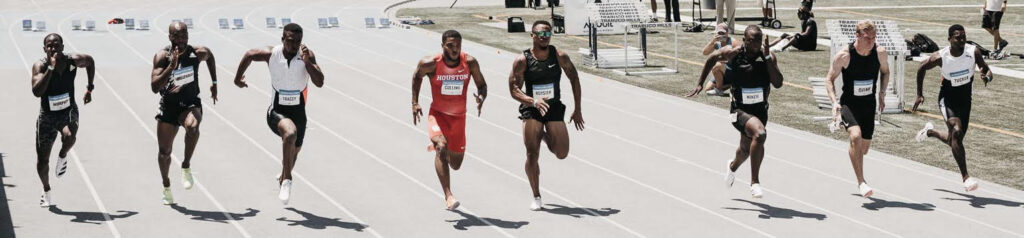
Whenever we observe a group of sprinters, it is clear that there is a range of different technical ‘solutions’. While there are some commonalities, we will always observe some significant differences as well. We can draw an analogy to the mean – the commonalities – and the standard deviation, the individual differences.
Two such variables that we can consider in this way are flight time and ground-contact time. The variance in these attributes is significant even in highly homogenous populations.
Consider the step times from the eight finalists at the IAAF 2018 World Indoor Championships, where the range within one standard deviation on either side of the mean is over 2/100ths of a second at each of the first three steps in both FT and GCT.
| Step 1 | Step 2 | Step 3 | ||||
| FT | GCT | FT | GCT | FT | GCT | |
| Coleman | 0.047 | 0.160 | 0.060 | 0.167 | 0.073 | 0.140 |
| Su | 0.047 | 0.167 | 0.047 | 0.160 | 0.053 | 0.133 |
| Baker | 0.033 | 0.187 | 0.040 | 0.193 | 0.047 | 0.153 |
| Xie | 0.060 | 0.167 | 0.080 | 0.160 | 0.073 | 0.120 |
| Taftian | 0.027 | 0.193 | 0.053 | 0.187 | 0.060 | 0.147 |
| Volko | 0.053 | 0.160 | 0.067 | 0.153 | 0.073 | 0.127 |
| Safo-Antwi | 0.033 | 0.193 | 0.060 | 0.167 | 0.047 | 0.140 |
| Barnes (s) | 0.053 | 0.173 | 0.053 | 0.180 | 0.073 | 0.140 |
| AVERAGE | 0.044 | 0.175 | 0.058 | 0.171 | 0.062 | 0.138 |
| STDEV | 0.012 | 0.014 | 0.012 | 0.014 | 0.012 | 0.011 |
| (-1 STDEV) | 0.032 | 0.161 | 0.045 | 0.157 | 0.050 | 0.127 |
| (+2 STDEV) | 0.056 | 0.189 | 0.070 | 0.185 | 0.074 | 0.148 |
Table 1. step times of the 8 finalists of the men’s 60m at the 2018 IAAF World Championships in Athletics (FT = flight time; GCT = ground contact time)
While it is highly speculative to suggest that this data alone enables us to place athletes into push-pull categories, it does at least give us an indication that different athletes use different strategies. Understanding these differences can aid us in our coaching instruction.
Coaches should remember to coach the person in front of them — not the average of the group. Rather than trying to shoehorn each athlete into some idealized biomechanical model, we have to remember that there is no one-size-fits-all in sports biomechanics.
Normative responses – i.e. the mean kinematic values across a group – provide us with general guidelines, but we should always be on the lookout for when athletes are at the very edges of these guidelines — and even outside of them.
So does that mean coaches should develop individual technical models for each individual athlete? This seems like a lot of work!
Luckily for coaches, it seems that this is not possible anyway [6].
That variability that we see across a group is also evident within each athlete. The inherent movement variability that exists in all humans means that no athlete is able to consistently reproduce the same movement pattern over and over again. Rather, there is a range of variability around the athlete’s movement solutions [7].
This is why categorization is not only useful, but necessary!
As coaches, we should be more concerned with the range of possible solutions than we are with identifying and applying a ‘most-correct’ one!
Tweet ThisAs coaches, we should be more concerned with the range of possible solutions than we are with identifying and applying a ‘most-correct’ one!
@StuartMcMillan1
Summing up, when it comes to technical instruction, I look at the coach’s role as the application of the following five steps:
- Identify the global model, a composite or computer-generated model that purports to establish the “most-correct” movement solution for the population the coach is working with.
- Identify the categories by understanding the inter-group distribution around the global model
- Determine where an athlete fits within the distribution. What is their “preferred” category?
- Analyze each athlete’s individual variability around their preferred solution.
The fifth step is the actual coaching. This includes helping the athlete(s) become more effective (greater adherence to biomechanical first principles), more efficient (reduce the cost of the applied technique) and more consistent with their technique (reducing the extent of variability).
The Performance Trinity — ALTIS’ three primary digital Courses — are re-launching this week after a few months out, receiving some updates. If you’re interested, check out https://altis.world/digital-education/courses/