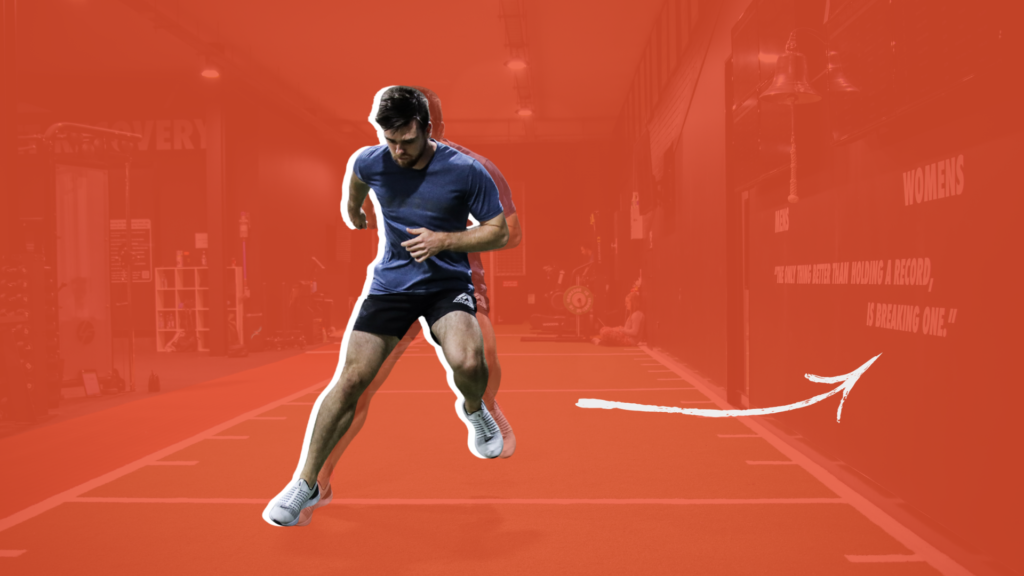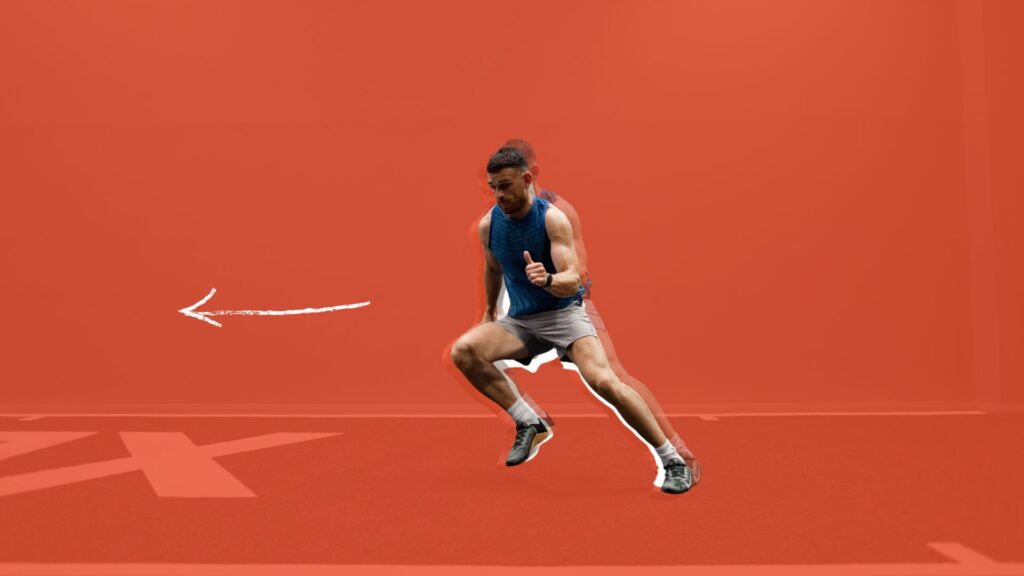

In my article ”Agility training is more than just change of direction training,” I explained that pre-planned change-of-direction (COD) tasks in training are quite different from the in-game agility demands that are part of invasion sports. Training with 1v1 contests and small-sided games (SSG) help develop agility in a holistic manner; and pre-planned COD activities can have a place in an agility training program. This remains a controversial issue that needs further exploration.
In this article, I recommend technique training to improve agility performance and to minimise the risk of knee injury. This will then inform how to select resistance training exercises to further enhance agility. Following this discussion of the technical and physical aspects of agility, a future article will focus on the cognitive component.
Identifying key technical components of agility movements
My first article mentioned that there are several agility techniques used in Australian football match play, and these are performed at varied speeds and angles. Other invasion sports also have varied agility demands.
Attempting to train all of the possible agility manoeuvres with pre-planned drills would be incredibly time-inefficient. The variability of attacking and defending agility movements and strategies can be better captured in a time-efficient way by using 1v1 and SSG. These activities also allow athletes to practise using deceptive techniques such as fake steps or passes, which they cannot do effectively during pre-planned COD drills. However, since the side-step technique is prevalent in invasion sports and is a typical movement responsible for non-contact anterior cruciate ligament (ACL) injuries across a range of invasion sports [1-4], coaches should spend some training time focussing on a safe and effective way to execute this technique.
Tweet This“The variability of attacking and defending agility movements and strategies can be better captured in a time-efficient way by using 1v1 and SSG”
@woozleyoung
A powerful side-step allows an attacking player to achieve separation from defenders. That can provide the time to progress down the field or court, or to pass the ball with reduced pressure from opposition players. To achieve this, the athlete must generate a high amount of force through the support leg in a limited time-frame, e.g., less than 0.5s. Lowering the body, leaning toward the new direction of travel and having a reasonably wide foot plant from the “outside leg” are requirements for applying force laterally to the ground.
Also, to produce a high amount of force, knee flexion should not be too large. This is why we can lift more weight in a quarter squat than a half squat.
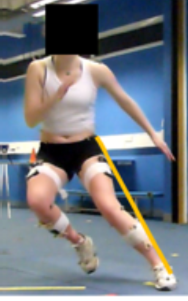
However, an extremely wide foot plant (>45 degrees to the vertical) or a very straight leg (<30 degrees of knee flexion) increases the risk of ACL injury [5].
This suggests there is “performance-injury trade-off” [6], that is, the technique that is preferred for performance might increase the risk of injury. There are two ways to deal with this dilemma. The first is to coach the technique that hits the “sweet spot” by aiming for a moderately wide foot plant position (20-45 degrees to the vertical, Fig. 1) and a moderate amount of knee flexion with an emphasis on “pushing the ground away” [6]. The second is to improve the tolerance of soft tissues to the high forces that side-stepping can impose, making the tissues more robust and less prone to injury [6]. Tissue strengthening will be discussed later in relation to strength training.
There are a number of other technique aspects that coaches can address to reduce the risk of ACL injury.
- Decelerate in the steps before the final foot plant. Deceleration reduces the load on the leg in the final foot plant. A suggested coaching cue is “slam on the brakes early” [6].
- Use a neutral foot position in the final foot plant. Try to avoid a position where the foot is either pointing inward or outward [5].
- Avoid lateral trunk flexion where the trunk “falls away” or “lags behind” the new direction of travel. Similarly, avoid the trunk rotating away from the new direction of travel. One coaching cue is “Face the intended direction of travel” [6]. A potential problem with this cue is that early preparation to turn the trunk to the intended direction of travel provides a postural cue to opponents who may use it to anticipate the athlete’s side-step direction. In this case, the safer option might compromise attacking agility performance. It’s another example of a performance-injury trade-off.
- Avoid knee valgus, which is an inward rotation of the knee (Figure 3).
Coaching safe and effective side-stepping technique
Although I have outlined some coaching cues, the ideal training approach to improving technique is not clear-cut. Research showed that a six week program based on similar cues was successful in modifying technique to make it safer, and also improved COD performance in a pre-planned side-stepping task [6]. While this is encouraging, we don’t know whether training-induced changes in technique developed in pre-planned COD drills can transfer to agility on the sporting field, where the side-step is part of a quick reaction to the stimulus of an opponent’s actions.
As I pointed out in my first article, technique can change significantly when an opponent provides a stimulus.
Side-stepping ACL injuries occur in contests when attackers and defenders are under extreme pressure from their opponent. I am not aware of ACL injuries occurring in pre-planned training drills where athletes can adjust their posture in a controlled way. It is likely that ACL injuries arise when athletes are not able to quickly adjust into safe body positions when reacting to an unpredictable stimulus. Therefore, athletes need time practising side-step performance while reacting to game-like stimuli with a time-stress.
Coaches should therefore devote some training time to developing technique in isolated pre-planned movements to reinforce safe and effective body positioning. This is likely to be more relevant for learners with a low training age; and for the middle stages of rehabilitation from lower limb injuries, where the coach can carefully introduce technical elements and control physical loads. However, coaches should first observe the way their athletes move and perform side-steps during contests in training and competition via video footage. If a player consistently demonstrates safe and effective postures in training and competition, it is not necessary to waste time practising pre-planned technique drills.
In general, most players should practice side-stepping technique by reacting to opponents in evasive contests, e.g., 1v1. The resistance to this approach is the perception that it would be too complex and intense, but that is not necessarily the case.
An example is a modification of the 1v1 activity described in my first article. The activity still involves an attacker attempting to evade a defender, but adds some constraints to reduce the complexity and intensity:
- Use a smaller space so running speeds are lower;
- Could include a rule that athletes can’t exceed a jogging pace;
- The defender is only allowed to shadow the attacker and is not permitted to tackle. This reduces the stress on the attacker.
- The attacker is not allowed to use deceptive actions such as fake steps.
By manipulating these constraints, both attacker and defender have more time and less perceived stress, facilitating execution of the desired techniques. The activity can then be progressed to gradually promote increased complexity and intensity.
A similar progressive approach can be designed with SSG. To facilitate learning, the coach should regularly provide video feedback so players can see their own body positions.
Physical development for agility
Players with a greater physical capacity to produce force have the potential to be more agile in either attacking or defending situations. However, while resistance training can enhance COD performance [7,8], I am not aware of any research evidence demonstrating a positive transfer of resistance training to improve agility performance based on sport-specific and valid outcome measures. This may partly be because of the difficulty of assessing sport-specific agility in research contexts [9].
There is some indirect evidence suggesting that reactive strength, in particular, is highly correlated with agility performance measures [10,11]. This makes sense, especially in relation to side-stepping. When the foot is planted the leg extensor muscles are exposed to relatively high eccentric loads, whereby knee flexion must be quickly attenuated before a fast leg extension and propulsion in the new direction of travel. The reactive strength demands are especially high if the athlete is moving at high speed and is attempting a sharp cut [12].
Ground contact times
Understanding the typical ground contact time (GCT) in agility manoeuvres as well as plyometric exercises can provide insights to inform program design.
Using side-stepping as an example, we know that a relatively fast approach speed and shallow cut angle (45-60 degrees) involves GCT between 0.16-0.25s, whereas a slower approach speed and sharper cut angles (90-180 degrees) produces longer GCT around 0.25-0.50s [12].
Given the principle of specificity, training exercises should contain similar demands (e.g. GCT) to the agility skill being targeted. In sports that require a range of approach speeds and cut angles, we should select plyometric exercises that span the entire GCT spectrum (0.16-0.50s).
The drop jump (DJ) is a fundamental plyometric exercise effective for developing reactive strength [13]. Using the instruction to attempt to jump for maximum height and minimum GCT, high eccentric loads occur with GCT around 0.17-0.20s [14], making this exercise suitable to enhance performance of fast and shallow cuts. The coach can increase the GCT by modifying the instructions to emphasize jump height rather than minimising the GCT [14]. Then the exercise is more suited to slower and sharper cuts.
Over time, the athlete should move from general bilateral and vertically oriented exercises like the DJ to unilateral and horizontally directed plyometric exercises (Figure 4).
| Bilateral and vertical | Bilateral and horizontal | Unilateral and horizontal | |
| Drop jump | Side jumps over a box or hurdle | Skater jumps | Zig zag bounding |
Probably the most specific plyometric exercise for developing reactive strength for side-stepping is lateral bounding (see video). Lateral bounding is similar to side-stepping in both the movement pattern and GCT. From a stationary start, the GCT during the bounds will be slower. But the GCT decreases with a 10-meter sprint before the first bound. Coaches can extend the GCT by increasing the lateral component of the bounds. The coach can easily monitor GCT for any plyometric exercise with high-speed video on a mobile phone or tablet, or with a contact mat or force platform.
Another very specific way to train for the physical demands of agility is to perform repetitions of the actual movement, such as side-stepping. To ensure there is enough load to induce a training stimulus, monitor the approach speed and angle of cut. Increase the load and intensity by using a faster approach and attempting sharper changes of direction. Pre-planned movements to the left and right without a need to react to a stimulus let the athlete hit those higher speeds and angles.
As the training load becomes more challenging, the coach should monitor technique to ensure the athlete is performing safely.
Please be aware that I am recommending this COD training as an option for developing the physical qualities required for agility performance, and not as a technique drill. As mentioned earlier, technique is developed better when it comes in the context of game play, reacting to an attacking or defending opponent.
Developing a strength base
Plyometric training designed to target reactive strength is specific to the demands of many agility movements such as side-stepping. But it’s also important to develop a general strength base, especially to prepare athletes for exercises such as high intensity plyometrics.
Strength training provides muscles with the potential to produce increased force, improves tissue robustness and reduces the risk of injury from high load plyometrics such as drop jumps [15]. Since many agility movements require tolerating high eccentric loads, we can target eccentric strength with resistance training. This could involve tools such as bands or flywheel devices that overload the eccentric phase of a lift.
Another way to enhance eccentric strength as it relates to agility is practicing repeated horizontal decelerations when running at various speeds [16].
Trunk strengthening
The trunk needs to remain rather “stiff” in order to transfer lateral force production to the whole body in a side-step. That is, the athlete has to avoid excessive lateral flexion or rotation. Not only would those movements increase the risk of ACL injury as already discussed, but they could provide an “energy leak,” impairing acceleration in the new direction of travel. An example in rugby is that the “lagging” trunk of an attacking player would limit separation of the body from an opponent, making the attacker more vulnerable to a tackle.
There are many choices of trunk strengthening exercises available to improve trunk stiffness and prevent the unwanted excessive lateral trunk flexion and rotation seen in side-stepping. Research has produced mixed results regarding the effectiveness of such programs [17,18], so more research and experimentation from coaches is needed. However, I recommend anti-rotation exercises in a standing posture, such as a Pallof press (Figure 5).
Another way to resist perturbations of the trunk while changing direction is to increase the load of the upper body. An example is using an aqua bag. The water not only adds weight at the top of the trunk, but also moves within its container to further challenge trunk stability (Figure 6).

Integrating technical and physical training for change of direction
Improving agility technique allows the athlete to express their physical capabilities more effectively, and may also reduce the risk of severe injuries such as ACL rupture.
Since side-stepping is a common agility technique in invasion sports and is associated with knee injury, it is worthwhile allocating training time to improving it. This can entail coaching various technical points with simple cues. Coaches can start with solo situations for athletes to learn the basics, and can then make the training more complex and intense to challenge the athlete. Thoughtfully designed one-v-one contests and small-sided games can control the technical and physical demands. This is vital if we want to expose athletes to the technical demands of competition.
Invasion sport athletes will most likely undertake strength training to enhance a range of physical qualities, so this general training can also be beneficial for agility demands. Coaches can supplement this with specific eccentric training, trunk strengthening and various plyometric exercises to specifically target agility performance. Plyometric exercises should span the spectrum of GCT used in agility manoeuvres, and progress from general to specific.