Despite every practitioner’s best intentions to implement an evidence-based approach to programming, often internal bias, habit and unquestioned tradition influence what we do. This is particularly evident in the world of training for power, where debates can rage on social media, pitting one exercise against another in a seemingly black-and-white narrative heavily influenced by opinion and preference. A prime example that seems particularly prevalent is the case of hex bar (or trap bar) jump squats as a replacement for Olympic lift variations. Much of the discourse in this area appears rooted in an attachment to certain training modalities or a clear rejection of others. Coaches can define themselves as either pro- or anti-Olympic lifting, such is the strength of feeling. This is a potentially myopic frame of reference for training modalities that could add immense value to a performance programme.
All exercises at our disposal are tools to impact sports performance. The more knowledge and understanding we have of a breadth of exercises, the more tools we have in our toolbox. Sometimes, taking a step back and considering the evidence of the efficacy of certain exercises can make the difference between targeted, informed coaching and a scatter gun approach to programming.
Tweet ThisAll exercises at our disposal are tools to impact sports performance. The more knowledge and understanding we have of a breadth of exercises, the more tools we have in our toolbox.
@tom__turner
Ultimately, we want to choose exercises based on their ability to influence the physical capacities that are linked to performance. In rugby union forwards, for example, relative peak power and jump height in a countermovement jump (CMJ) and reactive strength index (RSI) strongly correlate with clean breaks in match play [1]. Training with the most effective exercises to improve key physical qualities would likely have a tangible impact on performance on the field.
The aim of this article is to provide some insight into the process that a Performance Department working in rugby union went through to inform and guide the power programming that we deliver in a professional team sport environment. This process of validating key power exercises such as the jump squat and Olympic lifts involved a combination of in-house research, consulting relevant peer-reviewed research and, of course, experiential knowledge. The result was a small selection of power exercises that we can confidently prescribe based on known performance outcomes.
Matching the exercise to the adaptation and the performance outcomes
We have found the clearest way to classify exercises is by the physical capacity they have the biggest impact on. For example, under the category of maximum force, you will find all the typical staples of lower limb strength such as the back squat, rear foot elevated split squat and deadlifts. This is not to say they will not affect other qualities, as the loading and manner of execution will have a bearing on the adaptation (think of a back squat at 70% 1RM performed with maximal intent), but it is helpful in designing a programme to best target what a player may require.
When it comes to targeting power, we simply think about exercises that maximise power output and rate of force development, or are plyometric and improve reactive strength. We tend to keep only a few exercises that fall within these categories in our programme to allow players to develop mastery and to not over-complicate an athletic development programme that serves the sport.
Many coaches have provided strong evidence making the case for plyometric exercises (including my colleague, Dan Tobin), and coaches widely understand the value of plyometrics. However, more confusion attends the rationale for Olympic lifts and jump squats regarding which specific adaptation they best elicit.
Hex bar jump squats optimize power output from a better movement pattern
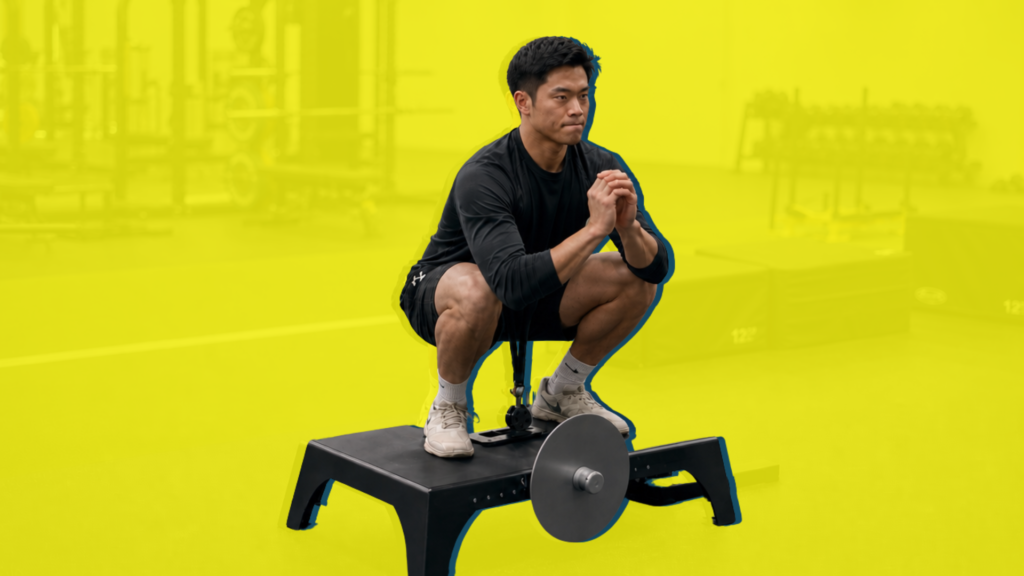
Jump squats have long been a staple of power training methods, with a barbell across the shoulders being the most common way of applying an external load. However, researchers generally agree that an unloaded condition optimises power [2-5]. The increasing popularity of the hex bar jump squat (HBJS), where the load is applied via a hexagonal barbell at arms’ length and the athlete in is inside the frame of the barbell, shifts the kinematic variables so the athlete produces peak power in a loaded condition.
Swinton et al [6] highlighted the viability of the HBJS as an effective power training tool. They compared the HBJS with the barbell jump squat (BBJS) at a range of loads (0, 20, 40 and 60% of squat 1RM) and found peak power was highest in the HBJS at the 20% load and even at 40%, at levels similar to the unloaded condition. In contrast and in line with previous research, the BBJS had lower peak power outputs than the unloaded jump. These findings prompted us to start using the HBJS as a tool for developing power in our players. The change in the positioning of the load with this variation improved kinetics and kinematics, which really suited our population and allowed for a less upright torso and more natural jumping profile.

The original research left some questions unanswered, which prompted further exploration so we could confidently employ the HBJS as a primary lower body power exercise. This revolved around a closer look at the optimal loading range of the exercise and whether there was any link with established performance markers.
We conducted our testing with the Academy squad, who were 21.3 ± 1.3 years old. We cannot just assume the senior players would attain the same results. But the Academy players’ age, advanced training status and the fact that the group trained with and shared the same methodologies as the senior squad allows us to feel confident in the universality of the findings.
We investigated peak power output of 17 players in the HBJS at loads of 0% (body mass) and 10%, 20%, 30% and 40% of squat 1RM (7), a tighter range of loads than the original research examined. The results suggested that a load range between 10-20% of 1RM maximized power output at the group level. There was no significant difference between the 10% and 20% loading conditions. Therefore, it is statistically correct to report optimal peak power within this range. Notably, power output was higher under all loaded conditions than at body mass alone, which is consistent with previous research (Swinton et al [6]).
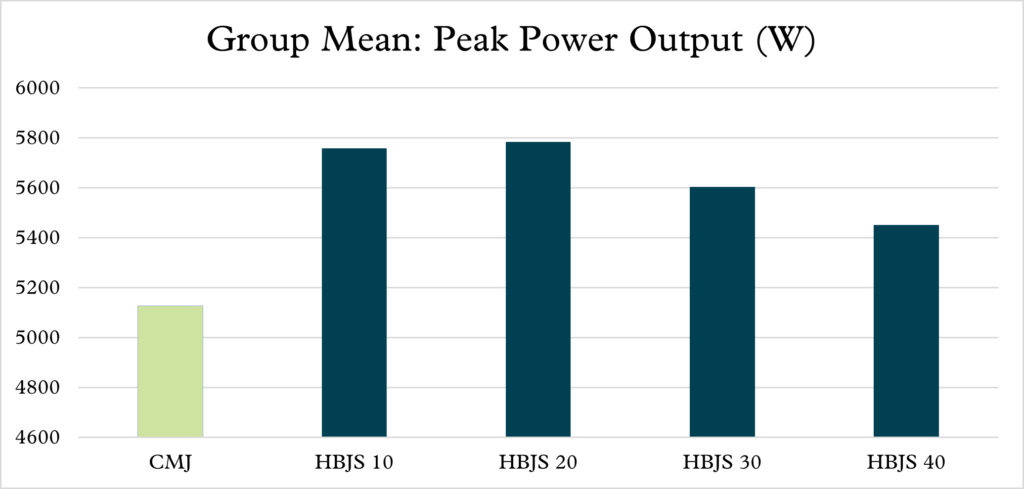
At a closer level, the results show that the optimal load for peak power in the HBJS is highly individual to the athlete. In the research study, 20% of 1RM was the highest power value at a mean level. However, 10 of 17 participants demonstrated their highest power value at loads other than 20% of 1RM.
A generic recommendation of a load range of 10-20% of 1RM accounts for the highest power value for 14 of the 17 participants (82%) in this study. But the range of loads from 10-40% 1RM should be appropriate for the majority of athletes. It happens that this range of loads in professional rugby union training corresponds to what feels like a natural load selection (approximately 20-70 kg) for athletes to jump and land confidently and safely.

A correlational analysis examining the relationship between peak power in the HBJS (measured at each participant’s individual optimal load) and key performance markers showed strong relationships [8]. The strongest correlation was between HBJS relative peak power and CMJ height (r = 0.80). Such a strong relationship is surely the result of the biomechanically similar movements.
Strong negative correlations emerged between relative peak power in the HBJS and acceleration times over 10m (r = -0.70,) and 20m (r = -0.75,). Training studies utilizing traditional jump squat methods have reported an improvement in peak power output, which is associated with positive changes in speed and vertical jump performance [9].
Consequently, significant improvements in athletic performance may occur following a period of training with the HBJS due to the higher peak power output values associated with it. While we haven’t scientifically validated this assertion, the evidence from years of use describes an exercise that is safe, effective and, as a tool in a balanced training programme, produces significant changes in our jumping and acceleration metrics.
Hang clean high pulls produce high rates of force development
The HBJS undeniably has become a popular and well-established training tool in the strength & conditioning community. It may be the most effective power training tool on offer. However, that does not imply it is the only tool for the job.
Some practitioners and even athletes may be confused over why athletes would need to spend time learning and executing the Olympic lifts, for example, when they could just do the HBJS exercise instead.
Tweet ThisSome practitioners and even athletes may be confused over why athletes would need to spend time learning and executing the Olympic lifts, for example, when they could just do the HBJS exercise instead
@tom__turner
One of the interesting findings from unpublished research that formed an auxiliary strand of exploration to the published work on the HBJS was a comparison between the HBJS and an Olympic lift variation. We were primarily concerned with peak power output and were interested in comparing the different power training exercises in use in the programme. The same cohort of 17 Academy athletes performed the hang clean high pull (HCHP) exercise on a force plate with loads ranging from 60% to 100% of their 3RM. The results are in Figure 4.

The CMJ and HBJS at all loads from 10-40% of 1RM squat produced higher peak power outputs than all the HCHP conditions. This supports previous research findings from Kawamori et al [10] and Cormie et al [11] showing that power output is much higher in jumps and jump squats than Olympic lift variations. The decreasing trend for power output as the load increases is consistent with the findings of Comfort et al [12], and points to another clue that the Olympic lift variations may not be the ideal exercise for maximising power output. Comfort [12] highlights 40% of power clean 1RM as the optimal load for peak power in the mid-thigh clean pull. But with most athletes, this load just seems too light for any meaningful benefit in an exercise they can load reasonably heavy.
Perhaps, then, the HBJS is a viable replacement for the Olympic lifts? This is an understandable conclusion, but the Olympic lifts pull away from the rest when the focus is on rate of force development (RFD), as Figure 5 illustrates.
Tweet ThisIs the hex bar jump squat a viable replacement for the Olympic lifts? Maybe not! The Olympic lifts pull away from the rest when the focus is on rate of force development
@tom__turner

Here, the key benefit of the Olympic lifts becomes apparent, with all loading conditions in the HCHP producing higher RFD levels than all HBJS loads examined and the unloaded jump.
RFD is a key discriminator of elite performance in a range of sporting actions (13-15). RFD relative to bodyweight in the HCHP in our cohort was moderately correlated to CMJ height (r=0.57). Relative RFD in the HBJS, on the other hand, showed a weak correlation with CMJ (r=0.22), despite the biomechanical similarities between the two jumping movements. Therefore, we can confirm that RFD is distinct from power output, and is a quality that requires its own specialised development. Our evidence suggests that an Olympic lift variation is far superior to the HBJS for RFD training (as the force-time trace below shows).

For consistency in the testing process, all participants performed the HCHP variation, as all were proficient with technique and performed it regularly in training. The picture sequence below highlights some of the key positions:

One of the detractions levelled at the Olympic lifts is the time required to learn safe technique. The start position from the hang and the lack of a catch in the HCHP variation lower the barrier to learning, although in our environment anyone who can rack the bar will generally do so. However, execution of the full Olympic lifts is not necessary to reap the benefits in terms of rate of force development. Comfort et al [16] found that the mid-thigh clean pull and mid-thigh power clean produced greater peak rate of force development than the power clean from the floor. The researchers also confirmed that there were no significant differences between the kinematic values of the hang clean or hang clean pull variations. While we conducted no research with snatch variations, we assume similar adaptations may occur; and it proves a popular variation with our taller players. Therefore, the range of tools available to the coach to develop RFD is reasonably broad, with many different options to suit different anthropometrics.
Hex bar jump squats and Olympic lifts can (should? must?) coexist in a training programme
Comparing the HBJS and Olympic lift variations makes it clear that they are different tools for different jobs, particularly in the loading range to maximise the key kinematic variables in question. As previously stated, peak power in the HBJS was optimal at 10-20% of squat 1RM. In our population this tends to fall between 20-50 kg. In the HCHP, a load range between 60-90% of 3RM optimised RFD in the HCHP. Again, like with the HBJS, there was a wide spread of loads which maximised RFD for each individual.

In practical terms, players will load the Olympic clean variations from approximately 60-120 kg. What starts to emerge when mapping this out is a load-velocity classification that naturally encompasses distinct kinematic variables, and the best exercise or “tool” for the job depends on the loads involved.
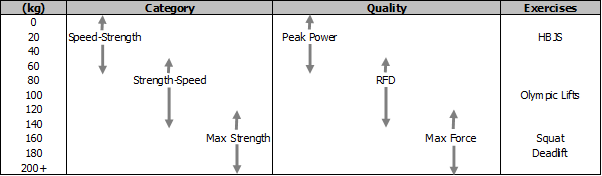
While this may all seem rather obvious, we can be confident that we can select the appropriate exercise and load to achieve the desired outcome in the population we work with.
We can be reasonably sure that programming the HBJS will target peak power output, while programming an Olympic lift is more likely to maximise rate of force development. Of course, these qualities are never mutually exclusive: an athlete who makes significant improvement in a power clean is undoubtedly going to become more powerful. Also, in most well-balanced programmes, the performance staff is concurrently targeting a blend of different capacities, so it shouldn’t be an all-or-nothing paradigm.
Tweet ThisWe can be reasonably sure that programming the HBJS will target peak power output, while programming an Olympic lift is more likely to maximise rate of force development
@tom__turner
The pursuit of knowledge in this area clarifies the efficacy of our main power exercises, allowing us to be clear and objective and not cling to personal preferences or bias in programming.
The evidence here also highlights the clear dichotomy between the Olympic lifts and jump squats, something arguments online can easily blur, causing coaches to lose sight of the fact that exercises don’t have to be an either/or option. An awareness of the clear difference in kinematic qualities between the Olympic lifts and hex bar jump squats should mean that coaches can be informed and choose the best tool for the job in question.