The foot, ankle and calf complex have a big influence on running performance and injury risk, yet many training programs fail to deliberately target this area. At the Sports Surgery Clinic (SSC) in Dublin, where I am the lead clinician for foot and ankle rehabilitation, we use biomechanical and lower limb performance assessments to profile athletes, guide exercise prescription and, during a rehabilitation pathway, make decisions on readiness to return to sport.

Lower-limb injuries occur through repetitive overload combined with poor capacity; or in acute settings where poor coordination and muscle recruitment pattern timing play a role. Injuries leave a legacy of altered muscle recruitment and joint coordination patterns that can increase the risk of a subsequent injury or impair performance [10,11]. Therefore, it is important to progress to exercises of high intensity towards the end stage of rehabilitation and have robust return-to sport outcome measures in place.
We often observe weakness and atrophy in the calf and foot muscles after a long-term injury, surgery or a period of immobilisation.
The foot and ankle influence loading at more proximal regions of the body. Reduced joint output from the ankle when fatigued results in increased loading at the knee and hip during a long-distance run [12]. By increasing ankle power at toe-off, you can reduce hip joint forces by up to 12.5% [13].
Considering the performance and injury factors related to the lower limb, it is, prudent to incorporate foot, ankle and calf assessments and training in an S&C program built around the athlete’s needs. Increasing the force output of the calf muscles and tendon stiffness, as well as coordination around the foot and ankle, may have a small but significant impact on performance and robustness against injury.
Lower limb assessments and exercises

Ankle isokinetic test
This standard test for all lower limb injuries provides a useful key performance metric. It gives us a measure of both plantar flexor and dorsiflexor peak torque at a speed of 30°/sec.
With a straight leg, measure the force capacity of all the plantar flexor muscles as well as torque at 20° plantarflexion and 10° dorsiflexion. By comparing the athlete’s peak torque as a percentage of bodyweight to our database of uninjured or fully rehabilitated athletes, we can aim for scores above 160% bodyweight for runners and 200% bodyweight in speed- and acceleration-based sports.
Of course, many practitioners do not have an isokinetic dynamometer. But with a horizontal leg press you can measure the maximal load an athlete can isometrically hold with the straight leg as a measure of maximal calf strength.
Setting a target of around 40% dorsiflexion peak torque with body weight can influence coordination around the ankle just before footstrike and during the early stance phase. For example, some athletes who run or hop with a forefoot strike but lack ankle stiffness often display poor dorsiflexion strength. Athletes recovering from an ankle sprain often fall into that category.

Single leg heel raise endurance test
Athletes who can produce high peak torque values on an isokinetic test or peak force on an isometric test may struggle to perform more than 20 satisfactory single-leg heel raises. Consequently, we should measure calf capacity across a spectrum between maximal strength and endurance.
In this test, the athlete stands barefoot on one leg with a neutral foot and aims to push up onto their big toe and lower down at a rhythm of one rep every two seconds until they fatigue. You can set a metronome to guide the protocol. The ability to perform 30 raises in 60 seconds is a good measure of calf endurance. We can profile the athlete accordingly using a quadrant like in Figure 2.

Developing Calf strength
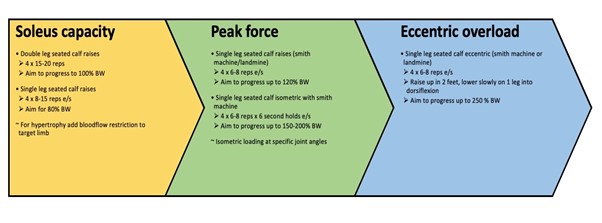
If an athlete is unable to perform 25 competent single leg raises, build calf capacity through single-leg calf raises. If an athlete is in the early recovery stages after surgery they can begin with double leg calf raises, possibly with bloodflow restriction for an extra hypertrophy stimulus on the involved limb. Or, manipulate foot position for a local muscular response in the medial or lateral gastrocnemius.
If the athlete shows deficits greater than 15% at 10° dorsiflexion or 20° plantarflexion on an isokinetic test, those joint angles become the targets for isometric loading. It is very common for athletes recovering from an Achilles tendon rupture to have long-term strength deficits at higher angle plantarflexion.
Once the athlete achieves some basic level of calf capacity, the focus shifts to developing maximal force through heavy combined concentric-eccentric or short repetitive isometric exercises with greater than bodyweight loading. This can be on a Smith machine or a leg press. The goal is to maximise force capacity in the calf complex, and these exercises provide a good stimulus to improve tendon stiffness [14]. Then progress to heavy eccentric exercise with loads 20-30% greater than during the isometric exercises. Supramaximal eccentric exercise increases muscle fascicle length and tendon stiffness [15,16]. These progressions are appropriate during the latter phases of Achilles injury rehab.
In a performance setting, practitioners can periodise isometric and eccentric overload exercises in the season before introducing a phase of high amplitude plyometric exercises. The athletes thereby build tendon stiffness before learning to use it effectively. Similarly, a phase of calf eccentric overload increases muscle fascicle length before a phase of developing explosive strength.

Seated calf isometric test
The soleus is the biggest force contributor to the Achilles tendon [17] and contributes more than half of the vertical support of the centre of mass during running [18]. It produces the largest muscle force during early acceleration, and the timing of soleus peak activation differs from that of the gastrocnemii [18]. Therefore, it is worth measuring its force capacity in isolation, and training it where necessary.
Tweet ThisThe soleus is the biggest force contributor to the Achilles tendon and contributes more than half of the vertical support of the centre of mass during running
@ColinGriffin

In this test, with a 90° knee angle and at least 10° of ankle dorsiflexion, the soleus produces most of the force. Similar to the isokinetic test, we aim for values of more than twice bodyweight for sprinters and field sport players where acceleration is important. For distance runners, we want to see minimum peak force values greater than 1.6x bodyweight. For practitioners who don’t have force plates, a Smith machine works to see how much load the athlete can isometrically hold for five seconds as you aim for similar relative strength targets.
If the soleus peak force is below the matched cohort threshold values, seated calf raise exercises are appropriate. If a distance runner has peak force above 1.6x bodyweight, they likely will achieve sufficient soleus stimulus from straight leg calf raises. For athletes in acceleration-based sports, continue training the soleus independently and in synergistic patterns with the foot, quad and hip extensor muscles working from deeper knee and hip flexion.
Toe flexor strength
Toe flexor strength is associated with sprint, vertical jump and change of direction performance [20-22]. Together with the calf muscles, some of the larger foot intrinsic muscles stiffen the foot and ankle [23]. Atrophy and an inability to maximise the activation of some of these foot intrinsic muscles are common among injured athletes [24]. Testing toe flexor strength is relevant for nearly all foot-related injuries, or where poor foot strength may be an important missing link.
Assessing toe flexor strength with the foot in plantarflexion and the first metatarsophalangeal joint dorsiflexed gives us a measure of the force capacity of some of the biggest force-producing muscles that cross the big toe joint, such as abductor hallucis and flexor hallucis brevis [25]. Use a handheld dynamometer with maximal isometric efforts of at least five seconds. Then divide the force in Newtons (N) by body mass (kg). Some good relative scores are close to 4 N/kg.


Developing foot strength
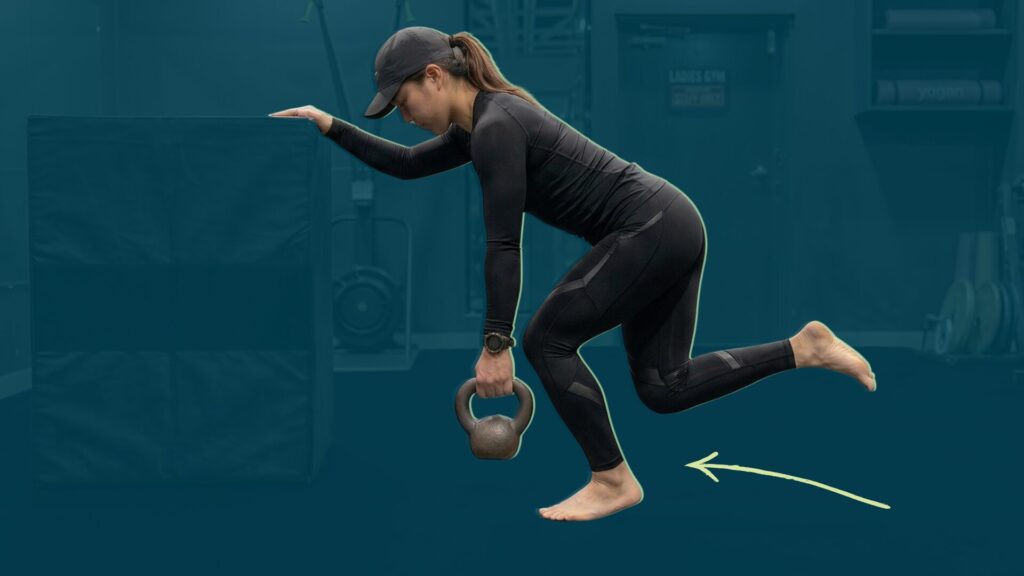
I usually perform foot exercises in closed chain, focusing on the athlete balancing through the first metatarsophalangeal joint under load or maintaining control while being perturbed. A heel raise maximally activates the key intrinsic foot muscles, as well as the tibialis posterior and peroneals [26,27]. I then incorporate foot control into synergies with simultaneous knee and hip extension.
If an athlete is recovering from surgery or has been immobilised for a long period, open-chain foot exercises may be a better starting point. In some cases, neuromuscular electro-stimulation (NMES) can help target foot intrinsic muscles or peroneals during a single leg weight-bearing task to maximise the timing of recruitment.

Video 10. Decline board rebounds
Assess lower limb reactive strength qualities with both double- and single-leg drop jumps. I am a little cautious about applying threshold values for jump height and contact time, as these depend on the athlete’s profile and the demands of their respective sport. Some athletes will favour more ground contact time to achieve their best reactive strength index and some – particularly distance runners – perform better on a multi-hop test when they get into a cyclic hop pattern. These tests also provide a useful place to measure leg and joint stiffness.
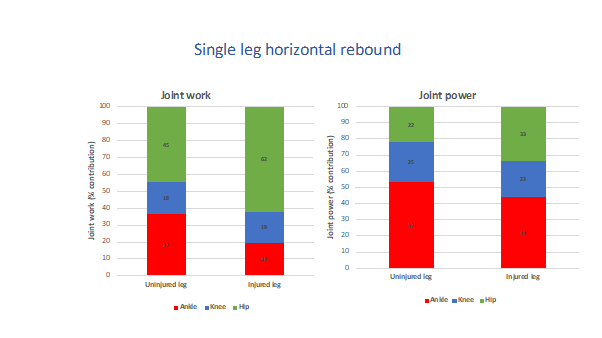
For Achilles and calf injuries, a single-leg horizontal rebound requires higher Achilles tendon loading rates that closely resemble maximal running speeds [28,29]. Aside from analysing their jump height / distance and ground contact times, it’s useful to examine the individual joint contributions using 3D motion capture and force plates to identify an adaptive joint strategy to perform the task. For example, if they are rehabilitating from an ankle injury, they may adopt an increased knee or hip strategy to compensate for the reduced output from the ankle. We also look at the smoothness of the ground reaction force trace: an oscillation during the initial force trace may indicate poor ankle stiffness.

Developing reactive strength
Plyometric training is a key link between training strength qualities in the gym and training the qualities needed for running. Vary the type of plyometric exercises between a focus on vertical and horizontal, between fast and slow stretch-shortening cycles, and contrast hops. Multi-directional plyometric exercises are important for field sport players. But they can also be useful for linear sport athletes to improve ankle stiffness and multi-planar control during rehab or as a risk mitigation measure.
I begin with pogo hops in place to build basic patterns and body awareness, as well as the Rudiment hop series popularised by ALTIS. The volume and multi-directional nature help build capacity and challenge the athlete to maintain good posture and smoothness. These sequences are particularly important for athletes with limited plyometric training history. Then progress to more advanced sequences such as drop jumps, depth jumps, single-leg hops, mini-hurdle hops and box-to-box rebounds. Based on the hop tests and matching the athlete’s profile with their reactive strength objectives, you have the option to constrain contact time and aim to improve jump height or distance; or, for a given height or distance, try to reduce contact time.
For end-stage Achilles, calf or ankle injury rehab, and particularly in sports where acceleration qualities are important, horizontal hopping and bounding with uphill progressions challenge the contractile properties of the calf muscles and the high loading rate demands on the Achilles tendon. Wherever reactive strength index and either jump height or distance is the target, focus on flat foot contacts with dorsiflexion before footstrike to pre-tension the calf complex. This produces earlier muscle recruitment [30].
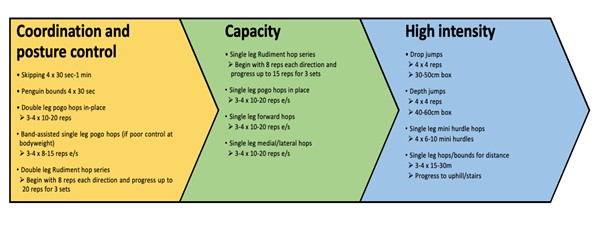
Where mid-foot stiffness is the primary objective, focus on landing on the ball of the foot and not allowing the heel to drop. Use a low step or a decline board to promote pre-activation and stiffening off the mid- and forefoot before contact. Bring this control into sled or prowler marches and bounding exercises to develop early acceleration patterns.
Explosive strength
Explosive strength is an important quality to assess for athletes in acceleration-based sports. Squat jump and countermovement jump performance are closely related to 10-meter acceleration performance [31]. A single-leg hop for distance may give better insight to the explosive qualities of the calf muscles given the soleus’ force contribution [19].
Start by working on basic ballistic patterns that emphasise projection of the centre of mass such as box jumps or squat jumps. Then progress to horizontal hops that require explosiveness from the calf muscles before developing acceleration-specific qualities with a sled or prowler. For the latter exercise progression, loads between 70-100% bodyweight are optimal to provide enough resistance but still achieve good displacement without compromising technique.
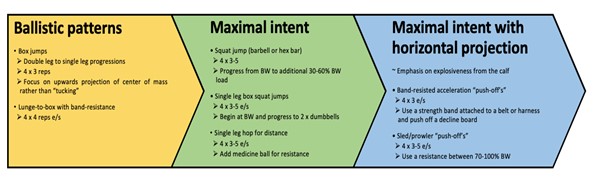

Periodizing the calf and foot exercises helps develop strength and capacity over a 6-12 week block early in the general preparation phase before running loads increase. Ideally, the athlete achieves a sufficient calf stimulus from their plyometric exercise and only requires a low volume maintenance program or periodic “top-up’s” during the season.
Building an athlete-centric progression from a rehab model
I break down my exercise progressions into phases for each quality that I am training. This is a very simple model to guide my programming. We should also be comfortable training a few qualities concurrently, with one or two main priorities for each phase, as opposed to a block periodisation model.
My assessments coupled with the nature of the sport guide me on the entry point and progression. Assessments are a good guide to profile the athlete’s strengths and limitations, and to start developing the area of biggest priority. It’s important not to neglect an athlete’s strengths!
The symmetry between injured and uninjured limbs might be a plausible target for certain injuries. But the outputs of healthy or fully rehabilitated athletes also provide a valuable baseline. Practitioners must be aware of what are good outputs for healthy or fully rehabilitated athletes in their sport, and use that as a guide for both limbs.
Ultimately, there is very little difference between rehabilitating an injured athlete and working with an uninjured athlete to improve their performance. Injury provides an opportunity to identify areas that may also limit performance so we can address them with a greater sense of urgency.