
The model of agility that I published with Brian Dawson and Greg Henry in 2015 [1] described agility as being determined by physical, technical and cognitive components. My first article for Sportsmith discussed what agility is in the context of invasion sports, and explained the philosophy that suggested agility, for the most part, should be trained holistically. The second article, “Technical and physical development to enhance agility performance in invasion sports,” delved into training agility technique and preparing the athlete for the physical demands of safe and effective agility performance.
This article is on the cognitive component, which refers to the thought processes or decision-making relating to agility.
The most critical ramifications for agility in invasion sports come when defenders and attackers contest possession of the ball. The attacker needs to evade opponents to maintain possession, whereas defenders aim to dispossess the attacker and achieve a turnover.
In a contest requiring agility, the players have to react to their opponent’s actions with fast and accurate decisions.
The faster an attacker can read and react to the defender’s movement, the more likely the attacker is to successfully evade. Likewise, the faster the defender can react to the attacker’s movement, the more likely they will be able to reduce time and space to apply pressure on the attacker.
Of course, speed of reaction is not the whole story. There is no value in defenders reacting quickly if they decide to move in the wrong direction, or are deceived by a fake step or pass. In fact, there can be a trade-off between the speed and accuracy of decision-making, whereby the faster the decision, the more likely the athlete will perform an error (moving the wrong way). Therefore, the challenge is for athletes to learn how to react more quickly without increasing the risk of error.
In-the-moment decisions underlie the cognition of agility
A unique way to understand the role of perception and decision-making in agility is to imagine you are an athlete in a contest. Let’s assume you are a soccer player in possession of the ball, and you are moving down the pitch a few meters inside the side line (Figure 1).

Imagine a defender approaches you, and the following thoughts – which all influence the speed and accuracy of your decision about how to react and move – go through your head:
Should I pass or attempt to evade the defender who is closing in on me?
Where are the other defenders and where are my teammates?
Is there enough space to evade the defenders?
How much time do I have?
Am I too close to the side-line to cut to that direction?
Which way is the defender’s momentum going? Should I attempt a fake step or pass?
Do I have enough skill and power to evade and get clear, or is he better than me?
Do my coaches want me to take risks and attempt to evade, or is our game plan to pass as a safer option?
Now imagine you are a defender:
Should I get closer to tackle or try to corral him to the side line, where he has fewer options?
Is he going to change direction, and which way?
Does he usually prefer to cut to the left or right?
What part of his body should I focus on? Should I just wait for him to make the move and then react, or should I try to anticipate his movement?
Where are his teammates and where are my teammates?
Is he enacting a set play?
These are just some examples of the conscious thinking or sub-conscious processes that the attacker and defender may use to make a decision in a split second. Not all of these thoughts arise in every situation, but at least some of them do.
The importance of the cognitive component is obvious when you consider the consequences of making the wrong decision. For example, a defender could execute the perfect technique (technical component) or side-step with incredible power (physical component), but if he or she cuts the wrong way, he loses the contest!
So let’s explore the cognitive aspects in more depth.
Cognitive factors influencing agility decision making
A key attribute that high performance athletes possess is the ability to anticipate their opponent’s actions. This means they initiate their agility manoeuvre before their opponent has completed the action that represents the stimulus. An example is a rugby defender starting to change direction to one side before the attacker plants the foot in a side step.
Research shows that higher standard netballers [2] and soccer players [3] achieve faster reactions through anticipation than lower standard players. Higher level defenders are especially superior when deceptive actions are involved, whereas novices are more susceptible to fake steps or passes [4].
How do top athletes achieve this superior anticipatory skill? The answer is that they have learned to search and select important cues from their opponent’s posture, body positions and movements, which allows them to accurately predict the change of direction about to occur [3].
An important point is that the use of generic or non-sport specific stimuli such as a flashing light or arrow that indicate the new direction of travel do not discriminate higher standard athletes from lower performing ones [5,6]. High performance athletes don’t necessarily have better general reaction times or visual skills, but rely on their capacity to use opponents’ postural cues to anticipate [7]. Therefore, using sport-specific stimuli in agility training activities is critical to facilitate learning how to anticipate in order to react faster and more accurately [8].
Tweet ThisThe use of generic or non-sport specific stimuli such as a flashing light or arrow that indicate the new direction of travel do not discriminate higher standard athletes from lower performing ones
@woozleyoung
An athlete’s decision making in an agility situation is not just determined by their view of the immediate opponent’s actions, but also by the location and movement of other players around the contest. The athlete may look at the “big picture” to determine if there is a recognisable pattern of play (e.g., a set piece), or whether there is some other tactical structure like defensive zoning that will influence whether the attacker decides to pass or find space to relocate. In soccer, the attacker has the option to pass or move in any direction, so ideally he should scan the environment and be aware of the locations of all players that could influence the contest [7].
All of this highlights how the cognitive demands of agility can be quite complex in competitive matches.
Split step vs. Side step: Technique meets cognition
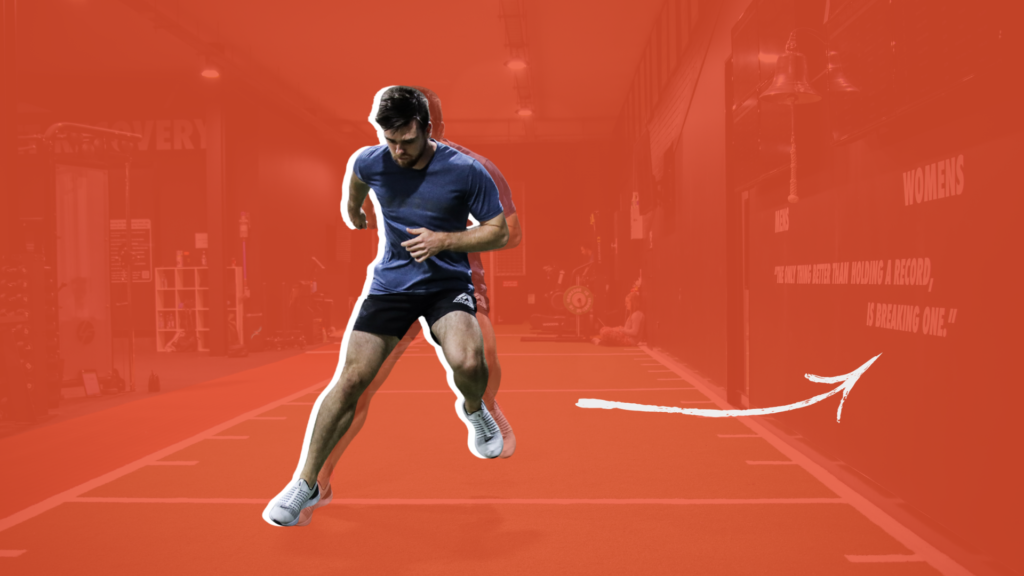
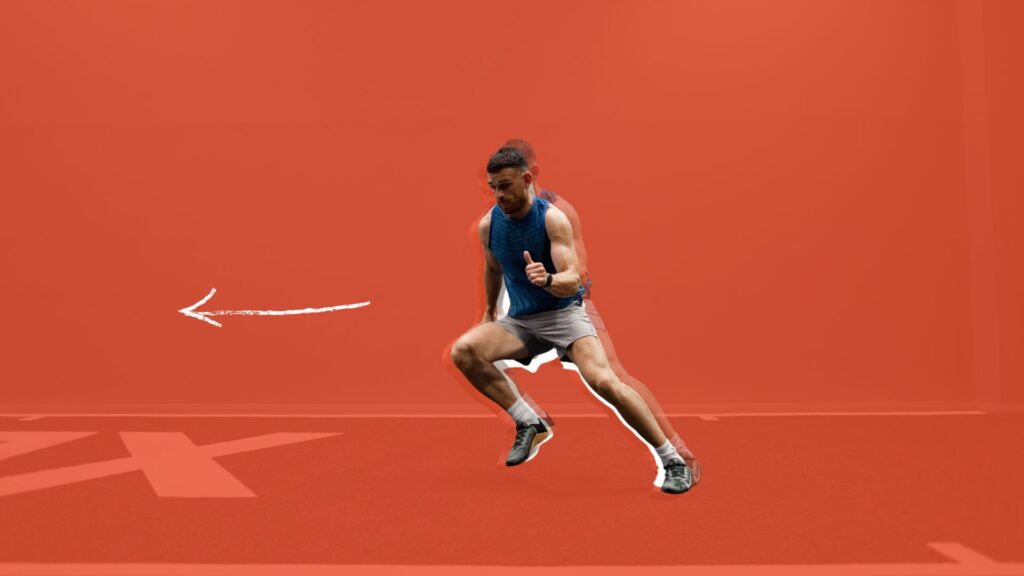
The split step is an agility technique that can be broken down as a small jump, landing on both feet simultaneously, followed immediately by a cut to the left or right (Figure 2, top).


Figure 2 shows both attacking techniques at a similar stage, just before the athlete plants the feet to apply a lateral force to the ground.
The side step reveals a postural cue that clearly signals to the observer (i.e., the defender in a 1v1 contest) that the player is going to move to the observer’s right. This allows the defender the opportunity to anticipate and commence the defensive movement to the same side, a decision he can make with confidence.
Therefore, although the side step can be a powerful technique to generate lateral speed, it can be relatively easy to defend.
In contrast, the body position adopted in the split step provides the opponent no indication of which direction the performer with move (Figure 2, top). A short time later, there will be a subtle shift in body position that may provide a cue, but this is delayed. This leaves the defending player with two options. The first is to wait for the attacker to reveal their intentions; and the second is to guess early, which has an increased risk of going the wrong way. Therefore, the split step clearly seems to provide an advantage to the attacker in this 1v1 scenario. Ryan Bradshaw and I conducted a study into this with a professional Australian Rules football team [9], and the results quantified the advantage of the split step. Our study showed that when players were asked to react to an attacker’s agility displayed on a life-sized projected video, their reactions were slower and they made more errors (selecting the wrong direction) when viewing the split step compared to the side step.
Tweet ThisWhen players were asked to react to an attacker’s agility displayed on a life-sized projected video, their reactions were slower and they made more errors when viewing the split step compared to the side step
@WoozleYoung
Based on the advantages of the split step technique from a decision-making perspective, this technique should be coached to athletes in sports where it can be performed, such as all codes of rugby, American football, Australian Rules and Gaelic football. Be aware that the split step cannot be executed effectively in all situations, such as when sprinting at very high speed. However, it is worth athletes spending some time learning the technique to have it as an option.
Creativity, cognition and agility skill development
Since player movements in invasion sports can be chaotic and unpredictable, it is not always possible to train for all the possible agility scenarios that emerge in match play. Think of an attacking soccer player who is surrounded by defenders but desperately wants to find enough time or space to have a shot on goal. The player may have to be inventive or creative to find a successful solution to evade the multiple opponents.
To solve this problem, the player may need to spontaneously execute movements that he has never knowingly rehearsed in training. The example from professional Australian Rules football below shows the flair associated with exceptional attacking agility that excites the spectators.
The player evaded multiple opponents and almost seemed to surprise himself with his creative footwork and decision-making.
A socio-cultural study of professional indigenous Australian football players provided insights into the development of this agility expertise [10]. The researchers found that these athletes were not taught how to play by coaches in their formative years, but learned implicitly through informal games where they were required to adapt to limited resources, e.g., playing football on a basketball court with a plastic bottle, or playing other invasion sports.
It is clear that problem-solving and creativity can only be developed through exposure to game play, and not by regimented structured drills involving running around obstacles such as poles, cones or ladders. In my most recent Sportsmith article, I suggested how isolated change of directions drills can be used in an agility program, but keep in mind that these drills cannot develop the decision-making element of agility.
Agility training examples to develop cognitive characteristics
Based on the points discussed above, I recommend the following agility training activities to develop the speed and accuracy of responding to an opponent’s actions.
1v1 contests
I discussed the benefits of 1v1 activities in “Agility training is more than just change of direction training.” I mentioned that they are a sport-specific way to train agility skill for both attacking (evasion) and defending. I also alluded to the perceptual and decision-making stimuli created by the need to react to the opponent’s actions.
Tweet This1v1 activities are a sport-specific way to train agility skill for both attacking (evasion) and defending
@woozleyoung
By repeated exposure to agility events, players can learn how to “read and react” by selecting postural cues from their opponent to respond more quickly and accurately.
My preference is to allow this process to occur organically by discovery, which is an unconscious process, rather than instructing athletes where to focus their attention. This implicit learning is more robust and holds up better under pressure, as opposed to trying to provide explicit “rules” that the athlete must follow [11]. Another reason for avoiding the use of instructions relating to where an athlete should focus their attention is that there is no evidence for particular cues being more effective for agility. Attackers should be encouraged to experiment with the use of deceptive actions (fake steps) during evasion to discover what strategies are most successful. Likewise, defenders need to experience various deceptive actions to learn how to detect them and, therefore, avoid being deceived.
A limitation of 1v1 training is that the attacker cannot use fake passes as a deceptive strategy because there are no teammates! However, coaches can overcome this by modifying the activity to a 2v2 scenario. Another limitation of 1v1 training is that it involves isolating all attention on one opponent, and therefore doesn’t take into consideration the influence of other players that participate on the sporting field or court.
Small-sided games
Small-sided games (SSG) can facilitate learning of agility techniques as they are required on the field or court. The added benefit of SSG compared to 1v1 or 2v2 training is that, with more players on the field or court (e.g., 3v3, 5v5), the cognitive demands increase due to the greater potential strategies and movement solutions available to players.
Only SSG can foster creativity, due to the variability, complexity and chaotic nature of the games.
My own research with elite youth Australian Rules football players [12] showed that SSG improved defensive agility performance. In addition, we found that this improvement was solely due to faster decision-making, rather than greater movement speed. In this study, each of the 10 SSG sessions lasted 15 minutes, and provided an average of 25 agility manoeuvres per player. Although this is not a huge amount of agility exposure, it is more than what you could expect from just playing a full field or court game.
Tweet ThisWe found that small sided games improved defensive agility performance and this improvement was solely due to faster decision-making, rather than greater movement speed
@woozleyoung
We concluded that carefully designed SSGs can induce a powerful training stimulus to enhance agility decision making. Also, the enhanced performance did not involve explicit instructions to the athletes about how to read their opponents’ movements.
Perceptual training
Given the contribution of the cognitive component to agility performance, can it be trained in isolation? Wouldn’t it be useful to train decision making without having to impose a physical load from change of direction or deceleration activities? In addition, injured players that have a limited capacity to perform physical work could really benefit from isolated cognitive training.
Training should ideally retain “perception-action coupling.” In other words, the stimulus should be linked to the consequent movement, such as in 1v1 or SSG. However, research has shown that 12 x 6-minute sessions of isolated 1v1 “video-based visual training” in youth soccer players not only enhanced the speed and accuracy of decision making, but also transferred to improved agility performance in a 1v1 agility test [13]. Although this training approach seems to be effective for enhancing agility performance, the study required considerable time and equipment to develop the video-based training, which is not readily available to coaches.
Virtual reality is another emerging technology that has the potential to enhance agility decision-making, but needs to be much more accessible to coaches before it is of practical value.
| 1v1 | SSG | Isolated perception and decision making | |
| Advantages | · Can include a variety of sport-specific visual information, including fake steps, attacking & defending perspectives · Can develop anticipatory skill · Can simultaneously develop agility technique · Can also be used as a tackling activity for some sports · Easy to administer | · Exposes athletes to a variety of sport-specific agility scenarios and associated visual and perception information, including all deceptive actions · Fosters creativity · Can simultaneously develop agility technique, as well as other fitness and tactical characteristics · Easy to administer | · Can develop cognitive function without a physical load, therefore ideally suited to injured players · Time-efficient once set up |
| Disadvantages/limitations | · Excludes attention to multiple players · Can’t use fake passes (except in modified 2×2) | · Physical exertion required to induce cognitive demands · Individual players can avoid engagement in agility activity | · Not commercially available, so must be purpose-designed, requiring considerable resources |
Coaches should use the content in Table 1 to determine what methods are most suited to your sport and requirements.
Overall, coaches should aim to address all three major components: the technical and physical, as I covered earlier, as well as the cognitive to optimise agility development.