
GPS data is used across sports to manage training loads. But GPS systems have a significant limitation: they cannot capture the context in which a physical action or output took place.
When reviewing and analysing data, we don’t differentiate between a one-on-one rehab session, a team training session, and a competitive match in front of thousands of fans. We simply look at the volumes and intensity, believing that all physical load is created equal. But it isn’t, and for the players it feels very different.
Consider two situations: a player alone on the pitch with the rehab coach, and playing a cup match in the stadium in front of TV cameras, with spectators watching his every step.
Which situation will heighten his emotion and stress? How much pressure is in the individual training and how much in the match? The first scenario has virtually no cognitive load: the player is simply watching the rehab coach and knows what is about to happen. He doesn’t need to anticipate another player passing him the ball nor scan for teammates, opponents, or open space, which are minimal requirements throughout every minute of the match.
Even if the data looked the same, we’d all agree that the match will leave the player feeling more fatigued than the rehab session.
We all have seen this pattern in other situations, as well: the GPS data doesn’t look that intense, but the players are shot. The data doesn’t consider that they are one or two days removed from an emotionally exhausting match, where they had to overcome a red card and two goal defecit at halftime.
Or, a similar phenomenon: players appear fresher after a victory than after a heavy defeat, completely uncorrelated with the data.
More factors affect fatigue than just the physical side of performance. The head coach feels this intuitively—that’s why they say “we need to clear their heads”—but your GPS data brings nothing to the discussion.
We all know this. We can all offer our own stories like the ones above. But as a profession, we’re still not addressing it. But practitioners are taking the first step, and questioning how we use GPS data.[2]

Tweet ThisGPS data is used across sports to manage training loads. But GPS systems have a significant limitation: they cannot capture the context in which a physical action or output took place.
Lasse Sievers
Complexity makes tasks more fatiguing
Complexity is a framework for examining the interplay between environment, context, behaviour, and—for our specific purpose here—fatigue. Complexity tells us that all attributes of a system influence, or are inputs to, any outcome we wish to examine.
Fatigue is not just a physical outcome, nor is it only the result of physical efforts. Take cognitive or mental fatigue. Football players with mental fatigue make significantly more incorrect decisions, perform worse tactically as a group (due to a lack of synchronicity), commit more individual tactical defensive errors, and display poorer technical execution of ball control, passing, and defensive tackles.[4–7]
Cognitive fatigue leads to more technical errors in football as well as other team sports, and is a relevant factor in performance and development. Conditional fatigue also affects coordination. Players alter their sprint mechanics when fatigued, which prompts changes in the conditional structure because the movement problem, its requirements, and potential solutions have changed.[8]
Cognitive fatigue affects physical outcome capabilities. Mentally fatigued athletes cannot do the same amount of conditional, physical work as when they are fresh. Inducing cognitive fatigue not only significantly increases training strain, but it also diminishes sport-specific physical capabilities: less distance covered and fewer high-intensity actions.[9,10]
The magnitude of this effect is similar to that of physical fatigue. That is, mental fatigue affects physical performance just as much as physical fatigue.
If practitioners do not properly identify and weigh mental fatigue, their players may be at risk of injury and the practitioners don’t even know it. The GPS data won’t tell you what you need to know.
Tweet ThisComplexity is a framework for examining the interplay between environment, context, behaviour, and—for our specific purpose here—fatigue. Complexity tells us that all attributes of a system influence, or are inputs to, any outcome we wish to examine.
Lasse Sievers
Creating a continuum of complexity
Match simulations re-create conditional stimuli, usually using GPS parameters (e.g., total distance, speed distance, sprints, changes of direction) or internal markers (heart rate, lactate values). The players complete these stimuli in isolation, purely running in a non-sport-specific context.
From a strictly physical point of view, the players complete approximately the same volume as in a game, e.g., 11 km total distance.
But the more complex stimuli of an actual 11v11 match lead to a stronger inflammatory and immunological response. This includes changes in creatine kinase, myoglobin, IL-6, lymphocytes, and monocytes; and more pronounced subjective fatigue and muscle soreness, especially in the legs.
The consistent observation is that two different contexts produce the same physical outcome, but widely different athlete responses.
Tweet ThisMatch simulations re-create conditional stimuli. From a physical point of view, the players complete approximately the same volume. But more complex stimuli of an actual 11v11 match lead to a stronger inflammatory and immunological response.
Lasse Sievers
Specificity of training tasks
Many forms of training only stress a few of these structures, sometimes to a minimal extent. For example, in purely athletic activities like an A-skip, there is little cognitive stress—there’s no perception task nor decision-making. This should be taken into account when considering complex training load and GPS data, particularly for activities that layer on the complexity of the tasks and the depth of the outcomes.
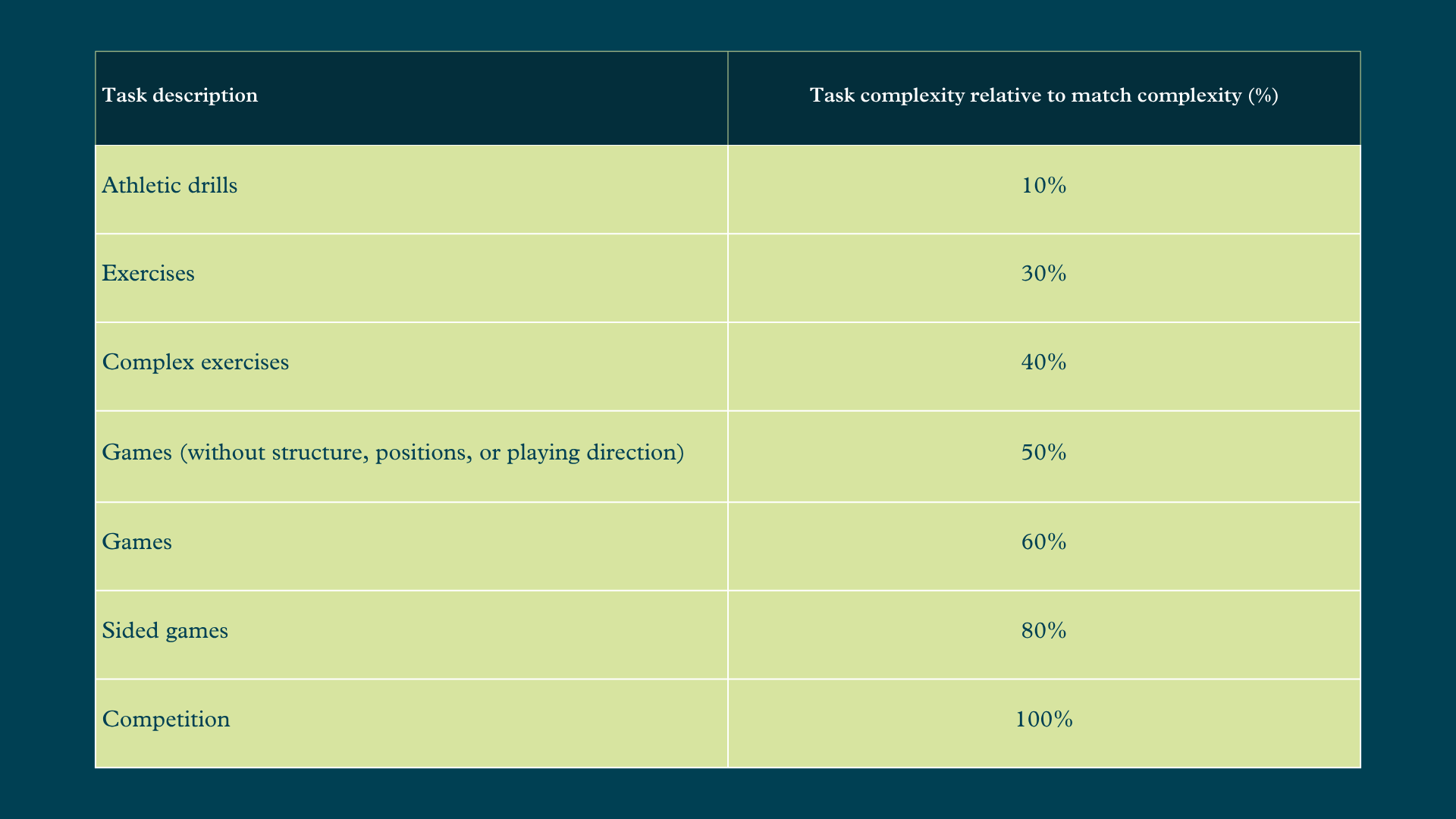
Javier Mallo, former Manchester City and Real Madrid physical coach, assigned weights for the loading complexity of different training situations.[12]
The reference for this model is the competitive match. The match is the most complex situation encountered in team sports, with the most degrees of freedom: number of teammates, opponents, referee decisions, opposing coach’s tactics, available space, and so on. The more specific the situation, the more complex the task is for the player.
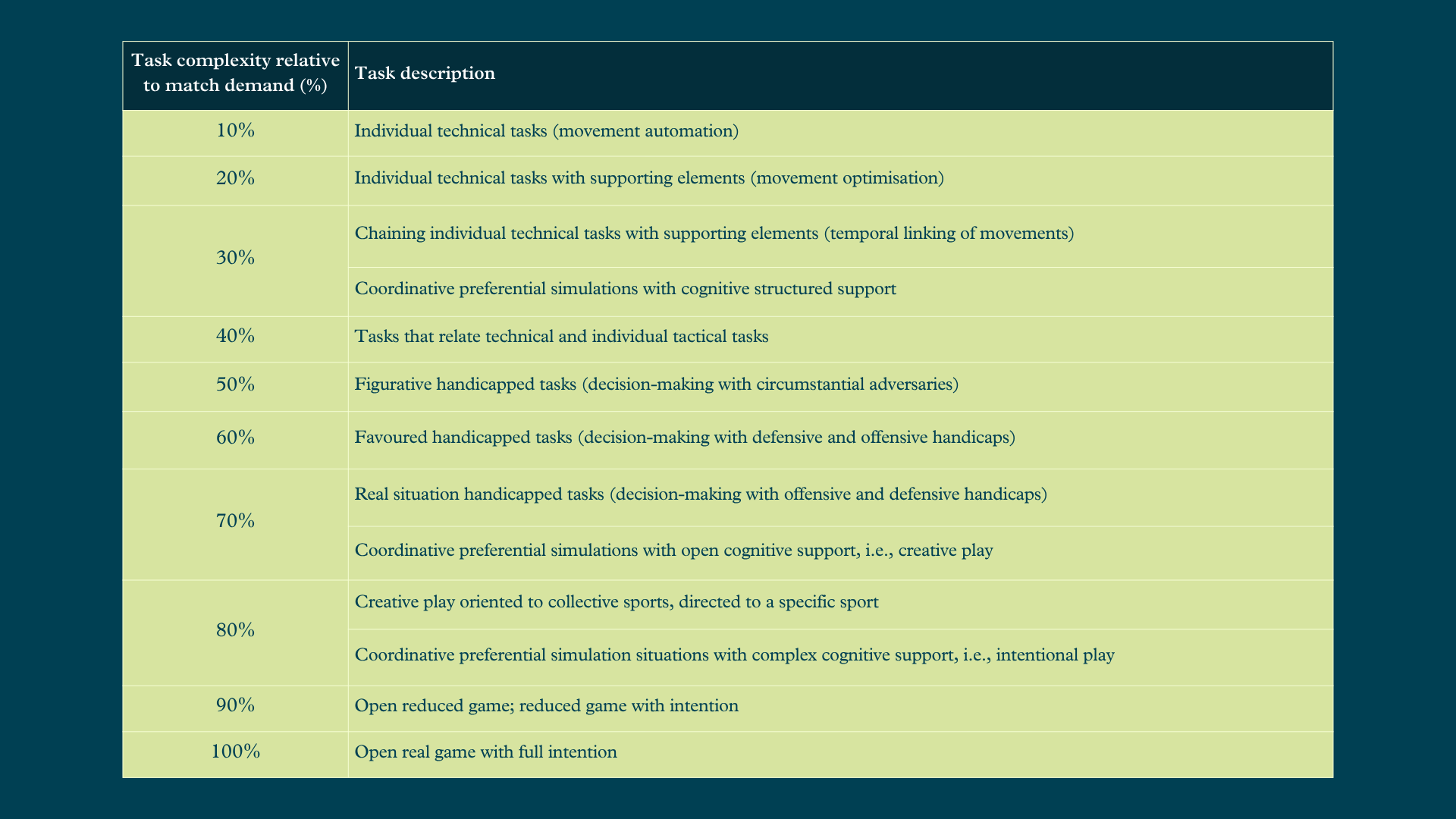
The complexity of training tasks is related to their proximity to the game. The more complex tasks enable game-specific problem solving. This is the context in which players need to perform and that we need to prepare them for.
Mallo classifies tasks in team training as conditional, technical, tactical, and competitive.
Tweet ThisThe complexity of training tasks is related to their proximity to the game. The more complex tasks enable game-specific problem solving. This is the context in which players need to perform and that we need to prepare them for.
Lasse Sievers
Conditional tasks (movements)
Conditional exercises do not involve any game equipment—not even the ball. This means there is no specific perception-action coupling, decision-making, or execution. An example is running an interval: an outside observer would not know whether this was training for basketball, football, or handball.
Technical tasks (actions)
Game equipment is involved, which creates a sport-specific movement intention. It’s now possible to recognise the sport, but there are no specific decisions or position-specific requirements.
An example is a passing exercise. This is a sport-specific exercise, but there are no positions. Accordingly, all players perform the same sequence of exercises and it is not clear which player occupies which position and has which tasks.
Tactical tasks (interactions)
In addition to the specific action that the task directs, the players now have decisions to make. They interact with each other, influence each other, and make game-like decisions.
These tasks readily subdivide. Ludic boxes are possession games in playing areas different from the sport’s actual dimensions. These games also feature a high numerical superiority, such as an 8v2 rondo.
Positional boxes are possession games in a larger space, a lower numerical advantage, and where the players have to make small movements. An example is 4v4+3 in a rectangle. Possession games utilise a larger space, giving the players more freedom of movement.
Positional drills have the players take up and maintain defined positions, creating more specific interactions between them. Positions create greater proximity to the game. An example would be practising offensive moves with 6v4 offensive vs. defensive overload with goalkeepers.
Positional games, by contrast, incorporate free switching between the four phases of play, e.g., 10v10 on mini goals.
Competitive tasks
These are essentially free play. The closer the number of players and the size of the playing area are to those of a match, the more specific the game becomes.
We can see how the complexity of the task increases with every step. This also increases the demands on the players.
A passing exercise is a more complex training load than isolated running, but less complex and demanding than a positional game. This makes sense: the coordination is more specific than running, but perception and decision-making is not as specific as the positional game where you cooperate with teammates and play against opponents.
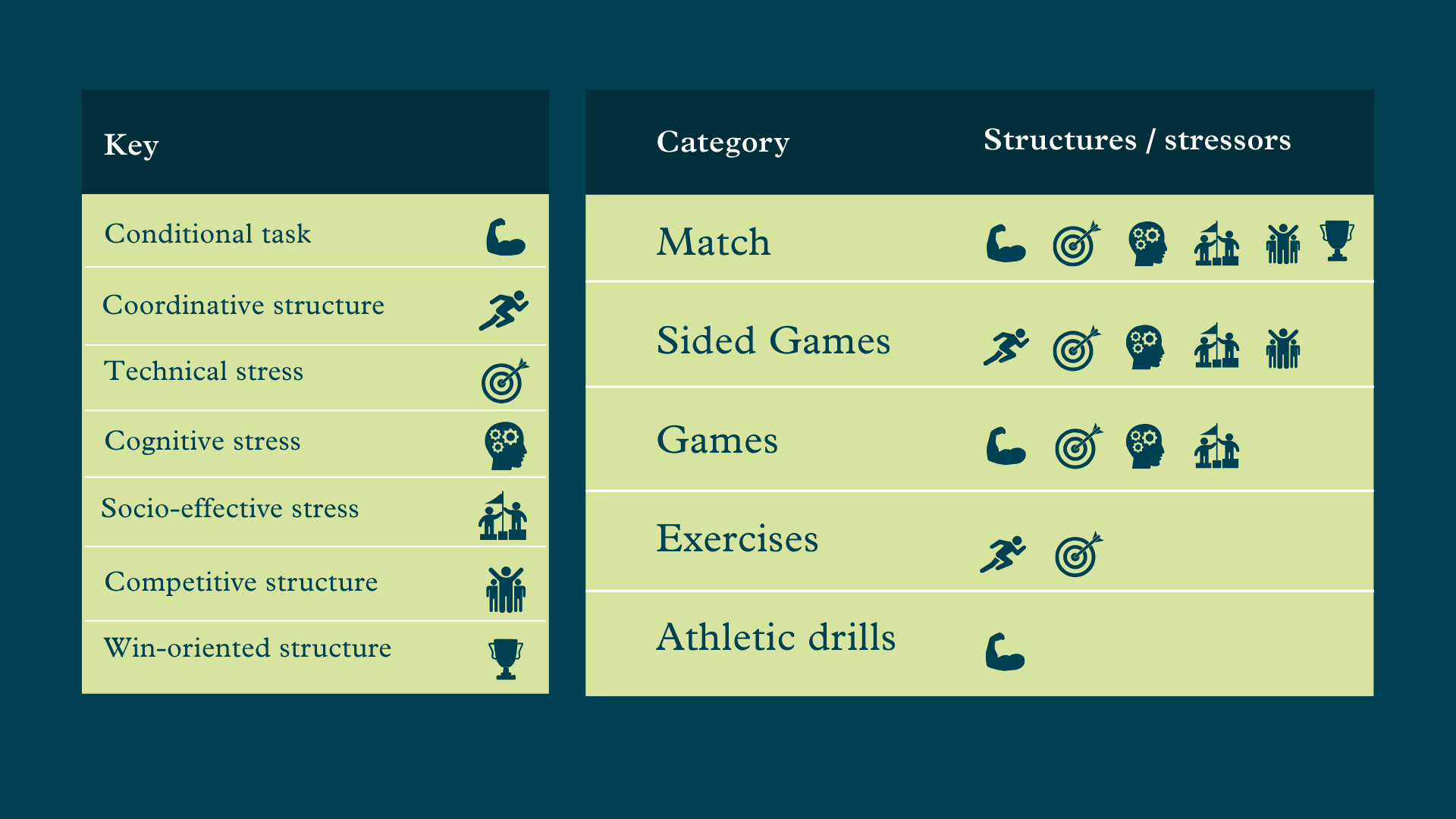
Understanding the complexity of our training tasks
The next step is applying these categories to programme and understand training in terms of complexity and specificity.
There are no clear separations or distinctions between the categories. Some passing patterns can cause socio-affective stress, and some ball possession games cause very intense cognitive stress. Nevertheless, games are generally closer to the internal logic of the complexity of a competitive match than drills and exercises.
Across all categories, as the complexity and proximity to the game increase, so does the overall stress and demand on a player.
Athletic drills
These stress only the conditional structure, i.e., the muscle. The coordinative structures omit game-specific movements. Running, strength training, and stretching have low cognitive and coordinative loads, and low socio-affective stress as athletes usually perform these solo.
Tweet ThisAthletic drills only stress the conditional structure, i.e., the muscle. The coordinative structures omit game-specific movements. Running, strength training, and stretching have low cognitive and coordinative loads.
Lasse Sievers
Game-specific exercises
In addition to the conditional structure, the coordinative structure addresses game-specific movements. These exercises are usually done with no opposition, or a passive opposition. This keeps the cognitive load low, as there is not a lot of decision-making. Still, the athletes are performing game-specific movements, e.g., a passing form or a shooting drill, and interacting with each other. Passing is a form of communication, like a dialogue through the ball, slightly elevating socio-affective load.
Games
The cognitive structure comes into play when there are teammates and opponents, leading to decision-making.
These activities are usually constrained in some way: a single playing direction, numerical superiority, sub-zones, or not playing on regular goals. But they have a playing dynamic. Players must perceive situations, make decisions, and execute them. In addition, teammates and opponents are now involved, so players are in constant communication and interaction, which are both indicators of the social-affective structure (team).
However, the cognitive and socio-affective load is still less than in competitive matches, because of the numerical superiority.
This allows for social loafing: if I lose the ball, it is not that dramatic. These are my teammates, not actual opponents. That decreases the socio-affective stress as well as simplifies decision-making (cognitive structure)—in turn making it easier to keep possession of the ball and more difficult to commit errors.
Sided games
Next comes competition-oriented play. An essential feature is the equal number of players on each team, resulting in “clear” opponents and direct duels. Direct duels prevent players from “hiding” or opting out. There is less social loafing and greater direct and indirect involvement.
Socio-affective and cognitive stresses increase because it’s harder to make good decisions, and because there is a higher cost to the team if a player makes a mistake. Competition also increases the emotion and willingness to win.
Equal numbers and competition offer more incentives and necessities to seek creative solutions to game problems.
With equal numbers, there are proportionally fewer free teammates to pass to. Searching the playing area for free teammates or free spaces takes on a greater role, and players have to look harder for more possible options for action. This forces the players to express themselves more creatively and to be attuned to the affordances offered by the environment.
At the same time, there are fewer restrictions, especially in free play (without constraints). Fewer restrictions lead to more degrees of freedom and more potential solutions for a given situation, and therefore higher complexity.
Competitive games
Everything from above is magnified by the pressure of a competitive game. Team success is the ultimate goal.
This is the most specific and complex situation for players. There are more players (teammates and opponents) than in a small-sided game, and more space to exploit.[13]
Applying complexity and specificity to load monitoring
Let’s get back to GPS data with an example. Isolated runs in the high-speed running band for a total volume of 300 m versus 300 m of high-speed running accumulated during an 8v8 training game. The small-sided game is closer to a competitive game, so the isolated running has a weaker stimulus, response, and adaptation. The subsequent fatigue is also lower, along with the transfer to competitive performance.
But we want to quantify this difference for tracking and programming purposes. Building off of Mallo’s table, athletic drills are weighted at 10% of a competitive match. Less complex exercises are weighted at 30%, and 40% if they are more complex and involve decision-making or opponents. Games are scored at 60%, sided games at 80%, and competition is the reference value of 100%.
Ismael Camenforte, former Leverkusen and Real Madrid physical coach, designed an algorithm to calculate a specificity score from 1-100 for any exercise.[14] Combining this specificity value or index with GPS data determined two parameters.
The specific load (CE) is the minutes a player completes in each training form, without breaks, multiplied by the specificity index.
The individual specific load is the specific load multiplied by the player’s subjective rating of perceived exertion on a scale of 1-10.
A study on a professional football team found that in a regular training week, the team’s specific load was 436 (47% match load) on the MD-4 session, 443 CE (48% match load) on MD-3, 371 CE (40% ML) on MD-2, 305 CE (33% match load) on MD-1, and 930 CE (100% match load) on a match day.
On MD+1 and MD+2, the recovery group was 29 and 33 CE (4-5% match load), respectively, and the substitute group was 237 and 213 CE (25% and 23% match load).
Simplifying complexity for daily use
To make this easier to use, I calculate relative match minutes: the time spent in each training form, multiplied by the percentages.
Under this approach, 15 minutes in a less complex passing exercise (30%) is equivalent to 4.5 minutes of specific, “match-like” load. Fifteen minutes in a sided game (80%) equates to 12 minutes of specific load.
This is very intuitive for the coaches, and a very easy yet high-impact parameter to track, as you only need the minutes in each exercise.
We usually reach average values of 25-30 minutes of specific load with our academy football teams on MD+2, 35-40 minutes on MD-4, 40-45 minutes on MD-2, and 28-33 minutes on MD-1. Match day is 105 minutes, accounting for extra time and warm-up.
The higher the specific load, the greater and more complex stress on your players. As this correlates with RPE and players’ feeling of well-being and freshness the next morning, practitioners can anticipate the players’ condition after the session.
Another option is calculating an intensity parameter for specificity (average specificity per minute) by dividing the specific load with training duration (measured in minutes).
To apply this with GPS data, scale the GPS parameters to specificity. We track the specific loads for high-speed running (absolute and relative values), sprinting (absolute and relative), accelerations, decelerations, explosive efforts, and high metabolic load distance. We tag the GPS periods with the appropriate exercise category, export the GPS values for each training period / exercise, and calculate the specific training loads for every player for each period. That produces each player’s “equivalent” match-like specific training load.
For example, 300 m of high-speed running in a sided game (80%, so 240 m specific HSR load) plus 150 m of high speed running in a complex exercise (40%, so 60 m of specific HSR load) equate to 300 m in the game.
Mallo’s table and categories are readily adaptable to any sport. Start by thinking about the training exercises in your sport, and order them by complexity. Then create categories and build a more detailed understanding of the actual training loads and stressors of full competition.
The coaching staff have much to contribute to this. This approach will feel intuitive for them, and they can help you determine which exercises are more specific, which categories might be missing, and what the appropriate indices are.
Let’s revisit the player returning to team training. Now we can quantify the difference in complexity of load that comes with returning to team training.
The maximum specificity he can be exposed to in a rehab setting would be a complex exercise: 40%. Jumping to a sided game in team training doubles the specificity (80%). The return to competition (100%) will be another spike in specific load.
The same goes for a substitute player thrown into a starting role: his specific load will spike because of the increased match time. Both will struggle if they haven’t accumulated enough specific load beforehand.
This is what load monitoring should actually be about: maximising readiness for match day. Unless you look at the complex context of your sport, you’re just blindly guessing and leaving far too much to chance.
Tweet ThisI calculate relative match minutes: time spent in each training form. 15 minutes in a less complex passing exercise is equivalent to 4.5 minutes of specific, “match-like” load. Fifteen minutes in a sided game equates to 12 minutes of specific load.
Lasse Sievers