

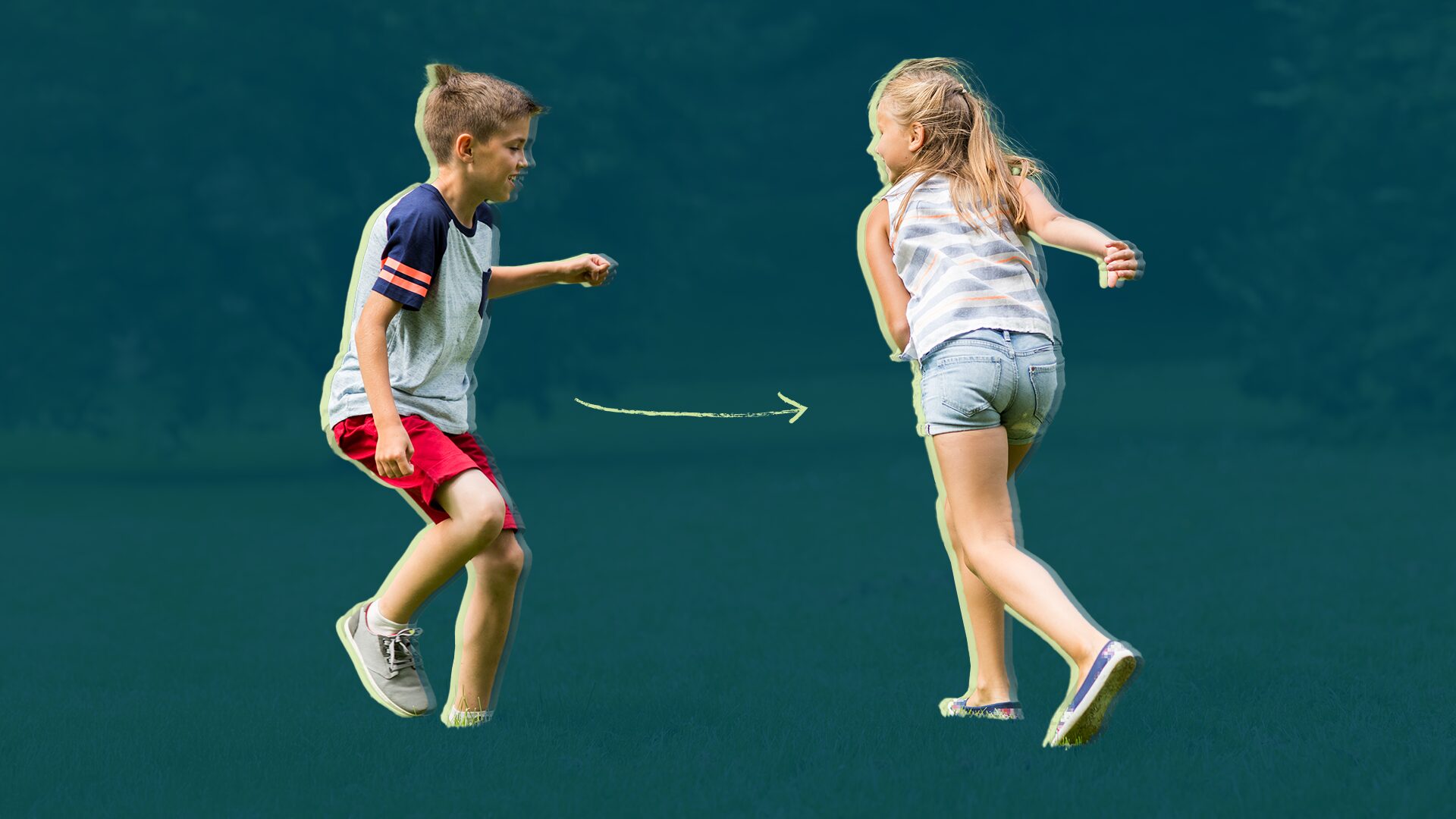
Technological advancements, increased professionalism in sport at a younger age and greater economic rewards for successful athletes have helped push the boundaries of human performance.
However, all change comes with a cost, dispensing with the old to make way for the new. Unfortunately for the current generation of young athletes, it’s a sacrifice of their opportunity to play, to participate in unstructured games, in person and with friends.
Let’s start with some nostalgia, a story of a Millennial childhood through play.
Back in the late 90’s, there was rarely an evening or weekend spent without a ball. Playing “curby” – trying to hit the corner of a curb with a 15 yard clip – for hours upon end and running for cover when one of your neighbours comes out to tell you off for hitting their car. Afternoons are spent at your friend’s house, the one lucky enough to have a small goal or a trampoline, playing 1v1’s and having balls pelted at your behind if you lost, before managing to annoy the neighbour again for launching the ball into their plant.
Weekends are spent at the park, anywhere you could find two trees spaced appropriately apart for a goal. Time for “Wembley singles” or doubles: you select two captains, pick the teams and fight tirelessly to ensure your team retains bragging rights, stopping only when someone’s exuberant effort from 20 yards flies high and wide into the brambles.
Google doesn’t even exist, so you must find your way on your own, make your own games from scratch, unaware if anyone else is doing the same outside of your small town.
Over the next decade, you may be lucky enough to get your first bike, your ticket to freedom. It offers far more possibilities than this Internet that is gaining popularity but still takes an age to “dial up,” and that only one person can use at a time.
Then the PlayStation and Football Manager combine to shift your footballing fantasies on cold wet days from the outdoors to the safety and comfort of your own bedroom, where you invest many hours researching the next “wonderkid” and adjusting formations as you try to get Weymouth into the Premier League. Before long, you’re adding all your friends to this new thing called “Facebook,” and all your interactions – social, football, and otherwise – are indoors.
Now let’s restart this story in 2021, the year my niece was born. She is a digital native. She has been acclimatised to phones, TVs and computers since the moment she was born. Parks are no longer places to go and play: they are places to walk your dog. We have access to on-demand news from all over the world, so, despite the world being safer than it was 50 years ago, no one perceives it as such, especially if you are a parent.
Her opportunity to develop, learn and socialise through play will be limited, unless her parents make a very deliberate attempt to protect it.
This article will remove the nostalgia and analyse a modern outlook on play. The youth of today receive far less exposure to play than any preceding generation [7].
As practitioners working in youth development, we should give this credence and explore how it may affect the generation of athletes we are working with today. What benefits can play offer? What is its relevance to skill acquisition and how we drive positive change? Technological advancements are helping to push the boundaries of human performance, but at what cost? Can we find a balance between protecting the positives of the past and embracing the opportunities this new world provides?
Easy to recognize, hard to define
Defining “play” can be difficult, and the terminology may vary depending upon the context. And the meaning of play evolves with age and maturity. While the outcomes remain the same, the activity will look very different, often increasing in organisation, competition and sophistication.
With those caveats, I propose that all types of play have four common characteristics:
- Fun. We choose to participate. Motivation is purely intrinsic. For children and adults alike it can be an opportunity for escaping reality, even if that reality can be very different for both.
- Freedom. The sense of freedom and safety in these activities allows children to master their competencies through exploration and provides the opportunity to try a broader range of behaviours and skills [5, 9]
- Autonomy. The power is in their hands. They feel a sense of empowerment as they have been involved in the design process: it is their game and they are the protectors of its integrity.
- Agreed set of rules or guidelines. This is slightly more contentious because we often describe play as “unstructured,” but unless the activity is played alone there needs to be some form of structure, rules or guidelines to help shape their interactions. This is likely to become more valued as children get older as will the desire for competition.
Play can be categorized further into three types.
Playful activity
Playful activity is the simplest form of “play” and is different from the others as it often lacks any clear rules or structure. It is often self-directed and requires creativity and problem solving. It is open ended, with the freedom for the participants to explore and express themselves. For a child, this could be role play, building scenarios and acting them out with their friends; or scaling a climbing frame in their local park. These activities tend to be more imaginative and spontaneous.
Play
Play includes more structure and predefined rules or guidelines. To ensure autonomy, the participants shape the games and all agree to the rules. The outcomes are similar: individuals use creativity to solve problems and emotional intelligence to collaborate with others and protect the integrity of the game. “Curby,” park football, bike races and a rugby kicking competition are all play. They resemble a sport or activity, but don’t subscribe to the same degree of rules and boundaries.
Deliberate play
Deliberate play is the combination of play and constraints based practice. It involves engaging in purposeful practice or an activity with a specific intention, making it more goal oriented and focused. It is less spontaneous and involves more structure than playful activities and play. However, it differs from deliberate practice in that it maintains its playful and enjoyable characteristics and allows participants to explore and experiment.
For example, a golfer trying to improve his putting may set up a circle putting drill, placing 10 tees at varying distances around the hole. The game may be to complete the circle in as few putts as possible, so the golfer with the fewest putts wins. Despite having the clear objective of learning to adjust the weight of your putt, it continues to be playful and allows for exploration. No one gives any specific instructions on how to execute the skill.
As we transition to deliberate play, coach involvement becomes more important, either as a resource for the athlete, or in how they organise the constraints. In Hidden Potential, Adam Grant discusses how basketball great Steph Curry harnessed deliberate play [1].
Curry’s coach describes some common principles.
“There is no boring in our workouts.”
The games they designed were fun, and he constantly refers to finding the passion in practice. Believing in variation not repetition, his coach describes never repeating the same challenge over and over. Curry thereby learns multiple skills at the same time, understanding how they complement each other and intertwine.
“Every drill is a game. There is always a time or a number to beat.”
The games have an agreed set of rules and guidelines, and ignite a huge sense of competition. The pressure he builds into these games is the deliberate part. He is trying to make the execution context specific, i.e., how it would feel during the game. However, there is still freedom and autonomy. The coach is not telling Curry to execute the skill. They are not pursuing the perfect way. Rather, they are after his perfect way in a variety of different contexts.
They are generating a desired outcome but with no desired or prescribed solution. The athlete can be creative in their solutions, but are nudged by the constraints of the game. The environments encourage greater exploration and self organization, which could not happen if the coach provided the athlete a solution [3].
Tweet ThisUnstructured play is essential for developing creativity and autonomy, offering young athletes the freedom to explore and experiment within self-set boundaries, thereby enhancing their problem-solving and decision-making skills
@Jack_C91
Why is play important?
Sport is chaotic and complex. Decision making often happens in a split second. Invasion games are faster and more athletic, and the margin for error is getting smaller in individual sports such as tennis and golf.
We want to develop individuals who are creative in their solutions and adaptable to the ever changing environment, both in life and in sport. Play stimulates curiosity and allows children to explore. It can also be a tool to develop self confidence as they have the potential to discover new strengths, interests and abilities [12].
This can be very powerful in a high performance setting, giving all children the opportunity to be the best at something. It also encourages the development of emotional regulation [2]. How do they respond to not being the best? They must learn how to process and manage their feelings. We can provide guidance and tools to help but play gives them the opportunity to practice and self-regulate.
Furthermore, life for children can be stressful. Among many things, they have pressure to perform both at school and in their sport. Sport can be an outlet for this stress, but with increased professionalism and pressure from outside sources, it may lose that purpose very early in their development journey. By participating in enjoyable activities with friends, play can potentially reverse, or at least offset, that negative effect.
Finally, it is an opportunity for social development. They have to interact with each other, communicate, show empathy, negotiate, share and resolve conflict [10].
Tweet ThisPlay allows children and adults alike to escape reality and engage in activities that are intrinsically motivating and enjoyable, fostering a sense of freedom and empowerment that is critical for healthy psychological development
@Jack_C91
How does play relate to skill acquisition?
Play gives children the opportunity to use their creativity and imagination [6]. By allowing greater freedom, they develop a greater variety of skills. This is vitally important. To flourish in a complex and chaotic environment, children need to develop a warehouse of athletic abilities, not a shed [13]. Having more than one solution to the same problem makes them more adaptable and robust [3].
We saw this repeatedly in the era of curby. Success in curby doesn’t come from one ideal technique. Some may get success with a low driven pass, some with a loop or curve. The constraints of the game are very simple, yet participants need to use their imagination.
Moving on to Wembley doubles in the park, does the best team always win? Absolutely not. Some individuals will adapt their solutions based upon their individual constraints. They may not be great at dribbling but are stronger than their opponents, so they decide to keep the area small and use their physicality, using their partner to be more successful in possession. Another team may have a partner who is great at shooting. They adapt their game to work any opportunity they can to create a shooting opportunity. They manipulate the environmental constraints to make the area as big as possible and ensure their game plan involves being quick in transition.
This may not be explicit or conscious at the time, but these children receive constant feedback from their environments, and learn to effectively filter which information is relevant so they can direct their attention appropriately. Not just sports and games – just “play.” [11]. They adapt their actions to the constraints of the environment. The purpose of this variability is to ensure the athlete develops the skill to adjust their technique given the chaotic and varying demands of games [3].
Consistently repeating a skill under an array of different task and environmental constraints requires us to view variability not as noise, but as necessary and important.
Skill acquisition still requires plenty of deliberate practice to help athletes work towards a desired technical framework. But coupled with variability in practice and an appreciation of the individual’s constraints, we help develop a skill that is more adaptable and transferable.
Psychosocial benefits of play
This discussion of the importance of play is from the perspective of long term athletic development. This model is not the only pathway to success, but it is a more sustainable pathway.
Athletes who specialize early often cite a lack of enjoyment or engagement with the sport [4]. I’ve seen that as sport becomes professionalized much earlier in their careers, some can lose the playful element of sport. Much to the frustration of everyone around them, they can also lack the passion and love for participating they had when they started out. There is a decrease in intrinsic motivation to participate and improve, which ultimately manifests itself in decreased engagement [8].
Athletes who are exposed to diverse activities early in their careers maintain enjoyment and engagement for longer. Additionally, they are more likely to find joy in the process of learning and mastering new skills [4]. Early specialization and a heavy focus on deliberate practice may yield greater success in the execution of skills in the short term, but in the long term it will often increase the risk of burnout, overuse injuries and psychological strain.
Case Study: Play during end stage rehab
A player suffered a metatarsal fracture. The bone healing process was a success, and he has recovered sufficient strength and stiffness qualities through the foot and ankle. He progressed well through his rehab, but he still unevenly distributes his weight when jumping and is noticeably cautious when changing direction aggressively off his injured side.
How can we help through play?
Play takes the individual outside of their injury. They are focused on the game and the challenges of the task, so they don’t over internalize how the foot feels with every foot strike, turn or landing. The body will naturally want to protect the injured site, partly by implementing movement strategies that reduce vulnerability. Play can break down these barriers.
Through deliberate play we can design games that encourage weight acceptance through his injured leg with a high degree of variability. We can implement constraints that encourage athletes to explore and increase body awareness.
Modified squash
Modified squash is perfect if the athlete injured the lower limb on the same side as his dominant hand.
The game is very simple but the constraints demand repeated lunge patterns in a variety of movement planes.
Body position changes with each shot and the game demands a high level of coordination to stop effectively and hit the ball. By changing the court dimensions, the outcome changes. If the court is longer court, the athlete has to move forwards and back more frequently. With a wider court, the lunge patterns are more extreme and varied. If we see consistent patterns within this game that we don’t like or deem unsafe, we can isolate them with deliberate practice and then return to the game.
Gymnastics
Air based gymnastic tasks get the athlete to jump, land, and stabilize. Through rotation we can subtly introduce variations in how they produce force. To rotate right they need to preferentially load through the left, and vice versa. By putting “exits” on both sides they must accept weight through both sides. If the outcome is speed (i.e., a race), they don’t have to find the most efficient solution, which will encourage them to explore even further.
Matt Taberner describes this through his work on chaos within the rehabilitation process. Play during rehab helps athletes add variety when they are rebuilding movement skills; and manipulates enjoyment and engagement to reduce internalization. We still want to do plenty of work developing the skill within the context of the sport, but this is just another tool in the toolbox.
Tweet ThisThe integration of play into rehabilitation strategies for athletes not only aids physical recovery but also mitigates psychological stress, helping them regain confidence and functionality without the pressure of structured training environments
@Jack_C91
Recommendations for play in competitive contexts
The benefits of play are clear, and the societal changes across Europe and the US are outside of our control. What can we do to drive positive change within youth development?
Educate parents, athletes and coaches
I’ve been fortunate to work with some fantastic, growth minded coaches who embrace this concept and are open to the work we suggest. Coaches are the gatekeepers and will have a big influence over the young athletes we work with. However, parents have the biggest influence on our young athletes’ lives.
Parents sacrifice a huge amount to support their children and enable them to participate within our youth development programs, and therefore have high expectations of the service we provide. They need to understand why we include play within our programs, why we expose their children to different sports and try to influence the decisions they make away from our care.
Ultimately, they will decide whether their child goes for additional one on one coaching, or has free time to play with their friends.
Last, we need to educate the athlete. This will help with engagement and developing self-aware, autonomous athletes who will make better and more informed decisions throughout their careers.
Create an antidote to society
We must accept reality, and ensure our environment reflects the principles we believe to be important. We can increase the proportion of our athletic development time to all types of play and be comfortable spending time developing general movement qualities, confident that the players will get a large dose of sport specific skill development elsewhere.
Athlete-led arrival activities
These are a great opportunity to let athletes design games and play with their friends. We provide the environment, resources and ensure it’s safe. They control everything else.
Extensive multisport curriculum
If youth are going to specialize early, we must challenge that within our own environment by providing opportunities for both general and intentional multisport games. They can play sports for their own sake instead of solely to target a specific skill.
Focus on how we coach
Manipulate constraints and be conscious of our style and practice design. Guide athletes to favourable, consistent movement patterns while letting them explore and discover a variety of ways to achieve success.
Make it fun
Prioritise sustainable skill development over short term improvements in execution. We want consistently high levels of intrinsic motivation and engagement.
Facility design
Think about how we design our facilities. The Johan Cruyff Foundation is doing some great work in this space. They spend a huge amount of their time at our facility and may not have access to facilities that encourage play within their local communities.
In addition, parents view our facility as a safe space, and therefore are comfortable with their children heading off to explore. We can shape our environments to encourage young people to play other sports, design games and have fun with their friends.
Restore play to sports
Children today have far less exposure to play and a different relationship with technology than the generation that precedes them. Coupled with a rise in early specialisation and professionalism, children may miss out on the opportunity to develop the diversification of motor skills they may have once achieved through their unstructured social activities.
Our responsibility as athletic development coaches is to build long term development models which offer the antidote to society. We can embrace the many benefits of technology and innovation while protecting the positive elements from the past.
Developing a model that provides a sustainable pathway to success and increases the volume of play within our programs is a fantastic place to start. We should protect the benefits of play in our efforts to maximise athletic potential and maintain engagement and enjoyment for the duration of our athletes’ careers.
Tweet ThisDeliberate play combines the structure of organized sports with the enjoyment of playful activities, providing a balanced approach that encourages purposeful practice while maintaining the pleasure and creative exploration of play
@Jack_C91


