

Considering the importance of football goalkeepers, they’ve been somewhat overlooked by the research community. Similarly, despite the essential role that they play, many goalkeepers still find themselves following physical development programs designed for the other, quite different positions.
The unique demands of goalkeeping, governed by distinct rules, deserve more attention. Understanding what goalkeepers must do in critical or frequently occurring in-game actions allows us to evaluate how well the individual meets these demands. Or, succinctly: “stop guessing, start assessing.”
Jumping actions are among the more recognized skills that goalies have to perform with a high degree of competence at all levels of football. Stopping shots on goal, intercepting high crosses, and punching clear corner kicks quickly come to mind.
While these actions might not happen frequently on a per minute basis, their importance cannot be overstated. A goalkeeper’s ability to displace their center of mass (COM) far and fast enough into the direction of the ball is a critical factor in determining whether a team goes home victorious or in defeat.
This article will delve into the position-specific jump demands of goalkeepers, consider strategies to assess an individual’s abilities, and explore general interventions for developing goalkeepers’ abilities to meet these demands.
Tweet ThisDespite the essential role that goalkeepers play, many still find themselves following physical development programs designed for the other quite different positions
Yoeri Pegel

Lateral and vertical displacement
The first consideration is the relative importance of both vertical and horizontal displacement.
When it comes to attempts on goal, the goalkeeper’s jump related actions are generally biased towards the lateral displacement of the COM towards the ball. The dimensions of the goal itself reveal why lateral displacement usually takes precedence over vertical. Most professional goalkeepers can easily reach the crossbar while standing and generally will only need significant vertical displacement when they are positioned further in front of the goal.
In comparison, the goal’s width (over seven meters wide) emphasizes the need for lateral displacement, which becomes especially apparent during shots on goal. Even when the shots target the upper corners, the lateral impulse remains more critical than vertical impulse (although vertical still is a very important consideration).
The dynamics are quite straightforward: fail to move far enough, and the ball will find its way into the net; move far enough but take too much time, and the outcome remains the same.
This shouldn’t overshadow the importance of vertical jump demands for goalkeepers. Goalkeepers face many demanding situations that require distinct vertical jumping abilities, especially during high crosses and corners. The capacity to leap high plays a far more prominent role in success rates during non-shooting scenarios that are similarly critical towards the game’s outcome.
Moreover, goalkeepers need to display a wide range of vertical jumping techniques within these scenarios. They must master the ability to scan their surroundings, time their approach towards the ball, and cope with physical contact both before and after take off. Beyond that, their jumping repertoire must encompass a variety of approach angles, distances, and take off strategies.
Of utmost importance, goalkeepers need to jump vertically off both feet and a single foot. Moreover, they must be able to leap high from both their left and right sides. The situation on the field determines the leg they use for take off, requiring well-developed capacities in both legs.
A goalkeeper’s movements stem from a diverse range of preceding actions, demanding the ability to read and react swiftly to the ever-changing game environment. It doesn’t matter how far or high you jump if you get to the ball late.

Lateral jump assessments
Assessing the goalkeeper’s capacity for lateral movement comes down to considering the ability to displace the COM laterally. The ability to generate force, especially in explosive actions such as jumping, is highly direction dependent. Assessments in the sagittal plane alone won’t provide a valid evaluation of an individual’s lateral force production capabilities.
As with most jump assessments, the optimal approach towards analyzing lateral jump capacities will likely be influenced by budget constraints.
A practical solution may involve implementing a lateral countermovement jump (LCJ) assessment. Coaches instruct the athlete to jump sideways, covering as much distance as possible before stabilizing their landing. Eric Leidersdorf’s recommendations are likely appropriate for the LCJ assessment.
LCJ distance alone may be insufficient to evaluate the full sport specific context of a lateral diving action. We may need to account for the time to take off; or, even better, we should analyze key kinetic variables through three dimensional force platforms. Of course, most teams won’t have access to advanced (and very expensive) technology like this. In such cases, measuring the distance of lateral jumps and bounds, as well as the time required for take off, could still provide actionable insights.
Another exploratory approach would be the lateral dive test. The athlete is instructed to perform a lateral dive, reaching overhead to cover as much distance as possible.
For optimal results, do this on a soft landing surface to minimize the impact upon landing. That way athletes can execute the test with full intent and achieve maximal lateral COM displacement. Incorporating three dimensional force platforms would undoubtedly elevate the precision of this assessment.
These assessments allow us to assess potential deficiencies in moving laterally towards both sides, addressing total displacement and the time needed to generate that displacement.
The LCJ and lateral dive are not commonly used, and haven’t been the beneficiary of much attention in the scientific realm. Choosing the most appropriate assessment and finding ways to standardize its implementation, while ensuring that the test is valid in assessing lateral force production capacities, appear to be a challenge.
Critically analyzing each assessment is, therefore, necessary, as there is not currently any clear guidance about which assessment is most appropriate for lateral jumping.
Tweet ThisThe dynamics are quite straightforward: fail to move far enough, and the ball will find its way into the net; move far enough but take too much time, and the outcome remains the same
Yoeri Pegel
Standing vertical jump assessments
Vertical jump assessments are quite a bit more common in football. Similar to lateral jump assessments, if we have access to force platforms for standing vertical jumps, they are an excellent option.
Force platforms allows us to use impulse-momentum metrics for a more accurate evaluation of jump capacities, while minimizing the error rate. They also let us consider critical underlying kinetic variables that can be highly influential towards guiding the training process.
Most other measurement devices rely on flight time calculations to determine jump height (vertical COM displacement). This approach makes it essential to be stringent about standardizing landing techniques, and to have those closely resemble take off postures. Athletes will find out rather quickly that they can “cheat” their way to higher jump outputs by altering their landing strategies (e.g., flexing the lower limbs before contact to prolong their flight time).
Similar to the lateral jump assessments, time is another crucial consideration. We not only want to accrue information about displacement, but also how an athlete achieved those levels of COM displacement. Regardless of the measuring device, practitioners should assess time to take-off and the time for each of various phases of the jumping action, in addition to jump height metrics.
There are a lot of different vertical jumps to choose from, and each jump can provide insight into different abilities. Four tasks that can potentially carry value within a vertically oriented testing battery are:
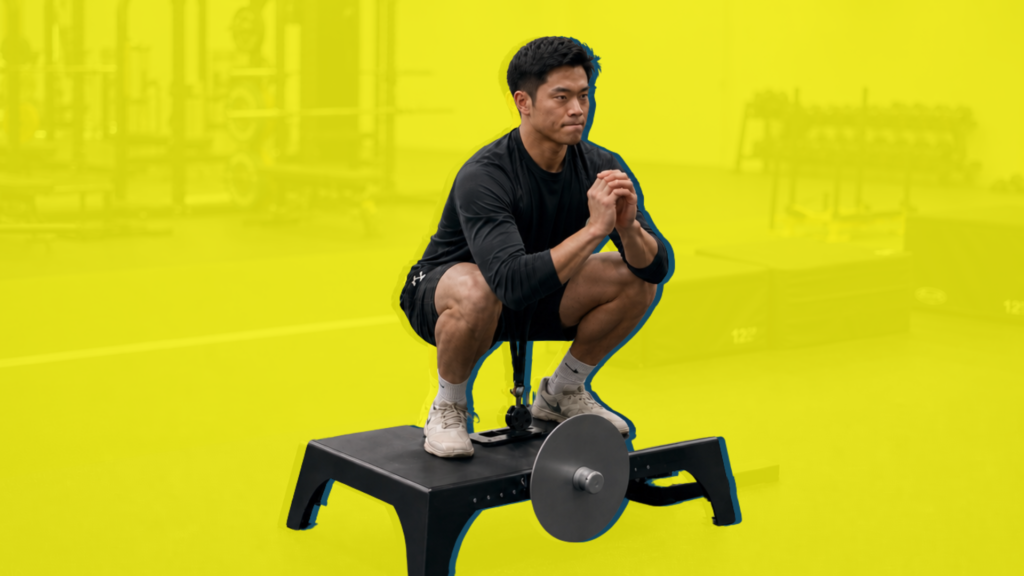
1. Squat or static jump. The athlete pauses in the bottom position, taking away the potentiating effects of the rapid lowering phase that normally occurs in jumping. As such, it primarily assesses the concentric (muscular) capacities of the lower limbs. Practitioners can instruct athletes to pause at a predetermined depth or a self-selected depth, depending on the objective behind the assessment. Athletes that score poorly in these tasks generally respond well to concentric based training interventions, such as the Olympic lifts, (loaded) static jump efforts, medicine ball throws, and traditional resistance training.
2. Countermovement jump. The athlete performs a vertical jump for maximal height from a standing position. Generally, athletes aren’t instructed to perform the countermovement action at a certain speed or to a predetermined depth, although those cueing strategies are certainly valid. The largest difference between the CMJ and squat jump is accessing the eccentric phase, or the ability to use eccentric muscular actions to improve concentric outputs. Metrics such as time to takeoff, countermovement depth, and RSI modified can be valuable considerations to view, helping understand the athlete’s jump strategies. Athletes that score poorly on the CMJ generally respond well to slow coupling plyometric interventions, which are generally going to be jumping actions with longer contraction or ground contact times (usually exceeding 250ms).
3. 10-5 repeated jump or drop jump. In these fast stretch-shortening cycle assessments, the athlete will need to handle the incoming downward momentum from their own body and redirect that rapidly into the opposite direction. Their performance reflects their ability to brake and subsequently generate momentum into the opposite direction. Most practitioners will cue their athletes to minimize their ground contact times (generally not exceeding 200-250ms) for these tests. These assessments should inform a coach about an athlete’s ability to pre-anticipate the ground and self organize while on the ground, in order to brake and redirect effectively. Athletes that score poorly generally respond well to fast coupling plyometric interventions, which will be some form of (impact) plyometric with a very rapid ground contact time. Due to the need to anticipate the ground in these activities, faster plyometrics that involve a landing and a subsequent take off phase are probably most appropriate.
4. Isometric mid-thigh pull or isometric push. These two assessments are optimal if the aim is to assess an athlete’s ability to produce maximal vertical force without any (relevant) time constraint. While the transfer of these outputs towards jump tasks is certainly questionable, metrics related to rate of force development (especially in relevant time spans for jumping) might be a valuable consideration. Athletes can perform these tests bilaterally or unilaterally, depending on the test objective; and at various joint angles that might be appropriate for analysis. Athletes that perform poorly generally respond well to a steady dose of heavy resistance training and overcoming isometrics.
These tests will shed light on various capacities that underpin the ability to displace vertically in different contexts, mostly revolving around the availability of time and whether the athlete has to handle high levels of incoming momentum into the take off phase. As these tests address some largely independent physical capacities, it might be valuable to cycle through all of these tests with goalkeepers. In isolation, none of them likely provides enough information about the entire vertical jumping spectrum to help us design appropriate interventions.

Approach vertical jump assessments
Within the context of football, athletes usually perform vertical jumps after a run up leading into the take off sequence. Assessments that target the capacities to jump from an approach usually employ some type of Vertec device. Once again, if we have access to force platforms for these assessments, those are an ideal addition. However, if force platforms aren’t available, we can consider the ground contact time in addition to jump height for a valuable analysis.
When assessing jumps off an approach, it’s crucial to distinguish between take offs from the left and right legs (and, to a potentially lesser extent, two foot take offs).
The length of the approach is another factor to consider. Given that goalkeepers must perform these approach jumps from various angles and distances, there’s no one size fits all approach.
These tests are likely more specific towards the common vertical jump tasks in the sport, and are quite a bit more technically demanding than their standing counterparts. This brings the athlete’s technical capacity into the picture as a factor to consider.
And while the context of the jump has a massive effect on the movement patterns, there remains a certain bandwidth of movement strategies that athletes should adhere to in order to maximize the odds of moving “efficiently.”
The first feature to look for is the height of the COM gradually decreasing as the athlete transitions through the penultimate stride into the start of the take off position. At the same time, athletes should be increasing stride length leading into the penultimate stride and increasing horizontal velocity. Regardless of the approach jump task, the best jumpers find a way to gradually lower their COM and move into that position at (relatively) high horizontal velocities.
This can be difficult to observe, so slow motion video analysis aid in this process. Developing technical landmarks can be a valuable additional consideration, and help in determining whether technical or physical development interventions are appropriate.
I’ve found it effective to conduct two sets of jumps. First are full approach jumps, where the athlete has a 5 meter run up towards the Vertec device. These provide insights into the athlete’s maximum vertical jump capacities and their preferred movement strategies. They allow us to assess how quickly the athletes move towards their target and their abilities to redirect large horizontal momentum vertically.
The other are one step approach jumps, which reveal the athlete’s ability to jump with minimal build up of horizontal momentum. These assess the individual’s ability to generate vertical momentum without having to redirect much horizontal momentum.
Tweet ThisGoalkeepers face many demanding situations that require distinct vertical jumping abilities, especially during high crosses and corners
Yoeri Pegel
Turning jump data into a holistic jump understanding
The test battery that we eventually conduct depends largely on factors like available technology, time constraints, and staff availability. Regardless of the assessments, it’s essential to approach data interpretation with caution.
Improved physical capacities do not automatically translate to enhanced abilities in the sport skills. Relying solely on data analysis and concluding that a program emphasizing [insert arbitrary physical capacity] is the most suitable option is short sighted.
Physical development will create the foundation or potential for enhanced outputs in the skills themselves.
But without adequate technical development and tactical abilities, this potential will remain largely untapped. Technical and tactical development allow the athlete to express those abilities within the sport skill itself and in the appropriate context.
Practitioners need to greatly appreciate how much these components are interrelated, and how they impact one another.
Context plays a crucial role
Interdisciplinary communication between the sports performance and technical staff departments becomes crucial. Detailed discussions and critical analysis can uncover potential performance bottlenecks and ensure that our efforts run in the most appropriate directions. Each staff member must be cognizant of their own role within the whole process.
Generally, the performance staff will be most equipped to address physical capacity development. The technical staff will take the lead in technical and tactical development, and the data analytics staff aims to increase the objectivity of decision making within this process, providing a bandwidth for the practitioners to operate in.

Stress consolidation and prioritization
If we want to induce any meaningful change – in jump capacities or otherwise – we’ll need to stress our athletes. But improperly induced stress can have serious consequences.
Training plans need to address both technical and physical components congruent with the total physical and mental load that the athlete is accumulating. Macro approach meetings, where the staff critically analyzes an individual athlete’s abilities, are greatly beneficial for ensuring long term goal setting and guiding the process of short term training intervention strategies. Understanding the technical and tactical emphasis throughout the week will improve the appropriateness of short term planning of stress, facilitating the continuation of long term objectives.
Quality is paramount when training explosive actions like jumping throughout the week or the day.
Jump training should largely be performed during moments of low levels of neuromuscular fatigue. Low fatigue levels allow for greater movement velocities and, subsequently, higher jump outputs.
Additionally, by performing the technical development of these explosive skills under low levels of fatigue, we’re enhancing the likelihood of efficient skill acquisition.
Program intense jump training for the days of the week when the athletes will likely have their lowest levels of neuromuscular fatigue. This largely depends on the weekly periodization model, leading up to game day.
Upon selecting the most appropriate days for jump training, it’s best to integrate the specific jump tasks with the technical aspects of the subsequent goalkeeper training session. That helps us create synergy between the physical and technical capacities, as well as the ability to choose the most appropriate movement strategy for a given context within the sport. This type of stress consolidation appears ideal not only from the development of these jump related tasks, but also allows for adequate recovery between bouts of intensive (jump) sessions.
Figures 3 and 4 show two examples of how we might sequence elements of physical, technical, and tactical elements for our jump development, for both vertically and laterally oriented jumps.
These hopefully exemplify the considerations of prioritizing jump training during low levels of fatigue, while also layering complexity into the technical demands of each drill. Depending on the physical abilities, level of skill, and the ability to make the most appropriate decisions in more chaotic environments, we’re able to adjust how much we time we spend on each of these components.


Lateral jump interventions
Dedicating time to activities that move beyond the sagittal plane, both ballistically and non-ballistically, should be a general training priority. When jumping sideways, there’s probably merit to developing the actions that the ipsilateral and contralateral lower limbs perform during the lateral diving save, while working abilities to generate and transfer lateral momentum of the COM, and to do so at various movement velocities.
Medial movement represents the orientation of the contralateral leg during a lateral diving save, and requires us to move towards our midline. Lateral movement represents the orientation of the ipsilateral leg during a lateral diving save, requiring the opposite for us to move away from our midline. Goalkeepers dive towards both sides of the goal, so proficiency in both medial and lateral jumping is essential.
Unilateral jump tasks in both directions are often best suited for this, aiding in the developing the capacity to push off from the outside and the inside edge of both feet. Both hops (unilateral take off with same leg take off and landing) and bounds (unilateral take off with opposing leg take off and landing) are appropriate.
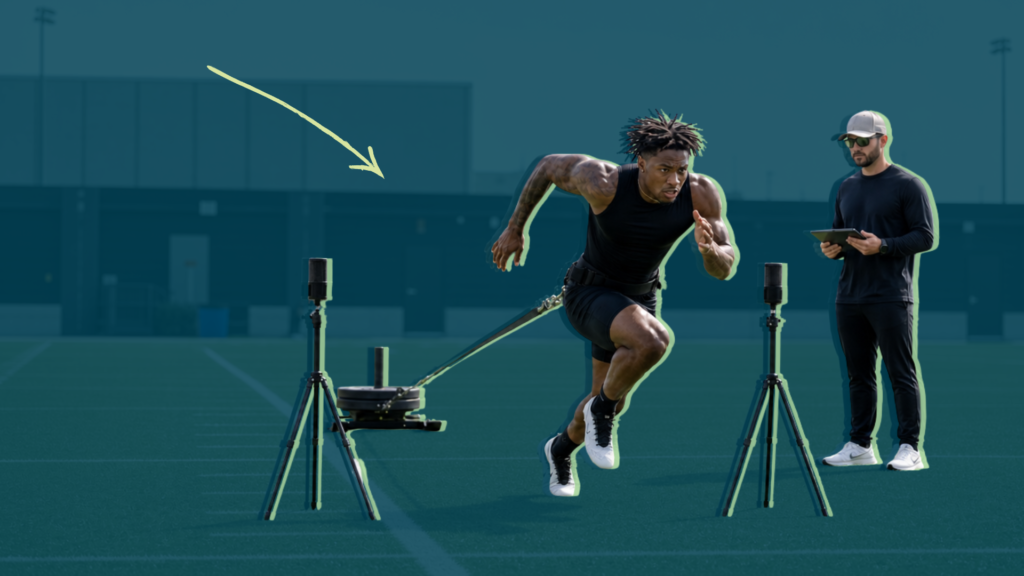
For non-ballistic intervention, general lower body strength training in the frontal plane is likely most valuable. Consider exercises such as lateral sled drags and lateral lunges or squats.
Vertical jump interventions
The assessments mentioned earlier evaluate physical capacities and technical skills that are, in a sense, quite dissimilar. Even when we focus on vertical force production capacities, there can be substantial differences between tasks with and without time constraints, and in the incoming momentum. We need to acknowledge the impact of different physiological mechanisms on performance in specific jump tasks, and train them accordingly.
For instance, heavy resistance training is likely to enhance concentric force production capacities. But those capacities are unlikely to limit the athlete’s overall potential to rapidly redirect high levels of downward momentum (such as in reactive strength tasks).
Therefore, when designing interventions, prioritize specificity for each relevant capacity and avoid assuming that transfer between them is a given.
Short and fast coupling (impact) plyometrics, other (semi) ballistics such as the Olympic lifts and their derivatives, as well as medicine ball throws, overcoming and yielding isometrics, and traditional resistance training are likely the primary interventions that will move the needle in the right direction.
In considering jump or plyometric tasks, implementing both unilateral and bilateral take off strategies is another fundamental consideration. While bilateral jumps are often prioritized in training, we cannot afford to overlook unilateral variations as a very potent jump training stimulus. Athletes must be able to perform jumps where they have to manage horizontal momentum transitioning into a vertical direction. Incorporating these jumps teaches athletes how to redirect momentum effectively.
We should also train athletes to generate vertical or horizontal momentum without preceding actions. Therefore, jumping, hopping, and bounding exercises should be executed in stationary positions and while in motion.
Closing thoughts
Various training interventions can enhance a goalkeeper’s jumping abilities, but none are more critical than well structured physical and technical jump training. But even having the physical and technical abilities to jump with the best of them does not guarantee that the athlete will be more successful on the pitch.
The ability to make the appropriate decision sets the athlete apart.
Each staff member therefore needs to understand their role in the overall process. We improve athletes’ ability to jump as a step towards improving their ability to complete key actions successfully. Keeping that as the bottom line consideration makes it more likely that we’ll appreciate each other’s value towards overall performance development, and hopefully lead the process in the right direction.
This will only come about if everyone understands each other’s roles and contributions towards the process, maintaining open communication to achieve the common goal: improving each individual’s ability to meet the specific jump demands of the most unique position in the world’s largest sport, allowing them to complete the right action at the right time.
Tweet ThisA goalkeeper’s movements stem from a diverse range of preceding actions, demanding the ability to read and react swiftly to the ever-changing game environment
Yoeri Pegel