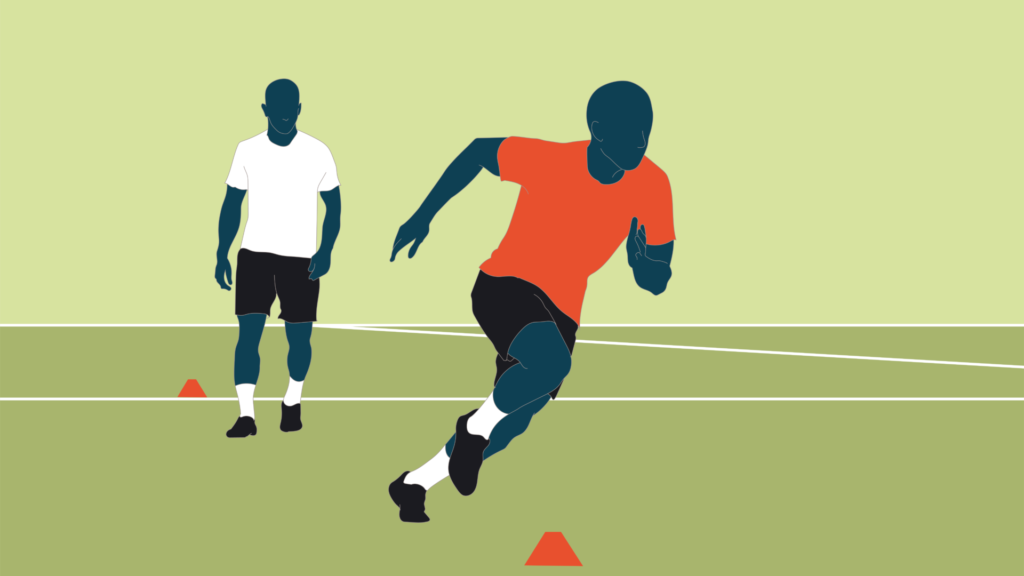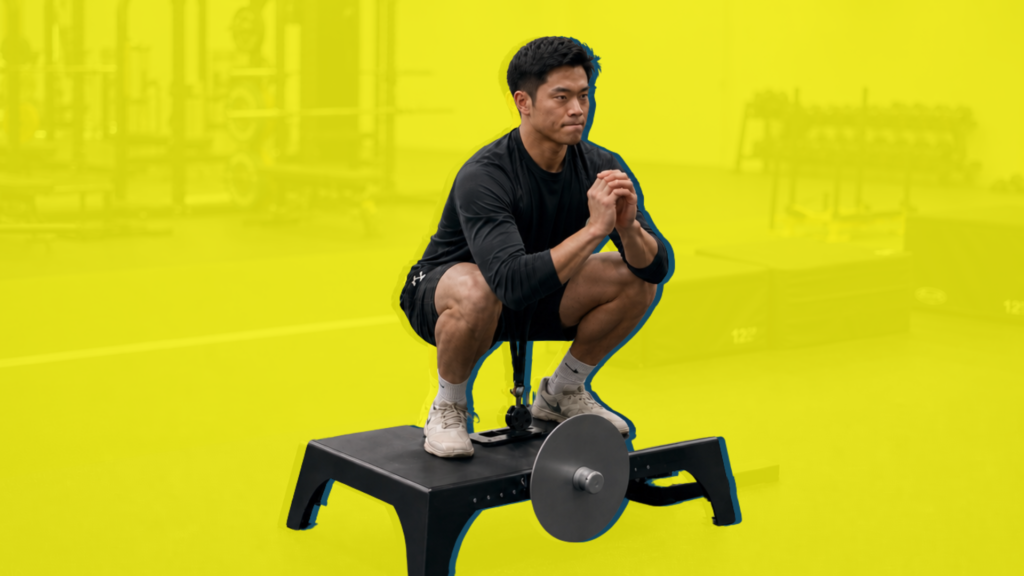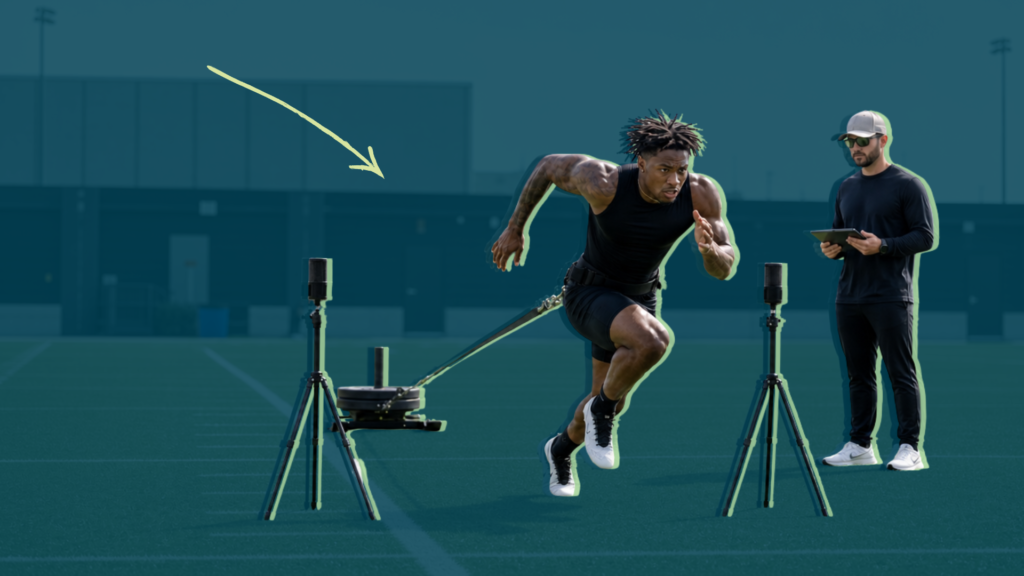

Whether you work in basketball or not, you will intuitively know that lateral plane movement is important. But just like change of direction ability, there is no consensus on how to assess the type of movement. Tests like the box lane agility test and modified T-agility test drag in so many more components than lateral movement ability making it hard to isolate what we actually want to assess. So we spoke to Eric Leidersdorf of P3 who has developed and used a test which can do this, the lateral CMJ.
Being able to move laterally is clearly a benefit for basketball players. Given its importance, how is it currently assessed?
As a field, we have not truly come to a consensus on how we can or should assess lateral movement. Specifically within basketball, lateral movement quality is often studied as a component of broader change of direction testing. The box lane agility test run at the NBA Combine and the modified T-agility test (MAT) stand out as examples.
In the box lane test, the athlete sprints the length of the NBA “key” (19 ft), shuffles laterally to their right for the width of the key (16ft), backpedals the length of the key, shuffles laterally to their left for the width of the key, then reverses those steps back to the starting position. Though an athlete’s ability to shuffle laterally will clearly impact their performance on this test, there are a number of components involved, such as sprinting, backpedalling and changing direction. So while this test may serve as a valid reflection of the complexities of movement in basketball, it also makes it difficult to truly zoom in on the mechanics (or limitations) of any particular section, like lateral shuffling for the purposes of this write-up!
The same premise holds true for the MAT, albeit over shorter distances. Given that up to 31% of game actions in basketball involve lateral shuffling, a deeper dive into lateral plane movement is warranted.
Tweet ThisRelative lateral force stood out as being significantly higher within our “fast” cohort compared to our “slow” cohort. And relative lateral force production can be reliably tested with the lateral CMJ test
@leidersdorf
You recently had a paper accepted relating to the reliability and effectiveness of a lateral CMJ. Why do we need a test like this, what are the results telling us and how would a coach set it up?
First, at a conceptual level, the ability to express force laterally seems like an important quality to measure in sports that value lateral movement. Beyond that, if a test can be administered quickly, doesn’t require a significant familiarization period and won’t tax the athlete from a mechanical loading perspective, even better.
Moving beyond concept, for a test to have any true utility to a practitioner it must demonstrate sufficient within / between session reliability before – ideally – exhibiting some degree of relationship to movements critical in sport.
The test results appear to bear this out. With respect to reliability within and between sessions, a few metrics derived from this assessment passed acceptable thresholds: peak vertical force, peak lateral force, relative lateral force and lateral impulse. Different populations produced similar results (Meylan et al., (2010) and Donskov et al., (2021)).
Temporal variables such as rates of lateral and vertical force development consistently fell shy of meeting acceptable reliability thresholds. Historically, rates of force development have demonstrated lower reliability results compared to peak force outputs in other traditional laboratory tests (e.g., countermovement jump. To that end, any temporal variables from the LCMJ should be interpreted with caution.
With respect to “effectiveness”, our results suggest that faster performers in the lateral shuffling task generally produced more relative lateral force (lateral force divided by mass) in the LCMJ compared to their slower counterparts.
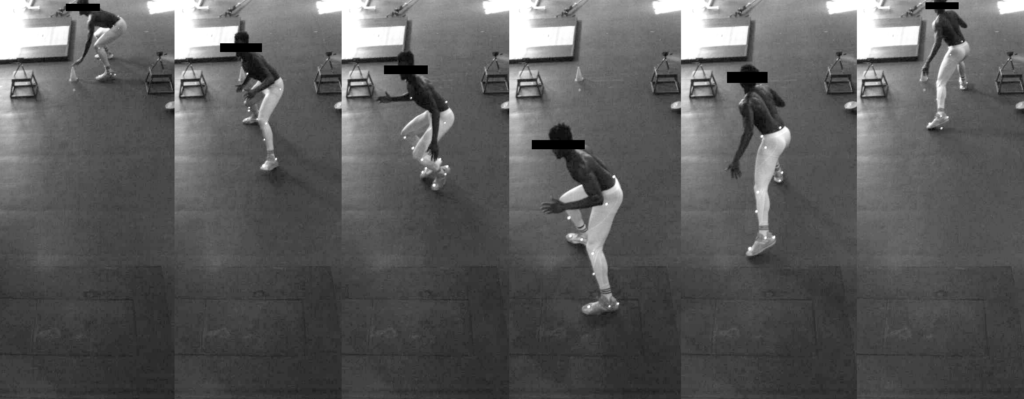
As with other tests that we run, we try to keep the goal of the test rather simple. In this case, we cue for an aggressive lateral push off of a single leg. Given that we’re trying to isolate lateral plane force production, we ask the athlete to refrain from rotating the lead leg behind the drive leg, as excessive movement in the transverse plane could confound our outputs. As an aside, you need a triaxial force plate to really get good results.
Tweet ThisGiven that up to 31% of game actions in basketball involve lateral shuffling, a deeper dive into lateral plane movement is warranted and that’s where the lateral countermovement jump test could come in
@leidersdorf

With this test, have you found any links to other physical qualities such as change of direction ability?
We have! Studying change of direction ability is complicated, as successful CoD performance requires the integration of a series of physical (eccentric, concentric, reactive strength) and technical factors (coordination, trunk positioning, angle of force distribution). But we have seen some nice early returns between LCMJ and performance in a lateral CoD drill.
In this instance, we implemented a lateral shuffling task, the “5-5 shuffle.” During this test, the athletes performed a lateral shuffle (as they would when playing defense in basketball) for 5m to a clearly identifiable mark on the floor, before performing a lateral change of direction and shuffling back through the starting line, all as quickly as possible
When we performed a median split of shuffling performance, “fast” and “slow” groups exhibited notable differences in their ability to generate lateral force (relative to body mass) in the LCMJ.
Of the variables we ultimately used in the final analysis – kinetic measures that passed reliability thresholds alongside some anthropometric measures – this relative lateral force value represents the strongest link between LCMJ performance and our ability to stratify 5-5 shuffle performance.
Circling back to the complexities of studying change of direction ability, I think we need more work to truly understand the underpinning factors that contribute to lateral change of direction performance. We plan on studying the kinematics of lateral force production during the LCMJ, in addition to the mechanics NBA players use during the actual changes of direction during the 5-5 shuffle. As we start to knit these subsequent studies together, hopefully we’ll obtain an even clearer picture of the physical and technical factors behind effective change of direction in the lateral plane.
What metrics are you interested in when undertaking this test, and can you evaluate these metrics in tandem with other jump data to provide a more rounded picture?
At this point in time, we are primarily interested in measuring an athlete’s relative lateral force production during the lateral countermovement jump. In this study, relative lateral force demonstrated solid reliability within and between sessions. Perhaps most importantly, it was also the only kinetic variable that was significantly different between fast and slow participants (p<0.000071, %Diff: 6.29%, ES: 0.70).
There may be some value in monitoring other data that passed reliability thresholds – lateral impulse, for instance. However, we have yet to see any significant relationships between this variable and lateral change of direction performance in our NBA cohort. To that end, we have administered this test across a number of different sports (baseball, football, etc.). While we are only seeing relationships between relative lateral force and 5-5 shuffle performance so far, perhaps other reliable measures will prove useful in other sporting environments.
We certainly do not view the LCMJ as an “all-inclusive” test. It is an important piece of our assessment at P3, but when putting together a plan for an athlete, we rarely look at the result of any test in isolation, and that includes the LCMJ.
As practitioners, regardless of which sport we work in, it is important to build out and utilize a well-rounded assessment battery. We want to challenge the athlete vertically, laterally, in acceleration and deceleration. Consequently, we often weigh LCMJ results in conjunction with jump data that we’ve collected on these qualities. Future research from our group will look to integrate these test results with the aim of better understanding movements critical to performance and risk of injury in basketball.
Tweet ThisIn a well-rounded assessment battery, we want to challenge the athlete vertically, laterally, in acceleration and deceleration. Consequently, we often weigh LCMJ results in conjunction with jump data that we’ve collected on these qualities
@leidersdorf
Do you have any data that basketball coaches could use as a benchmark for their athletes?
For lateral plane movement, we can provide LCMJ and 5-5 shuffle data for benchmarking. Relative lateral force stood out as being significantly higher within our “fast” cohort compared to our “slow” cohort (9.51 ± 0.80 Nx/kg vs. 8.93 ± 0.87 Nx/kg). 5-5 shuffle times between these same cohorts were also significantly different (Fast: 2.67 ± 0.07s vs. Slow: 2.87 ± 0.08s, %Difference (Diff) −7.22, p < 0.0000, ES = 2.67), as you might expect following a median split.
As referenced earlier, other data that satisfied our reliability thresholds may prove useful for monitoring developmental changes over time. Though we did not detect differences in these variables (peak vertical force, peak lateral force and lateral impulse) between our fast and slow cohorts, there may be some interesting latent value.
It may not need stating, but one word of caution for any coaches looking to benchmark their athletes with these tests: our findings linking LCMJ performance and 5-5 shuffle performance only truly generalize to the specific 5-5 shuffle assessment in our study.
This is yet another area that makes studying change of direction difficult. Historically, it has been challenging to compare findings in the literature examining relationships between practical laboratory tests and CoD performance, due to the fact that numerous CoD tests have been administered across varying sporting populations with variable approach velocities, number of direction changes, and angles of direction change.
Over time, it will be interesting to study the extent to which the relationships that we have observed in our elite basketball populations hold for sub-elite cohorts within the sport.
What are the biggest mistakes you see young practitioners/clinicians make and what advice would you give them to help?
Does this mean I have officially aged out of the “young practitioners” category? Ouch.
Given that we’ve been talking about publication over the course of this discussion, I suppose one “mistake” that I’ve noticed from some younger practitioners is the willingness to accept published literature. That isn’t to say that research isn’t valuable – it is. However, studies and study results should be challenged and replicated. We’ll be replicating our LCMJ study in-house before long in an effort to ensure that our findings are stable. I think that our field would benefit greatly from more concerted efforts in this direction.
In the way of advice, I would encourage young practitioners to avoid trying to “boil the ocean” when conducting studies. We can ask a lot of our athletes and really go deep on the data that we collect from them. However, being very intentional with how we shape our research questions will ultimately have the biggest impact on our work and the quality of care we can provide for the athlete. We don’t need to ask every question at once!