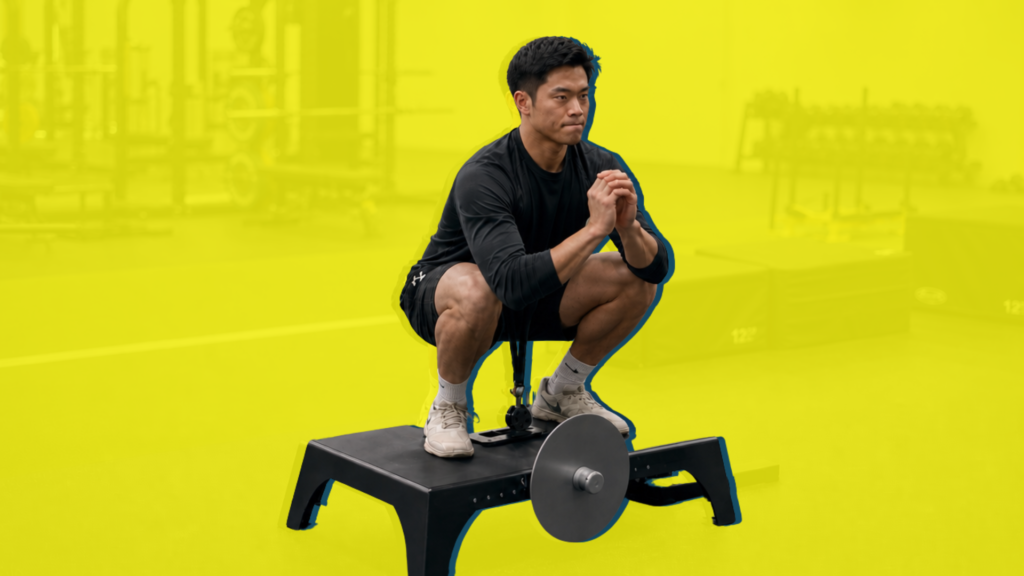
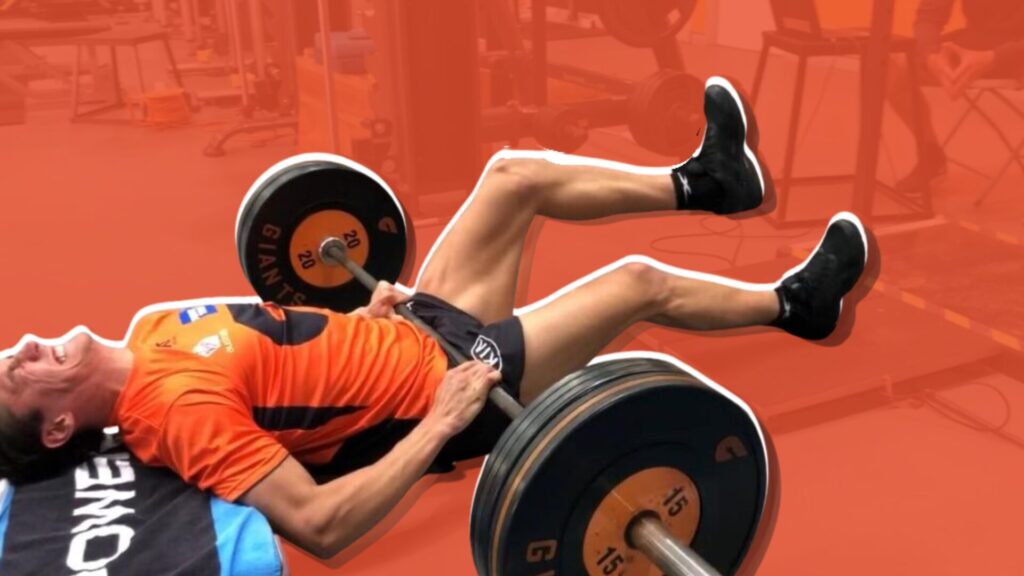
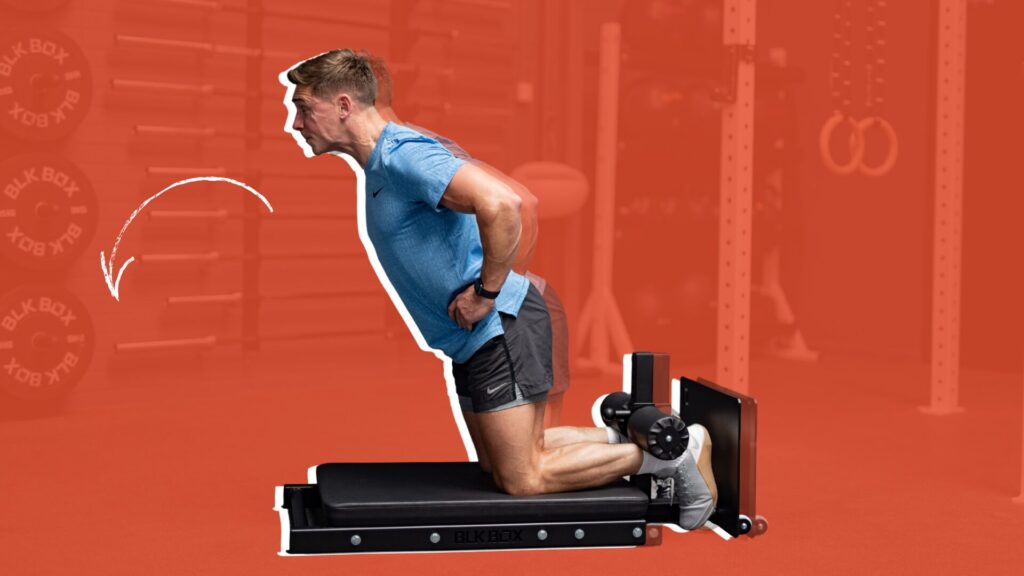
Has an athlete ever told you they suffered from “DOMS” after your foot exercises? I could count the times it happened to me on the fingers of one hand before I started to question myself: Do I really strengthen their feet?
Many practitioners understand that the human foot complex is the underestimated link of the kinetic chain, and can be the limiting factor in explosive tasks such as sprinting, cutting or jumping. However, judging by the research, conferences and online discussions around this area, many training programs overlook the basic fact that “the foot is a load bearing structure that copes with forces exceeding body weight.”
Exercise programs don’t account for this truism in the quantity or nature of sets, reps, intensity or context. I am still surprised to see so much enthusiasm in toe yoga or TheraBand exercises to strengthen the foot, leaving me with the impression that we want hands instead of feet. But we will come back later in this article to explain why this kind of exercise is perhaps not the most relevant for training the foot muscles from a neurophysiological point of view.
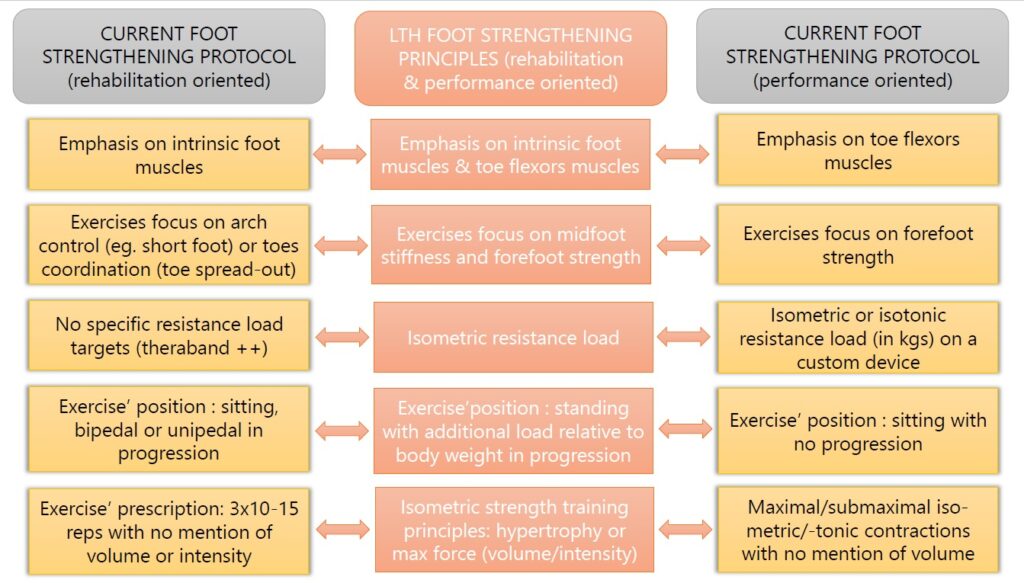
At La Tour Hospital in Geneva, Switzerland, where I am the lead clinician for foot and ankle rehabilitation at the Swiss Olympic Medical Center, I use what I call a “strong approach” to strengthen the foot in comparison to the current “light approach,” taking into consideration the magnitude of forces the foot encounters during locomotion (Figure 1). In parallel to this clinical work, I’m also currently involved in a Ph.D. around the role of the foot muscles on sport performance, with some promising initial results.
Foot strengthening is worth the investment for practitioners and athletes
Foot-ankle complex: More than the ankle plantar flexors
We all know that the ankle muscles, especially the plantar flexors, are key contributors to sport performance and play a critical role in accelerating the body rapidly during sprinting [1,2], cutting [3] or jumping [4]. However, these assumptions are based on an oversimplified rigid foot model, i.e., no deformation of the foot. This leads to overestimating ankle power while simultaneously underestimating the power generated by the structures within the foot [5].
The power of the ankle plantar flexors is equally as important as the capacity of the foot structures to resist deformation for efficiently promoting power transfer during push-off [6]. This relationship underpins the concept of force production and force transmission. We frequently notice massive athletes with big muscles and high overall power generation capability losing power and energy around their distal complex each time they push to the ground. Whatever your hip, knee and ankle power generation capability, if your foot system “deforms” under tension and is not able to transfer that power into the ground, your technique, mechanical effectiveness and, ultimately, acceleration performance degrade.
Human foot complex and locomotion
The medial longitudinal arch (MLA) is a key structural feature of the human foot. It has the necessary stiffness to act as a rigid lever, but it is also sufficiently flexible to function like a spring to store and release mechanical energy, allowing mechanical energy conversion [7]. Likewise, the metatarsophalangeal (MTP) joints in the forefoot are fundamental to absorbing energy via toe dorsiflexion, while the MLA simultaneously generates power during the stance phase [8,9].
Enhancing the biomechanical coupling between these joints via energy transfer are the intrinsic foot muscles (IFM) – those with both origin and insertion within the foot – and the extrinsic foot muscles (EFM), which originate outside the foot and insert within the foot.
During the push-off phase, the IFM and the extrinsic foot muscle toe flexors (EFMTf) work as functional groups to stiffen the MTP, augmenting the ability to generate propulsive power [10,11]. Removing the capacity to activate the IFM alters the leverage function of the foot and ankle joint moment production during propulsion, thereby affecting vertical jump performance [12].
Forefoot strength and performance: Research findings
Many athletic movements across all directions and planes of motion follow from the athlete’s ability to produce high amounts of ground reaction forces (GRF) over short contact times [4,13,14]. Although the moment produced by the MTP joint is smaller than that of other lower limb joints, the midfoot and forefoot are the only links between the body and the ground to transfer this large GRF.
Toe flexor strength (both IFM and EFMTf) is moderately correlated with performance during a 50 meter sprint, pro agility test, 3-cone tests and various vertical jumps [15–17]. Furthermore, IFM and EFMTf strength have a greater effect on sprint and horizontal jump performance than vertical jump performance [18–20]. This suggests foot strengthening has a greater impact on horizontally oriented explosive movements than vertically oriented ones.
These studies provide some arguments for investing time on foot strengthening, but we need more information and evidence before drawing definitive conclusions.
Therefore, we set out to clarify the association between foot strength and the specific kinetics underlying sprint performance (e.g., vertical or horizontal impulse); and between foot strength and overall, multifactorial performance on things like sprint or change of direction time, jump height or jump length. With this in mind, we are currently investigating the association of MPT joint plantarflexion isometric strength, MTP rate of force development (RFD), calf and quadriceps isometric strength on sprinting, cutting and jumping performance kinetics in healthy, high level athletes in soccer, basketball, handball, rugby and track and field.
For sprinting, the preliminary analysis on 52 athletes showed that foot strength (MTPj flexion torque) accounts for 28% and 36% of the variation of vertical net impulse and contact time during maximal speed whereas ankle plantarflexion torque explained 27% of the total variance in 10-m sprint time. Interestingly, we found no significant correlations during vertical and horizontal countermovement jump.
These preliminary results highlight the potential interest of forefoot strength for enhancing the ability to produce high amounts of GRF over short contact time periods, particularly in maximal speed but broadly across many sport related actions.
Tweet ThisFoot strengthening has a greater impact on horizontally oriented explosive movements than vertically oriented ones
@r_tourillon
Foot strength is a not a single, unitary measure
Forefoot strength assessment
As for all good physical performance or rehabilitation programs, we should start with the mindset that we cannot manage what we do not measure. But while we have robust methods for evaluating hip, knee or ankle muscle strength, evaluating foot muscle strength is challenging, and IFM strength even more so.
Considerable efforts have been made recently to develop foot strength assessments focusing on functional movement like toe gripping, toe pushing or doming; alongside new measurement devices like custom ergometers, a hand held dynamometer (HHD) and pressure mat [21–26].
I currently take two approaches to assessing foot strength: one for the laboratory and one for clinical / practical settings.
Our lab has developed a dynamometer for assessing MTP Joint maximal isometric plantarflexion strength, testing the joint at 30° with the ankle in a neutral position (Figure 2). We chose this position for the optimal force-length relationship of the IFM and the EFM [22,27]. The 3-D forces sensor allows us to evaluate the MTP joint strength in pushing (vertical force), the MTP joint strength in gripping / curling (antero-posterior force) and the resultant total force from both.
Total relative strength in this setting can measure maximal force around 520N (~53 kg) and minimal force around 155N (~16 kg). A good value for total relative strength around the MTP in a healthy male athlete is ~4N / kg.
Tweet ThisMTPj flexion torque accounts for 28% and 36% of the variation of vertical net impulse and contact time during maximal speed whereas ankle plantarflexion torque explained 27% of the total variance in 10-m sprint time
@r_tourillon

As many of us have experienced, taking the laboratory to the field is a challenge. At La Tour Hospital, I modify the method of Fraser et al.[25] to evaluate foot strength using an HHD (Figure 3). The hallux uses different muscles than the lesser toes to move, making it independent of them, so this testing method evaluates the strength of both sets of muscles.
With the foot in ~20° plantarflexion and the MTP near neutral position outside the table, the subjects perform maximal isometric contraction by pushing their toes downward for five seconds. The varying size and shape of the HHD sensors allows us to position it behind the hallux or the lesser toes. A good relative strength value with this setting is ~2.7 N/kg for hallux and ~2.2 N/kg for lesser toes (~19 kg and ~16 kg of force, respectively, for an average person of 70 kg).
This give a hallux:lesser toes strength ratio of approximately 1.2 – 1.3 in fully rehabilitated male and female athletes.
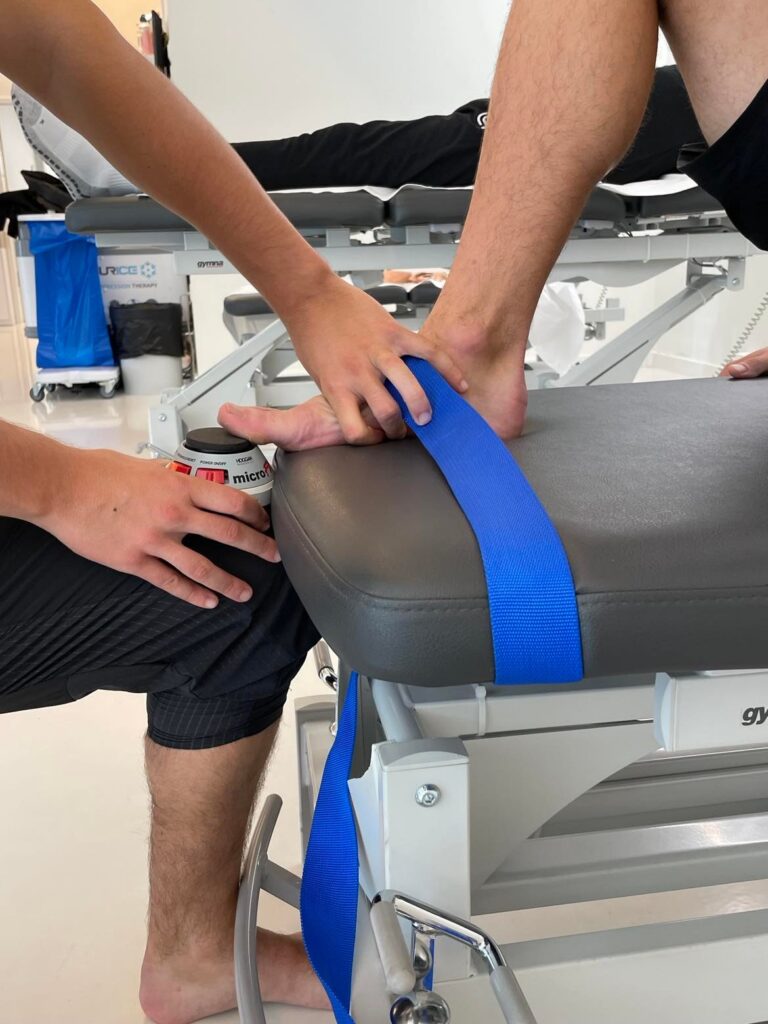
Practitioners need to monitor for ankle plantarflexion compensation to ensure the reliability of the measurement. We recommend putting a belt around the ankle in addition to using the hand to stabilize the MTP head.
For perfect isometric contraction, an automatic height adjustable table is ideal, and the HHD should be on the tester’s knee with the athlete’s entire foot contacting the floor. If you want to focus the assessment on IFM, putting the ankle in maximal plantarflexion increases IFM contribution to MTP strength flexion relative to EFMTf.
Midfoot strength and stiffness assessment
The single leg heel raise test (SLHRT) is commonly used to evaluate calf endurance capacity [28]. SLHRT performance is likely the product of ankle joint power via the gastrocnemius and soleus. However, it’s important to notice that midfoot / arch region power generation is also present during SLHRT due to the contribution of the EFM and IFM to elevating the arch during heel rise.
Interestingly, recent studies show that performing SLHRT with the toes in dorsiflexion (inclined plate) resulted in a greater amount of work at the midfoot region. This position allows foot muscles to operate closer to their optimal length, at which they can exert maximal force to stiffen the arch [30,31]. A modified SLHRT with toes dorsiflexed 25-45° may indirectly assess the strength around the midfoot region in addition to calf capacity.
For that set up, I use the same principle as SLHRT: maximal repetitions until exhaustion or technical failure at a cadence of 60 beats per minute guided by metronome. A good measure of midfoot strength and calf capacity is 33 repetitions for male and 27 repetitions for female athletes. Practitioners should also assess movement quality during the test with a particular focus on keeping the ankle aligned with the second metatarsal ray, force distribution through the first ray, toes and MTP in contact with the floor, and rear foot supination.
Video 1. Modified single-leg heel raise test
Developing foot strength: Programming and exercise recommendations
Consider the limitations of current foot strengthening programs
Through my years of interest around the foot-ankle complex, I have come to realize that current foot strengthening programs take a “light approach” to their exercise prescription, even – maybe especially – when designed for performance oriented athletes. Indeed, the juxtaposition of high load resistance to strengthen maximally the hip, knee or ankle muscles with the comparatively low loads for strengthening foot muscles is concerning.
A recent meta-analysis on rehabilitation oriented studies showed no effect of IFM training on foot strength and muscle morphology (volume, thickness, CSA), questioning the strength training efficiency [32].
Problem #1. Do we want hands instead of feet?
Neurophysiological properties of muscles are closely linked to their biological function[33,34]. The ratio of motor units to physiological cross sectional area (PCSA) for the abductor hallucis appears quite low compared to similar muscles from the hand, such as the abductor pollicis brevis (43 vs. 136 motor units, 6.6 cm vs. 1.6 cm PCSA, respectively)[35–37]. These neurophysiological properties tend to reduce the ability of the IFM to precisely control gradation of force, therefore questioning the utility of training athletes to successfully perform different toe posture or toe yoga exercises.
Given the magnitude of forces within the foot, the muscles are much more adapted to produce a high level of force in order to stiffen the forefoot for propulsion[38].
Problem #2. The foot is a load bearing structure, so why do so many programs just have sitting and standing exercise positions?
We’ve known for 70 years that there is no electrical activity of the IFM during quiet sitting and standing, as these muscles are recruited at forces exceeding bodyweight[39,40]. Since then, we’ve learned that IFM activation increases with loading of the foot via a load fine tuning function[41,42].
However, it is disappointing to find no study (to my knowledge) using loading in excess of bodyweight while performing foot exercises. The basic progression is often: sitting, double leg stance and single leg stance position. This is probably not beneficial for maximizing activation.
Problem #3. “OK, brain, I believe we’ve had a problem here.”
We all know athletes who struggle to perform toe contractions. Also, 77% of healthy active people are unable to fully activate abductor hallucis IFM near its full capacity (>90%), which could be explained by its complex muscle morphology or a neural activation deficit[43].
Overcoming the inability to achieve high voluntary activation is, therefore, an important training consideration in foot strengthening. Neuromuscular electrical stimulation of the abductor hallucis is an immediately effective modality after just a single session[24,44].
Problem #4. “3×10 reps is universal, so of course it applies to the foot.”
The majority of current foot strengthening programs are composed of exercises performed over 3 sets of 10 reps, or sometimes 3 sets of 15 reps, or daily reps. In addition to the question “Why 3×10?” these programs also fail to give specific duration of contractions, intensity or volume of sessions and a clear progression.
Compared to other joints, the foot complex suffers from generic protocols that do not consider the fundamentals of resistance training like progressive overload, specificity or variation [45].
The idea of this article is not to dismiss previous foot strengthening protocols but shift from these “light” generic protocols to an individualized, progressive “strong approach.” Doing so with my patients significantly improved their rehabilitation and performance success, as well as changed their perceptions on feeling the intensity and “burn” immediately during exercises. The IFM and EFM are tiny muscles, but that doesn’t mean they can’t be properly overloaded.
Forefoot strengthening
Considering the foregoing four problems, my main exercise for global forefoot strengthening places the athlete in a single or double leg stance with some amount of overload (+%BW), where the athlete must push with the MTP joint against an inclined plate (Video 2). This tilt dorsiflexes the MTP joint and puts the IFM and EFMTf in an optimal position for force production, given the force-length relationship around the ankle and the forefoot[22,27].
Depending on whether the session goal is maximal force or hypertrophy, the volume and intensity is described in detail in Figure 4.
Tweet ThisCompared to other joints, the foot complex suffers from generic protocols that do not consider the fundamentals of resistance training like progressive overload, specificity or variation
@r_tourillon

Video 2. Mix of the different forefoot strengthening strategies
Midfoot strengthening
When focusing more on the midfoot region, I use what I call the “foot bridge” exercise to target the foot arch support: tibialis anterior, tibialis posterior, fibularis longus, flexor hallucis longus and IFM.
The athlete starts either single or double leg with the forefoot and the rear foot region on planks or elevated supports. This position overloads the midfoot region by passively removing its supports. The athlete must then resist midfoot collapse by maintaining an elevated MLA.
Adding the instruction to lean the body forward leads to a more anterior center of pressure (COP) above the midfoot region, increasing the load under it.
In addition to MLA loading, this exercise also targets the transverse arch of the foot, that is, the part of the arch that curves across the foot at the base of the metatarsal bones. This region plays a crucial role in increasing foot stiffness [46]. The volume and intensity to build for maximal force or hypertrophy is in Figure 5.

Video 3. Mix of the different midfoot strengthening strategies
1st ray strengthening
The forefoot – the MTP joint and phalanges – is the last link between the human body and the ground. Forces are larger in the 1st ray than any other part of the foot [47].
The importance of the 1st ray for MLA stability and propulsion is mainly due to the flexor hallucis longus, which has the largest volume of the deep extrinsic and intrinsic toe flexors (~68 cm[3]). Adding the volume of the IFM dedicated to the 1st ray brings the total volume to 119 cm3 for 1st ray flexion, compared to 73 cm3 total for the lesser toes’ flexion [48,49].
The following video shows two different types of exercises to target the appropriate level and ratio of 1st ray strength: 1st ray elevation against leg curl loading, and 1st ray maximal isometric contraction with force-time curve biofeedback. If you don’t have a leg curl, place a heavy bag or weight above the knee and perform isometric contraction against a wall.
When programming these exercises, remember again that the same principles around volume, intensity and loading apply.
Video 4. Exercise streams for developing 1st ray strength
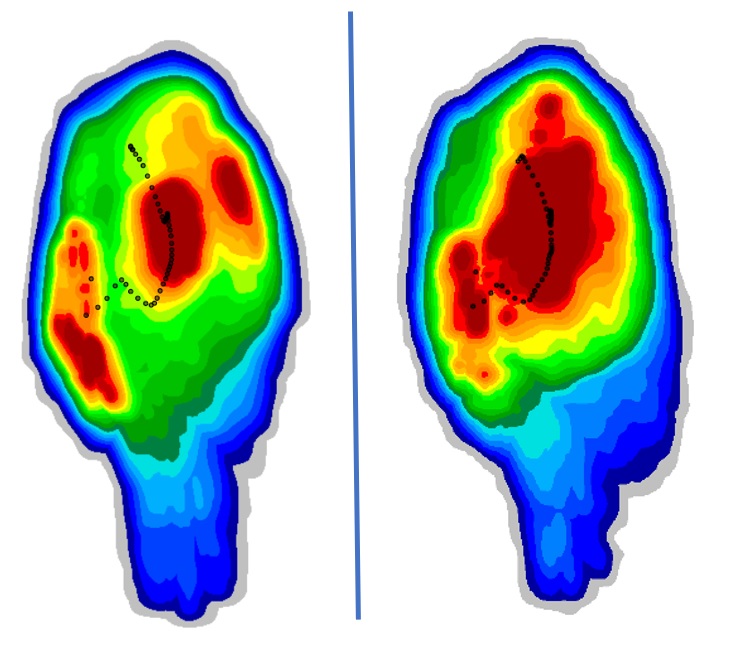
The following figure shows the change of maximal plantar pressure (PP) distribution after two months of 1st ray and forefoot strengthening in a track and field athlete dealing with chronic foot injuries. At the beginning of the process (left), maximal PP was largest around the 2nd and 3rd metatarsal heads, indicating weak relative 1st ray musculature of 2.1 N/kg (-30% of the right foot). The picture from two months later shows the increased PP under the 1st ray (MTP and phalanges), associated with an increase of 1st ray strength to 2.6 N/kg (-8% compared to the right foot).
Foot-ankle coupled strengthening
The functional coupling between IFM and plantarflexors is fundamental, and may be explained via a shared neural drive [7]. Therefore, in tandem with the previous exercises, I like to incorporate exercises such as isometric ankle plantarflexion push-off, explosive heel rise and pogo jumps to enhance this mechanical coupling between foot and ankle.
During all these exercises, I ask the athlete to focus on being stiff, avoiding foot collapse and transferring force application on their 1st ray. I use different types of feedback such as a TheraBand, NMES, tape or inclined plate, as shown in the following video.
Video 5. Exercise streams for developing foot-ankle coupled strengthening
What about other modalities? Plyometrics, minimalist footwear
The aim of this article is to analytically review ways to strengthen the foot and improve foot function. The guidelines here should not preclude other modalities, but these principles should be the foundation when your goal is strengthening the foot.
I’m not a great fan (who is?) of recommending that you just need to go barefoot or do plyometrics to strengthen your foot. For sure, it would be ideal to find a one size fits all approach. But if there’s not one for all the other joints in the body, there’s not going to be one for the foot.
Therefore, in addition to these basics, I microdose barefoot exposure during training sessions, as it’s an interesting stimulus for foot muscle morphology. Plyometrics are a great stimulus for the calf and foot complex. But there is still this misconception that we can only do this kind of training once the athlete has reached a certain level of strength. If some exercises are too advanced for some weak athletes, plyometric training should occur in parallel to increase strength capacity of the distal complex.
Practitioners should also consider the biomechanical specificities of the absorption (unlocked foot joints and energy storage through pronation) and propulsion (locked foot joints and energy return through supination) phases in order to promote a more dedicated strengthening strategy for each. For instance, sessions of double or single foot-ankle rebound jump on an everted or inverted inclined board (Video 6) mimics both of these critical stance phases.
Video 6. Foot-ankle rebound jumps on everted or inverted inclined board
Integrating these foot strengthening principles into existing programs
Every discussion I’ve had with physiotherapists, S&C coaches or athletes from different sports started with the best option to strengthen their foot (everything I presented above) and then worked its way down to using the least worst option given their sporting context.
Here are some examples of how we translate the “perfect, best and ideal” into the “least worst in reality.”
A physiotherapist from the French Olympic Youth Nordic Combined Team wanted me to create a foot strengthening program for his athletes during two months of general athletic development in off-season. The prerequisites were two sessions per week, not exceeding 25 minutes. Considering this timeline, their sport necessity of being strong in the shoes before jump skiing and their athletes’ perception of DOMS under the medial arch at the end of the cross-country skiing race, we implemented the “foot bridge” exercise for the midfoot region as well as maximal forefoot isometric contractions in a squat position to increase specificity to the jump skiing position.
Second, an international heptathlete wanted a warm-up dedicated to her foot muscles before sprinting races, as she struggled with foot pain for years at max speed. The context was that the warm-up has to be done at the track with no gym equipment: no squat bar, no kettlebells. Therefore, for this athlete I had to forget my principle of overloading beyond bodyweight. I landed on NMES on the track during different isometric and plyometric contractions as the least worst option to maximize activation and warm up her foot muscles.
Finally, there was the S&C coach in charge of the athletic development of two athletes from the French Olympic Bobsleigh Women’s Team. This collaboration was very interesting, as the bobsleigh is the flagship sport of acceleration, where the athletes’ ability to transmit a large amount of force efficiently on the ice plays a major role in their overall performance.
Periodization during the year is characterized by two three-week blocks of intensive foot strengthening in addition to a “remind” session with one exercise every week. With the possibility of being in a gym, the block of intensive foot strengthening used all the previous exercises: forefoot, midfoot, 1st ray and foot-ankle coupling. The athlete performed the weekly session of foot strengthening at home or in a hotel, for example, during the Olympics at Beijing. The least worst option in this context, then, was to perform isometric hallux contraction against a wall, doing the “foot bridge” exercise between two books or using NMES.
This last video shows the different options that we chose with the staff for integrating foot strengthening in their own program.
Video 7. Integration of foot strengthening exercises/protocol in high-level structures and athletes
Rehabilitation and strength & conditioning might under load the foot, as the foot is capable of dealing with huge forces. Even this “strong approach” with high loads in the gym are nowhere near what athletes face while running at moderate to fast speeds.
If we go even further, it is important to remember that forces in the real world impact the foot structure in three dimensions, not just vertically or horizontally. This simple fact adds even more complexity to our exercise prescription.
Leonardo Da Vinci was right: “The human foot is a masterpiece of engineering and a work of art.”